Kiribako and Tomobako: What the Wooden Box Your Japanese Bowl Comes In Actually Tells You
There are two wooden boxes that get called a kiribako, and they are not the same thing. One is packaging: a plain paulownia box that protects the bowl on its way to you. The other is a tomobako, a box the maker has inscribed and sealed by hand, and it is treated as part of the piece. Product photos usually make them look identical. If you are buying a boxed Japanese bowl, cup or teapot, especially as a gift, the first job is to work out which one you are looking at, because only one of them should change what you are willing to pay.
How this was put together. I did not buy a stack of boxed pieces to test. This is built from a Japanese pottery school’s Q&A on how makers inscribe boxes, a tea-ware dealer’s and a Kyoto crafts site’s explanations of tomobako, auction and dealer listings that describe boxes, and one published measurement of how paulownia cases handle humidity. I found no published figure for how much a signed box adds to a price, so this guide gives none. Where something is my reading rather than a source, I say so.
Kiribako and tomobako: the two words, side by side
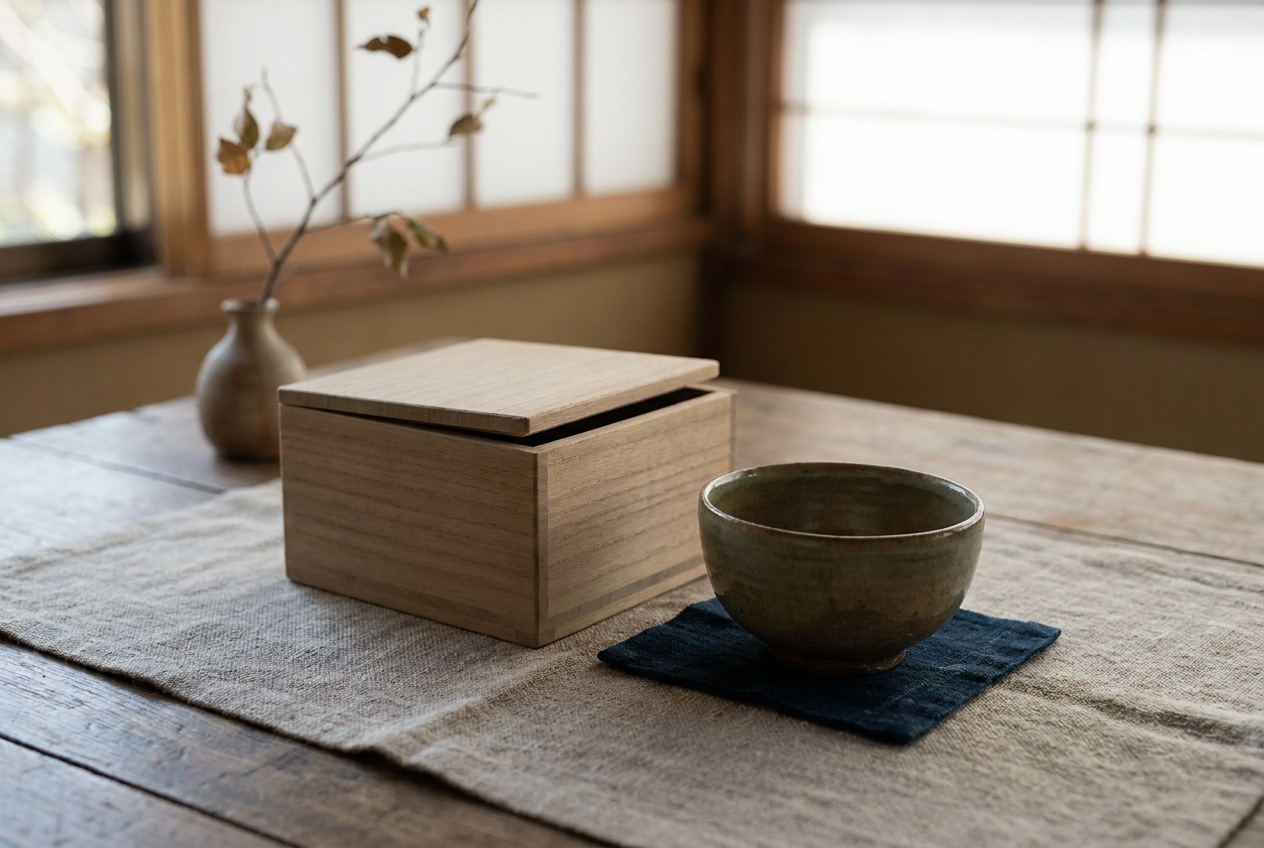
Kiribako (桐箱) simply means a paulownia-wood box. Tomobako (共箱) is a box that goes with the piece and carries the maker’s own inscription. Tezumi, a Japanese craft shop, describes tomobako as wooden boxes for protecting and storing ceramics, usually signed and sealed by the potter and tied with a cord, and notes that a piece in a kiri box is generally regarded as higher quality. A Kyoto crafts guide adds that the inscription may be written by the artist or by an expert appraiser, with details about the piece inside. Many tomobako are paulownia, so a tomobako is often also a kiribako. The reverse is not true: a kiribako with a blank lid is just a nice box.
What the inscription is, and what it is not
A pottery school in Chiba answers the question this way: what is written on a box is mostly the name of the piece and the maker’s signature with a seal, written vertically, and a very common arrangement is the title at the upper right of the lid and the signature and seal at the lower left. They say it depends on the maker. That is all a buyer can read from a photo.
It helps to know what the inscription does not do. It does not tell you the piece is good, and it does not authenticate itself. A box is a claim by the maker (or an appraiser) about the object inside, and the claim only means something if the object and the box actually belong together. Auction catalogues treat the two as separate checks: one SBI Akasaka Art Auction lot lists a signature on the base of the bowl and, separately, a signature, title and seal on the box. If you cannot see both, you know less.
Collector sources agree on the direction of the effect. They say an original box adds to a piece’s authenticity and value, and read the maker’s signed box as the maker’s own endorsement. None of the sources I found put a number on it, and I am not going to invent one. My reading, not a sourced fact: for a studio potter’s piece, part of what you pay for in the box is that endorsement. For a factory-made bowl with a plain kiri box, you are paying for packaging.
Three boxes you will meet, and what each one tells you
| Box | What is on the lid | What it tells you | What to do with it |
|---|---|---|---|
| Tomobako | Title, maker’s name, seal; often tied with a cord | The maker stands behind this piece. It is part of the object. | Keep it with the piece for life. Store the lid with its own box. |
| Plain kiribako | Nothing, or a printed shop label | Good protection and a formal look. No statement about who made the contents. | Use it for storage. Do not pay extra for the wood alone. |
| Shop or factory box (card, printed wood) | Brand print, barcode, sleeve | Packaging only. | Keep it for shipping and gifting if you like. Nothing else rides on it. |
Why paulownia, and what the wood does
Paulownia (kiri) is light, which matters when a box is carried and stacked. Sellers also credit it with moisture control and insect resistance, and a Japanese tea-ware dealer says paulownia boxes spread in the Edo period as cases for tea utensils and ceramics. Most of that is shop copy. The one measurement I found is a study by Kamba Nobuyuki on wooden storage cases, which reported hygrometric half-times of two to six days for well-made paulownia cases. In plain words, the wood slows down humidity swings over days. It does not seal anything, and a few sellers say so themselves.
For a glazed ceramic bowl this is a minor point, because glaze does not mind humidity the way lacquer, paper or unglazed ware can. It matters more for pieces with a porous body or fragile accessories. For ordinary care, see the guide to caring for Japanese ceramics; for the unglazed, deliberately weathered kind, wabi-sabi tableware explains how age is supposed to look.
Buy this, not that
Pay for a tomobako only when the listing shows the lid inscription and the maker’s name matches the maker of the piece. Do not pay extra for “paulownia box included” on its own: a plain kiri box is packaging, and if the bowl is a machine-made line, the box is not an upgrade, it is a nicer wrapper.
If you are buying it as a gift
A boxed piece reads as formal in Japan. That is my reading from living here, not a rule I can cite. For a gift to someone who will actually use the bowl daily, the box is the less important half: a box they have to store is a cost to them. Choose the box when the recipient collects, or when the occasion is a formal one such as a wedding or a thank-you to a host. Choose the bowl alone, in a clean shipping carton, when it is for use. The tableware and tea gift guide sorts options by occasion and recipient, and the Christmas ordering guide covers the timing and breakage side.
Four questions to ask before you pay for the box
- Is the lid inscribed, and can I see it? A photo of the lid (title, maker, seal) is the evidence. If the listing says “signed box” with no picture, ask for one.
- Does the maker’s name on the lid match the maker named for the piece? A mismatch, or a name that appears nowhere else in the listing, is the thing to resolve before buying.
- Is the signature also on the piece? Many auction listings record both. One without the other leaves a gap.
- Does it ship in the box? A wooden box adds bulk and weight. Ask how it is packed for international shipping, because a box is not a substitute for padding. The made-in-Japan check and how to read a Japanese tableware listing go through the other places a page can say too little.
If you already own a boxed piece
- Keep the box, with the lid matched to its own box. Keeping each lid with its own box avoids mixing up pieces when you own several.
- Do not write on it, and do not stick labels on the lid. The inscription is the point.
- Store the box where the piece is stored: away from a damp cupboard and out of direct sun. The wood slows humidity swings, it does not stop them.
- Keep any wrapping cloth and paper that came with it. Dealers’ sources name paperwork and matching cloths as part of the record of a piece.
- If you want to know what it is worth, a specialist ceramics dealer or auction house is the right person to ask. I do not appraise, and neither does this site.
Questions people ask
What is the difference between a kiribako and a tomobako?
A kiribako is any paulownia box. A tomobako is a box inscribed and sealed by the maker of the piece inside, often in paulownia but sometimes in another wood such as cedar. The word to look for on a listing is the inscription, not the wood.
Does a signed box make a bowl more valuable?
Collector and dealer sources say it adds credibility and value, because it is the maker’s own endorsement. I could not find a published price effect, so I will not give one. It is also not proof: the box and the piece must belong together.
Should I keep the box?
For a tomobako, yes, for as long as you own the piece. For a plain kiribako or a shop box, keep it if you have room and it protects the piece, and recycle it if you do not.
Is a wooden box safe for storing ceramics?
Paulownia is a traditional choice, and sellers credit it with stabilising humidity. The study I found measured a slowing effect over days, not a sealed environment. Treat it as good protection, not climate control.
Prices change, so this guide gives none. Look at the current listing, and compare the lid photo and the stated maker, not the word “box”.
Disclosure: Nagori Ware is an independent editorial guide written from Japan. Some links elsewhere on the site are affiliate links. Parts of this site are drafted with AI assistance and checked against Japanese sources. General information, not legal or safety advice.