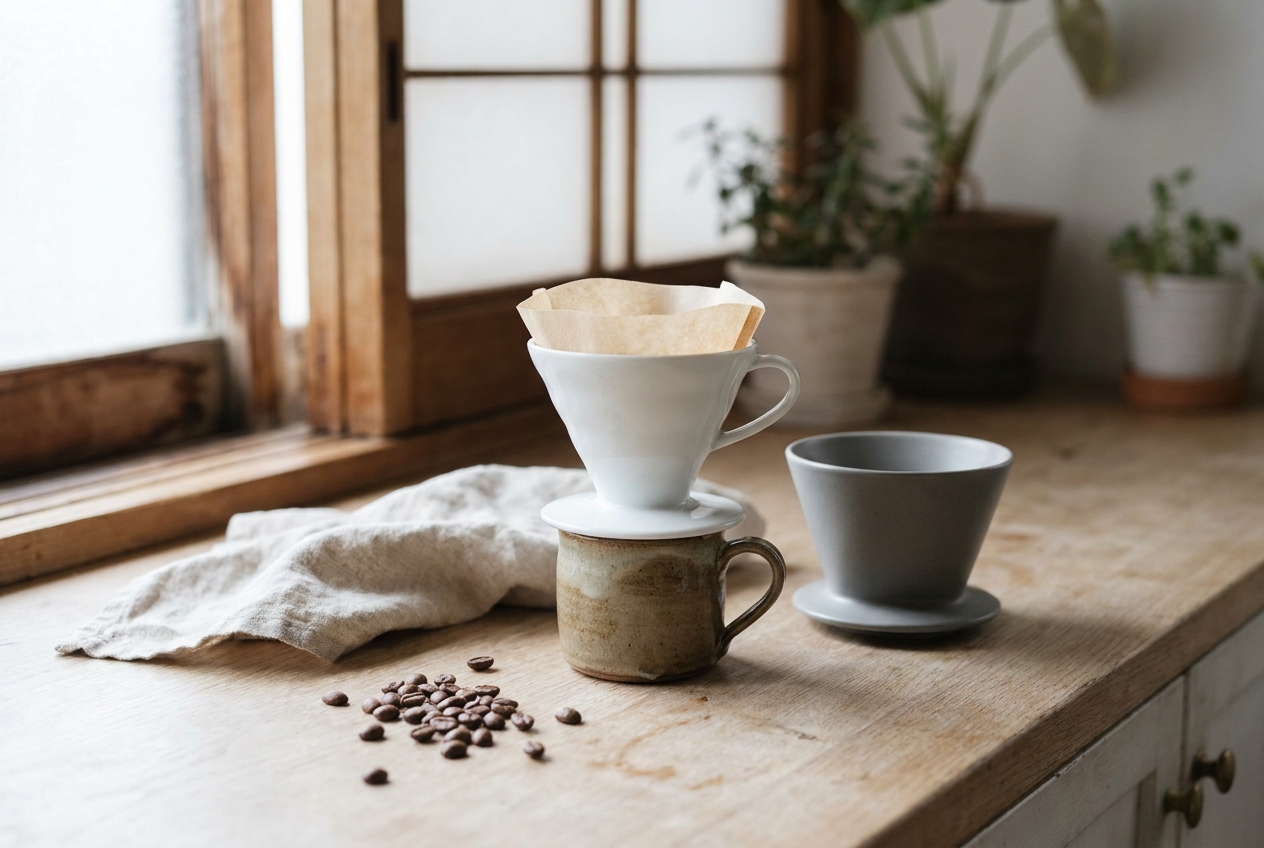
Japanese Ceramic Coffee Drippers: Arita, Hasami or Mino? Choose the Shape First
The word on the box, Arita, Hasami or Mino, does almost nothing to the coffee in your cup. What changes the cup is the shape of the dripper and the number of holes in the bottom, and that also decides which paper filters you will be buying for the next ten years. The town decides other things: how heavy the dripper is, how it looks on the counter, and part of the price. So the useful order is shape first, then the ware, then whether ceramic is worth it for you at all. If you only read one line: buy the shape whose filters you can get easily, and only buy ceramic if you are willing to rinse it with hot water before every brew.
How this was put together. I did not buy and test a row of drippers. This guide is built from the makers’ own specification pages (Hario’s Arita page, Kalita’s Hasami line as listed by Japanese retailers, Origami’s specs as published by a Kyoto coffee shop), two published temperature comparisons, the care instructions of the two best-known paperless ceramic filters, and buyer reviews and forum threads read for patterns. Prices are what the listed US shops showed on 27 November 2026. Where something is my reading rather than a source, I say so.
Start with the shape: cone, wedge or flat-bottom wave
Almost every Japanese ceramic dripper falls into one of three shapes, and each takes a different paper filter.
- Cone with one large hole, the Hario V60 shape. Hario says the name comes from the 60° V-shaped cone, that the spiral ribs stop the paper sticking to the wall, and that the single large opening lets water run through without the dripper holding it back. In practice your pouring speed controls the brew. Takes V60 cone filters (01 or 02).
- Wedge with three small holes, the classic Kalita 101/102 shape. The holes hold the water back a little, so the brew is less sensitive to how you pour. A Japanese roaster’s guide describes the wedge (台形) as giving more body and the cone as cleaner. That is a tendency, not a rule. Takes wedge filters (101 or 102).
- Flat bottom with three holes, the Kalita Wave shape. A flat bed under fluted paper. Takes Wave filters (155 or 185).
The Origami dripper from Mino is the exception: its 20 ribs and one 25 mm hole are designed to take both cone filters (V60 01/02) and Wave filters (155/185), according to the specification Kurasu publishes. If you cannot decide on a shape, that flexibility is the reason to buy one.
The drippers you will actually find, side by side
These are the Japanese ceramic drippers that come up again and again in US and Japanese shops. Sizes and weights are as the maker or retailer lists them; a blank means I could not find a published figure.
| Dripper | Ware / where made | Shape | Cups | Size, weight | Filter |
|---|---|---|---|---|---|
| Hario V60 ceramic 01 (VDC-01) | Arita porcelain, Saga | Cone, 1 hole | 1–2 | 119 × 100 × 82 mm | V60 01 |
| Hario V60 ceramic 02 (VDC-02) | Arita porcelain, Saga | Cone, 1 hole | 1–4 | 140 × 120 × 102 mm | V60 02 |
| Kalita HA101 | Hasami porcelain, Nagasaki | Wedge, 3 holes | 1–2 | 101 | |
| Kalita HA102 | Hasami porcelain, Nagasaki | Wedge, 3 holes | 2–4 | about 130 × 110 × 90 mm, about 390 g | 102 |
| Kalita HA185 (Wave) | Hasami porcelain, Nagasaki | Flat, 3 holes | 2–4 | 127 × 127 × 87 mm, about 320 g | Wave 185 |
| Kalita MI185 (Wave) | Mino ware, Toki, Gifu | Flat, 3 holes | 2–4 | Wave 185 | |
| Origami S | Mino ware, Gifu | Cone, 1 hole, 20 ribs | 2 | Ø115 × 70 mm, about 135 g | Cone (V60) or Wave filters |
| Origami M | Mino ware, Gifu | Cone, 1 hole, 20 ribs | 4 | Ø138 × 87 mm, about 200 g | Cone (V60) or Wave filters |
Arita, Hasami, Mino: what the name on the box tells you
All three are porcelain or stoneware towns that make huge amounts of everyday tableware, and all three can make a dripper that works perfectly well. The name tells you who fired it, not how it brews. Hario’s Arita drippers are fired at 1,250–1,300 °C and sold as made in Arita by local craftspeople. Kalita’s HA line is made in Hasami; Kurasu, the Kyoto coffee shop, brews with it and confirms the collaboration. Mino gives you Origami and Kalita’s MI185, which is made by a company in Toki.
Two things on a listing are worth checking. First, the model code. Kalita sells ceramic drippers outside the HA line too, so if the reason you are paying more is “Hasami”, look for HA in the model name or 波佐見焼 (Hasami-yaki) in the description. Second, the brand trap we explain in our guide to Hasami ware: HASAMI PORCELAIN is one design brand made in the town, and its dripper (about $85–90 in US shops this month) is priced as a design object. It is a fine dripper. It is not what “Hasami ware” costs in general. If a listing is vague about where something was made, our notes on checking whether tableware is really made in Japan apply to drippers too.
Is ceramic better than plastic? Only if you preheat it
This is the question people actually ask on coffee forums, and the answer from the two published tests I found is narrower than the marketing. Andytown, a San Francisco roaster, brewed 18 V60s across plastic, glass and ceramic and found the ceramic brews ran about 4 °F cooler than plastic; their tasters described the ceramic cups as rounder and sweeter. Eight Ounce Coffee put thermocouples in V60s of different materials after a 40 g hot-water rinse and found the differences showed up mostly during the bloom and were negligible once the main pour was going.
My reading of those two: a cold ceramic dripper pulls heat out of your first pour, and a rinsed one mostly does not. Kurasu says the same thing in plain words for the Kalita Hasami dripper: rinse it with hot water first and the porcelain stays warm through the brew. So a ceramic dripper is a dripper you rinse every morning. If you will not do that, plastic is the better tool. The forum threads I read land in the same place: ceramic works, if it is warmed first.
The other cost is weight. Reviews of the ceramic V60 mention that it is heavier than people expect, and reviews of ceramic drippers in general mention chips and breaks from a drop onto a tiled floor or a knock against the tap. The published weights show how wide the range is:
That is not a mark against the heavy ones. A thick dripper sits firmly on a mug and does not tip when the paper is full. It just means the rinse matters more.
Paperless ceramic filters: what you sign up for
The other kind of Japanese ceramic dripper has no paper at all. The ceramic itself is the filter, full of tiny pores. The two you will see are Cerapotta (made in Nagasaki with Hasami methods; the maker gives 5 µm pores and 1–4 cups) and COFIL (made by Imari Togei; its US retailer lists 50 µm pores, and COFIL Flow at $84.99). Cerapotta launched in the US at $80 in 2023.
The care is the part listings bury. Cerapotta’s own site says that if the coffee starts dripping slowly or tasting sour, the pores are clogged and the filter needs boiling. COFIL’s retailer says hand wash without soap, avoid sudden temperature changes, and boil it for 5–10 minutes with baking soda about once a month. A Japanese hometown-tax listing for a Hasami ceramic filter gives the same 5–10 minute boil. So you trade buying paper for a monthly boil.
On taste, retailers say oils and aroma pass through the ceramic that paper would hold back, and Cerapotta says it removes off-flavours. I found no independent test of either claim, so treat them as the sellers’ descriptions. Speed is the other open question: the finer the pores, the more grind size matters, and that is something to expect to adjust, not a fault.
Buy this, not that
If you already brew pour-over, buy the ceramic version of the shape you use, in the size of the filters already in your cupboard (02 / 102 / 185 for 2–4 cups). If you are starting from scratch or buying a gift, the Origami M (about 200 g, takes both cone and Wave filters, about $24 at Kurasu) is the forgiving choice. Don’t buy a heavy 390 g wedge for someone who brews half-asleep and will skip the rinse; a plastic dripper will make them better coffee. And don’t pay $85 for a paperless filter unless the person is happy to boil it once a month.
Prices seen this week, and buying from Japan
On 27 November 2026: Hario USA listed the ceramic V60 02 at $35 (sold out that day; other US shops list it from about $29 to $39). Kurasu listed Origami S at $20.90 and M at $24.20. Kinto’s US shop listed its 4-cup porcelain SCS brewer at $27.60. In Japan, the Kalita HA102 and HA185 were listed at ¥3,300 each and the HA101 at ¥3,080 on ANA Mall. Eight Ounce Coffee lists the HA185 in the US at $23.99, but it was sold out. Prices and stock change quickly, so check the listing on the day.
Japanese prices for the Kalita Hasami line look low next to US prices, but a single dripper rarely justifies international shipping on its own. If you are already ordering other pieces from Japan, our guide to ordering tableware from Japan before Christmas covers shipping times and who pays the duty. If you are reading a Japanese listing, our note on reading Japanese tableware listings helps with the size and material lines.
If it is a gift
- Ask, or look, which filters they already use. A V60 person and a Kalita Wave person each have a drawer of filters that only fits one shape. The Origami gets around this.
- Add a pack of the right filters. A dripper with no matching paper is a dripper that waits on the shelf.
- Pair it with a cup. A plain soba choko already works as a small coffee cup, and a sturdy stoneware yunomi is another option for a small pour. More ideas in our Japanese tableware and tea gift guide.
- Check that the dripper sits on their mug. The Hario VDC-02 is 140 mm wide at the rim; the base needs to rest on the cup, not balance on it.
Questions people ask
Is a ceramic V60 better than the plastic one?
Not by itself. In Andytown’s 18 brews ceramic ran about 4 °F cooler than plastic, and in Eight Ounce Coffee’s test the gap was mostly gone after a hot-water rinse. Ceramic is better if you like the weight and look and you rinse it first.
Does it matter whether a dripper is Arita or Hasami?
For the coffee, very little. The shape and hole count matter far more. The town matters for weight, finish and price, and for whether the “Hasami” on a listing means the town or the HASAMI PORCELAIN brand.
Which size should I buy, 01 or 02?
Hario rates the 01 for 1–2 cups and the 02 for 1–4. If you ever brew for two, buy the 02 (or 102 / 185 in Kalita sizes): it brews one cup fine, and the 01 cannot brew four.
Do paperless ceramic filters clog?
Their makers expect it. Cerapotta’s signs are a slow drip or a sour taste, and both makers’ fix is boiling. Plan on doing it regularly rather than waiting for it to slow down.
Can it go in the dishwasher?
It depends on the product, so follow the maker’s own care note. The paperless filters in particular are hand-wash items according to their sellers. For ceramics in general, our guide to caring for Japanese ceramics covers the basics.
Disclosure: Nagori Ware is an independent editorial guide written from Japan. Some links elsewhere on the site are affiliate links. Parts of this site are drafted with AI assistance and checked against Japanese sources. General information, not legal or safety advice.