Seasonal Japanese Table Setting: A Year at the Table
Japanese cooking does not really think in four seasons. It thinks in three moments, and they repeat for every ingredient: hashiri, the first of it; shun, the peak of it; nagori, the last of it. The table follows the same arc. Once you can see which of the three you are in, setting a seasonal table stops being a question of owning spring plates and autumn plates, and becomes a question of what one accent is doing on an otherwise plain setting.
Three words that do more work than four seasons
Hashiri (走り) is the first appearance of something after its dormant months. It is scarce, tender, expensive, and the pleasure is largely the surprise of it. Shun (旬) is the heart of the season: flavour and texture fully developed, supply everywhere, price at its lowest. Nagori (名残) is the tail — the last of it before it disappears, deeper and more concentrated, better for simmering and pickling than for eating raw. The word means a lingering trace, what is left behind. It is where this site’s name comes from.
Each stage wants a different table. Hashiri wants restraint and space, because the point is that there is only a little and it has just arrived. Shun wants the plainest dish you own, because the food does not need help. Nagori wants warmth — deeper glazes, a heavier body, something that reads as holding on rather than announcing.
Spring: pale colours and a lighter hand
Spring is the season most weighted toward hashiri, and the settings show it: soft and pale, the pinks and whites of cherry blossom, the fresh green of the first shoots. Smaller portions with space around them. A blossom-shaped dish or chopstick rest — late March into April and then away again — a sprig of something green laid beside the plate. Celadon and pale sometsuke feel right. A single blossom motif does more than a busy pattern, because the mood is anticipation rather than abundance.
Summer: glass, blue, and the work of looking cool
Summer settings are built around one goal — the impression of coolness, suzushisa — and this is the season with the clearest material rule in the whole Japanese year. Glass comes out, roughly from June to early September, and goes away again: clear or blue glass plates, small glass bowls for chilled dishes, a glass chopstick rest that catches the light. Cool colours dominate: indigo, pale blue, the green of bamboo. Chilled somen served in a glass vessel over ice is the season’s signature, and even an ordinary meal reads lighter on blue-and-white porcelain with plenty of empty space around it.
The same logic runs through to what you drink. Cold-brewed green tea — mizudashi — is a summer method, not just a summer temperature: about 1–1.5 g of sencha per 100 ml of cold water, left 4–8 hours in the fridge. Cold water pulls sweetness and leaves most of the bitterness behind, and in a clear glass it does more for the table than any centrepiece. Compare that with the 70–80 °C and 60–90 seconds you would use in winter, and you can see the season working on the leaf itself.
Autumn: earth tones and the harvest table
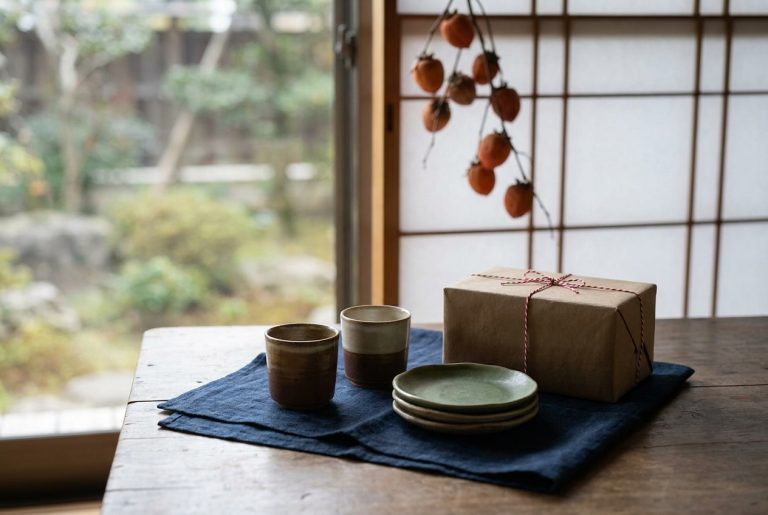
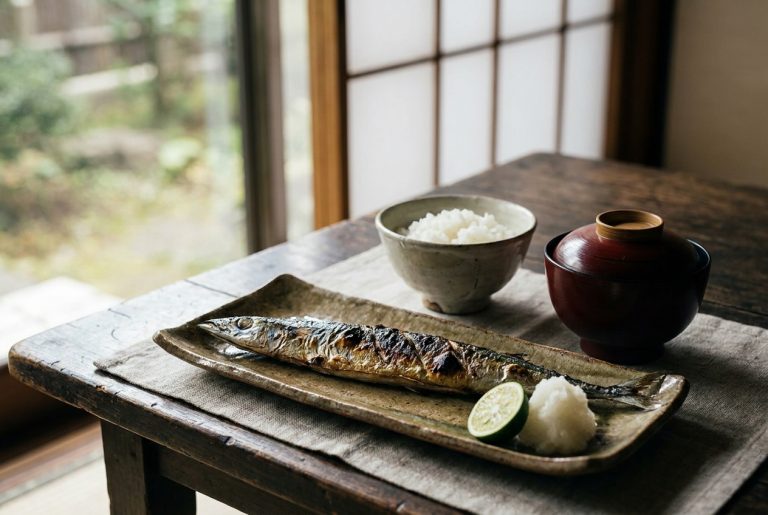
Autumn is the richest season for the Japanese table and the one most associated with nagori — the year visibly ending. Colours warm to russet, brown, ochre, and deep green: the palette of maple (momiji) and ginkgo, roughly October into November. Rustic stoneware with visible texture, iron-glazed plates, and deeper bowls suit the heavier food — mushrooms, chestnuts, grilled fish, simmered roots. A maple-leaf motif, or an actual leaf set beside the food rather than under it, marks the moment exactly. This is the season to let the ware itself feel tactile and grounded.
Winter: warmth you can hold
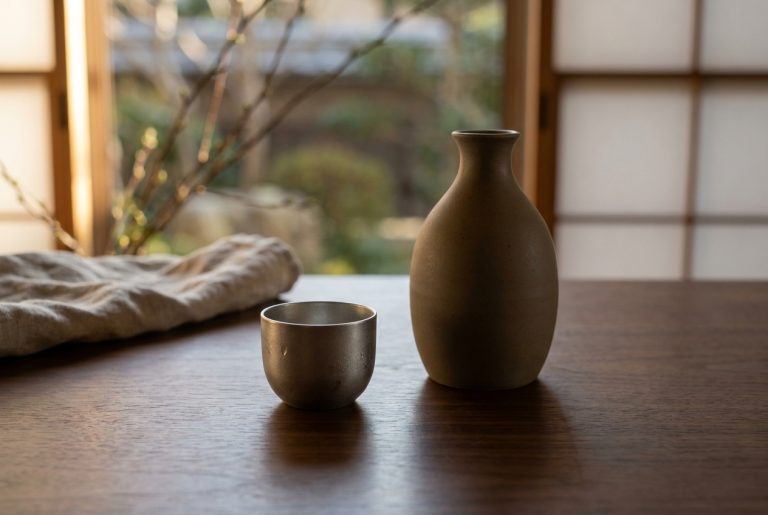
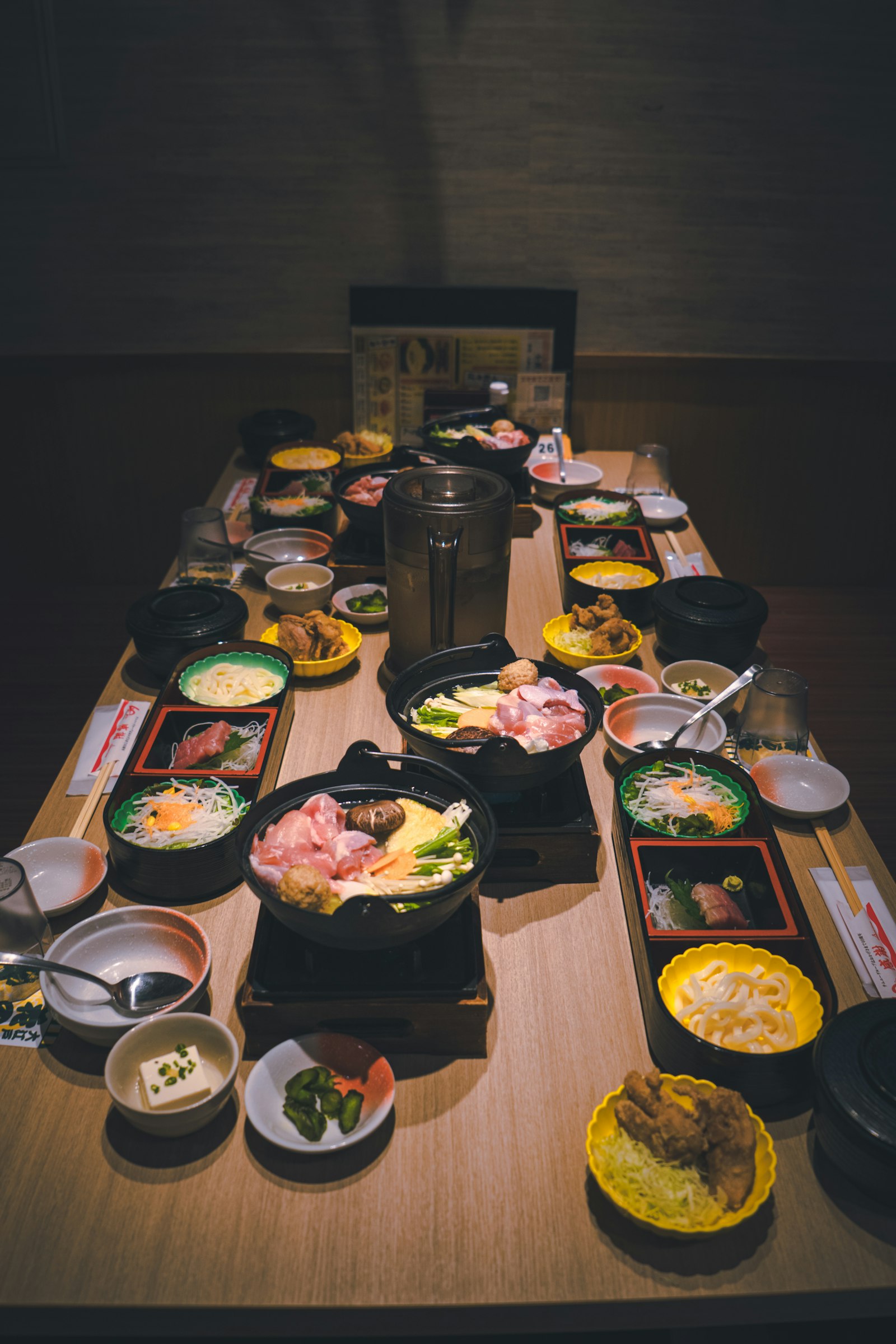
Winter settings are about warmth, real and visual. Deeper, darker glazes; thicker walls; pieces that hold heat. This is the season of the shared pot at the centre of the table, of a yunomi cupped in both hands — 150–220 ml is enough to hold and not enough to go cold — and of dark lacquer glowing under indoor light. Reds, deep browns, and black tenmoku glazes read as seasonal. If you drink matcha, this is when the tall, narrow tsutsu-jawan comes out instead of the wide summer bowl, for exactly the reason you would expect: less surface, slower cooling.
Where the pieces actually go — and which ones move
Underneath the seasonal accents sits a layout that does not change at all. The standard everyday setting is ichijū-sansai: one soup, three dishes, plus rice. Rice goes at the front left, soup at the front right — rice on the left so it is easy to lift and set down, soup on the right so it is less likely to be knocked. The three side dishes sit behind them, with the main one at the back right. Chopsticks lie across the front, tips pointing left, on a rest.
That arrangement is fixed, and getting it backwards is noticed immediately by anyone Japanese. Which is useful, because it tells you exactly where the seasonal freedom lives: not in the rice bowl or the soup bowl, but in the three side dishes, the rest, and one accent.
What not to buy
- Four seasonal dinner sets. This is the expensive mistake, and it is the one the photographs push you toward. Nobody in Japan owns four dinner services. They own a neutral core and a box of small things.
- Sakura-patterned dinner plates. A motif that literal is usable for about three weeks a year, and awkward for the other forty-nine. Buy the blossom in the smallest, cheapest object you can — a chopstick rest, a 9 cm mamezara — and keep the plates plain.
- Thin-rimmed decorative glass for hot food. Summer glass is for chilled dishes. Hot soup in a thin glass bowl is a bad idea for reasons of both comfort and thermal shock; keep glass for cold things and put the hot ones in ceramic.
- The sixteen-piece “Japanese-style” boxed set. Almost always four of everything, in shapes that match each other and nothing else. Japanese sets come in fives — shi, four, is also the word for death — and a real Japanese cupboard is deliberately unmatched.
- A leaf from the garden placed under the food. Beside it, yes; underneath it, no. The gesture reads the same and you avoid an unnecessary question about what was on the leaf.
The core that stays, the accents that move
Build the fixed layer once: white or blue-and-white plates, a good rice bowl, a soup bowl, and a stack of small dishes. That is the whole of the everyday set, and it is deliberately quiet so that one seasonal thing can be loud. Then spend very little on the moving layer — five chopstick rests at 4–7 cm each, one glass piece for summer, one textured stoneware plate for autumn. Those are the cheapest objects on the table and they carry almost all of the seasonal signal.
Three habits hold it together across all four seasons. Leave empty space — a Japanese tray is not filled to the edges, and the emptiness is part of the composition. Vary height and texture so a meal has rhythm instead of a flat row of matching dishes. And let one accent carry the message. A single maple leaf beside a plate in late October says more than a table crowded with decoration, and it costs nothing at all — which is, in the end, the argument for the whole approach.
Related guides
- Japanese Tableware Guide — the neutral, all-year foundations to build on.
- Small Dishes: Kobachi & Mamezara — the seasonal accents that do the most work.
- Japanese Sushi Plates & Serveware — serving pieces for a composed table.
- Japanese Tea Guide — the tea that closes a seasonal meal.
- Matcha Bowls (Chawan) — where the summer and winter bowl shapes come from.
Disclosure: Nagori Ware is an independent editorial guide written from Japan. Some links elsewhere on the site are affiliate links. Parts of this site are drafted with AI assistance and checked against Japanese sources. General information, not legal or safety advice.