Tetsubin vs. Kyusu: The Japanese Cast Iron Teapot, Explained
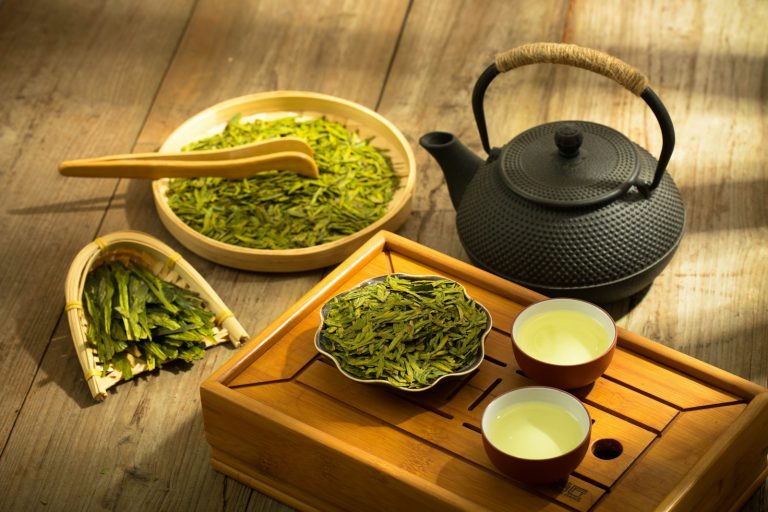
A cast iron teapot has real presence — heavy, dark, often textured with a pattern of raised dots. It looks like an heirloom, and a good one can be. But the single most common mistake buyers make is assuming all Japanese cast iron is the same. It isn’t. There are two different objects here, they do two different jobs, and buying the wrong one leads to rust, disappointment, and a fair amount of confusion.
This guide explains the difference between a tetsubin and a tetsu kyusu, what each is actually for, and how to care for cast iron so it lasts. Where care touches on rust and iron, we’ve kept to what’s widely documented — but cast iron rewards attention, so read the care section before your first use.
Tetsubin vs. tetsu kyusu: the key difference
The distinction comes down to what’s inside the pot.
- Tetsubin (鉄瓶) is a cast iron kettle for boiling water. Its interior is bare, unlined iron, and it is designed to be heated directly over a flame or on an induction hob.
- Tetsu kyusu (鉄急須) is a cast iron teapot for steeping and serving tea. Its interior is coated with enamel, and it is not meant to go on a heat source — you fill it with already-hot water.
That enamel lining is the whole story. Without it, bare iron rusts quickly when it sits in contact with water and tea — which is fine in a tetsubin, because a tetsubin is emptied and dried after boiling, but would be a problem in a teapot that holds tea while you drink. The enamel in a tetsu kyusu prevents rust and makes daily cleaning simple, at the cost of the direct iron contact that tetsubin owners actually want.
Many attractive cast iron pots sold internationally are enamel-lined tetsu kyusu, even when they’re loosely marketed as “tetsubin.” If a listing says the pot can go on the stove, treat that as a claim to verify with the maker — most enamel-lined teapots cannot.
Which one do you want?
- Buy a tetsubin if you want to boil water on a stove or brazier, you like the idea of iron subtly changing the water, and you’re willing to dry it carefully every time.
- Buy a tetsu kyusu if you want a beautiful, low-maintenance teapot to steep and serve loose-leaf tea, and you’ll heat your water separately (in a kettle).
Most people who just want to make and pour tea are better served by an enamel-lined tetsu kyusu. The bare-iron tetsubin is the choice of someone who enjoys the ritual and upkeep of true cast iron.
Buy this, not that
If what you want is to make and pour tea, buy the enamel-lined tetsu kyusu — it does the job with a rinse and a dry, and it is the right answer for most people. Buy the bare-iron tetsubin only if you actually want the ritual: boiling on a flame, emptying it while it is still hot, drying it every single time. And whichever you buy, do not put an enamel-lined pot on a heat source — it is not built for it.
Does a tetsubin really change the water?
This is the claim you’ll see most often, and it has a basis. Boiling water in bare, unlined iron releases a trace of iron into the water, which many drinkers describe as softening or rounding the water’s character — one reason tetsubin are prized for tea. This effect depends on the iron being uncoated, which is exactly why it applies to a tetsubin and not to an enamel-lined tetsu kyusu.
We’d frame this as a widely reported, traditional benefit rather than a medical one. If you have specific dietary needs around iron intake, that’s a question for a doctor, not a teapot — the amounts involved are small and hard to quantify precisely.
What about rust — is it safe?
Rust is the anxiety every new tetsubin owner has, so let’s be plain about what’s documented. A light film of surface rust inside a well-used tetsubin is normal, and iron oxide (ordinary rust) is generally described as non-toxic; the trace amounts that dissolve from a lightly surface-rusted tetsubin are typically considered below any health concern. What rust does reliably affect is taste — too much of it makes tea taste metallic or off.
So the goal isn’t a rust-free interior at all costs; it’s keeping rust light and controlled through good habits. If rust becomes heavy, flaking, or the water tastes strongly metallic, stop using the kettle for tea and restore it (below) or have it looked at. When in doubt, don’t drink it.
Caring for cast iron
First use: seasoning
Season a new bare-iron tetsubin before you brew with it. A common traditional method is to boil water in it several times, and some owners boil water with used green tea leaves or a little cooked rice; the tannins in tea and starch in rice are said to help build a protective layer and clear any metallic edge from a new pot. Follow the specific instructions from your maker, as fine antique and handmade tetsubin can have their own requirements.
Every day
- Empty it while it’s still hot. The residual heat of the iron evaporates the last of the moisture. Water left standing in a tetsubin — especially overnight — is what accelerates rust fastest.
- Rinse with hot water only. Skip soap: detergent strips the seasoning that protects the interior.
- Dry thoroughly. Leave the lid off and let the pot air-dry completely before storing.
- Don’t scrub the interior of a bare-iron tetsubin with abrasives; you’ll remove the protective layer you’re trying to build.
Never do this
- Never put cast iron in the dishwasher. Detergent and heat strip seasoning, damage the exterior finish, and accelerate rust.
- Never use soap on the bare-iron interior.
- Never leave water sitting inside it.
- Never heat a tetsu kyusu (enamel teapot) on the stove — it’s not built for direct heat.
If rust appears
For light surface rust in a tetsubin, a documented approach is to brew and discard a few pots of strong tea: the tannins help rebuild the protective coat and neutralize metallic flavors. Gently removing loose surface rust with a soft brush and hot water (no soap), then re-seasoning, is another common step. Enamel-lined tetsu kyusu shouldn’t rust internally under normal use precisely because of the coating; if the enamel chips, treat exposed iron with the same care as a tetsubin.
“Cast iron” is a material. “Nanbu tekki” is an address.
Everything above this point is about what the pot is made of and what it is for. There is a second question that decides the price far more sharply than either, and most listings answer it by saying nothing at all: where was it cast, and by whom.
The Japanese cast iron worth the name has a place attached to it. Nanbu tekki (南部鉄器) is ironware from Iwate Prefecture — specifically Morioka City and Mizusawa in Oshu City — and it was designated a national traditional craft in 1975, among the first group to be recognised. The two towns have separate lineages, which is why the style varies: Mizusawa’s foundry tradition is traced back roughly 950 years, while Morioka’s dates to about 400 years ago, when the lord of the Morioka domain brought a pot from Kyoto and invited a kettle maker to work locally. That Morioka line began with tea ceremony kettles, which is why Morioka pieces so often look like tea things and Mizusawa pieces often look like cookware.
Two foundry names do most of the work in English-language shops. Iwachu, founded in Morioka in 1902, is the one you will meet first and the source of most of the coloured enamel-lined pots sold abroad. OIGEN, founded in 1852 in Oshu, is the older house and leans towards bare iron and cookware. Neither is the “right” answer; they are different rooms of the same craft.
| What the listing says | What it tells you |
|---|---|
| A foundry name — Iwachu, OIGEN, Kamasada, Suzuki Morihisa | The most specific signal available. You can look the foundry up. |
| “Nanbu tekki” or “Iwate” with no foundry | A place, which is real information, though less than a name. |
| “Japanese-style” or “Japanese cast iron teapot” alone | A description of the look. It says nothing about where it was cast. |
| Neither a place nor a foundry, at a low price | Almost certainly a mass-produced import. Not a scandal — just a different product. |
That last row is the one to be calm about. A pot cast outside Japan is not a fake and is not necessarily bad; for a lot of people it is the sensible buy, and it will pour tea perfectly well. But you should know which of the two things you are paying for, because the gap is wide and the photographs look identical. The raised-dot pattern, the shape, the black finish — all of it is straightforward to reproduce. A foundry name is not.
So when a listing offers you only the words “cast iron teapot,” treat that the way you would treat any specification the seller had no reason to leave out. Our guide to reading a listing goes through the rest of that habit of silence in Japanese tableware listings; the pattern here is the same one, applied to a foundry.
Tetsubin vs. tetsu kyusu at a glance
| Tetsubin (kettle) | Tetsu kyusu (teapot) | |
|---|---|---|
| Job | Boil water | Steep & serve tea |
| Interior | Bare, unlined iron | Enamel-coated |
| Use on stove / induction | Yes (that’s the point) | No |
| Changes the water | Yes, trace iron | No (enamel barrier) |
| Care | Higher — dry after every use | Lower — rinse and dry |
| Best for | Ritual, iron-rich water | Everyday, low-maintenance brewing |
Materials, finishes and maker instructions vary. Always confirm whether a specific pot is stove-safe and how it should be cared for on the retailer’s or maker’s own page before buying or first use.
Frequently asked questions
Can I boil water in a tetsu kyusu?
No. A tetsu kyusu is an enamel-lined teapot for steeping, not a kettle. Heat your water separately and pour it in. Only a bare-iron tetsubin is made to go on a heat source.
Is a little rust in my tetsubin dangerous?
A light film of surface rust is generally considered normal and low-risk, and ordinary rust is described as non-toxic in the small amounts involved. Its main effect is on taste. If rust is heavy or the water tastes strongly metallic, stop using it for tea and restore the pot — and when unsure, don’t drink it.
How do I stop my cast iron teapot from rusting?
Empty it while hot, rinse with hot water only (no soap), dry it thoroughly with the lid off, and never leave water standing inside. Never put it in the dishwasher.
Why can’t I use soap?
On bare iron, soap strips the seasoning — the protective layer built up through use — which then exposes the iron to rust. Hot water alone is enough for a rinse.
What is the raised dot pattern on cast iron teapots?
It’s called arare (hailstone) — a classic decorative texture on Japanese cast iron. It’s traditional styling; on a kettle, the added surface can also help with heat distribution.
About this guide. Nagori Ware is an independent guide to Japanese tableware and tea. We research materials, regions and makers so you can buy once and buy well. We do not sell products; we point you to the specialist shops that make and stock them, and may earn a referral fee if you buy.
What size tetsu kyusu to buy
Cast iron teapots are sold in a narrower band than clay ones. Japanese listings cluster at 0.4–0.6 litres, with 450 ml an extremely common single size; the range available abroad stretches from about 400 ml to a litre. Divide by a yunomi at 130–160 ml and a 450 ml pot is three cups — one person twice over, or two people once.
Now the part that is worth knowing before you spend the money, because it runs against the standard advice. For a clay kyusu the rule is buy small: Japanese green tea is brewed in short repeated infusions, so a big pot is wasted. For cast iron that logic inverts, and the reason is geometry. You are buying a tetsu kyusu for heat retention, and heat retention is a fight between how much hot liquid is inside (volume) and how much surface it can escape through (area). Make the pot smaller and the surface shrinks more slowly than the volume does, so a small cast-iron pot gives up its heat proportionally faster than a large one.
The practical effect: a 400 ml tetsu kyusu does not hold heat dramatically better than good thick ceramic, and you have paid for iron and carried its weight to get there. If heat retention is the reason you want one, the 600 ml-and-up sizes are where the property you are buying actually shows up. If you mostly brew two small cups of good sencha, a tetsu kyusu is the wrong pot and a 300 ml clay kyusu is the right one.
Weight is the other number nobody prints. Cast iron at a given capacity is several times the mass of clay at the same capacity, and it is all in your pouring hand. This is the quiet argument for the third shape: if what you want is volume for a table of people, the pot Japan actually reaches for is not iron at all but the ceramic dobin, which hangs a cool cane handle over the top precisely so that the weight stops being your wrist’s problem.
- 400–500 ml — one or two drinkers. The common size, and the one where the heat-retention argument is weakest.
- 600–800 ml — three or four cups, and the band where cast iron starts behaving the way the marketing says it does.
- 1 litre and over — heavy enough that most people stop enjoying the pour. Consider a ceramic pot instead.
None of this changes the lining question above: a tetsu kyusu is enamel-lined and is for brewing, not for putting over a flame. Size is the second decision, after that one.
The basket inside a tetsu kyusu, and why it is the part to inspect
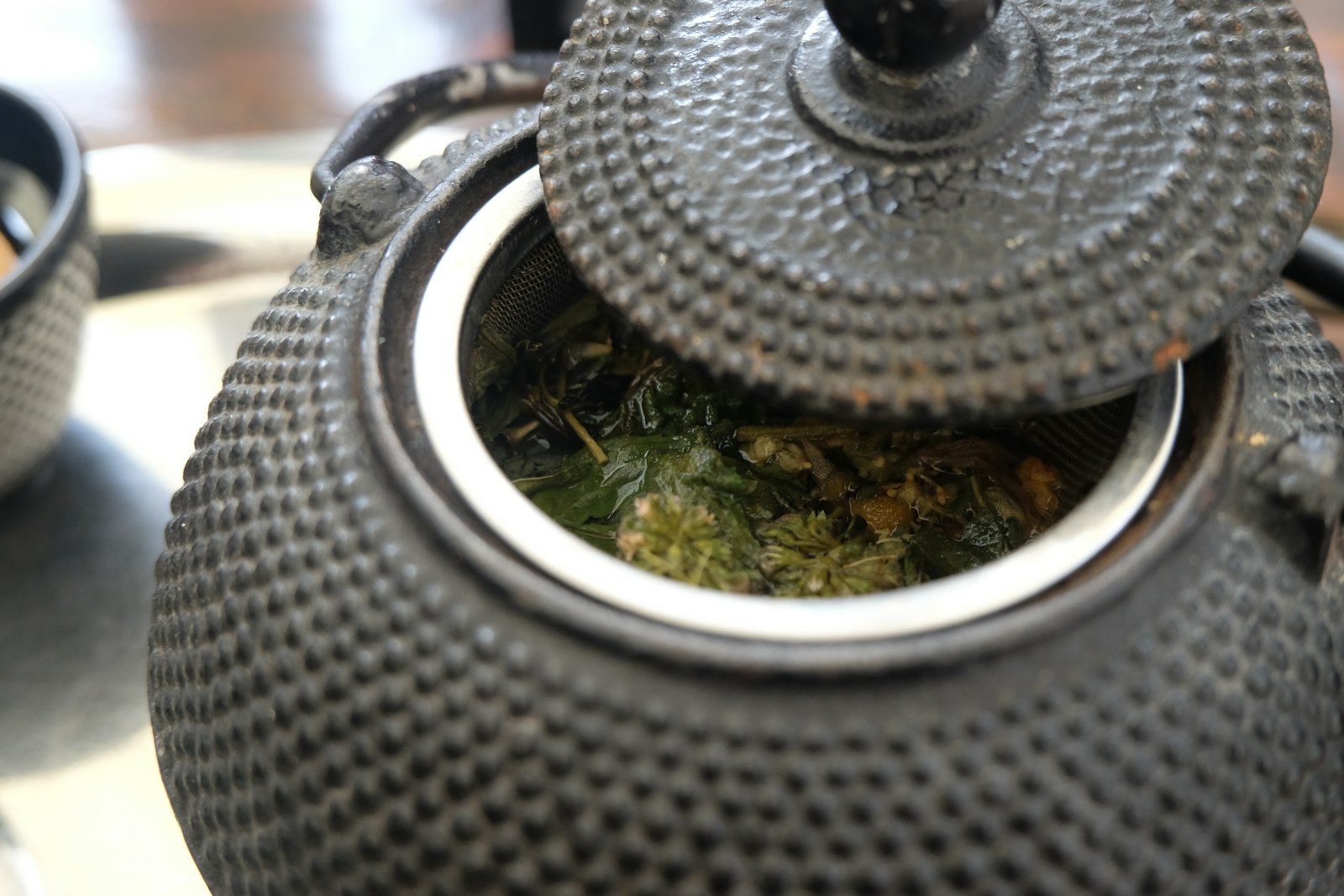
Almost every tetsu kyusu sold today ships with a removable stainless steel mesh basket that drops into the mouth of the pot, and sellers treat it as a given rather than a feature — which is why it rarely gets discussed. It deserves more attention than the casting does, for a reason specific to this pot: the interior is enamelled, so the iron contributes nothing to the brew. In a clay kyusu the body is part of the equation. Here it is not. The basket is the only thing inside the pot that touches your tea, which makes it the only part of a tetsu kyusu that changes how the tea comes out.
And a basket is not the same device as the strainer built into a clay pot. A ceramic kyusu filters at the wall, through a band of holes or a fitted mesh set into the side, which lets the leaf lie across the whole floor of the pot and open flat. A drop-in basket holds the leaf in a narrow column instead. That column is the trade-off you are accepting: it is tidy, it lifts out in one motion, and it keeps wet leaf off the enamel — but a leaf that needs room to unfurl does not get it. The practical reading is that a tetsu kyusu suits broken and small-leaf teas better than it suits a whole-leaf sencha you want to open properly, which is a separate question from the one about how fine the mesh needs to be.
So three things to look at before you pay, all of them visible in a decent product photograph. Does the basket lift out at all? A few budget pots have a fixed perforated plate instead, and a fixed plate is a cleaning problem for the rest of the pot’s life. Does it sit down into the pot, or perch in the mouth? A basket that only rests on the rim tips when you pour at an angle, and a tipped basket dumps the leaf into the pot you were trying to keep clean. How fine is the weave? Loose weave lets fragments through, which matters most with deep-steamed leaf; fine weave strains well but packs with particles and needs a brush across its face rather than a rinse.
One thing the basket does not do is let you treat the pot as a kettle. Loose leaf against bare iron is the failure mode a tetsubin owner is warned about, and the basket in a tetsu kyusu is not a workaround for that — the enamel is. The basket is for convenience; the lining is for the metal. Sellers also advise keeping fruit teas and anything sharply acidic out of an enamelled pot, since repeated acid contact is hard on the lining. Rinse the basket under hot water, shake it out, and let it dry open, the same way you would with anything else that holds damp leaf.
Related reading
- Japanese Tea: A Beginner’s Guide — types, grades, and how to brew each.
- How to Brew Sencha vs Gyokuro — water temperature and timing that change the flavor.
- The Best Japanese Teapots (Kyusu) — the everyday pot for steeping leaf tea.
- Yunomi: The Everyday Japanese Teacup — what to pour your tea into.
Disclosure: Nagori Ware is an independent editorial guide written from Japan. Some links elsewhere on the site are affiliate links. Parts of this site are drafted with AI assistance and checked against Japanese sources. General information, not legal or safety advice.