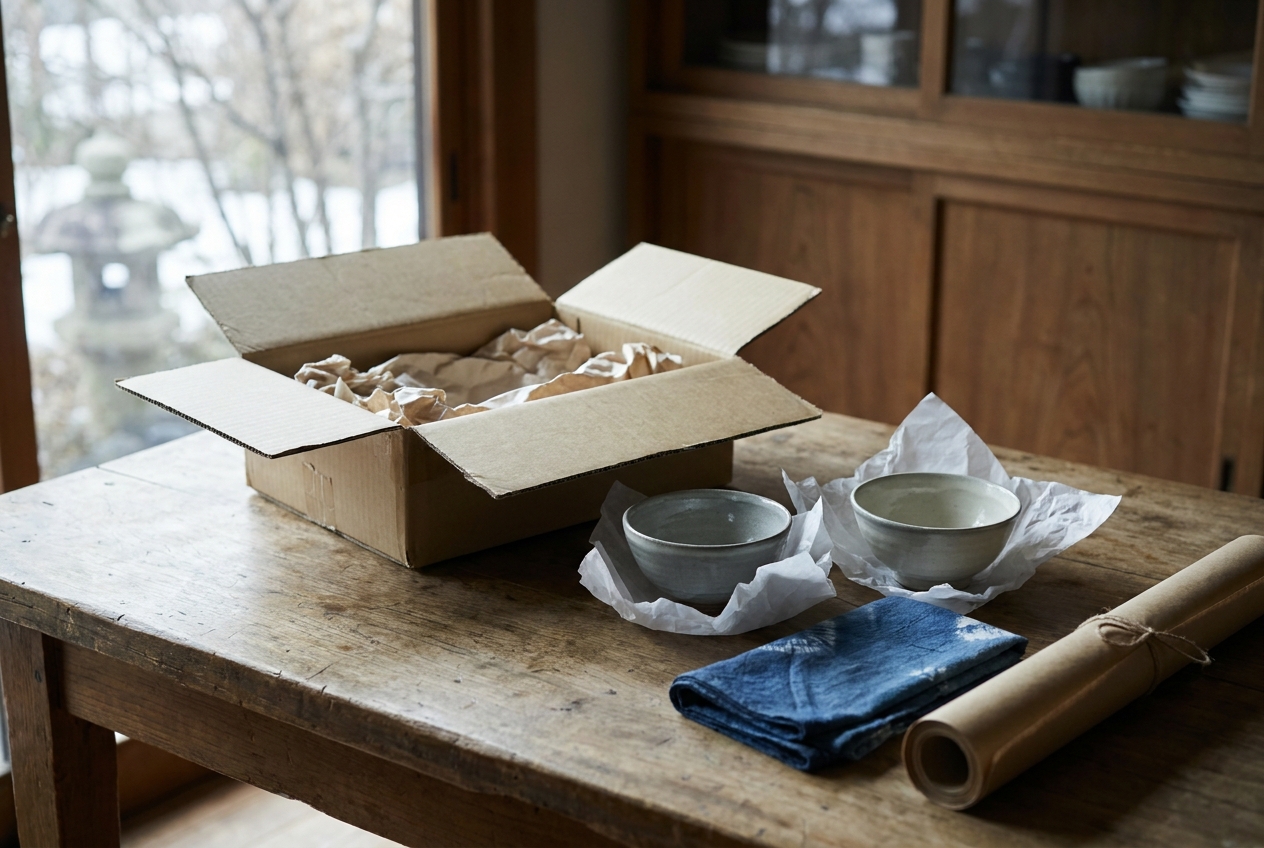
Ordering Japanese Tableware From Japan for Christmas: When to Order, Who Pays the Duty, and What to Do If It Arrives Broken
If you want Japanese tableware from a shop in Japan under the tree this year, order in-stock pieces by about 8 December and pick a courier (FedEx, DHL, UPS) over the post. Made-to-order pieces are already late. Before you pay, find the words “duties prepaid” or “DDP” on the shop’s shipping page, or the person you are giving it to may get a bill at the door. Open the box the day it arrives, not on Christmas morning. And don’t order from Japan after mid-December: Japan’s New Year break means a late order may not even leave the shop until January.
Every December, shops in Japan answer the same three questions from overseas customers. Will it arrive by the 25th? Will it arrive in one piece? Will someone have to pay to receive it? The answers are scattered across shipping pages, holiday notices and postal bulletins, and most of them changed in the last eighteen months. This page puts them in one place, in the order you need them: when to order, how it should travel, who pays, and what to do if the box rattles.
How this was put together. I have not tested delivery times myself, and I won’t pretend to have. I read the shipping and holiday pages of shops in Japan that sell kitchenware, tea and tableware abroad, Japan Post’s notices on mail to the United States, and the US Customs and Border Protection rules published in the Federal Register. Everything here was checked on 17 November 2026. Most shops post this year’s holiday schedule in late November, so where I quote last year’s dates, I say so. This is general information, not customs or legal advice.
Why the deadline comes earlier than the flight time suggests
A courier parcel from Japan to the US takes about a week. Seido, a Japanese kitchenware shop, says it usually delivers in 4–7 days to North America. So it is tempting to think an order on the 18th is fine. It usually isn’t, for two reasons that have nothing to do with planes.
The first is the shop. Small Japanese shops pack by hand and dispatch on their own schedule, often within 2–5 business days of the order, and longer in December. The second is the New Year. In Japan, oshōgatsu is the one holiday when almost everything stops, and shops, warehouses and courier depots close with it. Last winter, Seido was closed from 27 December to 4 January. JP Stationery Store closed from 30 December to 2 January and said that courier orders not sent by 29 December would leave on or after 5 January. Kurasu in Kyoto shipped orders (without coffee beans) placed by 25 December within the year, and anything later from 5 January.
That is the trap. An order placed on 20 December, meant as a late gift or a New Year present, can sit in a closed shop for two weeks before it starts the journey. So the real deadline is set by the shop’s last dispatch day, not by the flight. And I would aim about a week before that day, around 8 December, because the last dispatch day is when a shop stops promising, not when its packing queue gets shorter.
Some shops publish a softer target. MIWA’s Tableware, which packs in Japan and ships by FedEx, says on its home page to order by mid-November “for the best chance” of Christmas delivery. Read that as a shop being honest about its own packing queue. If you are reading this after mid-November, ask the shop directly whether an order today will make it, and get the answer in writing.
Courier, post, or a shop in the US: what each one means for you
The shipping method decides three things at once: how fast it comes, how the duty is handled, and who you deal with if it breaks. It is worth choosing on purpose rather than taking the default at checkout.
| How it travels | Speed | Duty | Choose it when |
|---|---|---|---|
| Courier from Japan (FedEx, DHL, UPS) | About a week door to door once dispatched | Depends on the shop. Some prepay it, many leave it to the person receiving the parcel, plus a carrier fee | You need it before Christmas and the shop says clearly who pays the duty |
| Japan Post (EMS, airmail, small packet) | Slower, and Japan Post warns of delays from reduced flights | For goods a shop sends (up to $2,500), prepaid by the sender before it leaves Japan | You are ordering in November and want no bill at the door |
| A shop that ships from inside the US | Days, and no customs stop | None on your side | It is mid-December, or the item has to arrive on a fixed day |
Japan Post deserves a word, because a lot of advice online is out of date. On 27 August 2025 it stopped accepting most goods for the US, after the US ended duty-free entry for low-value parcels. It started again on 14 April 2026, on one condition: the sender prepays the US duty through an approved service (Japan Post names Zonos and SafePackage), and the parcel carries a “DDP” number. Since 15 October 2026 that works at nearly every post office. So “EMS to the US is suspended”, which you will still see on some shop pages, is no longer true. But a shop has to have set up prepayment to use it.
Who pays the duty, and how to tell before you pay
Until August 2025, a parcel worth under $800 entered the US without duty. That allowance is gone for things you buy. US Customs has suspended it for mail and for couriers alike; for couriers, the current rule took effect on 24 June 2026. So a $60 bowl ordered from Japan owes duty, and somebody pays it. The only question is whether that is the shop, at checkout, or the person who opens the door.
A small exception still exists for genuine gifts of $100 or less sent from one private person to another. It does not cover an order from a shop. Japan Post’s own table puts “gifts between private individuals” in one column and everything else in another, and a shop’s sale is in the second column, the one that needs duty prepaid. So asking the shop to mark the box “gift” doesn’t help, and shouldn’t be asked for.
Here is how the shops I read handle it, which shows how much it varies:
- Prepaid by the shop. Artistic Nippon, which ships ceramics from its shop in Chiba, says it arranges US duties and fees through Zonos before the parcel ships. Japanese Green Tea Shops sends US orders DDP by Japan Post, so the customer pays no tariff on arrival.
- Paid by the recipient. MIWA’s Tableware says duties are not included in the price and may now apply to US orders of any value. JP Stationery Store says the customer pays the duty on or after delivery. Hibiki-an, a Kyoto tea shop, listed on 12 November a 15% tariff on teaware plus an $18.34 DHL handling fee, paid by the person receiving it. We go through that example in our green tea gift guide.
So read the shipping or FAQ page for one of these phrases before you pay: “DDP”, “duties prepaid”, “duties included”, or the name of a prepayment service such as Zonos. If none of them is there, assume the bill goes to the address on the label. If that address is someone else’s, either tell them a charge is coming, or have it sent to yourself and hand it over. A gift that starts with a customs invoice is not the gift you meant.
Buy this, not that
Order an in-stock piece, sent by courier with duties prepaid, by about 8 December, and have it delivered to yourself. That gives you a week to open it, check it and wrap it. Not a made-to-order piece from now on, and not any order from Japan after the shop’s last dispatch day (about 16 December last year). After that, buy from a shop that stocks the same maker in the US, or give a card that says the bowl arrives in January.
Will it arrive in one piece?
Most of the time, yes, but not always, and the buyer reviews show it plainly. On gift sets of teacups, rice bowls and sushi plates sold on Amazon, praise for “each piece wrapped on its own” and “the box itself looks like a gift” sits right next to one-line reviews that say the set came shattered. Sake sets and donabe pots show the same pattern: most arrive fine, a few arrive with one cup or the lid in pieces. Nobody can promise you which side your parcel lands on. What you can do is buy from shops that pack for it and insure it, and set yourself up to claim if it goes wrong.
Three things to look for on the shop’s page:
- Insured, tracked shipping. Artistic Nippon “strongly” recommends insured shipping for ceramics, and replaces or refunds a broken piece only after the carrier has approved the insurance claim. If insurance is an option at checkout, take it.
- Who you claim with. Some shops handle the claim; others send you to the carrier. Know which before you order, because the carrier’s deadline is usually the shorter one.
- Which part is fragile, and whether it can be replaced. On a donabe, the lid is the piece the reviews I read most often describe as broken, and on a teapot it is the most fragile part too. A kyusu lid is made for its own pot and can’t simply be swapped for another, while a donabe lid sometimes can if you measure the right circle. Either way, it is worth knowing before the gift is in someone else’s hands.
If the box arrives damaged: four photos, in this order
Damage claims are won or lost on evidence, and the evidence is easiest to collect before you start unwrapping. The windows on the damage policies I read ran from 48 hours after delivery (a US importer of Japanese goods) to 7 days (a Taiwanese porcelain maker that asks for a video of the unboxing). Artistic Nippon may ask you to keep the broken piece, the packing and the box for inspection. So the safe habit is the same everywhere:
This is also the strongest reason to ship to yourself first. If the parcel goes straight to the person you are giving it to, they are the one who has to notice the rattle, take the photos in the right order and send the message within two days. Most people open a gift on the day, not when the courier comes, and by then the window may have closed. One reviewer of a boxed chopstick set found a chipped rest only when the recipient opened it a month later.
Before you order: a short check
- Is it in stock? If the page says “made to order” or gives a production time, it is already late for Christmas.
- What is the shop’s last dispatch day? Look for a holiday or year-end notice. If there isn’t one yet, write and ask.
- Which carrier? A courier for December orders. The post is fine in November if the shop prepays the duty.
- Who pays the duty? Look for “DDP”, “duties prepaid” or “Zonos”. No mention means the recipient pays.
- Is it insured, and how long do you have to report damage? Write the window down.
- Does the size match what they need? The dimensions on Japanese listings are often in sun or gō; our guide to reading a Japanese tableware listing converts them.
If you are still choosing what to give, start with our guide to Japanese tableware and tea gifts, which covers how many to give and how to wrap them, or the budget guides for ramen lovers and matcha drinkers.
Quick answers
Can I still use EMS to send to the US?
Yes, since 14 April 2026, as long as the sender prepays the US duty through one of Japan Post’s approved services and labels the parcel with its “DDP” number. Some shop pages still say EMS to the US is suspended. That was true from August 2025 to April 2026.
Will the person I’m sending it to pay duty on a $60 bowl?
Someone will. Since the US suspended the under-$800 allowance, purchases from abroad owe duty at any value. If the shop prepays it, you pay at checkout and nothing is due on arrival. If not, the bill goes to the recipient, and a courier may add its own fee: on Hibiki-an’s page, DHL’s handling fee was $18.34.
The shop doesn’t say when it closes for New Year. What should I assume?
Assume nothing ships from about 27–29 December to about 4–5 January, which is the pattern in the notices I read. Then work backwards: the shop’s packing time, plus about a week in transit, has to end before the 25th.
It’s past the deadline. Is there any way to still give something from Japan?
Two honest options. Buy the same maker’s work from a shop that stocks it in the US, which skips customs and the New Year break. Or order from Japan anyway and give a card on the day that says what is coming. A good bowl that arrives on 10 January is still a good bowl.
The short version
In stock, by courier, duties prepaid, by about 8 December, and sent to yourself. Take four photos before you unwrap anything that rattles. After mid-December, buy in the US or give a card, because from the end of December Japan stops for the New Year.
Disclosure: Nagori Ware is an independent editorial guide written from Japan. Some links elsewhere on the site are affiliate links. Parts of this site are drafted with AI assistance and checked against Japanese sources. General information, not legal or safety advice.