Donabe Replacement Lid: Which Circle to Measure Before You Order
Yes, you can buy a replacement lid for a donabe. That is worth saying first, because the last time I wrote about a broken Japanese lid the answer was the opposite: a kyusu lid cannot be replaced at all, not by the shop and not by the potter who made it. Same material, same country, same accident, and a completely different outcome.
The reason for the difference is the whole of this article, and it also tells you what to do next. A kyusu lid is ground onto one body by hand after firing, so it belongs to that pot and no other. A production donabe lid is pressed in a mould, in a line that has been running for decades, and it belongs to a model number. Parts exist for the second kind.
What nobody tells you is what to ask for. You cannot order by the pot’s name, and you cannot order by the size on the listing, because the figure on the listing is measured somewhere the lid never touches. There is exactly one number that matters, no maker prints it, and it takes thirty seconds with a ruler.
Scope: this is about fit and about where to buy. Anything to do with direct flame, dry heating, thermal shock or whether a chipped pot is still safe to cook in belongs to the donabe guide and to the microwave and dishwasher piece; I am not adding any safety advice here, and where a manufacturer has an instruction, follow theirs.
Why this pot has a spare and your teapot did not
A kyusu is a fitted pair. The lid is turned slightly oversize, then ground down against its own body until the two sit flush, and the grinding is what makes the fit — which means the fit cannot be reproduced on a lid that was ground against something else.
A donabe from a production line is the opposite kind of object. Yokkaichi in Mie Prefecture makes Banko ware, and Japanese sellers routinely describe Banko as around 80% of the country’s domestic donabe output. That concentration is the thing working in your favour: a handful of model lines cover most of the pots in most Japanese kitchens, they have been in production for decades — Ginpo’s Hanamishima pattern dates to the 1970s and is still sold — and a lid is therefore a stock item rather than a one-off.
So the split is not clay versus clay. It is a piece finished against one body versus a part made to a pattern. If you own a studio donabe by a named potter, you are back in kyusu territory and should expect no spare; the regional styles that trade on individual making are the ones with no parts bin behind them. If you own a Ginpo or a Nagatani-en, you are in luck.
Which is also why the American donabe specialists are quiet on this. TOIRO, the best-known donabe shop in the United States, has a long FAQ that never mentions replacement lids at all — the only repair line in it warns you off using super glue on a chipped pot. The answer exists; it just lives on Japanese maker pages.
Three numbers on the listing, and the lid answers to none of them
Take the single most ordinary donabe sold in Japan. Ginpo’s Hanamishima 8-gō is published by the maker as 27.5 cm wide including the handles, 25 cm at the mouth, 14 cm high, 2.2 litres, about 2,000 g.
Notice that there are already two widths there, 2.5 cm apart, and that most third-party listings quote the larger one because a bigger number reads better. The handles are two lugs sticking out into the air. A lid lands inside the mouth. If you shop for a lid against the handle figure you will buy something 2.5 cm too big, which on a clay lid is not a near miss — it will sit on the rim and rock.
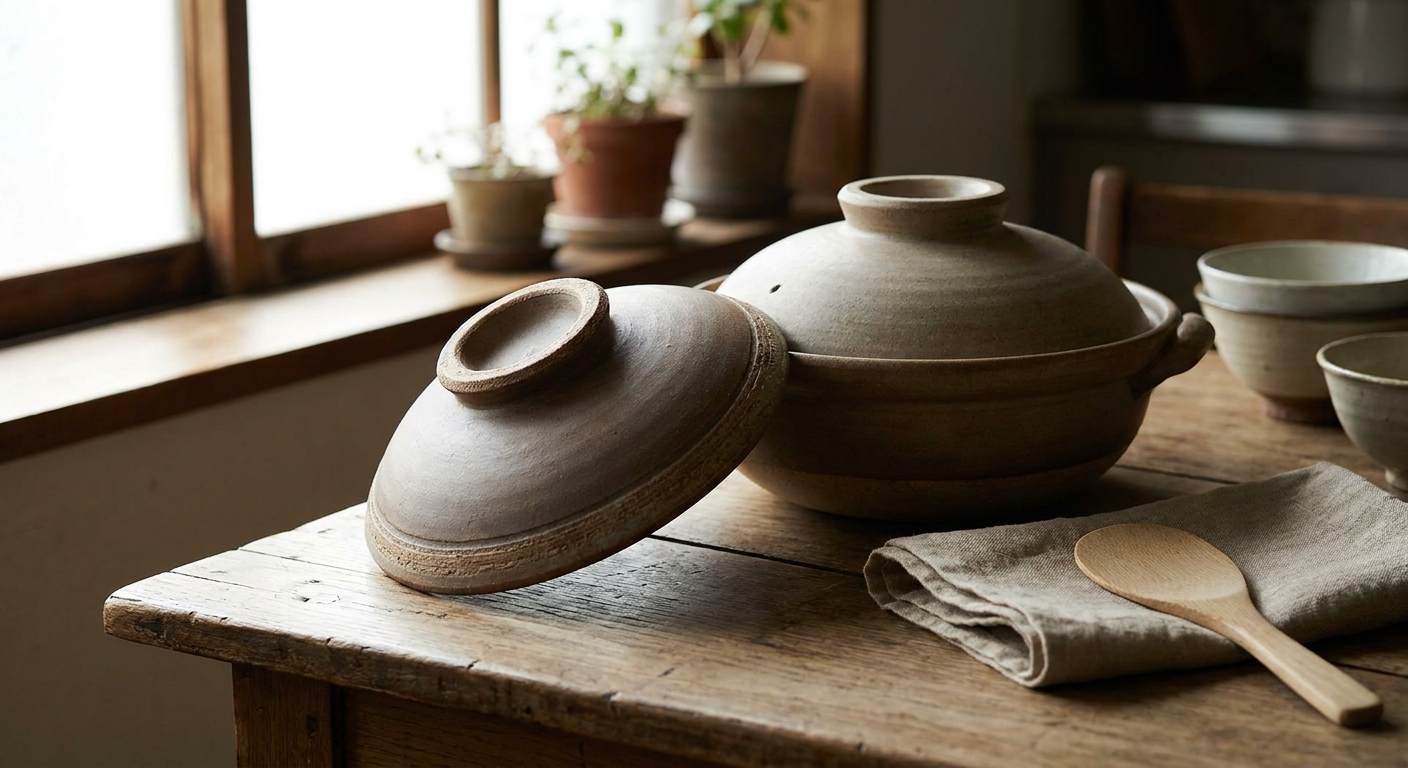
And the mouth measurement is not the answer either, though it is close. A donabe rim is stepped: the wall rises, then there is a shelf, and the lid’s rim drops onto that shelf. Potters in the English-speaking world call that shelf the gallery — the studio Clay Coyote, which handles this problem for its own customers, defines it plainly as “the dip in the base where the rim of the lid sits” and says the lid’s rim has to fit right into it. The seat is narrower than the mouth, and the seat is the number.
This is the same trap as the one under your hot pot. When I worked out what size trivet a donabe needs, the answer was that the 30–32 cm on the listing described the handles and the trivet answered to a circle of base nobody publishes. Lids are that problem turned upside down: same pot, same misleading number, a different unpublished circle. If you want the general version of this habit, it is the whole point of reading a listing.
“8-gō” is not a measurement
Japanese pots are sized in gō. One gō corresponds to one sun, about 3 cm, so the convention is to multiply: 8-gō is roughly 24 cm at the mouth, 9-gō roughly 27 cm. Useful for guessing how many people you can feed. Useless for buying a part.
Two reasons. First, Japanese retailers say out loud that the gō number is not an industry standard — it is an old rule of thumb, and the same “8-gō” differs between makers, series and clay bodies in both dimensions and capacity. Second, you can watch it fail on the example above: the convention predicts 24 cm for an 8-gō pot, and Ginpo publishes 25 cm for its own best-selling 8-gō. One centimetre, on the country’s most common donabe line, in the direction that matters.
So “I need a lid for an 8-gō donabe” is not a specification. It is a rough hint that happens to be wrong about a centimetre of the time. The gō scale is worth knowing for everything else on the table — it runs through the sizes and terms reference — but not for this.
Buy this, not that
Buy the lid from the pot’s own maker, by model, and measure the seat before you order — Ginpo’s own shop lists lids from ¥1,280 and says replacement parts are sold on their official channel only. Do not buy a generic “Japanese donabe replacement lid” from a marketplace listing that gives you one inch-rounded diameter and no seat figure; a lid that is 5 mm out is a lid that rocks, and you cannot return the 5 mm. If your pot is a one-off by a named potter, stop shopping for a lid and read the last section instead.
What to measure, in the order that saves you a wrong order
Cold pot, empty, on a towel. You want three figures and a photograph, and the third figure is the one you lead with.
1. The mouth. Lay a ruler flat across the opening, rim to rim at the widest point, ignoring the handles entirely. On our example this is the 25 cm.
2. The seat. Now look down into the rim and find the step. Measure across the inner edge of that step — the circle the lid’s rim actually stands on. It will be a few millimetres to a centimetre less than the mouth. This is the number a replacement lid has to match, and the number no listing gives you.
3. The broken lid, if you still have the pieces. Measure the rim across, and note its height and whether it is domed or flat. A lid that is the right diameter and the wrong depth will still close, but on a rice pot it changes how much room the boil has.
4. Photograph four things before you write to anyone: the whole pot from the side, a close-up straight down onto the rim step, the lid rim if you have it, and the whole lid. That is exactly the set Clay Coyote asks its customers for, and it is the set that lets a shop answer you in one reply instead of four. They are also honest about the limit — kiln firing moves both fit and colour, so a matched lid is a good match rather than the original.
Write those down in centimetres and millimetres, not inches. Every Japanese maker page you are about to read is metric, and a lid quoted as “9 inch” on a marketplace has already been rounded once by somebody who did not measure the seat.
If it is a Kamado-san, say which lid
Nagatani-en’s Kamado-san is the rice donabe most people outside Japan own, and it is the one case where “my lid broke” is genuinely ambiguous, because it has two. The inner lid drops down inside the mouth and carries two steam holes; the outer lid sits above it and has one. They do different jobs and they are sold as different parts.
In practice the inner lid is the one that goes. It is the thinner of the two, it is the one you lift off wet and set down on a worktop while the rice rests, and it has no handles to speak of. If you are about to order, count the holes in the piece that broke and quote that.
Then there is the sentence on Nagatani-en’s own parts page that changes how you order. They sell rice-pot lids from ¥1,320 up to ¥4,950, plus the metal lid clips separately — and they instruct you, in writing, to measure the lid yourself and state the size in the order notes, because the parts are handmade and there is some variation in size from one to the next.
Read that carefully, because it is the strongest evidence for everything above. The workshop that made your pot, that knows the model, that has the moulds, still asks you for a measurement. If Nagatani-en cannot pick your lid from the product name alone, a marketplace seller with one photograph certainly cannot.
Also note what that means for expectations: on a handmade part, “fits” means sits down evenly and does not rock. It does not mean airtight, and it was never airtight. A donabe lid is supposed to let steam out; the ohitsu your rice moves into afterwards is the vessel built to manage moisture, and the pot itself only has to hold a boil.
Where a lid actually exists
Prices and specifications as published at the time of writing. The useful column is the last one.
| Source | What is sold | Price | What you must supply |
|---|---|---|---|
| Ginpo official shop (G.M.P., English) | Kikka donabe / rice-cooker outer lid; Kikka rice-cooker inner lid; Hana Mishima lid | ¥1,280–3,980 | Model and size. Their note: replacement parts are sold on the official shop only |
| Nagatani-en official parts page (Japanese) | Rice-pot lids, by pot size; lid clips | ¥1,320–4,950 | Your own measurement, written in the order notes — their instruction, not mine |
| Korin (US) | Lid for Ginpo Mishima toban, listed at 6–6.75” diameter | Retail | Match the model; note the inch rounding |
| mycookware (AU) | Replacement lid for Ginpo donabe | Retail | Match the model |
| Marketplaces (Amazon, eBay) | Generic “donabe replacement lid”, often one size, often unbranded | Low | Nothing — which is the problem |
| Studio and named-potter donabe | Nothing | — | Photographs, and a tolerance for a close match at best |
The pattern is plain enough. The two makers who will actually sell you a lid are the two who also ask you for a number. Everyone who asks you for nothing is selling you a diameter and hoping.
One more practical note about marketplace listings: a “10 inch” lid is 25.4 cm, and a “9 inch” lid is 22.9 cm. There is nothing in between on offer, and real donabe seats do not conveniently land on inch boundaries. That gap is where the returns come from.
What a new lid does not change
People worry about this more than they need to, so: the seasoning is in the body, not in the lid. The starch-and-water routine that closes up the pores of a new donabe — the process described in the donabe guide — is done to the vessel that holds the food. A lid spends its life above the liquid. Putting a new lid on a seasoned pot does not un-season the pot and does not ask you to start again.
Nor does a new lid change how the pot behaves on heat. A donabe is slow to warm and slow to let go, and that is a property of a thick clay wall with food pressed against it. You will not taste the lid.
What a new lid does change is the look, and you should expect that. Clay bodies and glazes shift between firings; a lid made this year on a pattern from the 1970s may be a shade off the one you broke in 2014. Both makers above are open about it. If a visible difference in colour would bother you more than the missing lid does, that is a real reason to buy a whole new pot instead, and it is not a silly one.
What I would do, in order
Turn the pot over and find the maker’s mark. If it says Ginpo, or Nagatani-en, or “Banko”, you have a part to buy and the rest is measurement. If it says nothing, or it says a potter’s name, assume there is no part and decide whether the pot is still worth using open.
Then measure the seat, photograph the rim, and write to the maker’s own shop before you look at a marketplace. A ¥1,280 lid from the company that made the pot is a better outcome than a ¥3,000 generic that rocks, and the difference between those two outcomes is one ruler and about half a minute of your attention.
And if there is no lid to be had — which is where the studio pots and the old inherited ones end up — the pot is not finished. A lidless donabe is a perfectly good vessel for anything you were going to serve at the table and eat straight away, which is most of what a hot pot does anyway: everyone leans in, the tonsui bowls go round, and nobody puts the lid back on between servings. What you lose is the covered cooking, not the pot.
The pot that cannot be helped is still the teapot. If that is the object you broke, read why a kyusu lid has no spare and skip the shopping entirely.
Disclosure: Nagori Ware is an independent editorial guide written from Japan. Some links elsewhere on the site are affiliate links. Parts of this site are drafted with AI assistance and checked against Japanese sources. General information, not legal or safety advice.