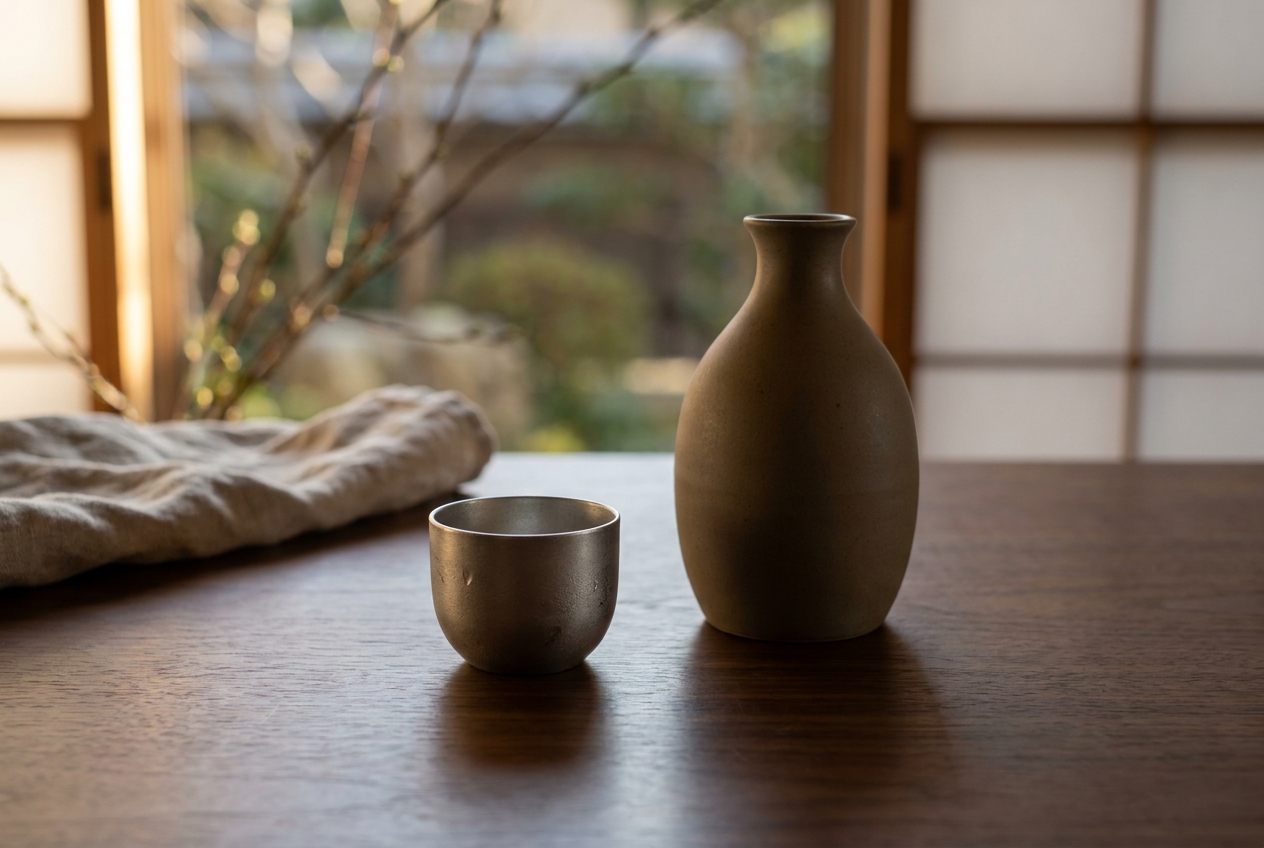
Tin Sake Cups: What the Metal Actually Does (and Who Says It Tastes Better)
A tin sake cup that holds 60 ml costs around $40 to $70, which is five to ten times what a perfectly good porcelain ochoko costs, and almost every page selling one carries the same sentence: tin softens sake. I went looking for where that sentence comes from. It comes from the people who make tin.
That does not make it false. It does mean the claim has never had to survive anyone who had no stake in the answer, and if it is the reason you are about to spend $60, you should know that before you do. Meanwhile there is a second property of tin that is measurable, that the product pages routinely describe backwards, and that actually tells you which tin piece to buy first. It is not the cup.
What a tin sake cup is, and why it bends
Tin is the soft one. On the Mohs scale it sits around 1.5, which puts it below your fingernail, and the makers do not hide this — Nousaku, the Takaoka foundry in Toyama Prefecture that most English-language shops are selling when they say “100% tin”, states plainly that its tinware “is very soft and can be easily bent by hand depending on its shape and thickness.” A whole line of their bowls is sold on that: you are meant to bend them.
This is why two different words show up in listings. Pure tin or 100% tin means what it says. Pewter means tin alloyed with something else to stiffen it — Osaka Tinware, the other well-known Japanese house, mixes in about 3% of a second metal for strength. Both are legitimate; they are just not the same material, and a piece that is merely tin-plated is a third thing entirely, a thin coat over a base metal that will eventually wear through. If a listing will not tell you which of the three it is, that silence is itself information — the same kind we look at in how to read a Japanese listing.
Scale, for the sake of proportion: the Osaka workshop runs 27 people, 16 of them craftsmen on the floor, and a 10 kg ingot of tin becomes roughly 40 tumblers. That is where the price is. It is not a mass-produced object, and nobody is pretending otherwise.
The one claim everyone repeats, and who it comes from
The claim, in its fullest form, is that tin releases ions which neutralise fusel compounds in sake, removing the harsh edge. Follow it back through the English pages and it converges on two places: Japanese tin makers, and the shops that stock them.
Here is Tatsumasa Imai, president of Osaka Tinware and a certified Contemporary Master Craftsman, in an interview: tin “smooths out the sharp edges in the sake’s flavor, making it easier to drink,” and, on the mechanism, “I think it will remove any unpleasant flavors that may be present in the sake.” I think. He is being careful. The retailers quoting him are not.
What makes this worth a section rather than a footnote is that the sources contradict each other on whether it has been tested at all, and they do it in the same breath as the claim:
- One shop’s guide: the effect of tin sake cups “is proved scientifically.” No study is named.
- Another: tin “is believed to soften a sake taste, though not proven scientifically.”
- A third, more honestly: “this is difficult to prove scientifically, but everyone who has tried it swears by it.”
- Nousaku’s own FAQ, which is the most careful of the four: “It has been said that tin enhances the flavor of Sake since the old days in Japan.”
Read those in order and the pattern is hard to miss. The further you get from the foundry, the more certain the language becomes. The manufacturer says it has been said; the reseller says proved. I have not found a published blind tasting, a chemical analysis, or any independent test, and I am not going to tell you the effect is imaginary either — I have no test of my own, and a tradition running since the Nara period is not nothing. What I can tell you is the shape of the evidence, which is: an old belief, repeated by the people who sell the metal, hardening into fact as it travels.
If you want the honest version of what happens when you drink from one, it is this: a metal cup at 8°C against your lip is a strong sensory event, and sensory events change how a drink reads. Whether the tin is doing chemistry or your mouth is doing the work, nobody selling you the cup has demonstrated.
What tin measurably does: it conducts, and that is the opposite of insulating
Here is the part the product pages get backwards. Several of them promise that a tin cup “keeps sake cold for longer.” It cannot. Keeping something cold is insulation, and tin is one of the better conductors in your kitchen: roughly 66 W/(m·K), against about 1.5 for porcelain and about 1.0 for glass. It passes heat through itself something like forty times faster than a ceramic cup does.
And it barely stores any. Run the numbers on an actual piece: a Nousaku guinomi is listed at 110 g and holds about 60 ml. The tin can hold about 25 joules per kelvin; the sake in it holds about 250. The cup is roughly a tenth of the thermal mass of its own contents. It has no capacity to impose a temperature on the drink and no resistance to losing one. Chill it in the fridge beforehand and it will be at the sake’s temperature within a few seconds of pouring, and at the room’s within minutes.
So what are you getting? Contact. Because the metal conducts so fast, the cold of the sake arrives at your fingers and your lower lip immediately and without softening, in a way a thick-walled ceramic cup never delivers. That sensation is real, it is the thing regular buyers describe when they say cold sake is “sublime” in tin, and it is a perfectly good reason to buy one. It is simply not the same claim as keeping the drink cold, and it points at a different purchase.
Which tin piece to buy first — and why it is probably not a cup
Fast conduction is close to useless in a vessel that just sits in your hand. It is the entire point of a vessel you put into hot water. That vessel is the chirori, the lidded tin pitcher used to warm sake in a bath, and it is the one piece in the family where the metal does work you cannot get from pottery: 200 ml of sake comes up to temperature in a couple of minutes, evenly, without ever being put over heat. If you drink atsukan — warmed sake — this changes your evening. If you drink everything chilled, it will sit in a cupboard.
| Piece | Capacity | Typical price | What tin adds |
|---|---|---|---|
| Ochoko | 30–45 ml | $25–40 | Little. Poured for you, emptied in two sips. |
| Guinomi | ~60 ml, ~110 g | $40–70 | Immediate cold at the lip. The one to try first. |
| Katakuchi (pouring bowl) | 200–300 ml | $70–140 | Cold service only; no lid, so it warms in the room. |
| Chirori (pitcher) | 200 ml / 380 ml | $125–210 | Fast, even warming in a water bath. The real case for tin. |
Buy this, not that
If you are curious, buy one guinomi (about 60 ml, $40–70) and nothing else. One cup tells you everything a set of five would, and if the effect does not move you, you are out $50 rather than $250. If you already know you drink warmed sake, skip the cups entirely and buy the chirori ($125–210) — it is the only tin piece whose advantage is measurable rather than debated. And do not buy a tin katakuchi as your first piece: it is the most expensive way to own the least of what tin is good at.
The care rules are strange, and the strangeness is the material talking
Tin comes with a list of restrictions that reads oddly until you know the numbers behind it. These are Nousaku’s own instructions, in their words:
- “Do not put an item over a fire nor use it in microwave as the melting point is low.”
- “Not suitable for use in dishwashing or drying machines.”
- “Wash with a mild detergent using a soft sponge.”
- “Refrain from storing in the refrigerator more than 30 minutes or in the freezer to avoid deterioration of the material.”
- “Excessive bending and changing shapes may lead to cracks and breakage of the item.”
- “Polish with a common metal polisher, tooth paste, or pasty baking soda to restore the shine.”
The flame rule is arithmetic: tin melts at about 232°C, which an empty pan on a burner passes without trying. Treat “never over heat” as absolute, and note that it is the reason the chirori goes into water rather than onto the stove. For what your other Japanese pieces can and cannot take, which Japanese vessels are microwave and dishwasher safe is the reference on this site.
The refrigerator rule is the interesting one, because it is the only care instruction I know of on any Japanese vessel that limits cold. Nousaku says only “to avoid deterioration of the material” and does not explain further. What is documented about the metal itself is that pure tin has a second crystal form below 13.2°C, the change to which makes it crumble and expand by about a quarter in volume; in practice the transformation is extremely slow and wants temperatures far below a fridge for a long time, which is why almost nobody ever sees it. I have not found the maker stating that this is their reason, so I am not going to assert the connection — I am telling you the instruction and the known property, and leaving the join where the evidence leaves it. Either way the instruction is easy to follow: chill the sake, not the cup.
The rest is gentler than it sounds. Tin will dull and grey with use, which polish reverses, and it will take scratches and small dents from a drawer, which it will not. Anyone raised on the idea that a good vessel is one that survives the household unchanged should read that clearly: this metal records everything. Whether that is a flaw or the point is the same argument we have about wabi-sabi and the pieces that change.
When not to buy tin at all
- You wanted an heirloom. A Mohs 1.5 metal in a drawer with other things will not look new in five years. It will look used, and no amount of polish returns a dent.
- You want it for a dinner party of eight. Five tin guinomi is $250 of cups that all need hand-washing while the porcelain goes in the machine.
- You are buying it to fix cheap sake. If the smoothing effect is real, you have bought a vessel that hides what is in it. That is fine for a rough house sake and actively unhelpful when you want to taste what a good bottle is doing.
- You found an antique pewter piece of unknown composition. Old pewter was alloyed to many different recipes, and the listing usually cannot tell you which. If the seller cannot state the metal, treat it as a decorative object and drink from something you can identify.
Reading a tin listing without being talked into anything
Three checks, in order. First, the metal: “100% tin” or a stated alloy, never just “tin finish” or “tin-plated” at this price. Second, the weight: tin is dense, around 7.3 g per cubic centimetre, so a listed weight tells you whether you are buying a solid cup or a thin shell — roughly 110 g for a 60 ml guinomi is the honest number to compare against. Third, the maker and town: Takaoka in Toyama and Osaka’s Naniwa tinware are the two centres with names attached, and a piece with neither a maker nor a town is not necessarily bad, but it is cheaper for a reason.
What you can ignore: gold and silver foil linings, which are decorative and add thirty dollars; the word “traditional” without a town behind it; and any paragraph about ions that does not name a source. On the box itself — tin pieces often arrive in a paulownia box, and what that box means when the piece is a gift is worth knowing before you decide whether it belongs in the price or the recycling.
So: is a tin sake cup worth it?
Yes, if you buy it for the right property. Buy one guinomi and pour cold sake into it, and the thing you will notice within a second is the cold arriving at your mouth with nothing in the way — a real, repeatable effect of a metal that conducts forty times better than the porcelain you own. If you also taste the sake as rounder, enjoy it; just hold the reason loosely, because everyone who has told you why is also selling you the cup.
And if you drink your sake warm, stop reading about cups. The chirori is the piece where this metal earns its price, and it is the only one I would tell a stranger to buy first.
Next to this sit the pieces it shares a table with: Japanese sake sets for the tokkuri-and-ochoko set that most people start from, Japanese pottery styles if you want to know why the ware of a cup is named after a town, and Japanese sizes and terms for what the numbers in any Japanese listing are actually measuring. For keeping the rest of your ceramics alive, how to care for Japanese ceramics.
Disclosure: Nagori Ware is an independent editorial guide written from Japan. Some links elsewhere on the site are affiliate links. Parts of this site are drafted with AI assistance and checked against Japanese sources. General information, not legal or safety advice.