What Size Seiro to Buy: Measure the Pot, Not the People
Buy the basket that fits the pot you already own. That is the decision, and it runs the opposite way from how the size charts read: the pot has to be 1–2 cm smaller in diameter than the seiro, because the rim of the pot is what carries the basket. A pot of the same width gives it nothing to sit on. So before you compare 18, 21 and 24 cm, go and measure the pot.
Every English listing I can find sells the number as a serving size — one person, two people, a family of four. That part is roughly true and completely useless, because the constraint that stops people using a seiro is never appetite. It is that the basket they bought wobbles on every pot in the kitchen.
This is the steaming basket, the kitchen tool. If you arrived looking for the shallow lacquered tray that cold soba is served on, that is a different object with the same name, and it is covered in the guide to zaru, mori and seiro on a soba menu — it steams nothing.
The one measurement that decides the purchase is on a pot, not a basket
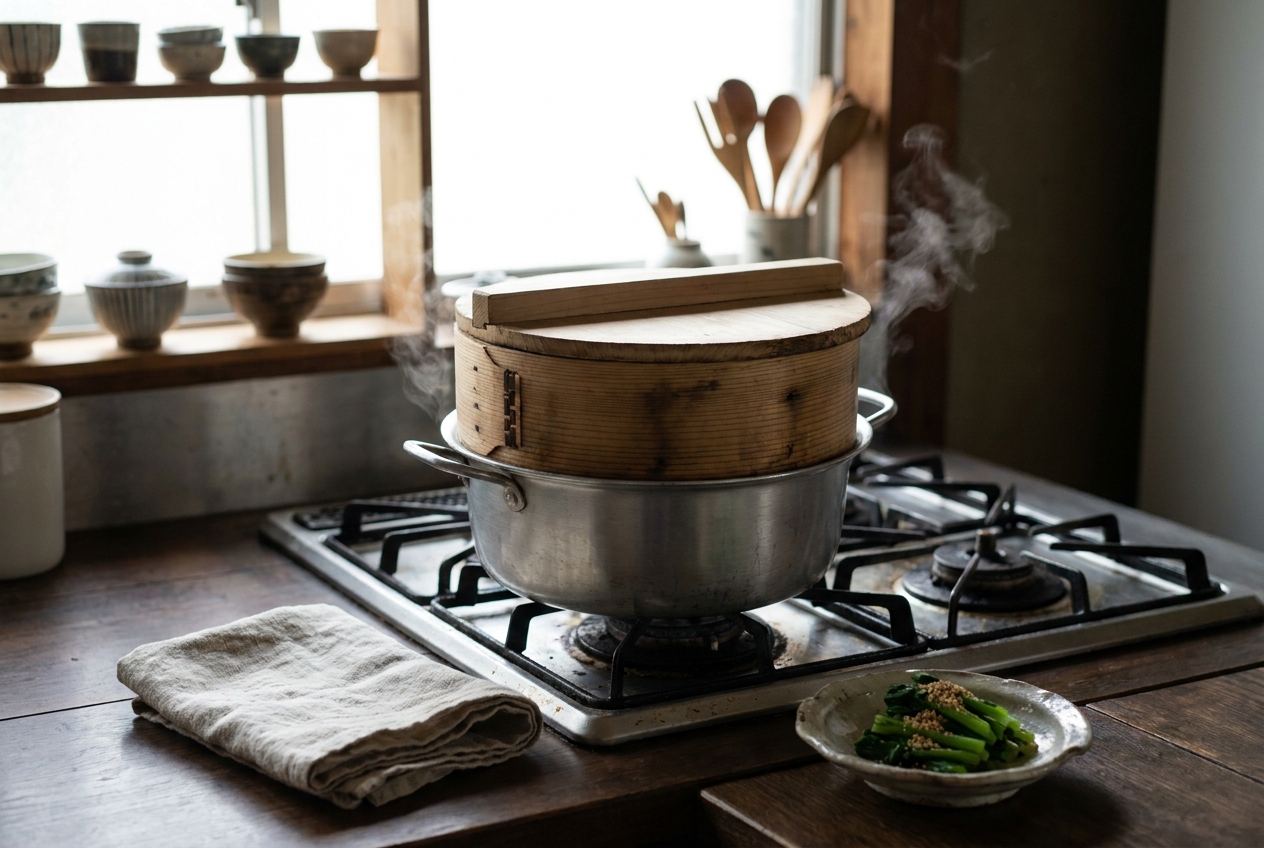
A seiro has no legs, no feet and no handle that hooks over anything. It is an open wooden cylinder with a slatted floor, and it works by being set down on a pot of boiling water so that steam passes up through the slats. The only thing holding it there is the lip of the pot pressing on the underside of the basket wall.
That gives you three cases, and Japanese retailers state the rule plainly even though the English ones do not: a pot 1–2 cm smaller in diameter than the seiro takes the basket directly. A pot the same diameter as the seiro is unstable — the basket rocks, and its bottom edge ends up sitting where the heat is travelling up the outside of the pot. A pot wider than the seiro cannot carry it at all, and that is the case the steaming plate exists for.
Measure the pot across the outside of its rim, not the inside, and not the base. If you own a 20 cm pot, a 21 cm seiro is the natural match and a 24 cm one is not. If your only deep pot is a 24 cm stockpot, you are shopping for a plate as well as a basket. This is also why a wok turns up so often in photographs of steaming: its sloping wall means there is always some diameter at which a basket sits down and stops moving.
Seiro sizes: what each one is really a list of
Read the table below as pots. The serving figures are the ones Japanese kitchenware shops give — 18–21 cm in a single tier is reckoned at about one person’s food, and 24 cm and up is where a household of three or four starts — but they move a lot depending on whether you are steaming a plate of dumplings or a fillet of fish with vegetables around it.
| Seiro (outer) | Pot that takes it directly | Single tier holds | Typical use |
|---|---|---|---|
| 18 cm | 16–17 cm | One person | Side dishes, a few dumplings, reheating rice |
| 21 cm | 19–20 cm | One to two people | The common first size; buns, vegetables, fish |
| 24 cm | 22–23 cm | Three to four people | A main dish; a whole plate can go inside |
| 27 cm+ | 25–26 cm | Larger households | A whole fish, steamed rice in quantity |
One more number that catches people out: the outer and inner diameters are not the same, and shops quote both. A 21 cm basket is listed by some makers as 21.5 cm outside and 17.5 cm inside. The outside figure is the one that has to clear your pot; the inside figure is the one that has to hold your plate. If you intend to steam on a dish rather than directly on the slats — which you should for anything oily, fishy or saucy — check that a small plate you own actually fits within the inner figure.
The steaming plate, and why so many people end up buying one
A steaming plate — mushi‑ita, sold in English as a steamer ring or steam plate — is a flat metal disc with a hole in the middle. It goes on the pot, and the basket goes on it. It solves the case where your pot is wider than the basket, which is the usual situation in a kitchen that was not assembled around a seiro.
The sizing is quoted against the basket, not the pot. A 20 cm plate is sold as suiting baskets of roughly 10–18 cm; a 24 cm plate covers roughly 10–21 cm. The plate’s own outer diameter runs about 2 cm larger than its name — a 20 cm plate measures around 22 cm across — so with a plate in play the pot needs to be bigger than the basket, the reverse of the direct-fit rule. It also holds more water underneath, which matters more than it sounds like it should, because the failure mode of a long steam is the pot running dry.
The third route is a dantsuki pot — a pot with a ledge cast into the inside wall for the basket to sit on. Sold as a set with a matched seiro, it removes the fitting problem entirely and costs the most. If you are buying your first seiro and do not already own a pot within 1–2 cm, a set is the honest answer even though it is the expensive one.
Buy this, not that
Buy the 21 cm basket, and buy the steaming plate with it unless you have physically measured a pot at 19–20 cm. Do not buy an 18 cm basket to save money — it is a genuinely one-person object, and the gap in price between 18 and 21 cm is small. Do not buy the two-tier set as a beginner either, if you only own one pot: two tiers of food need a longer steam and more water beneath than a first pot usually holds, and the top tier is the one you will forget to check.
Wa‑seiro and chuka‑seiro are two tools, not two nationalities
English shops call both of them a bamboo steamer. They are built differently, and the difference is in two places: the lid and the floor.
The Japanese basket, wa‑seiro, has a thick flat wooden lid that seals and a slatted floor — the sunoko — that lifts out. The sealed lid keeps the steam in, so it cooks faster and harder; the removable floor means the basket washes flat and dries properly. It is also deeper, which is the practical reason it is the one used for things standing upright inside a container: savoury custard cups, rice with the grain still whole.
The Chinese basket, chuka‑seiro, has a woven bamboo lid and a floor fixed into the frame. The woven lid lets steam escape, and Japanese retailers give that as the reason condensation is less likely to drip back onto the food. The fixed floor is what allows the tiers to stack. That is the shape you have seen: two or three shallow rounds on a single pot, dim sum in each.
Neither is better and both fail in a particular way. A sealed lid means water collects underneath it and can fall on whatever is directly below; a vented lid means heat leaves, so a long steam takes longer. If you are steaming buns and dumplings, take the woven lid. If you are steaming a custard or a bowl of rice, take the sealed one and keep a cloth under the lid if drips are a problem.
Cedar, bamboo, hinoki: what the price is actually buying
Three materials, and the ranking by price is not the ranking by usefulness.
- Sugi (Japanese cedar) — light, inexpensive, and the one with a noticeable scent when it heats. Cedar absorbs moisture readily, which is the property sellers point to for rice and for keeping condensation off food.
- Bamboo — the cheapest and the most forgiving as a first purchase. Little aroma, good durability, and readily available. It absorbs less water than the woods, which is why bamboo baskets are the ones most often described as dripping.
- Hinoki (Japanese cypress) — thick-walled, the longest-lived, and the most expensive. The rim has more meat in it, which is the part that takes the abuse of being set down on a hot pot over and over.
For prices: two-tier cedar and bamboo sets from Japanese makers sell in the range of about $85 at 18 cm, $100 at 21 cm and $115 at 24 cm, and kits that come with a matched pot and a steam ring cost more again. Hinoki sits above that. A plain single-tier bamboo basket can be found for a great deal less, and for a first basket that is a reasonable thing to do — find out whether you steam before you buy cypress.
The same logic runs through everything wooden on a Japanese table, and it is always the same question: where does the water go? A rice tub absorbs it out of cooked rice; a sushi tub wipes it off the grain; a wooden bento box soaks it up so a lunch does not sweat. A seiro is the one case where the answer is that water is the whole point of the tool, which is exactly why it is the hardest of them to keep.
The first five minutes, and the thing that actually kills a seiro
Wet the whole basket under running water before every use, not just the first. A dry basket scorches where it meets the pot and takes on the smell of whatever is inside it; a wet one does neither. This is the single instruction that separates baskets that last a decade from baskets that go dark and warped in a season.
Afterwards: hot water and a stiff brush, no detergent or very little. Then dry it properly, and properly means with air on all sides. Japanese makers recommend standing it at an angle in a ventilated spot and turning it over occasionally so both faces get air, out of direct sun — sun dries it too fast and the wood shrinks and splits. Then the part everyone gets wrong: never store it in a plastic bag or a sealed box. Japanese retailers warn that sealing a seiro away invites not only mould but warping and insects. A paper bag or an open shelf is what it wants.
Rough steaming times, for calibration rather than as a recipe: root vegetables such as potato or pumpkin around 10 minutes, broccoli around 8, a normal slice of fish 5–10, and something you want thoroughly cooked through about 20. Times vary with thickness and with how hard your water is boiling. For anything where doneness matters for safety — poultry, pork, shellfish, eggs — go by the food safety guidance where you live and by the instructions that came with the basket, not by a table in an article. The same goes for the maker’s own rules on heat and first use, which vary by workshop and always win over general advice.
Nothing here is dishwasher or microwave territory, in case that needs saying. If you want the general rules for what survives which machine, they are in the microwave and dishwasher guide, and the ceramics you put inside the basket are covered in how to care for Japanese ceramics.
Should you buy one at all?
A collapsible metal steamer insert costs a fraction of this, fits almost any pot, goes in the dishwasher and cannot grow mould. If what you want is cooked vegetables, buy that. Nothing in a wooden basket makes broccoli more cooked.
What the wood does is take the condensation out of play and let you put the basket on the table, and those two are the real arguments. Steam that condenses on a metal lid falls straight back down as water; a wooden lid holds some of it and a woven one lets it out. And a seiro goes from the pot to the table as the serving vessel, which is most of the reason it has become fashionable again in Japan — single-serving meals arranged in one basket photograph well and need no plating. If you have ever cooked in a donabe and carried it straight to the table, it is the same trade: a vessel that is also the dish.
Do not buy one if you will not dry it. That is not a tidiness point. A basket that gets put away damp is a basket you will be throwing out, and everything else in this article — the sizes, the plate, the cedar versus the cypress — stops mattering at that point.
Before you order
Three things to settle, in this order. Measure the outside of the rim of the pot you will use, and subtract one to two centimetres to get the basket size. Decide whether you need a steaming plate — you do, if the pot is wider than the basket. Then, and only then, choose between the sealed wooden lid and the woven one, based on whether you are cooking dumplings or custard.
If you are filling out a Japanese kitchen more broadly, the pieces that sit closest to this one are the donabe, the drop lid that keeps a simmer from tossing the food about, and the long cooking chopsticks you will want for lifting things out of a hot basket. And if a listing is giving you dimensions you cannot interpret, Japanese sizes and terms and how to read a Japanese listing are the two references on this site for exactly that problem.
Disclosure: Nagori Ware is an independent editorial guide written from Japan. Some links elsewhere on the site are affiliate links. Parts of this site are drafted with AI assistance and checked against Japanese sources. General information, not legal or safety advice.