Chataku: How to Buy a Japanese Tea Saucer for Cups You Already Own
Japanese offices still teach tea service as a procedure, and the first instruction in it surprises people: do not put the cups on the saucers. Carry both on the tray, cups standing in a row and saucers stacked beside them. Set the tray down on a side table. Then lift each cup onto its saucer, and only then does the pair go in front of the guest. A European saucer arrives under its cup on the day you buy the set and stays there for twenty years. A chataku (茶托) spends almost its entire life separated from any cup at all.
Every confusing thing about buying one comes out of that separation. The shop sells you five bare discs and no teacups. The listing gives a diameter, which is a number about the saucer and not about the fit. And the price runs from a few dollars for a moulded disc to ¥41,030 for a boxed set of five in tin — for an object that, as we will see, has no mechanical job left to do.
Here is what actually decides the purchase: the width of a foot ring you have never measured, and a word on the label that English listings tend to drop.
What a chataku is, and what it stopped doing
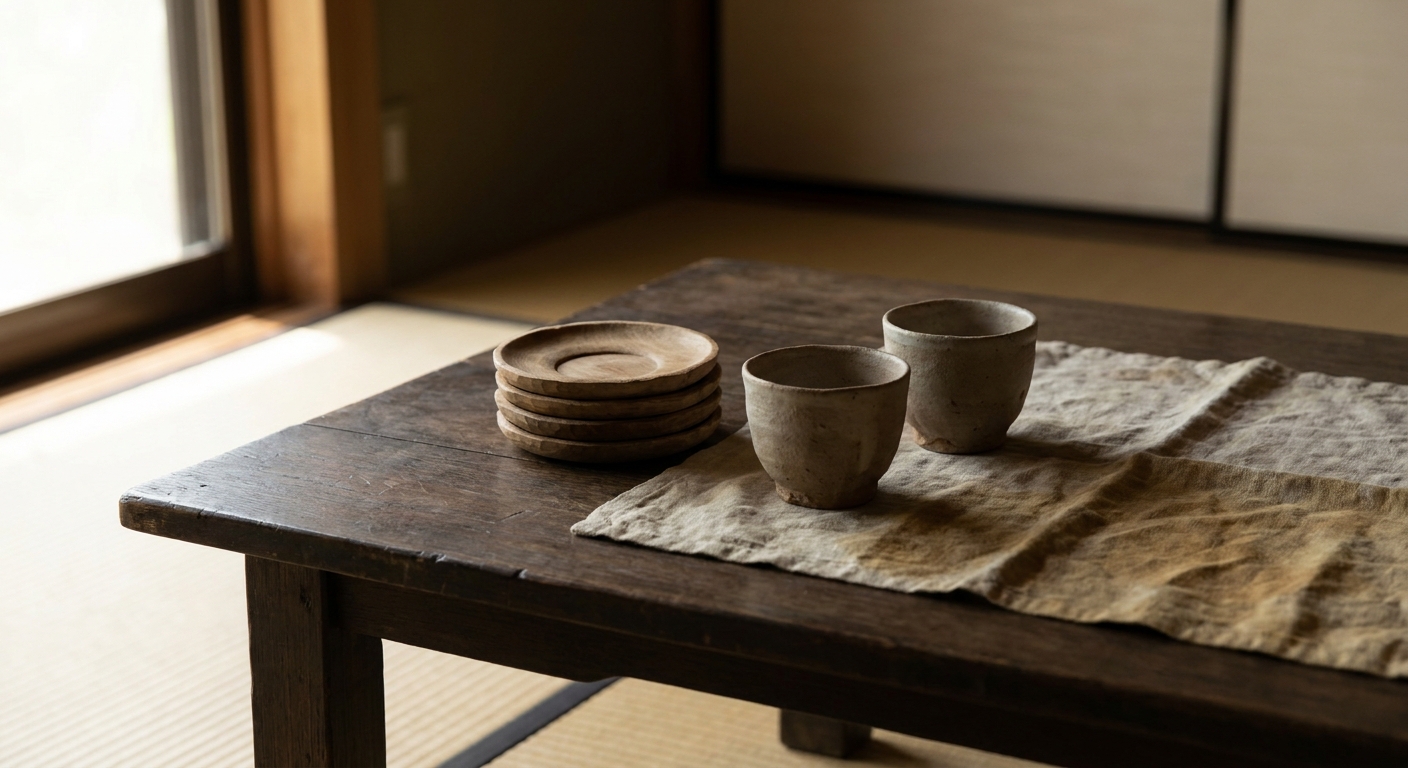
A chataku is the small saucer set under a teacup when you are serving someone else. It is guest equipment. Nobody in Japan puts one under their own morning cup. It is also specifically for steeped tea: the shops that sell chataku say plainly that they come out for sencha and gyokuro and not for matcha, which is drunk from a bowl that goes straight onto the table.
Its ancestor had a real load to carry. Porcelain teabowls that came over from China conduct heat quickly and have little to grip, so they were served on a stand — the tenmokudai — because the bowl itself was too hot to hold. As steeped tea spread through Japan in the Edo period, that stand shrank and flattened into the chataku. A second line runs in parallel: from the mid-Edo period Japanese buyers were importing cups and cup-stands from Qing China, and in Japanese practice the imported cup was pressed into service as a teabowl while its stand became a chataku. Most of those imported stands were tin, which is the reason the sencha world still ranks tin saucers at the top — a piece of taste we will come back to, because it runs backwards from what most people expect.
Then the job went away. A Japanese teacup has a foot ring, the kodai — the ring of clay it stands on — and that ring is what holds the hot base off the table and off your fingertips. The foot ring took the stand’s work three hundred years ago and never gave it back. Put a full yunomi on a bare wooden table and nothing bad happens. The chataku is not preventing it.
What it does now is smaller and not nothing. It catches the drip that runs down the outside of a cup poured a moment ago, and gives a wet foot ring somewhere to stand that is not somebody’s table. It gives you something to hold, so your hands never touch the cup a guest is about to drink from. And it announces that the tea was offered rather than merely put there.
That matters for buying, because an object with no load to carry is sold entirely on appearance. The photograph does all the work, the specification is one number, and the two facts you need — how wide the usable centre is, and what the thing is actually made of — are treated as details.
Four sun, and the second diameter nobody prints
The default size is 12 cm across. In the old units that is four sun, the traditional 3.03 cm module, and Japanese shops sell chataku by that number, in size categories rather than by centimetre. If your cups have lids — the deeper futatsuki yunomi used for more formal service — go up to 13.5 cm, four sun five bu, because a lid widens the cup at the top and has to be set down somewhere when the guest drinks.
The rule of thumb every Japanese tableware shop repeats is about the look: set the cup down and you want roughly one index finger’s width of saucer showing on each side. An everyday yunomi in the usual 150–220 ml range measures something like 7–8 cm at the rim, so a 12 cm saucer leaves about the right margin. That rule is sound and it is also incomplete, because the rim is not what touches.
What touches is the foot ring, and it has to land on the flat centre of the saucer. Most chataku are not flat discs — they have a raised outer rim and a recessed field inside it, and the field is considerably smaller than the headline number. One seller lists a wooden chataku as 9 cm across and states the inner cup area as 4.5 cm: exactly half. A cup whose foot ring is wider than the field rides up on the rise and rocks, which you will discover the first time a guest sets it down one-handed.
No shop publishes foot-ring diameters. Neither do we, because they vary too much to be worth guessing at. Turn one of your cups over and measure the ring it stands on. It takes ten seconds and it is the only measurement in this article that has to be true of your particular cupboard.
Height is the quieter half of the same problem. Japanese shops pair a tall cup with a deeper saucer and a low cup with a shallow one, and real chataku heights run 1.5–2.3 cm. A tall cup on a shallow disc looks precarious because it is; a short cup sunk into a deep one looks borrowed.
Shape is the one place you can safely follow your eye. Round, oval, the lobed mokkō outline, and a boat shape are all traditional. Sencha practice rates round above oval, which is worth knowing mostly because a lot of the oval ones on the secondhand market are priced as if that preference did not exist.
Buy this, not that
Measure the foot ring of the cups you already own before you shop, then buy 12 cm as the default — 13.5 cm if the cups have lids. Skip any listing that gives one diameter and no photograph of the top surface at an angle: you cannot see the rise from a flat overhead shot, and the rise is what decides whether the cup sits or rocks. If you are choosing between two and the cups are tall, take the deeper one.
Why it travels empty
Back to the procedure, because it explains the object. Three things are going on when the saucers ride next to the cups instead of under them.
- A cup poured thirty seconds ago is wet around the foot, and a wet glazed ring on a lacquered surface has almost no friction. On a tray that is moving, a cup on a chataku is a cup looking for the floor.
- The saucer is the handle. You lift and place the pair by the saucer, so your fingers stay off the cup and off the rim.
- Assembling at the last moment means the two were never a matched pair to begin with — which is precisely why the shop does not sell them to you together.
There is a buying consequence hiding in the first of those. The top of a chataku is a working surface, not just a face. A high-gloss saucer with a dead-flat field is the worst version of it. The good ones give the foot something to bite: a recessed field, concentric turning grooves left from the lathe, the carved relief of Kamakura-bori, the woven texture of cherry-bark kabazaiku from Akita. Those are usually sold as decoration. They are also doing a job.
The placement conventions are quick and worth knowing if you will use these with Japanese guests. Wood grain runs across, parallel to the guest’s edge of the table, not pointing at them. If the cup carries a picture, that side turns to face them. Tea goes at the guest’s right hand, a sweet at their left. And colour carries meaning: black and dark tones are the funeral and memorial register, vermilion and red are celebratory. If you will own exactly one set and it may see both kinds of day, plain wood or a mid-brown stays out of the argument.
Wood, lacquer, tin — and a ranking that runs backwards
Chataku are made in more materials than almost anything else on the Japanese table: plain wood, lacquered wood, bamboo, porcelain, stainless steel, copper, brass, pewter, tin, and moulded resin. Wood is the common case, often jujube or zelkova, and bamboo is a summer preference in shops the way heavier wood is a winter one.
The material question that actually costs people money is wood versus resin, because the trade grade that fills Japanese reception rooms is moulded plastic with a printed grain, and it photographs identically. Japan handles this with a labelling law: anything made for eating or serving and coated in urushi or one of its substitutes must state its base material and its coating — natural wood or synthetic resin, urushi or urethane or cashew. A Japanese box tells you. An English listing frequently compresses all of it into the word “wooden.” We have written the full decoder for those two lines in the guide to reading a lacquerware label; for a chataku specifically, the field test is that a solid wooden one floats and a resin-bodied one sinks, and that wood answers a fingernail with a dull sound where resin gives a hard click.
Then there is tin, and this is where the traditional hierarchy stops agreeing with Western instinct. Because the Chinese stands that became chataku were tin, sencha practice has ranked tin saucers highest ever since — and within tin, a saucer that has darkened with age is held to be worth more than a bright one. Patina is not wear here; it is the point of the material, the same logic we traced through tin drinking vessels and through the wabi-sabi way of buying. Nothing about a tin chataku makes the tea better. You are buying a two-hundred-year-old preference, knowingly.
What the money is buying
Prices below are ones we checked on live listings in September 2026; the point is the shape of the ladder rather than any single figure.
| What it is | Size as listed | Price |
|---|---|---|
| Moulded resin, printed wood grain — the commercial trade grade | 12 cm | a few dollars each; sold by the dozen |
| Solid wood, plain or lacquered, made in Japan | 11.9 × 11.9 × 1.9 cm, about 60 g | ¥1,980 each |
| Small turned wooden saucer with a stated 4.5 cm inner field | 9 cm × 1.5 cm, 21 g | about $7 each |
| Craft wood — carved Kamakura-bori, cherry-bark kabazaiku | 12.1 cm × 2 cm | about $16–36 each |
| Tin, boxed set of five, Osaka | 10.0 × 7.4 × 2.3 cm, oval | ¥41,030 the set, in a wooden box |
The jump from the third row to the last is roughly fifty-fold for an object of the same size doing the same amount of nothing. That is not a scandal — it is what happens when function leaves a piece and only meaning is left to price. It does mean the middle of that ladder is where most people should stand: solid Japanese wood, five of them, somewhere between $60 and $120 for the set.
Three households, three different answers
You have people over a few times a year. Buy one set of five in solid wood at 12 cm and stop thinking about it. Plain, mid-brown, a recessed field, no lacquer you would be anxious about. This is the whole decision, and it will outlast the cups.
You drink tea alone every morning. You do not need one, and a chataku under your own cup is fancy dress. The foot ring on your yunomi is already doing the thermal work. If you want something between cup and desk, that object is a coaster and it costs a fraction as much. Spend the difference on a better kyusu, which will change your tea more than any saucer can.
You are buying a gift. This is the piece’s natural home. A chataku is one of the few things in a Japanese kitchen that almost nobody buys for themselves, which makes it a genuinely useful thing to receive. Buy five rather than four — the counting matters, and we explain why here — and if you have ever seen the recipient’s teacups, measure them first. Sets in Japanese tea sets often skip the saucers entirely, so a set of five chataku completes something they already own rather than duplicating it.
Almost everything else on a Japanese table earns its place by doing something — the donabe holds heat, the kyusu holds back leaf, the foot ring holds the burn off your fingers. The chataku is the exception. Its work was taken over centuries ago and it stayed on anyway, because the gesture turned out to be worth more than the function. Which is fine, and also means there is no performance to research. Turn a cup over, measure the ring it stands on, and buy the saucer that fits it.
Related guides
- Yunomi: the everyday Japanese teacup — the everyday cup a chataku is usually sized to, and what the foot ring does
- How to choose a Japanese tea set — what a guest set contains, and why the count is five
- Japanese lacquerware (urushi) — reading the two label lines that separate $18 from $180
- Tin sake cups — what tin actually does, and why a darkened surface is wanted
- Japanese tableware sizes and terms — sun, bu and the other units Japanese listings use
Disclosure: Nagori Ware is an independent editorial guide written from Japan. Some links elsewhere on the site are affiliate links. Parts of this site are drafted with AI assistance and checked against Japanese sources. General information, not legal or safety advice.