Sushi Making Kit as a Gift: Which Pieces a Beginner Actually Uses, and What the Box Leaves Out
A sushi making kit is a good gift for someone who has never made sushi, and three pieces in it do almost all the work: a bamboo mat, a rice paddle, and something wide and shallow to cool the rice in. The mat and paddle come in the boxes I checked. The mat is listed at 24 cm, which is a little short, and the cooling tub is usually missing. Everything else, the bazooka, the molds, the avocado slicer, gets played with once. A 27-piece kit is not a better gift than a 9-piece one, and neither includes the rice or the nori.
The question arrives in a very particular form. He loves sushi, he has never made it, it is for Christmas, and the kit with 27 pieces looks like the generous choice. In the Amazon reviews of one popular 27-in-1 kit (I read the ones that mention “gift” on 15 November 2026), buyers describe exactly that: a present for a partner who likes sushi and has not made it, a birthday request from a sister, a purchase for two daughters aged seven and ten. One buyer says the bazooka lets them make rolls they could not manage by hand. Nobody is wrong to buy it. The useful question is what, in the box, the person will still be using in February.
How this was put together. I have not used any of these kits and will not pretend to. I read the sellers’ own listings for what is inside and how big the mat is, Just One Cookbook’s kit roundup (February 2024), a tester’s account in Food & Wine, a review at Bite My Bun, and the Amazon reviews above. Prices come from the Just One Cookbook roundup unless I say otherwise, so they are from February 2024 and will have moved. None of the links on this page earn us anything. This guide is about tools: what goes inside the roll, and how raw fish is handled, is outside it, so follow your local food-safety authority for that.
What a “27-piece kit” actually holds
It depends on the listing, and the listings disagree. One 27-piece kit is described as a bazooka, a roller, a mat and a mold. A 27-in-1 from the same family adds nigiri and musubi molds. A different 27-in-1 “parent-child” kit lists bamboo mats, a bazooka, an onigiri mold, a rice paddle, a knife and a guide book. Chopsticks are the easiest way to pad a count: the Wayfair and Wonena kits I looked at list five pairs.
Two things hold across the ones I checked. Roundups note that most kits are tools only, so rice, nori and fillings are extra. And the tools that matter are the oldest-looking ones in the box. The figure below is how I would sort a typical box. It is my judgement from the sources above, not a test.
The mat does the work, and the one in the box is small
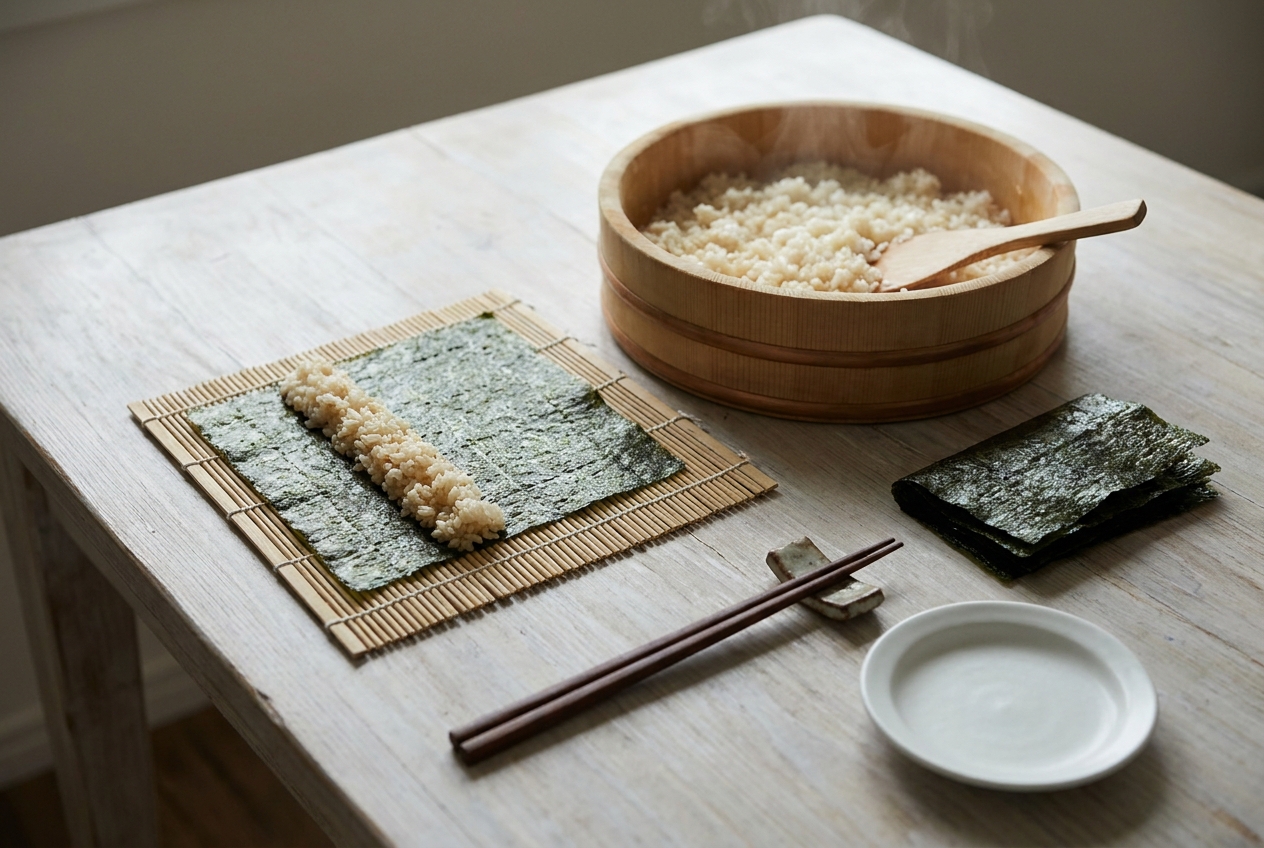
A full sheet of nori in Japan is 21 cm by 19 cm. That has been the standard since the 1960s, and Japan’s agriculture ministry gives the same figure. You lay it on the near edge of the mat with the 21 cm side running left to right, and you roll away from yourself. So the mat has to be wider than 21 cm and deeper than 19 cm, and whatever is left at the back is the only bamboo you have to lift and tighten with.
The kit listings I read give the mat as 9.5 inches, which is 24 cm: Sur La Table, Joyce Chen, Zen Cuisine, and the Wayfair and Wonena kits among them. Run it against the nori and you get this.
Five centimetres is enough for a thin roll or a half sheet. It runs out on a roll packed the way a first roll always is. Our makisu guide goes through the arithmetic, including why the depth matters more than the width. The fix is cheap: a plain 27 cm bamboo mat costs about $2–8 and sits in the box beside the kit’s one. Wrap whichever you use in plastic wrap before layering, as Bite My Bun advises. Just One Cookbook adds that a thick towel or a placemat will do in a pinch.
If the person does not want a mat at all, a hand roll (temaki) needs none: Japanese recipe sites treat it as a cone of nori, rice and filling rolled in the hand, with the sheet cut in half or in quarters. It is the better first night, because nobody has to make a roll hold its shape.
The bazooka: training wheels, not a technique
The plastic tube you fill with rice is the piece buyers mention most. Food & Wine tested the bazooka in 2023 and its verdict was “sort of.” It made a perfectly formed roll with julienned carrot, but a chef’s roll from a bamboo mat was better-looking and better-tasting, and the bazooka’s was less tight and harder to cut. The chef called it “like chopstick training wheels.” It cost $7. Bite My Bun is blunter about the build of one kit’s bazooka: flimsy plastic that will not last many years.
Just One Cookbook says it would rather use a basic kit with traditional tools. I agree for an adult who wants to learn. For a child, or for someone nervous enough that the mat would put them off, the bazooka is a reasonable way to get a first roll on the plate. Give it as an extra. Do not choose a kit because it has one.
What the box leaves out: a tub, rice, nori
Sushi rice has to be seasoned and cooled quickly, spread thin. The wooden tub that does it is a hangiri, and it is a cooling device, not a bowl. The size that matters is how deep the rice sits: the Kiso cooper whose chart our hangiri guide uses rates a 30 cm tub for 3 gō of rice at a depth of 26 mm. The same rice in a 24 cm tub sits about 43 mm deep and steams itself from the middle. Nami Chen of Just One Cookbook uses a 10-inch tub for two or three people and says to fill it no more than about a quarter of the way up the side, and that if a kit lacks a hangiri you should buy one separately. A glass or metal bowl does the job less well, because the wood is what draws the water out instead of letting it condense back.
Two of the five kits she lists come with a hangiri: the JapanBargain kit ($26.99 in February 2024; three paddles, three mats, one tub) and the BambooMN kit ($34.95; tub, two mats, two paddles and serving extras). The Delamu 20-piece with a bazooka and molds ($22.78) and the 9-piece ($9.99) do not. Check the mat size on those two, since I could not confirm it.
The paddle in a kit is small: the Sur La Table and Zen Cuisine listings give 8 inches (20 cm), and buyers of one kit call the paddles very small but fine. Do not pay extra for one at first. If it becomes a daily tool, our shamoji guide explains why a wooden one outlasts a plastic one with dots on it. If the box has a bar-shaped press, the cut count is a length, not a number of servings, as our oshizushi mold guide shows.
Buy this, not that
Buy a kit that has a mat, a paddle and a spreader ($10–25), and add a 27 cm mat for $2–8 if the kit’s is 24 cm. If you want to spend about $30, take the kit with a hangiri over the one with more molds. Do not pay extra for a bazooka, and do not choose by piece count. For someone who would rather eat sushi than make it, buy neither: book a sushi counter or give a good plate from our sushi plates guide instead.
Three budgets, and what each buys
| Spend | What you get | For whom |
|---|---|---|
| About $10 | A basic kit: two mats, rice spreader, paddle, five pairs of chopsticks (Delamu 9-piece, $9.99 in Feb 2024) | Someone curious. Add nori and rice. |
| About $23 | A 20-piece with bazooka, molds and a knife (Delamu 20-in-1, $22.78 in Feb 2024); no tub | Children, or a nervous first roll |
| $27–35 | A kit with a hangiri (JapanBargain $26.99, BambooMN $34.95 in Feb 2024) | An adult who will make rice for two or three |
| Build it | A 27 cm mat ($2–8), a wooden paddle, a 27–30 cm hangiri | Someone who already cooks |
Put nori in the box with it, full sheets, and a bag of short-grain rice, because the kit will not. If it is a Christmas gift, the rest of the table is easy to add from our Japanese tableware and tea gift guide, and a chopsticks guide covers the pair of chopsticks for eating. Giving it to someone who loves ramen? Our ramen lover guide has the bowl.
Questions people ask before buying
Is a 27-piece kit better than a 9-piece one?
Not for the three pieces that matter. The extra pieces are molds, a bazooka and gadgets. A bigger box is better for a child and no better for a beginner who wants to roll properly.
Do these kits include rice and nori?
Most roundups say they do not. One in the Just One Cookbook list, the Global Grub kit at $35.99, comes with shelf-stable ingredients. Read the listing.
Can a beginner skip the mat?
Yes, for hand rolls. For rolled maki a thick towel or a placemat will do, but a $2 mat is simpler.
Disclosure: Nagori Ware is an independent editorial guide written from Japan. Some links elsewhere on the site are affiliate links. Parts of this site are drafted with AI assistance and checked against Japanese sources. General information, not legal or safety advice.