Oshizushi Mold Size: Why 8 Cuts Is Not 8 Servings
A pressed-sushi mold is sold to you as a size — eight cuts, five cuts, 8.5 inches — and none of those numbers mean what a buyer assumes. The cut count is not a serving count. The length is the least important dimension on the listing. And the shape you are almost certainly about to buy makes one specific Osaka dish while quietly ruling out the famous one.
So the decision is not what size. It is which dish. In Japan that is not a metaphor: the mold is what gives the sushi its name.
The number of cuts is a length, not a portion
Line up the specifications and the pattern is immediate. A five-cut bar mold listed by one professional supplier measures 172 × 44 mm inside. Yamaichi’s eight-cut hinoki mold, made in Nakatsugawa in Gifu, is 240 × 70 mm inside and 40 mm deep. A Kiso-wood eight-cut mold from a Nagano workshop is 240 × 60 × 42 mm. Trade presses for nigiri come in three lengths — 240, 267 and 290 mm — all of them 48 mm wide, all cut ten ways.
Divide each one by its cut count and you get 34, 30, 30, 24, 27 and 29 mm. Six molds from different makers in different woods at prices from about ¥1,000 to ¥8,600, and the slice is always somewhere between a fraction over two centimetres and a fraction under three and a half. That is not a coincidence, and it is not a standard anyone publishes. It is the width of a mouthful, and the grooves are cut to it.
Which means the eight on the box is telling you how many, not how big. Yamaichi rates its eight-cut mold at about 500 g of cooked rice — one and a half gō — which divides out to roughly 60 g of rice a slice. The rice in a hand-formed nigiri is usually put at 15 to 20 g. So one slice of pressed sushi is three or four nigiri of rice standing in a block, and eight of them is a platter for two or three people, not eight servings. If you have been sizing a mold by headcount, that is the error.
Width is the piece. Length is only the batch.
Cut across a bar mold and the face of the slice is the mold’s width by the depth of the packed rice. Length contributes nothing to it. So the dimension that decides what your sushi looks like on the plate, and what topping will sit on it, is the one nobody leads with.
At 44 mm you are making a narrow baton. One strip of fish covers it, the slice is taller than it is wide, and it reads as a single elegant bite. At 70 mm the slice is wider than it is tall — a squat rectangle that takes a fillet laid flat and gets cut crosswise into something closer to a small terrine. The 48 mm trade presses sit deliberately between: that is a mold for putting a topping on a rice base the size of a nigiri, which is exactly what it is for.
The practical version: measure the fish before you measure the box. A fillet of vinegar-cured mackerel is what most people buy one of these for, and a half-fillet trimmed square runs roughly 5 to 7 cm across at the shoulder. In a 44 mm mold you are trimming that down and losing the good part. In a 70 mm mold it lies flat. That single check settles more than any comparison of cut counts does.
If you are buying from a Japanese listing, note that the numbers you want are the inside ones. The five-cut mold above is 172 × 44 mm inside and 207 × 73 mm outside — the walls take 15 mm off the width. Japanese listings usually give both, labelled naisun and gaisun; English listings usually give one number and do not say which. It is the same problem we set out in our guide to reading a Japanese tableware listing, and the same rule applies: if it is silent on the specifics, ask.
In Japan, the mold names the dish
This is the part the product pages leave out entirely. Yoshino Sushi, an Osaka house trading since 1841, puts it plainly on its own page: within pressed sushi, the name changes according to the size and shape of the mold used — bōzushi, kosodezushi, battera, matsumaezushi, hakozushi. The mold is not equipment sitting outside the dish. It is the specification.
A couple of those names you will meet on menus. Battera is mackerel under a sheet of vinegared white kombu; Osaka’s tourism board gives the name as the Portuguese word for a small boat, after the shape. Hakozushi — box sushi — is the grand one, and Yoshino Sushi’s own account is that their third-generation owner, Torazō, devised it in the Meiji era, trading up from the everyday mackerel and horse-mackerel pressed sushi of the day to sea bream, prawn and conger eel. The Ministry of Agriculture’s regional-cuisine record uses the phrase Osaka applies to it: ni-sun rokubu no kaiseki, a kaiseki two sun six bu across — about 79 mm, in the old measure we unpack in our glossary of Japanese sizes and terms.
Seventy-nine millimetres square. Not 240 by 60. A different object entirely, and the reason matters.
The dish your mold cannot make
The ministry’s description of how hakozushi is built is one sentence and it is the whole constraint: pack sushi rice into the wooden frame, layer omelette and prepared fillings on top, lid it, press hard. Layer. Rice, then fillings, then more rice, then the topping. Look up the boxes Japanese trade suppliers sell for the job and they are 182, 212 or 243 mm square and 75 mm deep, at ¥14,500 to ¥18,500.
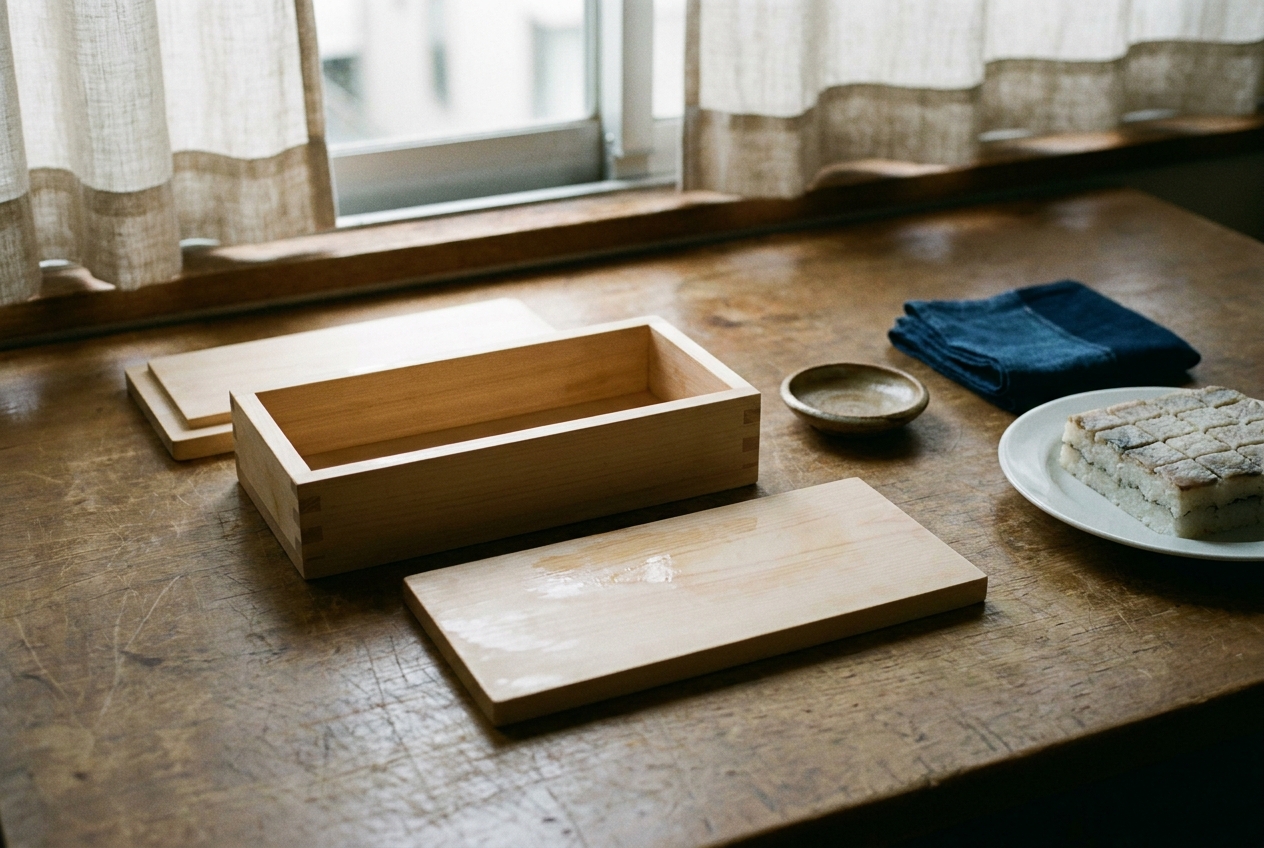
A bar mold is 40 mm deep. There is no arrangement of rice and omelette and simmered shiitake that fits four layers into 40 mm and still cuts cleanly. The mold you can buy in English is not a cheap hakozushi box; it is a competent bōzushi and battera mold, and those are good dishes. But if you came here having eaten hakozushi in Osaka and wanting to make it, the 8.5-inch pine box on Amazon will not get you there, and no amount of technique closes the gap.
Wood or plastic, and why yours will stick
The wooden molds are unfinished softwood — hinoki cypress usually, pine in the cheaper imports, Kiso wood in the Nagano ones. Plastic versions exist, cost a fraction, wash with detergent, and are textured to release the rice.
Every wooden mold ships with the same instruction and it is the one buyers outside Japan skip. Yamaichi: soak it in water before use, then wipe the surface moisture off with a cloth. The Nagano workshop’s English card says the same thing in five words — wet and wipe it lightly before use. Skip that step and the first layer of grains cements itself to dry, thirsty wood, and you will conclude the mold is badly made. It is not. We went through the mechanism in detail for the rice paddle, where the same thin film of water is the entire non-stick, and for the hangiri, where makers disagree about the first soak but agree about the wipe before every use. Follow the card that came with yours.
The trade-off worth knowing before you choose hinoki: the scent is not free. Our rice container guide explains why sawara, not hinoki, is the wood chosen for vessels that hold seasoned rice — it smells less. Pressed sushi puts oily cured fish in direct contact with bare cypress for as long as it sits under the weight. One Japanese cook writing up his own test of a five-cut mold worried about exactly that and lined the frame with film to keep the hinoki off his mackerel; he says himself he could not confirm it changed anything. That is the honest state of it. If you are pressing salmon and avocado, the cypress is a pleasure. If you are pressing shime-saba, line it and see what you think.
Care is the short list that applies to every bare wooden tool on this site: water and a brush, no detergent, no soak after use, no dishwasher, dry it standing in shade with air on all sides. The general rules for what may go in either machine live in our microwave and dishwasher guide, and the wider principles for unglazed and untreated surfaces are in the care guide. Follow the maker’s sheet over anything general, including this page: a wooden mold stored damp will develop problems no advice at a distance can fix.
Buy this, not that
If the dish you actually want is saba-bōzushi — the cured-mackerel log — buy nothing. A Japanese cookery writer working through pressed sushi with a bamboo mat states it flatly: mackerel bōzushi can be made beautifully with a makisu and no dedicated mold at all. A mat costs a few dollars, you may own one, and it rolls rather than presses, which suits a log. Buy the mold when you want the square-shouldered slice a box gives and the repeatability of cutting on grooves. And if it is hakozushi you are after, do not buy a 40 mm bar mold and hope — save for a deep square box, or eat it in Osaka.
Which size to buy
Assume you are pressing cured mackerel or smoked salmon for a table of two to four, a few times a year. Then:
- Width first. 60–70 mm inside. It takes a half-fillet flat and gives a slice that looks like the thing you ate in a restaurant. Below 50 mm you are trimming good fish away.
- Then length. 240 mm — the common eight-cut — is about 500 g of rice, which is a platter for two or three. Two smaller molds beat one large one if you want two toppings on the same plate; that is why the cook mentioned above chose a five-cut.
- Depth is a ceiling, not a target. 40–42 mm is normal on bar molds and enough for rice plus topping. Only the deep square boxes do layers.
- Grooves, not lines. The cutting grooves inside the walls are what make eight equal slices rather than eight guesses. Yamaichi gives that as the reason theirs are there.
- Three pieces, and check that they separate. A proper oshizushihako comes apart into base, walls and press lid. That is how the block leaves the mold without being levered out.
Prices for reference, from Japanese listings: around ¥1,000 for a small domestic five-cut, ¥2,860 for Yamaichi’s eight-cut hinoki, ¥4,180 for the Kiso-wood one, and ¥8,600 upward once you are into trade presses. Imports sold in English tend to sit in the $15–30 band, in pine, at 8.5 × 2.75 in — about 216 × 70 mm, which is a sensible width and a slightly short length.
| Mold | Inside size | Cuts | Per slice | What it makes |
|---|---|---|---|---|
| Small five-cut bar | 172 × 44 × 30 mm | 5 | 34 mm | Narrow batons; two molds for two toppings |
| Eight-cut bar (Kiso) | 240 × 60 × 42 mm | 8 | 30 mm | Bōzushi, battera; the standard home choice |
| Eight-cut bar (Gifu hinoki) | 240 × 70 × 40 mm | 8 | 30 mm | As above, wider slice; ~500 g rice |
| Nigiri trade press | 240–290 × 48 × 44 mm | 10 | 24–29 mm | Topped rice bases, nigiri-sized |
| Hakozushi trade box | 182–243 mm square × 75 mm | grid | — | Layered Osaka box sushi only |
The rest of the table
Pressed sushi is the one sushi you can make ahead, which is the reason it exists: it travels, it keeps its shape, and it was food for the theatre and for gifts long before it was a dinner-party project. That also means the mold is the last tool in the chain, not the first. The rice is made and cooled in a hangiri and turned with a shamoji; the slices go out on something flat and the choices there are in our guide to Japanese sushi plates. If rolled sushi is also on the menu, the bamboo mat does that job and, as above, will do this one too at a push.
Buy the mold for the slice you want to see, not the number printed on the sleeve. Sixty to seventy millimetres wide, eight grooves, three pieces that come apart, wet before use. And if what you pictured was the lacquer-boxed grid of sea bream and omelette, that is a 75 mm box and a different afternoon.
Disclosure: Nagori Ware is an independent editorial guide written from Japan. Some links elsewhere on the site are affiliate links. Parts of this site are drafted with AI assistance and checked against Japanese sources. General information, not legal or safety advice.