Gifts for Someone Who Cooks Japanese Food (That Aren’t a Knife)
Skip the knife. Every gift guide for a person who cooks Japanese food opens with one, and a knife is the wrong first gift for most of us: steel, length, edge and sharpening are a decision the cook has usually already made. The better gift is a small Japanese tool that does one job well, costs less than a dinner out, and that the person probably does not own yet. This guide picks seven, by budget, and tells you which ones you can buy without knowing a thing about their kitchen.
How these were chosen. I did not use or test any of these. They are picked from specifications, the makers’ own price lists, shop listings and the guides we have already written on each tool, and every number below comes from those. Prices are what the makers and shops listed in August 2026 and will drift, so check the listing before you buy. Where I could not pin down a reliable price, I say so rather than guess.
The seven, at a glance
| Gift | What to look for | Price (as listed, Aug 2026) | Safe without their measurements? |
|---|---|---|---|
| Cooking chopsticks (saibashi) | 33 cm bamboo pair; add 27 cm for plating | $1.10–$1.95 a pair or set | Yes |
| Rice paddle (shamoji) | Japanese-made embossed paddle | ¥780–¥1,000 (about $6–8) | Yes |
| Sushi mat (makisu) | 27 × 27 cm bamboo, the cheapest one | The cheapest your shop sells | Yes |
| Drop lid (otoshibuta) | Wooden at 0.87 × their pot, or an adjustable steel one | ¥1,100–¥2,000 wooden; $25.95 adjustable | Only the adjustable one |
| Ceramic grater (oroshigane) | Porcelain-toothed plate, about Ø 15 cm | About ¥2,000–¥3,000 | Yes |
| Grinding bowl (suribachi) | 6-gō, 18.5 cm, ridges up the whole wall | No reliable price found; check the listing | Yes, it only needs a shelf |
| Hinoki cutting board | About 26 mm thick | About ¥4,000 in Japan, about $115 in the US | Needs counter space |
Under $10: the small things that earn their place
Cooking chopsticks. A three-piece bamboo set of 33, 29 and 27 cm costs $1.95 at Korin, and a single 33 cm pair is $1.10 at MTC Kitchen. Those numbers are why this is a stocking filler rather than a present on its own, and also why it is a good one: at the stove a 33 cm pair puts about 22 cm between knuckle and food, which is what a home pan needs. Buy the 30–33 cm pair first and a 27 cm pair if they plate carefully; lengths of 36–45 cm are for deep frying only. The cooking chopsticks guide explains why length here is set by heat and not by hand size.
A rice paddle. The plastic paddle that came with a rice cooker stops releasing rice once the embossed dots fill with starch or get scrubbed flat. A Japanese-made embossed one at ¥780–¥1,000 (roughly $6–8) fixes that, and you should expect to replace it eventually, the way you would a non-stick pan. If they cook rice every day, a wooden one at about ¥1,320 has no surface to wear out. Details are in the rice paddle guide.
A sushi mat, for the right person. One 27 × 27 cm bamboo mat, the cheapest one your shop sells. Do not buy the 24 cm mat that comes in sushi kits: it is the size that runs out mid-roll. If the person has never made sushi, pair it with the thinking in our sushi kit gift guide instead of buying a 27-piece box.
$10 to $30: the tools that change a dish
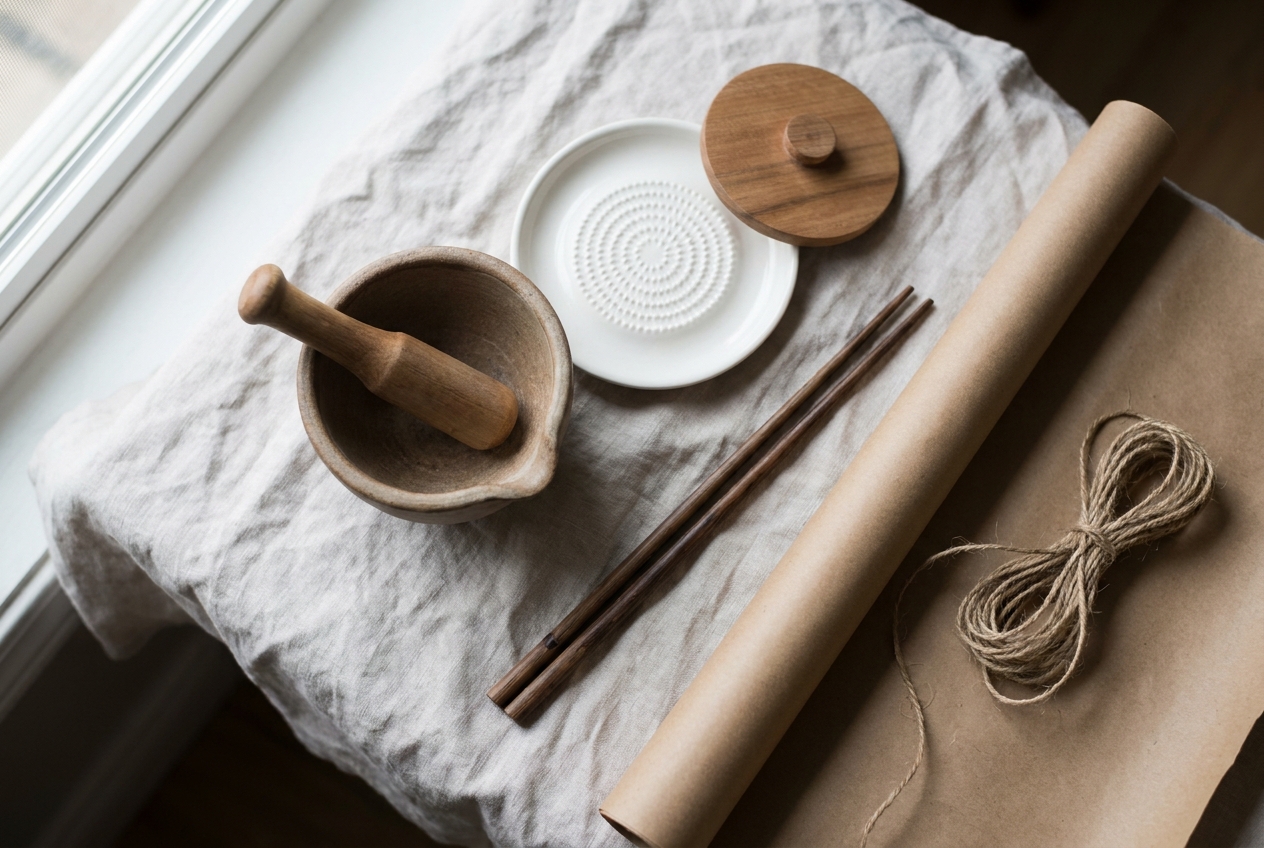
A drop lid, with one catch. An otoshibuta does not seal the pot. It sits on the surface of a simmering dish and leaves a ring of two or three centimetres of broth visible around its edge, which is what keeps the liquid circulating without stirring. That makes the size everything: a wooden lid should be about 0.87 times the inside diameter of the pot, roughly ¥1,100–¥2,000 in Japan or $10–$22 abroad. You will not know that number for someone else’s pot. So for a gift, either ask, or buy the adjustable stainless lid (Milk Street’s is $25.95 and spans 5.5–9 inches, about 14–23 cm). Parchment paper cut to a circle is the free version, and it is worth telling them so. The drop lid guide has the sizing chart.
A ceramic grater. The grater that suits most cooks is a ceramic plate with porcelain teeth set into it, around Ø 15 cm, at roughly ¥2,000–¥3,000. It handles ginger, garlic and daikon, and it is shallow enough to pass across a table. What makes a grater work is the teeth, not the metal, which is also why we would not buy the copper or sharkskin versions for most people. The full reasoning is in the oroshigane guide.
Buy this, not that
Buy the Ø 15 cm ceramic grater at ¥2,000–¥3,000. Do not buy a ¥10,450 hand-cut copper paddle for someone who grates daikon less than weekly or will not dry it right after use, and do not buy a ¥3,300 sharkskin board unless they buy fresh wasabi rhizome, because it does nothing for tube wasabi.
$30 and up: one object they will keep
A suribachi. This is the gift with a story. In a suribachi the comb-like ridges cut into the clay do the grinding, and the wooden stick only holds food against them. For one or two people, buy a 6-gō bowl, about 18.5 cm across and about 600 g, with a stick roughly its diameter plus 6 cm. That is light enough to hold at an angle over the sink and presentable enough to carry to the table. Do not start with an 8-gō bowl because it looks more serious: at 1.36 kg empty it is a two-handed object that gets left on the shelf. Check the interior photo taken at an angle. If the grooves fade out halfway up the wall, you are paying for a rim diameter nobody can use. I could not find a reliable price for a 6-gō set, so compare listings; retailers in the results I checked priced sets in dollars and Australian dollars, not yen. The suribachi guide covers glazed versus unglazed and the wooden stick.
A hinoki cutting board. The honest version is about 26 mm thick. Hinoki-mura lists 39 × 20 × 2.6 cm at 900 g for ¥3,980 and 42 × 24 × 2.6 cm at 1,200 g for ¥4,320, and the maker Tadafusa charges ¥550 to plane one face. In the US expect about $115. A 12.7 mm board at $35 is a prep and serving board, which is fine as long as nobody expects it to last a lifetime. It is a heavy parcel and it needs counter space, so this is the one tool where you should ask first. See the hinoki cutting board guide.
Gifts to skip, and why
A few things look like safe gifts and are not:
- A two-tier steamer for a beginner. Two tiers need a longer steam and more water than a first pot usually holds. Buy the 21 cm single basket with its steaming plate, unless you have measured a pot at 19–20 cm. See the steamer size guide.
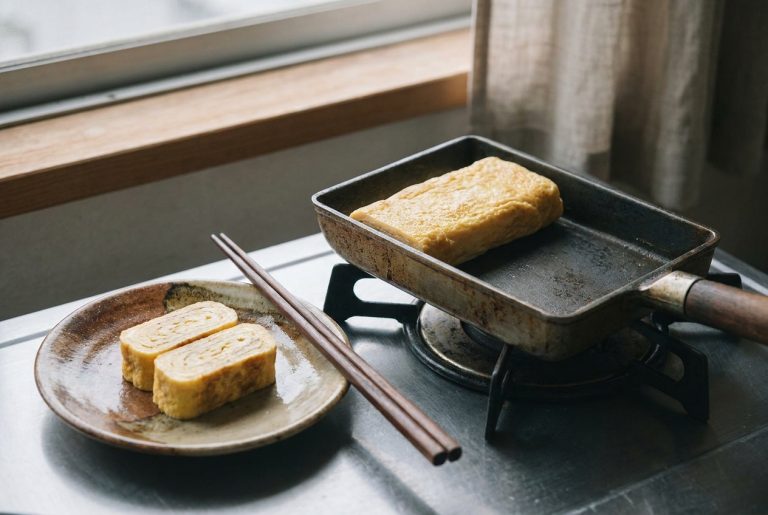
- An 18 × 18 cm tamagoyaki pan. Two eggs spread too thin to roll. A learner wants a non-stick rectangle of about 13 × 18 cm, and copper rewards someone who already knows what the egg should sound like. See the tamagoyaki pan guide.
- A plastic or granite mortar sold as a suribachi. Moulded plastic ridges are rounded from new, and granite grinds by impact against a smooth wall, so it bruises sesame instead of breaking it.
If you can only buy one
Buy the ceramic grater if they cook Japanese food at all, and add a $2 pair of 33 cm cooking chopsticks in the same box so the parcel has some weight in it. If you know they simmer vegetables or fish, make it the drop lid and ask for the pot diameter first. For a person who already has the basics, the suribachi is the one that feels like a gift, because they will use it the day sesame goes into something. For gifts beyond the kitchen, including the number rules that apply to weddings, see our tableware and tea gift guide, and for a ramen fan the ramen gift guide.
Disclosure: Nagori Ware is an independent editorial guide written from Japan. Some links elsewhere on the site are affiliate links. Parts of this site are drafted with AI assistance and checked against Japanese sources. General information, not legal or safety advice.