Suribachi: How to Choose a Japanese Mortar and Pestle, and Why the Bowl Does the Grinding
The first time most people use a suribachi, they lift the pestle, bring it down, and almost nothing happens. The sesame skitters up the side of the bowl and sits there, whole. Nothing is wrong with the bowl. You are simply using the wrong half of the tool.
In a stone mortar the pestle does the work: you crush by weight and impact, against a wall that is deliberately smooth. A suribachi is the reverse. The fine ridges cut into the clay are the working surface, and the wooden stick exists only to hold food against them while you turn it. The stick is wood for a specific reason — wood is softer than the fired bowl, so the stick gives way and the ridges do not. The bowl is the tool. The stick is the part designed to lose.
Every decision below falls out of that one fact: what size to buy, why nobody sells a stone surikogi, why one bowl can be soaked for half an hour and another cannot, and why the spec that matters most is the one almost no listing mentions.
The short answer: a suribachi (擂り鉢) is a Japanese grinding bowl whose ridged interior, the kushi-no-me, does the grinding; the wooden surikogi only holds food against it. For one or two people, buy a 6-gō bowl, about 18.5 cm across, with a stick roughly its diameter plus 6 cm.
The ridges are the cutting edge
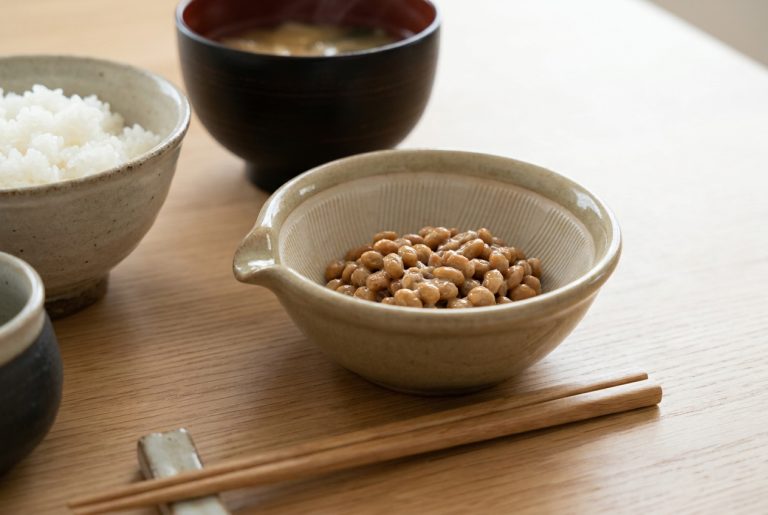
The pattern inside the bowl is called kushi-no-me (櫛目), literally “comb teeth”: radial grooves running from the base up to the rim. They are cut into the wet clay before firing with a metal comb, by hand, one bowl at a time. Japanese sources tracking excavated examples note that the grooves have grown steadily denser over the centuries — the tool has been quietly optimised for a very long time.
Yuta Iida, the sixth-generation head of Iidaya, a kitchenware shop on Tokyo’s Kappabashi street, makes the practical distinction: grooves cut by hand with a metal tool have sharp peaks and valleys, and they grind better than grooves that were pressed in. That is the whole quality question in one line. A moulded groove is shallow and rounded from the day it is made, and it polishes itself smooth inside a year of real use.
So when you are looking at a product photograph, ignore the glaze colour and look at the interior shot taken at an angle. Good grooves catch the light as distinct, separate lines all the way up the wall. If the pattern fades out halfway up, the usable grinding area is much smaller than the rim diameter implies — which is the sort of thing a listing will never tell you outright, and one more example of what the silences in a Japanese tableware listing actually mean.
How to hold it, and where the leverage is
Put a damp folded cloth or a rubber mat under the bowl first. A suribachi that slides is a suribachi you fight, and you will compensate by pressing harder, which is exactly wrong.
Then the grip, which is the part nobody explains. Hold the middle of the shaft with your dominant hand. Rest your other hand on the top of the stick and keep it still. The top hand is a pivot; the lower hand draws the circle. That is a lever, and it is why a well-used suribachi is quiet work rather than a workout. Let the weight of the stick supply the pressure, and keep the face of the pestle against the sloped wall rather than flat on the floor of the bowl — you want food travelling up the side, across the ridges, not sitting in the middle.
On pestle length, Japanese and English sources disagree, and it is worth knowing which one to follow. Japanese guidance is roughly twice the bowl’s depth, or the bowl’s diameter plus about 6 cm — so a 12 cm bowl takes an 18 cm stick. English shops frequently say “at least twice the diameter”, which for an 18.5 cm bowl means a 37 cm pestle. That is a restaurant tool, and in a home kitchen it is unwieldy. If your set arrives with its own stick this is moot; if you are buying the two separately, use the Japanese rule.
Size: read the gō number
Japanese suribachi are sold by 号 (gō), a traditional step of roughly 3 cm measured across the rim — not by volume, and not by the width of the grinding surface. The figures below come from Motoshige Seitosho, an Iwami ware workshop in Gōtsu, Shimane that makes essentially nothing but suribachi. If the gō system is new to you, it turns up all over the Japanese table; our reference on Japanese tableware sizes and terms covers the rest.
| Size | Diameter | Height | Weight | Who it suits |
|---|---|---|---|---|
| 4号 | 12.3 cm | 4.8 cm | 200 g | Sesame for one; doubles as a small dish |
| 5号 | 15.3 cm | 6.5 cm | 370 g | Dressings and sauces |
| 6号 | 18.5 cm | 7.3 cm | 600 g | One to two people. The default first bowl |
| 7号 | 21.5 cm | 8.5 cm | 880 g | Two to four people |
| 8号 | 24.8 cm | 10.4 cm | 1.36 kg | Five or more; grating yam |
| 9号 | 27.7 cm | 11.5 cm | 1.77 kg | Restaurant work |
| 10号 | 31.0 cm | 12.5 cm | 2.18 kg | Restaurant work |
Two failure modes at the ends of that table. Go under 15 cm and sesame escapes over the rim, and there is not enough wall to get the pestle angle — you end up working flat on the floor of the bowl, which is the slow way. Go to 8号 and you are handling 1.36 kg empty, before food and before the weight of your hand on the stick; a bowl that heavy stays in the cupboard, and a tool in the cupboard grinds nothing.
Buy this, not that
Buy the 6号 — 18.5 cm, about 600 g. It grinds sesame for two without seeds climbing the rim, it is light enough to hold at an angle over the sink, and it is presentable enough to carry to the table. Don’t start with an 8号 because it looks more serious: at 1.36 kg empty it is a two-handed object you will stop reaching for. And if a bowl’s interior photo shows grooves that stop halfway up the wall, buy a different bowl — you are paying for a rim diameter you cannot use.
Glazed, unglazed or porcelain — the line that decides your washing-up
English-language reference pages almost all describe a suribachi the same way: glazed on the outside, unglazed inside. That was a fair description of older bowls. It is not a reliable description of what is on sale now, and getting it wrong costs you either a scrubbing session or, worse, a long soak you should not have given it.
Motoshige Seitosho, the Shimane workshop above, is explicit that the inside of its bowls carries a glass-like glaze, so residue does not sink into the body the way it does with porous clay — and that the fix for sesame welded into the grooves is thirty minutes soaking in water with dish soap, then a palm-fibre tawashi. The workshop has tried the alternatives and prefers the tawashi to a toothbrush, which covers less surface and has an awkward handle. Meanwhile a Japanese side-by-side test of three suribachi found three different answers within a single product category: an Iga ware bowl with a thin glaze over the ridges, an Iwami stoneware bowl fired hard and left bare, and an Arita porcelain bowl that rinses clean with water alone.
So there is no single right answer to hunt for — there is a trade you are choosing, whether you realise it or not.
Whichever you end up with, three habits apply. Wash along the grooves rather than across them — across, you are just packing residue sideways into the next channel. Use a palm-fibre brush, and a toothpick for whatever survives it. Then dry it completely and store it face down, because damp trapped in thirty narrow channels is how these bowls go mouldy. Unglazed bodies want noticeably longer to dry; the general rules in our guide to caring for Japanese ceramics apply here more strictly than usual.
On dishwashers and microwaves, don’t reason from the material — check what the maker states for that specific piece, and see our guide to microwave and dishwasher safety for Japanese bowls for how to read those labels. The wooden pestle is a separate matter and a simpler one: wash it by hand, stand it up to dry, and never oil or varnish it. A sealed surikogi is a surikogi that has stopped being a surikogi.
Where suribachi are made
Mino (Gifu) is the centre of the trade. One maker there, Maruhon Seitosho, founded in 1910, states that it alone accounts for around 60% of the suribachi market. Mino’s hard clay fired hot gives ridges that hold their edge against sesame and nuts — which is the entire job. Iwami (Gōtsu, Shimane) is the other name that keeps appearing, high-fired stoneware from small workshops that specialise. Arita and Hasami porcelain give you the whitest, thinnest, easiest-to-rinse bowl with the shallowest bite — good if you mostly grind small dry quantities, and Hasami in particular is the best-value porcelain in Japan. Iga is the coarse, heat-tolerant clay you already know if you own a donabe.
Here is the unpopular part: for this one object, the region is not the spec. With a teabowl or a plate, the ware tells you most of what you need — that is the premise of our guide to telling Japanese pottery styles apart. With a suribachi, two bowls from the same town can differ more than two bowls from opposite ends of the country, because everything depends on how the grooves were cut and whether the interior was glazed. Buy the region for how it looks on your counter. Buy the grooves for whether it works.
The pestle, and which claims about it to believe
An ordinary surikogi is hōnoki, Japanese magnolia. The better ones are sanshō, Japanese prickly ash — the same plant whose peppercorns you may already have in the cupboard. Japanese sources describe sanshō as hard and aromatic; Iida adds that it resists wear, and that its knobbly, irregular grain gives the hand something to hold onto. Both of those you can confirm the moment you pick one up.
The third claim you will meet is that sanshō is naturally antibacterial. That one gets repeated across the trade, and I have not found an independent measurement of it for a kitchen pestle in normal use — so treat it as a reason people are fond of the wood, not as a reason to pay a premium. There is also a folk story that the wood’s medicinal properties transfer into your food in exactly the right quantity as the stick wears. That is folklore, and it is worth setting aside, because the wear itself has a real and much more interesting explanation.
The pestle is wood because wood is softer than a bowl fired at stoneware temperatures. The stick is the sacrificial component. Over years it loses a little of itself to those ridges, and the ridges keep their edge — which is the correct trade, because the stick costs a few dollars and the bowl does not. This is also why a stone or metal pestle is not a clever upgrade: it would win that contest, and what it would win is your grinding surface.
Buy this, not that
Buy a plain unfinished wooden surikogi and expect to replace it eventually — that is the design working, not failing. Don’t buy a plastic suribachi: the moulded ridges are rounded from new and give up within a couple of years. And don’t buy a granite mortar expecting it to do this job. It grinds by impact against a smooth wall, so it will bruise sesame rather than break it — a heavier tool that is worse at the one task you bought a suribachi for.
What a suribachi is genuinely good at
Sesame, above everything. Ground fresh, the seeds break and the smell comes up out of the bowl in a way that the pre-ground packet simply does not do — that is the whole argument for owning one, and it takes about forty seconds. From there: goma-ae dressing for blanched spinach, gomashio for rice, walnut sauce, small batches of miso dressing, grated yam for tororo, peppercorns cracked coarse. If you have ever ordered tonkatsu in Japan and been handed a tiny bowl of sesame seeds and a short stick to grind them into the sauce, you have already used one. The sesame grinder set down on the table in a ramen shop, beside the renge and the bowl itself, is the same idea; the same seeds also turn up scattered over rice in a packed bento.
Where it is the wrong tool: wet pastes in volume. A Thai granite mortar exists because pounding fibrous lemongrass and galangal needs mass and impact, and a suribachi supplies neither. Buy the right mortar for the cuisine you actually cook.
One more thing that surprises people: a suribachi is a serving vessel. Many are made in the katakuchi form, with a lip pulled out at one side for pouring, and they go from counter to table without transferring anything — you make the dressing in the bowl and put the bowl down. It behaves like the rest of the small dishes that do several jobs each on a Japanese table, which is the general habit worth borrowing from the way a Japanese table is put together.
Why it is also called atari-bachi
You will occasionally see the bowl called atari-bachi (当たり鉢) instead, and the reason is a small piece of superstition that stuck. The verb suru (擂る), to grind, is a homophone of the suru that means to lose your money — gamblers avoided saying it, so the word was flipped to its opposite, ataru (当たる), to hit, to win. The grinding bowl became the winning bowl. It is the same instinct that governs which numbers and which words are safe when you are giving Japanese tableware as a gift.
The superstition is a hint at how long this object has been in daily use. A woman is shown using one in the Yamai no Sōshi, a late-Heian handscroll now designated a National Treasure — roughly eight hundred years ago. The earliest excavated bowls come from Bizen kilns in the mid-to-late Kamakura period, the late thirteenth to early fourteenth century; Shigaraki and Seto were producing them by the fifteenth and sixteenth. Across all that time the shape has barely moved. The grooves just got finer.
Which brings it back to where this started. Buy the bowl for its grooves, buy the size you will actually lift, check the interior finish before you soak it, and accept that the stick is meant to wear out. Then grind some sesame, badly, with your top hand held still — and it will stop being badly within about a week.
Disclosure: Nagori Ware is an independent editorial guide written from Japan. Some links elsewhere on the site are affiliate links. Parts of this site are drafted with AI assistance and checked against Japanese sources. General information, not legal or safety advice.