Hinoki Cutting Board: Why 13 mm and 26 mm Are Not the Same Product
A hinoki cutting board is a surface you are supposed to remove.
That single sentence separates the board a Japanese household buys from the one sold to you in English, and almost nothing in an English listing says it out loud. In Japan the ordinary household board is 26 mm thick, and there is a small service industry that will plane it flat again when it stops being flat. Tadafusa, the knife maker in Sanjo, charges ¥550 to plane one face and ¥1,100 for both, trims the sides free, takes two to three weeks, and accepts boards made by other companies. The hinoki board most often on sale in English is 12.7 mm thick, and nobody who sold it to you will plane anything.
So the decision is narrower than the review sites make it look. Thickness is the only number on a hinoki listing you cannot change afterwards. Buy the millimetres. Everything else — why the wood is deliberately soft, why it stains, why you must wet both faces and never one, why the extra-large board is usually the wrong board — falls out of the fact that this one is meant to get thinner.
The softness is the point. The hardness number is a mess.
Hinoki is Japanese cypress, Chamaecyparis obtusa. Its air-dry specific gravity sits around 0.44, against about 0.38 for sugi (Japanese cedar), 0.65 for beech and 0.69 for keyaki (zelkova). It is a softwood, and it is chosen for the board because it is soft: the wood gives way under the edge instead of the edge giving way against the wood. Kobiki, a Japanese timber merchant, puts the claim plainly — hinoki is slow to damage the blade and helps prevent chipping, and food is easier to cut because the knife lands kindly.
Now look at the hardness figures people quote at you. One Japanese knife retailer gives hinoki a Janka rating of “510 to 800 lbf.” A review site puts it at “~500 to 800, commonly cited near 600.” A third guide states it as “approximately 1,050 lbf.” Hard maple is 1,450 and black walnut about 1,380, and those two numbers everyone agrees on. The hinoki figure disagrees with itself by a factor of two.
That spread is reason enough not to shop on hardness. But the direction is not in doubt, and neither is the trade it buys you: the edge survives and the board records. Every cut you make stays in the surface. A maple board resists the knife and keeps its face; a hinoki board yields to the knife and loses its face. Which is exactly why a Japanese maker sells you extra millimetres instead of extra hardness.
Thickness is a planing budget, and it is priced per face
Hinoki-mura, which sells Yoshino hinoki boards in Japan, offers two household sizes and gives both the same thickness: 39 × 20 × 2.6 cm at 900 g for ¥3,980, and 42 × 24 × 2.6 cm at 1,200 g for ¥4,320. Kobiki tells buyers to look for “around 3 cm” so the board can be planed more than once, and to buy a single slab rather than glued-up pieces, because laminated boards do not last.
The resurfacing is not a theory. Tadafusa’s maintenance page lists ¥550 for one face, ¥1,100 for both, side edges free, other makers’ boards accepted except unusual constructions. Sugimoto Mokkou charges a flat ¥2,580 including return shipping anywhere in Japan outside Okinawa and the remote islands, again for any maker’s board. Aomori Hiba Craft advertises plane repair that includes resizing the board. Kobiki will re-plane free within the first month if a board warps or cracks on you.
Notice that Tadafusa prices the work per face. That is not a billing quirk. A board is two faces, and everything you do to it — wetting, drying, planing — you do to both or you pay for it later. Hold on to that; it comes back in a minute.
There is a second thing planing gives back. Hinoki’s smell comes from volatiles — α-pinene and the other compounds people file under phytoncide — and it fades as you use the board. Take a shaving off and it returns. The scent is a readout of how much board you have left.
So a ¥4,320 board with a ¥550 face behind it is a different financial object from a $35 board with no service behind it at all, even though they cost roughly the same money. One is a surface with a maintenance contract. The other is a surface.
What is actually on sale in English is about half a board
English buying guides repeat that “3–5 cm is typical for quality hinoki boards.” That sentence does not describe the English market. Here is what the shops are actually listing.
Two of the eight reach the Japanese household standard: a $114.95 Shun at 25.4 mm, and a 24 × 18 inch slab at 38 mm that costs $239.99 and weighs 12 pounds. The other six run 12.7 to 19.8 mm. The cheapest Shun, at 12.7 mm and $34.95, costs about what the 26 mm Japanese board costs — and is half the board.
The thin boards are not badly made. They are made for a different plan. Milk Street builds its board with “anti-warp corner inserts”; Yoshihiro sells an “anti-twist core.” Those are a sensible answer to the question a thin board asks, which is how do we stop it bending — prevent the warp rather than correct it later. But neither maker’s care page says a word about resurfacing, and the one American retailer I found that discusses the board’s life tells you to take 120-grit sandpaper to it yourself and finish with 220.
One thing to avoid outright: boards glued up from hinoki offcuts or shavings. The seams are a place for water and food to sit, and the board will not last. If a listing will not say “single slab” or ichimai-ita, assume it is not one. That silence is the same silence you learn to read everywhere else on a Japanese listing — the specs a seller leaves out are usually the ones that would cost them the sale.
Wet both faces. Dry both faces. That is the whole care routine.
Every source agrees you wet a wooden board before you cut on it. The English ones stop there. Milk Street: “Wet the board lightly with water before use to help with stain resistance.” An American retailer: “Traditionally, hinoki is wetted down or even dunked in water by the chef before cutting, in order to prevent staining of the wood.” Both true, both incomplete.
Tadafusa adds the part that matters: wet it thoroughly, and wet both faces — because wetting only one side is itself a cause of the board distorting. Wood moves with moisture. Wet one face and you have made a board with two different moisture contents, which is the definition of a bend waiting to happen.
Drying is the same rule running backwards. Japanese care pages say the same thing in the same words: wash it, wipe the water off at once, and stand it on edge — grain running vertically — somewhere with moving air, so both faces and the bottom edge dry at the same rate. Dark staining and mould on a wooden board come from water left standing on it after use, not from the wood being wrong. A board left lying flat on a counter dries one face.
Three places the sources genuinely disagree, which you should know about rather than be told a tidy answer:
- Sunlight. Japanese retail care columns say keep it out of direct sun, and Milk Street warns against “prolonged exposure to heat or direct sunlight.” Tadafusa says to let the board see the sun occasionally in a well-ventilated spot. The reconcilable reading is that an airing is not a windowsill.
- Oil. One American retailer recommends regular mineral oil and a board conditioner. A second says hinoki “is meant to stay bare,” unlike maple. The Japanese makers’ own pages do not ask you to oil anything; they ask you to wet it, dry it, and eventually plane it.
- Bleach. Japanese care pages warn that chlorine bleach discolours the wood and leaves its smell in it, and point to oxygen bleach instead. Nobody recommends starting a wash with hot water, which sets protein stains into the grain; hot water is for after the board is clean.
On dishwashers, Japanese retailers are not ambiguous: they tell you not to, because the heat-and-dry cycle warps and cracks wooden boards. That is a durability instruction from the people who make them, and it is the one I would follow. If what you actually want is the safety question — what survives a microwave or a dishwasher and what does not — that lives in a separate article about Japanese bowls and the two machines, and it is not a question this one answers.
Buy this, not that
Buy the thickest single slab you can stand on edge to dry — 25 mm minimum, 26–30 mm if you can get it. Don’t buy a 12.7 mm board at $35 expecting a board for life; it is a prep and serving board, and that is fine as long as you bought it knowing. And don’t buy the 61 × 46 cm, 5.4 kg slab unless you have already decided where it will stand up between dinners — a board you won’t lift is a board that dries on one side.
The size is set by where it dries, not by your counter
Japanese retailers size a household board by the number of people eating: roughly 15–20 × 30 cm for one person, 20 × 40 cm for two, 25 × 45 cm for three or four. English guides start where that list ends — 30 × 45 cm is routinely called the primary board for a serious home cook, with 36 × 54 cm and up offered as the next step.
Neither recommendation is wrong about cutting. They are answering different questions. The English one is answering “how much room do I want while I work.” The Japanese one is answering a question the English guides never ask, which is “what am I going to do with this thing for the twenty-three hours a day I am not cutting on it.”
Stood on edge the way every care instruction tells you to stand it, a board’s drying height is its long dimension. The two-person Japanese board is 40 cm tall and 900 g; you can lift it one-handed and park it against a splashback. The extra-large board on sale abroad is 61 cm tall and 5.4 kg. That does not fit a dish rack, it does not stand under a wall cabinet, and it is heavy enough that on an ordinary Tuesday you will leave it lying flat. Then the face against the counter stays wet, and in a few months you own a board with a dark patch on one side and a bend in it.
This is the same arithmetic as several other Japanese wooden objects that get sold abroad on their looks: the bento box that is really a humidity device, the ohitsu whose stated millilitres are not the rice it holds, the hangiri you size by the rice and not by the tub. In every case the wood is doing a job with water, and the size that works is the size you can look after. It is worth measuring the gap between your tap and the cabinet above it before you measure your counter.
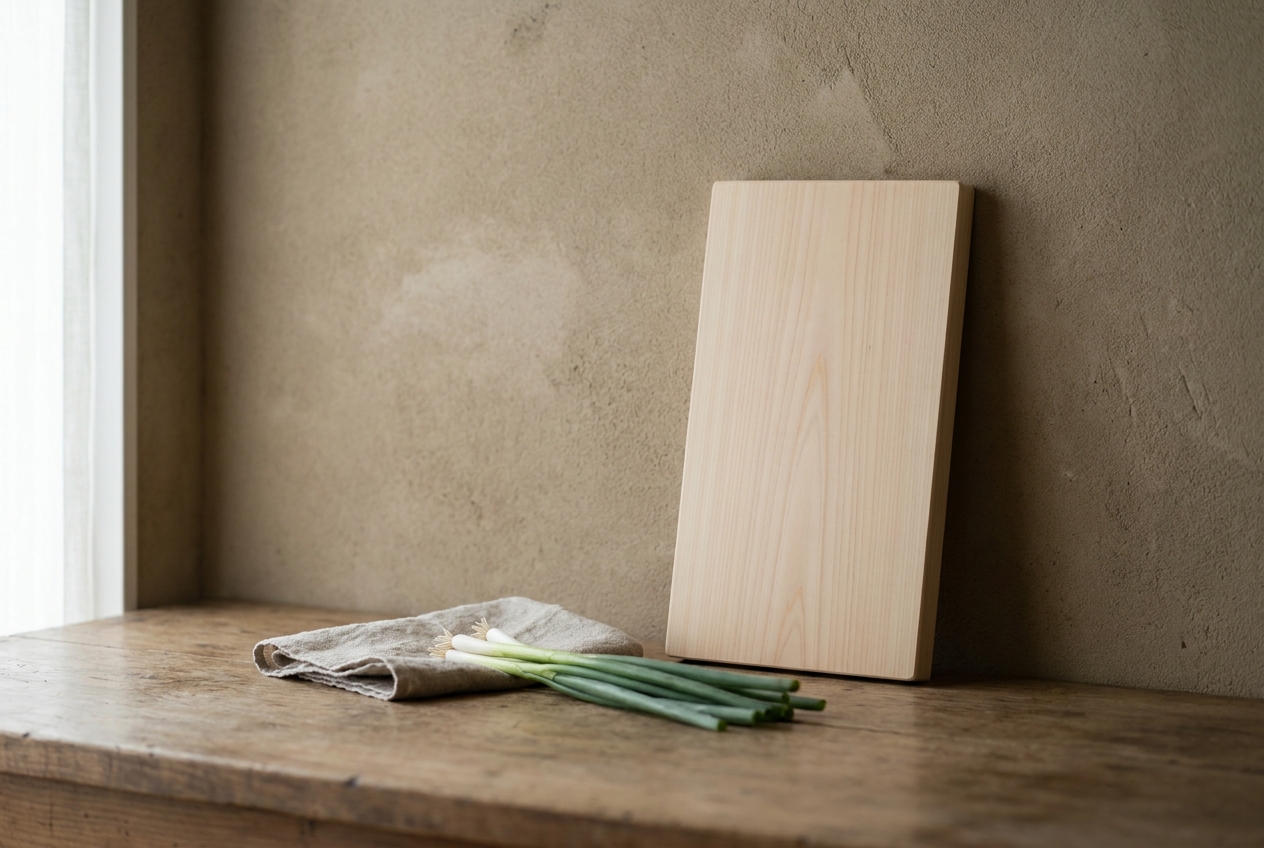
One more detail Japanese merchants mention and English listings never do: grain direction. Quarter-sawn boards (masame, straight parallel grain) resist warping and splitting and cost more. Flat-sawn boards (itame, the cathedral-arch figure) are described as kinder under the knife and less tiring on the hand and arm. If a listing shows you a photo, you can see which one you are buying, which is more than you can say for most of the specifications.
The claim on the listing that this article will not settle
A large American knife retailer describes its hinoki boards as “gentle on knife edges and naturally anti-bacterial.” The first half is defensible and we have been through it. The second half deserves a straight answer about what is actually known.
The compound people are reaching for is hinokitiol, isolated in 1936 by Tetsuo Nozoe from cypress heartwood. It is real and it has been measured. Published figures put Chamaecyparis obtusa — hinoki — at about 0.02% of dry heartwood, roughly 0.2 mg per gram of sawdust, and Thujopsis dolabrata var. hondai — hiba, the wood Aomori is known for — at about 0.04%, close to double. Kobiki names two others, α-cadinol and hinokiol, as antibacterial constituents of hinoki.
Those are composition numbers, measured on dried sawdust in a laboratory. They are not a test of the board you just cut chicken on, and the distance between the two is exactly where a buying guide should stop. This is a food-safety question; settling it honestly needs a laboratory, not an editor. So I am not going to settle it, and I would be careful of anyone who settles it for you in a product description.
What every Japanese maker does say, in the same words, is the dull instruction: dry it, standing up, both faces, straight after you wash it. That is the advice they all converge on, and it is free.
So: what to actually buy
If you want one hinoki board and you want it to last, buy a single slab at 25 mm or thicker, in the largest size you can comfortably stand on edge — for most kitchens that is somewhere between 40 × 20 and 45 × 30 cm. Expect to pay around $115 in the United States or about ¥4,000 in Japan for the honest version, and expect the thin ones to be cheaper for a reason you can measure with a ruler.
If you are an everyday Western cook who browns meat, cuts through bones and will not wipe a board dry within the minute, one review site’s advice is sound and I will repeat it rather than pretend I disagree: make maple your workhorse, and buy hinoki as the second board, for fish and vegetables and the days you care. That is a real recommendation, not a hedge. Hinoki is a consumable in a way maple is not, and a consumable you are not prepared to maintain is just an expensive one.
And when the smell starts to go, that is not the board dying. That is the board telling you how many millimetres you have left. On a 26 mm slab you get that message two or three times. On a 12.7 mm board you get it once — the day you open the box. The dimension printed on the listing is the only part of this you can decide, so decide it first, and let the rest of the care routine be the easy part.
Disclosure: Nagori Ware is an independent editorial guide written from Japan. Some links elsewhere on the site are affiliate links. Parts of this site are drafted with AI assistance and checked against Japanese sources. General information, not legal or safety advice.