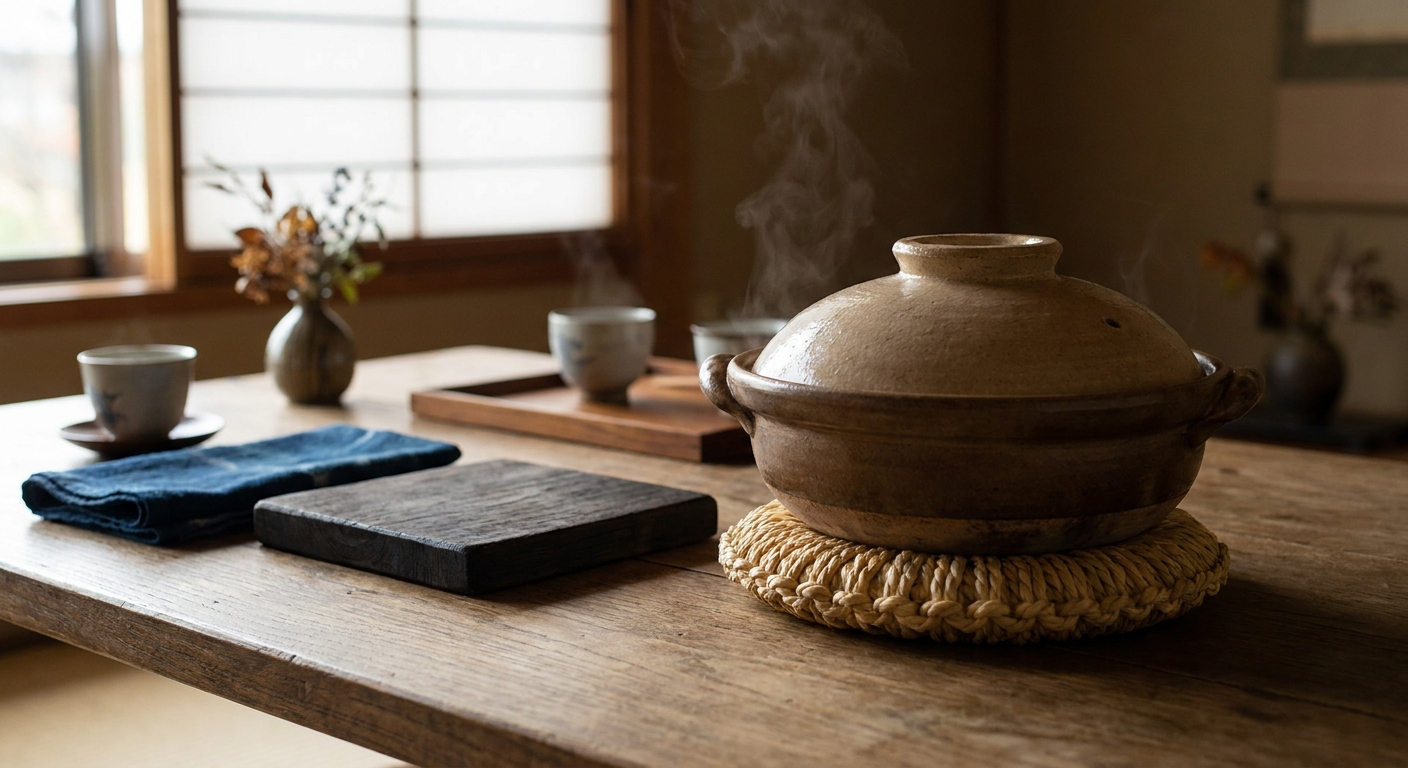
Nabeshiki: What Size Trivet a Donabe Needs (Measure the Base, Not the Pot)
You measure your donabe, get 32 cm, and go looking for a 32 cm trivet. It is not there. The largest rush ring on sale is 24.8 cm. The largest brass one FUTAGAMI makes is 18 cm. Nagatani-en — the Iga workshop that makes Kamado-san, the most famous rice donabe in Japan — sells a trivet for its own pots at 18 cm, ¥3,190.
That is not a hole in the market. It is that you measured the wrong circle. The number printed on a donabe listing is taken across the handles, and the handles never touch anything. The only part of the pot that meets the trivet is the base, and no listing anywhere gives you that figure.
So this page is about one measurement and one exception. The measurement is the base. The exception is that a donabe is the single pot on the Japanese table whose base breaks the ordinary rule — and once you see why, the strange shapes of Japanese trivets stop looking decorative.
One boundary first. What follows is about sizes, shapes and materials. What a hot clay pot does to a cold or wet surface, and what sudden temperature changes do to ceramics, is covered in the donabe guide and in the piece on thermal shock. On what your particular pot and your particular tabletop will tolerate, follow the maker’s instructions — not me.
A donabe has three diameters, and the listing gives you the useless one
Take three pots that English-language shops actually stock. A three-cup Kamado-san is listed at 24 × 30 × 18 cm, handles and lid included. The five-cup is 26 × 32.5 × 21 cm. A Ginpo Hanamishima nine-gō hot pot, the pattern most Japanese households own, is 28 × 31 × 16.4 cm. Every one of those first two numbers is a width measured at the widest point of the object, which on a donabe means the tips of the lugs.
The gō number is closer to useful. It tracks the body diameter rather than the handles, so a nine-gō pot has a body around 28 cm, an eight-gō around 24 cm. But the retailer LAFUGO is blunt that gō is not an industry standard: dimensions and capacity vary by maker, series and material, so you should read the stated full-brim capacity, inside diameter and depth rather than trusting the number. That is the same warning that applies to every size marked in sun and gō, and the same habit of reading what a listing does not say.
None of the three figures is the one the trivet meets. Turn the pot over. On a Banko or Iga donabe you will find an unglazed underside that flattens out into a shallow circle somewhere well inside the body diameter — on a family-sized pot, roughly 15 to 18 cm. That circle is the whole of the contact. Measure it with a ruler across the middle and write the number down, because you are about to buy against it.
A trivet smaller than the pot is fine — a Japanese shop tested it and said so
This is the part that English guides never quite commit to. Cotogoto, a Tokyo shop that publishes long side-by-side comparisons of ordinary household tools, put its staff through a round of trivets and landed on the plain answer: a trivet somewhat smaller than the pot is no problem, provided the pot’s base is flat. In their own words, “鈴より鈴敷きのほうが多少小さくても、底が平らかであれば問題はないと思います」.
They sort by base diameter, not by pot. A base of 9 to 14 cm sits happily on the small trivets. A base of 18 to 22 cm is where you should move to a wooden lattice. Those two brackets explain the shape of the whole market: cast iron at 13 and 17 cm, rush at 14.6, 17.8 and 24.8, wooden boards at 17 to 20, brass from 13 to 18. The trade converged on 17 to 18 cm because that is where the bases are, and the maker of Kamado-san choosing 18 cm for its own pot is the cleanest confirmation you will get.
There is exactly one honest reason to go a size up, and it is not heat. Cotogoto note that a trivet a little larger than the pot shows its own pattern around the base, which makes it part of the table setting rather than hardware hidden underneath. If you are buying a woven rush ring or a kumiko lattice because it is beautiful, buy it a size larger and let it show. Just do not tell yourself that the extra 5 cm is doing any work.
The donabe is the pot that breaks the rule
Read the permission again and you will see the condition hiding in it: provided the pot’s base is flat. A donabe’s base is not flat. Cotogoto name the pot specifically and give two reasons — it stores a great deal of heat, so scorching the table is a live worry, and its underside carries a slight roundness, which makes it less stable than something that size ought to be.
English sellers know this and never explain it. JINEN, which imports handmade rush trivets from Niigata, writes only that theirs is “shaped to hold even a round-bottomed pot like a donabe securely in place.” That is the physics in one clause. A flat plate under a convex base gives you a tangent — contact along a narrow circle, with a heavy pot free to rock or slide on it. A ring gives you a seat: the curve drops into the hole and the pot is held rather than balanced.
Which turns the number you read inside out. On a rush ring the figure that matters is the inner diameter, not the outer. JINEN’s large is 24.8 cm across with a 17.1 cm hole; the medium is 17.8 cm with a 10.2 cm hole. Your pot does not rest on the 24.8; it settles into the 17.1. Every rush listing publishes both figures and none of them tells you that the second one is the one to compare against your base.
Cotogoto’s other answer for a donabe is a wooden kumiko lattice — the fine interlocking joinery used in Japanese screens and doors, assembled flat into a square. Their reason is purely mechanical: it has no feet, so even a large heavy pot sits still on it. A three-cup Kamado-san with the lid on weighs 3.6 kg empty, and it is not empty when it comes to the table.
Buy this, not that
For a family donabe — eight or nine gō, body 24–28 cm, listed at 30–32 cm with the handles: a handmade rush ring of about 24–25 cm outside with a 17 cm hole, or a footless wooden kumiko lattice of 18 cm or more. Both are in the $18–40 range. Match the hole to your base, not the outside to your pot.
Not a 13 cm disc. TOIRO, which sells nothing but donabe and their accessories, calls its 13 cm cast-iron trivet right for a small donabe “or tea pot”, and its 17 cm one right for a medium donabe. FUTAGAMI’s 13 cm brass Tsuki is the same class of object. These are lovely under a tetsubin or a kyusu. They are not under-sized for a hot pot in a cosmetic way; they are the wrong tool.
Not a footed metal trivet, unless your base is genuinely flat. Three feet under a convex base is a tripod under a curve. A 3.6 kg pot of boiling broth is the last thing on your table that should be free to tip.
Not a fabric pot mat for a donabe straight off the flame. It is the best insulator here, for the reason it is the worst choice: it has no openings to let heat away, and that is also how it chars.
Insulate or elevate: the two mechanisms, and the one combination that has neither
Strip the materials down to what they do with heat and there are only two designs on the table.
Wood and rush do not pass heat on. Hardwood sits at roughly 0.17 W/(m·K); the thickness of the board is the whole of the protection, which is why MUJI describes its 17 –20 cm domestic-timber trivet, at ¥1,390, as made deliberately on the thick side so a very hot pot can go on it. Thin wood is not a smaller version of thick wood. It is a worse one.
Brass and cast iron do the opposite. Brass conducts at about 111 W/(m·K) and cast iron at about 52 — brass moving heat roughly 650 times faster than wood, and faster still than the tin in a sake cup. A brass plate is not insulating anything. So the makers hold it off the table instead: FUTAGAMI puts three non-slip pads on the underside of every trivet and hollows out the centre, describing the opening as both a finger-hold and a way for heat to escape. TOIRO says the same of its cast iron in plainer words — the trivets are “slightly elevated for better protection of the surface.” The metal is the look. The feet are the function.
Which leaves one combination with no mechanism at all: a thin solid plate of conductive metal lying flat on the wood. If you are buying metal, turn it over first and check that something holds it up.
Metal also carries two costs the listings do not mention, and both Japanese sources raise them. The surface is slippery, which matters more than it sounds under a round base. And bare metal marks a table, which is why Japanese guides tell you to choose the versions with cork or rubber on the feet. Brass has one real compensation: it oxidises into a patina with use, the same argument this site makes about buying the piece that will change. Buy the brass because you want to watch it go green. Not because you think it is protecting the table.
The openwork is not ventilation
I went into this expecting the lattice and the ring to be about steam — a hot clay pot gives off moisture, a solid board would trap it, so the tradition opens the surface up and lets it out. It is a tidy story. It is also not what the Japanese comparisons describe.
The hole in a rush ring does two jobs, and neither is airflow: a round base drops into it and sits firm, and your fingers go into it when you lift the thing. Cotogoto even put the hole on the debit side of the ledger — the place they worry about a scorch mark appearing is the hole, where the pot is closest to whatever is underneath. And the trivet with no openings whatsoever, a quilted fabric pot mat, turns out to be the best insulator of the lot because it has nowhere for the heat to go, while being the one that burns.
So openwork buys stability and a grip. Getting heat away from the table is the job of feet and of thickness. That is worth knowing before you pay a craft premium for a pattern on the theory that it breathes.
The moisture question does exist, but it belongs to the pot rather than the trivet. A donabe’s unglazed base takes up water and has to be dried right through before it goes near heat again, which is why the sellers who explain anything tell you to stand the pot upside down to dry. That is care for the pot — the same territory as looking after Japanese ceramics and the seasoning routine in the donabe guide — and no trivet fixes it.
What is actually sold, and what each size is for
Prices and sizes as listed at the time of writing. The right-hand column is the maker’s or shop’s own description wherever one exists, because that is the only place the pairing is ever stated.
| Trivet | Size | Price | What it is for |
|---|---|---|---|
| TOIRO cast iron, three-wave | 13 cm ø × 1.3 cm, 200 g | $40 | Small donabe “or tea pot” — the shop’s words |
| TOIRO cast iron, four-wave | 17 cm ø × 1.3 cm, 350 g | $40 | Medium donabe; slightly raised off the table |
| JINEN rush ring, Niigata | 14.6 / 17.8 / 24.8 cm outside (8.3 / 10.2 / 17.1 cm hole) | $18 / $20 / $24 | Round-bottomed pots; read the hole |
| MTC Kitchen rush | 14.5 / 17 / 24 cm ø × 2.5 cm | $17.90 / $19.90 / — | Same class; loop for hanging |
| Wooden board | 18 × 18 cm | $17 | Flat-based pots and kettles |
| MUJI, domestic softwood | 17–20 cm ø | ¥1,390 | Made thick on purpose; the cheapest sound answer |
| Nagatani-en, own brand | 18 cm | ¥3,190 | Sold by the workshop that makes Kamado-san |
| FUTAGAMI brass Tsuki / Taiyō | 13 / 15 cm ø, 67 mm hollow, 12 mm high | ¥6,300 | Teapot scale. Three pads underneath |
| FUTAGAMI brass Ginga | 18 cm ø | ¥7,100 | Their largest; “for large pots and pans” |
Note what is missing from that table: nothing above 25 cm, and nothing sized to the 30–32 cm figure on your pot’s listing. Once you know the trade sizes to the base, the absence stops being suspicious.
What each material does badly
Every one of these has a failure mode, and Japanese suppliers are more candid about them than Western product pages.
Rush and straw are light, grippy, and cushion a heavy pot; they dislike damp and they scorch at high temperature, generally at the hole. Wood is non-slip and warm to look at; it warps, it can go mouldy if it is stored wet, and it will burn if you push it. Cork is light and takes heat well but darkens over time. Silicone is the easiest to clean and the least durable, and it does not like sustained high heat. Ceramic insulates well and chips. Metal is the most heat-resistant and the longest-lived, and the most slippery. Fabric insulates best, doubles as a pot holder, and chars.
For wood there is a care routine worth borrowing from elsewhere on this site, because it is the same routine every time: quick wash, long dry, put it away only when it is dry through. That is how a wooden ohitsu, a wooden bento box and a piece of real lacquer all stay alive, and a trivet is the least demanding member of that family. A rush ring wants the opposite of a soak — brush it, dry it, hang it up.
Measure it in thirty seconds
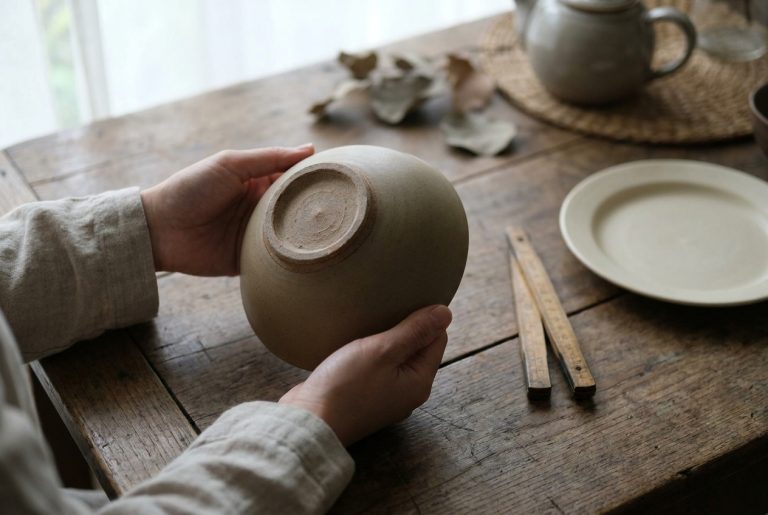
Cool pot, empty, upside down on a towel. Find the circle that actually touches — on a donabe it is where the curve of the underside flattens out, usually a clear band of unglazed clay. Lay a ruler across the middle of it. That is your number.
Then: if it falls between 9 and 14 cm you are in small-trivet territory and almost anything will do. Between 18 and 22 cm, go to a lattice or a large ring and skip the feet. If the base is convex rather than flat — press the pot gently and see whether it rocks — buy a ring and match the hole to the flattest part, or buy the footless lattice. And if the base is flat and you like the look of metal, that is the one case where a footed brass or iron trivet is the correct answer rather than a compromise.
Everything else on the hot-pot table follows the same logic of measuring the part that does the work rather than the part in the photograph: the tonsui bowls you serve into, the owan whose useful volume is half its stated capacity, a yukihira pan whose sheet thickness matters more than its pattern, a seiro sized to the pot rather than the eaters, and an obon tray whose depth nobody publishes.
What I would buy, and what I would not
Two trivets cover a Japanese table. A rush ring of around 24 cm with a 17 cm hole lives under the donabe from October to February and does nothing for the rest of the year. A thick wooden board of 18 cm handles the kettle, the small clay pot, and everything that arrives hot from the stove with a flat bottom. Together that is under $45 and it is genuinely finished — there is no third one to want.
What I would not do is buy up in size to match the pot. The 32 cm figure on your listing describes two handles reaching out into the air. The trivet answers to a circle of clay you have probably never looked at, and looking at it takes half a minute. Go and turn the pot over.
Disclosure: Nagori Ware is an independent editorial guide written from Japan. Some links elsewhere on the site are affiliate links. Parts of this site are drafted with AI assistance and checked against Japanese sources. General information, not legal or safety advice.