Japanese Bento Boxes: The Box Is a Humidity Device, Not a Container
Open the lid at half past twelve and one of two things has happened. Either the rice is still loose — grains that separate under the chopsticks, dry enough to lift cleanly — or it has settled into a damp slab, there is a film of water on the underside of the lid, and the bottom layer has gone grey and slightly sticky.
That difference is almost never the recipe. It is the wall of the box.
A lunch box has one job nothing else on the Japanese table has: it is closed, and it holds food that was warm when it went in. Rice packed at eight in the morning goes on giving off steam for the next twenty minutes inside a sealed space the size of a paperback. Where that water ends up — drawn into the wall, or handed straight back to the rice — is the whole product. Compartments, silicone gaskets, the pattern on the lid: all of it sits downstream of that one question. So this guide is organised around it.
One boundary first, because it matters. Everything below is about texture, craft and care. It is not food-safety advice, and a tableware site is the wrong place to get any. How long a packed meal can safely go unrefrigerated depends on your climate, your commute and your local guidance — take that from your local food-safety authority, not from me.
What a wappa bento box actually does
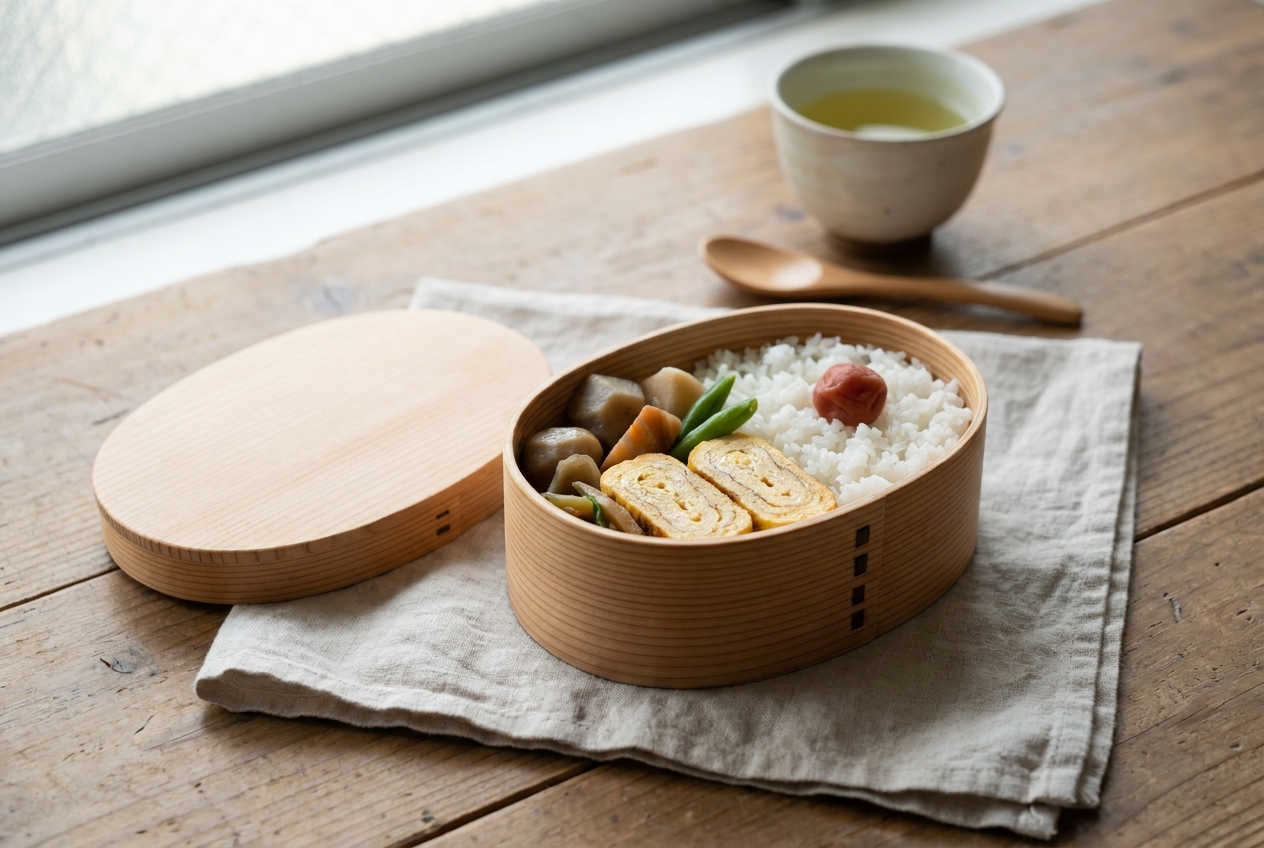
Japan’s wooden lunch box is magewappa — literally “bent wappa”, a thin sheet of cedar softened in hot water, bent around a form into an oval, stitched shut and fitted with a base. It is the oldest surviving answer to the problem above, and the answer is not insulation. A magewappa keeps nothing warm. What cedar does is take water out of the air inside the box.
Wood is hygroscopic: it absorbs moisture when the surrounding air is wet and gives it back when the air is dry. Akita cedar, the timber the Odate boxes are made from, is prized for doing this briskly and evenly. The steam coming off freshly packed rice goes into the wall of the box instead of condensing on the lid and dripping back down. Five hours later the rice has lost its excess moisture rather than sat in it, which is exactly what “still fluffy when cold” means in practice.
It is the same physics that governs everything else on this site: whether a material is open or sealed decides how you live with it. Porous stoneware absorbs and has to be dried; dense porcelain does not and can go in the dishwasher. If you have read our guide to Japanese pottery styles or to caring for Japanese ceramics, this is the same axis, applied to wood, over five hours instead of five years.
Two honest limits. The effect is real but modest — it is the difference between good rice and wet rice, not between hot lunch and cold lunch. And it can be wiped out for free: if you seal the lid while the rice is still steaming, you have handed the wall more water than it can take. Let a packed box stand open for five or ten minutes before you close it. That single habit does more than any upgrade in material.
The four walls you can actually buy
Nearly every lunch box on the market is one of four things, and the finish — not the shape, not the price — tells you which.
Unfinished cedar (shiraki)
Bare wood, nothing between the cedar and the rice. Maximum moisture regulation, the strongest cedar scent, and the shortest patience. No detergent: wash in lukewarm water with a soft sponge, soak only a couple of minutes if something has stuck, and never leave it in the sink overnight. Oil from fried food soaks in and stains. Put it away damp and it will grow mould at the seam, where you cannot see it. Dry it standing on edge so both faces get air — not face-down on a tea towel, which traps the water it has just absorbed.
Wiped lacquer (fuki-urushi)
Urushi rubbed on in thin transparent coats so the grain still shows. This is the sweet spot for most people: the film is thin enough that the cedar still breathes, detergent is fine, oil does not stain, and lacquer is the most durable of the finishes as well as the only one that can be renewed when it dulls. It is also the most expensive. Opaque coloured lacquer (hon-nuri) is beautiful and seals more completely — at which point you are buying lacquerware rather than cedar, and our guide to Japanese lacquerware is the better place to start, particularly for the label conventions.
Urethane-coated wood
A clear plastic film sprayed over the same cedar. Wipes clean, takes detergent, never stains, never moulds, costs least, and is what Japanese shops honestly recommend to beginners. It also does not regulate moisture, because the wood is no longer in contact with the air inside the box. Water condenses on the lid exactly as it would in a plastic container.
This is the one place the category quietly misleads people. In a photograph a urethane-coated magewappa and a bare one are indistinguishable, they are made in the same workshops from the same cedar, and overseas listings frequently sell the coated version at craft prices while describing the wood’s breathability in the copy. The coating is a perfectly good choice. Paying for cedar and receiving the behaviour of plastic is not.
Plastic and stainless steel
No pretence, and no shame in it either: cheap, light, dishwasher-safe, and the obvious answer for a child who will drop it. Just expect condensation, and manage it the free way — cool the food before the lid goes on, or pack rice and hot dishes in separate tiers.
How to read a listing: the Japanese word for the finish is tosō (塗装). Mutosō or shiraki (無塗装 / 白木) means unfinished; urushi-nuri (漆塗り) means lacquer; uretan-tosō (ウレタン塗装) means urethane. If a listing shows a wooden box and says nothing at all about the finish, assume urethane — an unfinished box has to carry care warnings, so silence is itself information.
Buy this, not that
If you want the cedar effect without the anxiety, buy a wiped-lacquer (fuki-urushi) cedar box in the 600–700 mL range and wash it the evening you use it. Don’t make an unfinished shiraki box your first one if you leave at 7:30 and wash up at nine at night — it wants same-day washing, no detergent, and a night standing on edge to dry, and a box put away damp grows mould at the seam where you will not see it until it smells. And don’t pay $100 or more for a urethane-coated wooden box expecting loose rice at lunchtime: for moisture, that box behaves like the $12 plastic one.
Why the rice goes hard in the fridge — and why that isn’t a safety question
Cooked rice does not stale evenly across temperatures. The starch recrystallises — retrogradation, called 老化 (“ageing”) in Japanese food science — and it does so fastest at roughly 0–4°C. That is precisely the inside of a domestic refrigerator. Rice chilled overnight comes out dry and crumbly not because it dried out but because the water was pushed out of the starch as it recrystallised.
Two consequences follow, and both are practical. Freezing cooked rice works well because the freezer carries it through that band quickly and holds it below it. And room temperature, unfashionable as it sounds to anyone raised on reheated lunches, is genuinely the kindest place for cooked rice over a few hours — which is why the chilled cabinets holding onigiri in Japanese convenience stores are set warmer than a fridge, in the region of 14–20°C.
So the Japanese habit of eating lunch at room temperature is not stoicism. It is the texture-optimal choice, and an entire cuisine grew around it: bento dishes are seasoned a little more assertively than the same dish served hot, because cool food reads flatter, and the classic contents — rolled omelette, simmered root vegetables, grilled fish, pickles — are chosen because they are good cold rather than merely tolerable. Ekiben, the station lunch boxes sold on the railways for over a century, are a whole genre engineered for it.
Again: none of that is a claim about how long food keeps. It is a claim about starch. Whether your lunch should be refrigerated between eight and half past twelve is a food-safety question with a local answer, and it outranks texture every time.
The box that does not leak is the box that does not breathe
Every other bento guide tells you to look for a gasket and a four-point lock. That is sound advice, and it is advice against the box this article is about — though nobody ever says so out loud.
A standard magewappa cannot be sealed, and the reason is structural rather than a matter of quality. The side wall is one board bent into a loop. A single bent board will never hold a perfect circle, so Japanese sellers are blunt about the consequence: fit a gasket to it and gaps still remain, which is why these boxes are not sold for soupy food. Wood also moves with the weather, swelling and shrinking through the year, and there is no rubber ring to take up the difference the way a plastic box has. So the honest instruction that comes with a wappa is narrow — it will take the steam coming off your rice, and it will not take a pool of broth.
Which is the same sentence as the rest of this guide, said from the other side. A seal and an absorbing wall are asking for opposite things. The wall works because water can get into it; the seal works because water cannot get out. You cannot have both in one compartment, and if you force the issue you get the damp slab from the opening paragraph.
The market has already conceded this, and the concession is worth looking at because it is more useful than any lock rating. One Japanese maker sells a two-tier “modern wappa” at ¥3,600 — 18.2 × 10.3 × 9.2 cm and about 910 ml for the large, 15.7 × 9.8 × 7 cm and about 630 ml for the small. The upper tier holds a removable silicone container, and that is where the wet food goes and the only part the maker describes as going in the microwave; the wooden body is not sold that way, and the box is not sold as dishwasher-safe either. The lower tier is left as bare cedar, and the maker explains why in one line: the wood draws off the steam the rice gives out, so the rice does not turn sticky as it cools.
They did not solve the conflict. They moved the two halves into separate rooms. That is the correct answer, and you can apply it without buying their box: decide which compartment the rice is in, keep the sauce somewhere else, and stop looking for the wooden box that seals. Boxes with a gasket and an inner lid do exist in wappa form and they do leak less — but every millimetre of that seal is taken out of the wall’s budget. What a maker will or will not put in a microwave or a dishwasher varies by piece and by coating, and we keep that question in one place: what is actually microwave and dishwasher safe.
Size first: the box is the portion
The most common complaint about Japanese lunch boxes from overseas buyers is that they are too small. They are not small. They are portioned — and Japan has a published formula for it that almost no English-language guide mentions.
It is called the 3・1・2 bento box method, developed at Kagawa Nutrition University and promoted through public-health and rice-industry channels for decades. Two rules. First: choose a box whose capacity in millilitres is close to the calories you want that meal to carry — a 600 kcal lunch means a 600 mL box. Second: fill it in the proportions three parts staple (rice), one part main dish (fish, meat, egg, tofu), two parts vegetables, measured by volume and packed level rather than heaped.
The elegance of it is that the container does the measuring. There is nothing to weigh and nothing to log; once you own the right box, packing it correctly is the portion control. It also explains the proportions in the photographs — rice occupying half the box is not stinginess, it is the rule being followed.
If you already own a box and do not know its capacity, fill it with water and pour that into a measuring jug. That number, not the label, is what you are choosing between. And test a cheap box at the size you think you want for a month before you commit to a beautiful one — activity level shifts these figures far more than age does, and the wrong capacity is wrong every single day, in a way no amount of cedar will rescue.
Odate magewappa, and what the price is for
Bent-cedar bentware is made in several parts of Japan, but the one with the paperwork is Odate, in Akita, in the far north. Odate magewappa was designated a national traditional craft by the Minister of Economy, Trade and Industry in 1980, and it remains the bent-woodwork bentware tradition holding that designation.
The making is quick to describe and hard to do. Straight-grained cedar is split and planed thin, softened in hot water until it will bend without breaking, wrapped around a wooden form and left to set, then the overlap is stitched — with strips of wild cherry bark, yamazakura, sewn through in a neat row — and a base is fitted and sealed. The cherry-bark stitches are the quickest authenticity check you have: on a genuine piece they read as a tight row of dark slim staples at the seam, cut and set by hand, and the grain runs continuously around the curve rather than meeting at a glued corner.
One thing worth knowing before you compare prices. Natural-growth Akita cedar — the slow-grown timber with the famously fine, even rings — has been protected from harvest since 2013, so current production uses planted cedar. Boxes advertising natural-growth timber are drawing on old stock, and priced accordingly. Expect roughly $90–200 for workshop-made Odate pieces, against $20–40 for the wappa-shaped imports that share the silhouette and none of the construction.
Living with one
Wash it the evening you use it, not the following morning. That is the single rule the wooden boxes actually enforce, and most of the failures people report — the smell, the black spotting at the seam, the lid that stops seating — trace back to a box that spent the night closed with yesterday’s lunch in it.
Dry it standing on edge, both faces open to the air, out of direct sun and away from the radiator. Wood that dries too fast splits, and the bend is where the stress lives. Never put a wooden box in the dishwasher or the microwave; if you want the general rules for which of your pieces can take either, we set them out in our guide to microwave and dishwasher safety.
Two habits keep an unfinished box looking new for years. Pack anything oily — fried chicken, anything dressed in sesame oil — in a small dish or a paper cup set inside the box rather than directly against the wood; the little plates in our guide to Japanese small dishes do this job on the table and in the box alike. And accept the first month: a new cedar box smells strongly of cedar, and some of that transfers to the rice. It fades within a few weeks of use.
If a lacquered box goes dull, it can be recoated by the maker. A split seam can often be restitched. This is the part of the purchase that plastic cannot match and that rarely appears in the price comparison: the wooden box is the one with a second life.
What to buy, in order
Decide the number first — the capacity in millilitres, tested for a month. Then decide how much care you are actually willing to give it, and buy the finish that matches that answer rather than the one that photographs best. Unfinished cedar for the person who washes up the same evening and enjoys the ritual; wiped lacquer for almost everyone else who wants wood; plastic or steel, without apology, for a school run.
There is a neat symmetry with the other container we have written about. A tea caddy turns out to matter less than people think, because the thing that really protects the tea is buying less of it at a time. A bento box is the opposite case: here the wall genuinely is the work, and it is doing that work every day between eight and half past twelve, on the one part of the meal — the rice — that everything else on the tray is arranged around.
If the rest of the table is where you are heading next, our guide to Japanese tableware maps the pieces that sit either side of it: the rice bowl the same rice goes into at home, the donburi when it becomes a whole meal, the chopsticks you will eat it with, the yunomi for the tea alongside, and how the table changes through the year.
Disclosure: Nagori Ware is an independent editorial guide written from Japan. Some links elsewhere on the site are affiliate links. Parts of this site are drafted with AI assistance and checked against Japanese sources. The photograph is AI-generated and illustrative. General information, not legal or safety advice. Everything here concerns texture, craft and care — not food safety. How long a packed meal can safely sit unrefrigerated depends on your climate, your commute and your local food-safety guidance; follow those, and follow any maker’s or shop’s own care instructions where they differ from ours.