Do You Need a Matcha Sifter? What the Mesh Numbers Actually Say
The short answer: probably not as a separate purchase. A matcha sifter is 60 to 80 mesh, which means its holes are 250 to 180 micrometres wide. A matcha particle is 5 to 10 micrometres. The mesh is roughly twenty to fifty times wider than the powder it is supposedly straining, so it cannot be a filter. It is a lump breaker — and a $5 tea strainer breaks lumps.
I went looking for an honest answer to this and found something stranger than a bad answer. The first page of search results is entirely people with something to sell, and they contradict each other along exactly the line you would predict from what is on their shelves. The shops that sell matcha but not tools say a sieve is unnecessary. The shops that sell tools say the difference is not subtle. Nobody prints the one number that settles it.
The number nobody puts on the product page
Mesh count is the number of wires per linear inch, so a higher number means smaller holes. Under ASTM E11, the standard that defines test sieves, No. 60 has a nominal opening of 250 µm and No. 80 has 180 µm. For reference: No. 40 is 425 µm, No. 100 is 150 µm, No. 200 is 75 µm. Kitchen sifters are not certified to that standard, so treat a seller’s “60 mesh” as nominal rather than measured — but the order of magnitude is right.
Now the other number. Matcha is tencha ground between granite stones turning at 30 to 40 revolutions per minute, under an upper stone weighing around 23 kg, producing roughly 30 to 40 grams per hour. That slowness is the point: it yields particles of about 5 to 10 micrometres (some accounts widen this to 5–15).
Put those two numbers on the same scale and the product category stops making sense.
So what is the mesh actually doing?
Work backwards from the hole. A 250 µm opening can only stop something wider than a quarter of a millimetre. At that size you are not looking at a particle — you are looking at an agglomerate, thousands of particles stuck together. That is the entire mechanism. You press a lump against the wire, the wire shears it apart, and what falls through is the same powder that went in, just no longer welded to itself.
Matcha clumps because it is hygroscopic and electrostatic: the powder picks up moisture and charge sitting in its tin, and fine powders agglomerate more readily than coarse ones, not less. The sieve does not prevent that. It undoes it, after the fact, for one serving at a time.
The follow-up question is why the whisk cannot do the same job. MatchaWhat — a seller, and to their credit a blunt one — puts it well: “Whisking is aeration, not dissolution. A chasen breaks the surface tension and whips air in, but it doesn’t have the force to break a compacted clump — it just moves the clump around the bowl.” That matches what the tool is. The tines of a chasen are split bamboo, flexed to move liquid. They are not a mill.
Which gives you the first practical consequence, and it is the opposite of what the marketing says: finer mesh is not better. Below about 100 mesh the powder stops moving under its own weight and you are standing there pressing it through with the back of a spoon, for no benefit, because the particle was never the thing being caught.
Why the people on the first page disagree with each other
Health Bar, which sells matcha and not sifters, states it plainly: “Our high-quality organic matcha is ground so finely that a sieve is superfluous.” Nio Teas, which sells matcha and teaware, answers the same question with: “Yes, and the difference it makes is not subtle.”
Neither is lying. Each is describing the half of the problem that suits the inventory. And the honest version of the answer is already sitting on both pages, a paragraph below the buy button — Nio Teas says a fine-mesh kitchen strainer “works just as well,” and MatchaWhat says “a generic fine kitchen sieve at $5 works perfectly well.” The information is not hidden. It is just never the headline, because it is not a headline that sells anything.
For the record: Nagori Ware sells neither matcha nor sifters. There is nothing on this page I earn from, which is the only reason I can end this section with most people should not buy one.
Where the sifting is supposed to happen — and it is not at the bowl
Here is the part that reframes the purchase, and the part the English-language buying guides mostly skip. In the tea ceremony, sifting is not a step you perform in front of a guest. The powder is sifted beforehand, into the caddy: into a natsume for usucha, into a ceramic chaire for koicha. The furui, the sieve itself, is not a tool you see in the tea room at all.
So the traditional practice is a batch operation. You sift twenty or thirty grams once, it lives in a sealed caddy, and every bowl that week is made from pre-sifted powder. Done that way, the sieve is something you touch roughly once a week — which is a very different object from the one being sold to you as a per-serving necessity.
It also tells you where the real fix is. Lumps form in storage, so storage is the lever: airtight, cool, opaque, and not left open on a humid counter while you find the whisk. I have written the specifics up separately in how to store green tea.
Mesh numbers, and which one to look for
If you have decided you want one, this is the whole specification. Ignore “ultra-fine,” “professional,” and “ceremonial grade” on a piece of steel mesh; look for a number.
A few notes on the ends of that range. 40 mesh is what a standard Japanese tea strainer is — the EBM 18-8 stainless strainers sold in Japanese kitchen suppliers are listed at 40 mesh and described as usable either as a tea strainer or a powder sieve. It will catch the big lumps and pass the small ones, which for an everyday bowl is usually enough. At the other end, as MatchaWhat notes, “standard flour sifters are usually too coarse, and very fine chemistry sieves are slower than they’re worth.”
One thing a sifter cannot do, which follows from the same arithmetic: it cannot improve your matcha. If the powder was ground coarsely — 20 or 30 micrometres instead of 7 — every one of those oversized particles still sails through a 250 µm hole. Sifting fixes texture. It does not fix grade, and no sieve will turn culinary powder into ceremonial.
What one costs, and what the money buys
Handheld stainless sifters from tea shops run about $9 to $12 — Hugo Tea and the Three Snow chakoshi are both $10, Matcha Sunday is $9, MatchaJP is $11.60, and the wholesale price at matcha.com is $7.40. Boutique-branded versions reach $30 (Kettl). Sifter-and-storage-can combinations, where the mesh sits inside a tin so you sift directly into the container, run $58 at MatchaJP and up past $100 on Etsy. Prices move; check current pricing before you decide.
What the extra money buys at $30 instead of $10 is the frame, the rim finish, and the name. It is not a different hole. The can versions are the only ones I would defend above about $20, and only because they are buying the batch workflow from the previous section — sieve and caddy in one object — rather than a better sieve.
Buy this, not that
If you already own a fine tea strainer or a small kitchen sieve, buy nothing — use it. If you don’t, buy a plain stainless handheld at 60 mesh for $9–12. Don’t buy anything sold as “ultra-fine” without a printed mesh number; above 100 mesh (150 µm) the powder stalls and you end up pressing it through with a spoon. And don’t pay $58–110 for a sifter-and-tin unless you genuinely sift into a caddy once a week — otherwise you are paying three figures for a tin.
Three ways to skip the purchase entirely
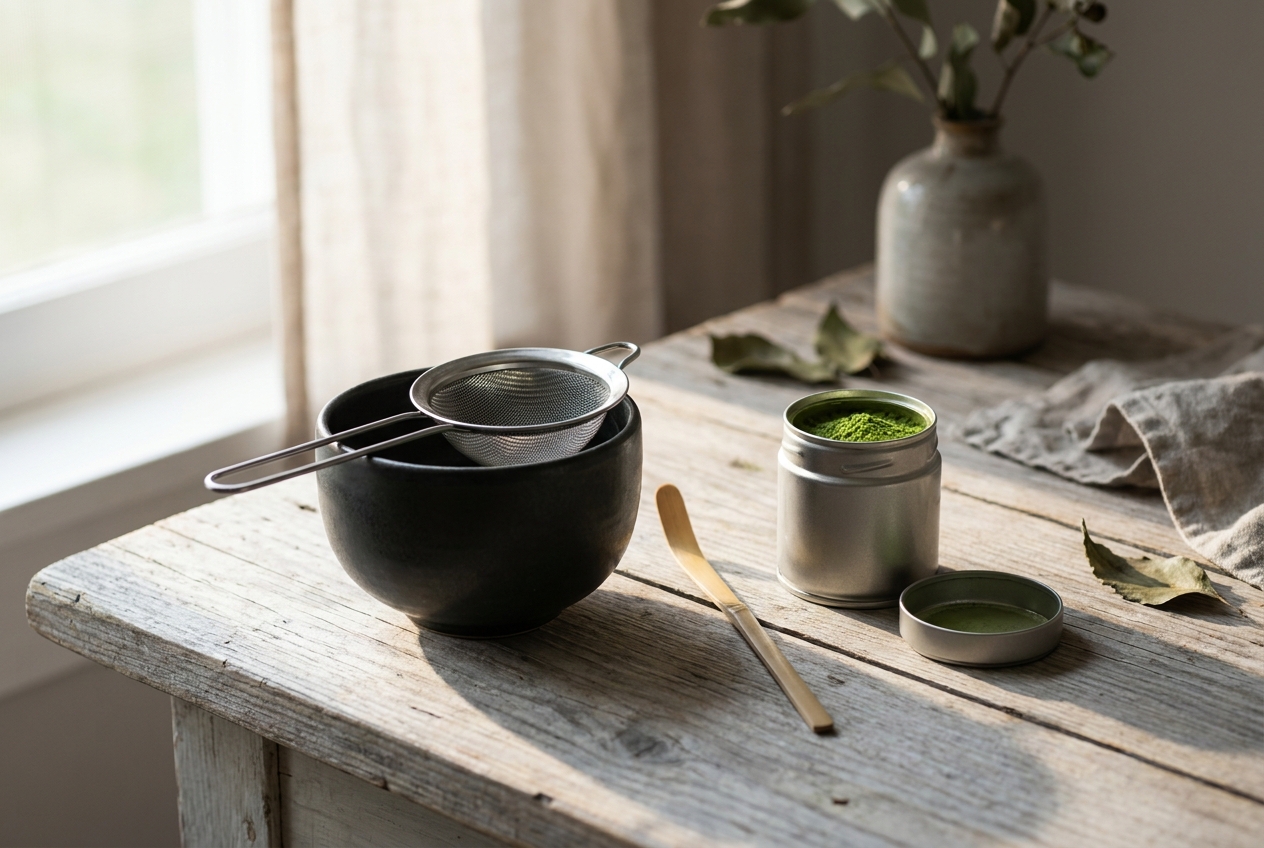
Use the strainer in your drawer. If it is a fine mesh tea strainer, it is almost certainly in the 40–60 range already. Hold it over the chawan, tip 2 g in, and push it through with the flat of a spoon or the chashaku. Ten seconds.
Make a paste first. Add a few drops of water to the measured powder and work it into a smooth paste before the rest of the water goes in. This is the standard workaround and Nio Teas recommends it themselves. It does not break every lump, but it stops the ones that survive from floating on the surface as dry islands.
Stop the lumps forming. Buy 20–30 g tins rather than 100 g, keep them sealed and cool, and close the tin between bowls instead of leaving it open next to a kettle. Humidity is the input to this whole problem; the sieve is downstream of it.
Who should actually buy one
There is a real case, and it is narrower than the internet suggests. Koicha — thick tea, roughly four grams to a few tablespoons of water — is unforgiving, because there is not enough liquid for a lump to disperse into even if you wanted it to. Volume and speed: if you are making two or three bowls every morning, or working behind a counter, batch-sifting into a caddy stops being a nicety. And as a gift, where the object is part of the present rather than a solution to a problem — a sifter sits naturally alongside the pieces in our matcha set guide and the tea gift guide.
Everyone else is buying a $10 object to solve a problem a $0 object already solves.
Frequently asked questions
Does sifting change how matcha tastes?
What it reliably changes is evenness. An intact lump resists the whisk, floats, and dissolves late, so the first mouthfuls are weaker than the last. Sellers also claim sifting produces a better foam, and that is plausible, but I have not found a side-by-side test of it and will not state it as fact.
Can I use a flour sifter?
Usually not — flour sifters are typically coarser than 40 mesh, so the lumps you are trying to break will fall through intact. A tea strainer is the right order of magnitude.
How often should I sift?
Per caddy fill, not per bowl, if you keep a caddy. Otherwise before each bowl, which takes about ten seconds.
Is it true that good matcha doesn’t clump?
Treat that claim carefully — it is usually made by people selling matcha. Clumping is driven by humidity and static charge, and as a general rule finer powders agglomerate more readily, not less, because surface area rises relative to weight. I have not found a controlled comparison of matcha grades for clumping, so I would not accept either side of that argument as settled.
Is a 200 mesh sifter better than 60?
No. At 75 µm the powder will not move under light pressure, and since the particle is 5–10 µm you have gained nothing in separation. You have only made the job harder.
Related reading
The powder is only one part of the setup. For the bowl itself, see our guide to choosing a chawan; for the whisk and scoop, chasen and chashaku; for the caddy that makes batch-sifting worthwhile, the natsume. Water matters more than most people expect — see water for Japanese green tea — and the wider context sits in our Japanese tea guide.
Disclosure: Nagori Ware is an independent editorial guide written from Japan. Some links elsewhere on the site are affiliate links. Parts of this site are drafted with AI assistance and checked against Japanese sources. General information, not legal or safety advice.