Japanese Curry Plate: What Size to Buy, and Why Kare Raisu Goes on a Deep Oval
If you are about to buy a plate for Japanese curry, buy an oval about 24 cm long and 16 cm wide, with at least 3.5 cm of listed height and a rim that climbs instead of flaring out. That is the whole answer. The rest of this page is why, and how to read a product listing so you don’t end up with a pretty oval that is really a flat platter.
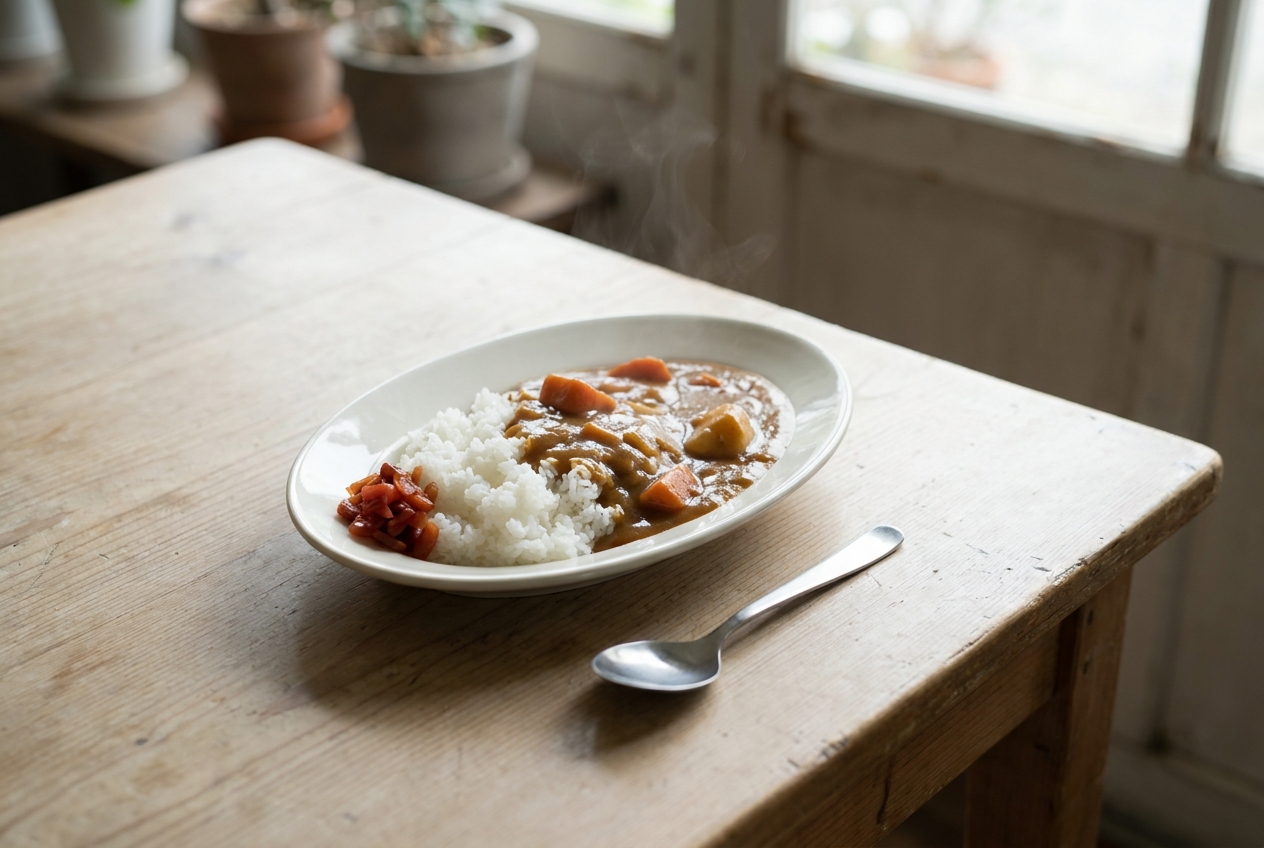
Here is the thing most guides skip. Japanese curry rice, kare raisu, is one of the few everyday Japanese meals where the rice and the main dish share one vessel. A normal Japanese table splits food across a rice bowl, a soup bowl and several small dishes. Curry puts two very different things side by side on one surface: a mound of rice that should stay partly dry, and a thick sauce that wants to spread. The plate has one job, which is to keep those two apart until your spoon brings them together.
Why a Japanese curry plate is oval
An oval has two ends. Rice goes on one end, curry is poured over the other end and the middle, and the long axis gives your spoon a straight runway from the dry side to the wet side. On a round plate the sauce runs toward the centre from every direction and the rice island shrinks as you eat. Japanese tableware writers will tell you the oval has been the default shape for curry for a long time, and that round or square plates work if you prefer the look. Shape is a preference. The two numbers below are not.
The size: 23–25 cm long for one person
Look at what Japanese makers actually sell as curry plates and the single-serving ovals cluster tightly. Muji’s oval is about 24 × 16 cm. A typical Mino ware “curry plate” listing gives 23 × 16.5 × 3.5 cm. A Japanese porcelain oval at 23 cm is described by its seller as right for one person’s curry or pasta. Japanese cooking sites that recommend a round plate instead put it at about 25 cm across. So the band is narrow: 23–25 cm long, 16–17 cm wide.
Why so specific? Do the arithmetic on a box of roux. House Foods’ small Vermont Curry box makes six servings from 250 g meat, 400 g onion, 230 g potato, 100 g carrot and 850 ml water. Add it up and you have a little under 2 kg in the pot before it reduces. That works out to roughly 300 g of curry per serving. That’s our estimate from the recipe, not a figure House prints. A standard Japanese rice bowl of cooked rice is about 150 g, and curry is usually served with more rice than that. So one plate carries something like 450–550 g of food, about half of it liquid. A 21 cm plate can hold that only if you pile it. A 27–29 cm oval holds it with room to spare. Sellers list those bigger sizes for meat and fish mains or shared platters, which tells you what they are really for.
| Listed length | What it is really for | For curry? |
|---|---|---|
| 21–22 cm | A child’s portion, katsu without much sauce, a side dish | Only for small eaters |
| 23–25 cm | One adult serving of curry, pasta, a one-plate lunch | Yes — the default |
| 27–29 cm | Fish or meat mains, a platter to share | Too big for one; fine for katsu curry with a full cutlet |
The one exception is katsu kare. A whole pork cutlet is long, and it sits across the rice, so it needs length more than depth. If katsu curry is what you make most, a 25–27 cm oval earns its space. For everyone else, 24 cm.
The depth: why 3.5 cm on the listing is the floor
Japanese curry is thick, and that’s not a coincidence. The usual history goes back to the Imperial Japanese Navy. It served curry over rice instead of with bread, and thickened it with flour so it would not slop around on a moving ship. That thickness is why a plate works at all. A thin Thai or South Indian curry needs a bowl. Japanese roux will sit on a shallow well and stay put.
Shallow, though, not flat. Every Japanese buying guide says the same thing: curry needs some depth, so pick a plate whose rim actually rises. The listings that sell as curry plates sit at about 3.5 cm high, and the deep ones go to about 5 cm. Below that you are looking at a dinner plate, and the curry will reach the edge before you are halfway through.
Now the trap. The listed height is measured from the table to the top of the rim. That includes the foot ring underneath. A plate listed at 3.5 cm has less than 3.5 cm of usable well, and a plate listed at 2.5 cm, which looks almost the same in a photo, may hold sauce only a centimetre or so deep. Product pages almost never say how much of the height is foot. That’s the same silence we wrote about in how to read a Japanese tableware listing. So treat the listed height as an upper limit and buy above it.
Why not just use a bowl?
You can. In Japan curry rice turns up on everything from flat plates to soup bowls, and nobody will stop you. But a bowl changes the dish. Rice in a deep bowl sinks under the sauce. The first spoonfuls are all curry, the last are all wet rice, and you lose the choice of how much sauce goes with each bite. The bowl’s wall also gets in the way. A spoon has to come out at a steep angle, so you end up scraping. A curry plate’s rim rises just enough to push food against, and the spoon slides along it and out.
If you already own a good donburi bowl, that is the right vessel for curry udon or for curry poured over rice as a rice-bowl dish, which is a different meal. It is the wrong vessel for kare raisu as it’s served at a Japanese home or diner. A round pasta plate is the closest Western substitute, if its rim really rises.
Buy this, not that
Buy an oval listed at 23–25 cm long and at least 3.5 cm high, with a rim that turns up rather than out. If you make katsu curry most weeks, go to 25–27 cm. Don’t buy a “curry plate” listed under 3 cm high. After the foot ring that’s a flat plate, and the sauce will find the edge. And if you reheat leftovers on the plate, skip gold or silver rims.
Rim, glaze and weight: the details that decide daily use
Rim direction. On a product photo taken from above, a flaring rim and a rising rim look identical. Find the side-on shot. You want the wall to curve up from the well, not open out like a saucer. A wide flat rim is a decorative border. It holds nothing.
Glaze. Turmeric stains. A glossy glaze on porcelain wipes clean. A matte or semi-matte glaze on stoneware can take on a faint yellow tint in the well if curry sits on it overnight. That’s not damage, but it’s not what you saw in the shop either. For a plate that will see curry every week, porcelain from places like Hasami or Arita is the easy choice. If you love a matte stoneware piece anyway, rinse it after the meal rather than the next morning. Our ceramics care guide covers the rest.
Gold and silver trim. Metallic rims and the microwave don’t mix, and the trim wears with washing. Curry is a dish people reheat. Buy plain. Whether a particular plate can go in the microwave or dishwasher at all is its own question, and we answer it in our microwave and dishwasher guide.
Weight. An oval this size in thick stoneware can be heavy enough that a stack of four becomes a two-handed lift. Porcelain at the same size is thinner and lighter. If the plates live on a high shelf, that matters more than the glaze.
Where the fukujinzuke goes
Curry rice usually comes with a pickle on the side: fukujinzuke, the sweet red relish of chopped vegetables, or rakkyo, small pickled shallots. At home they go straight onto the plate, in the corner the rice end leaves free. That’s one more reason for 24 cm rather than 21. If you want the pickle kept apart from the sauce, a mamezara about 8–10 cm across beside the plate does it. Our guide to Japanese small dishes has the sizes.
Curry is eaten with a spoon, not chopsticks, because it’s too liquid to pick up. A Western dessert or table spoon works fine. A renge is the wrong tool here. It’s built to carry broth to your mouth, and its flat bottom can’t sweep rice along the plate.
One oval, more than one dinner
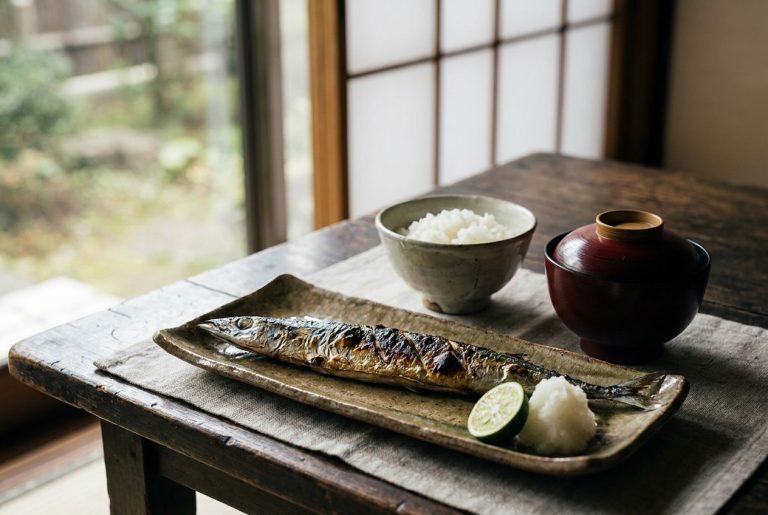
A 24 cm oval with 3.5–5 cm of height is the most useful odd-sized plate you can own. It takes pasta, saucy stir-fries, omurice with its ketchup or demi-glace, hayashi rice, and a grilled fish if the fish is small. It won’t take a whole sanma, though. That needs a long plate, and we explain why the so-called sanma plates are usually too short in our long plate guide. If you are building a set from scratch, see where the curry oval fits in our guide to Japanese dinnerware sets and the wider Japanese tableware guide.
Measure the plate you already eat pasta from. If it is about 24 cm long and the side view shows a real wall, you already own a curry plate. If it is flat, or round and 27 cm, the oval is the one piece that will make Friday-night curry look and eat the way it does in Japan.
Disclosure: Nagori Ware is an independent editorial guide written from Japan. Some links elsewhere on the site are affiliate links. Parts of this site are drafted with AI assistance and checked against Japanese sources. General information, not legal or safety advice.