Oyakodon Pan Size: Measure the Bowl, Not the Stove
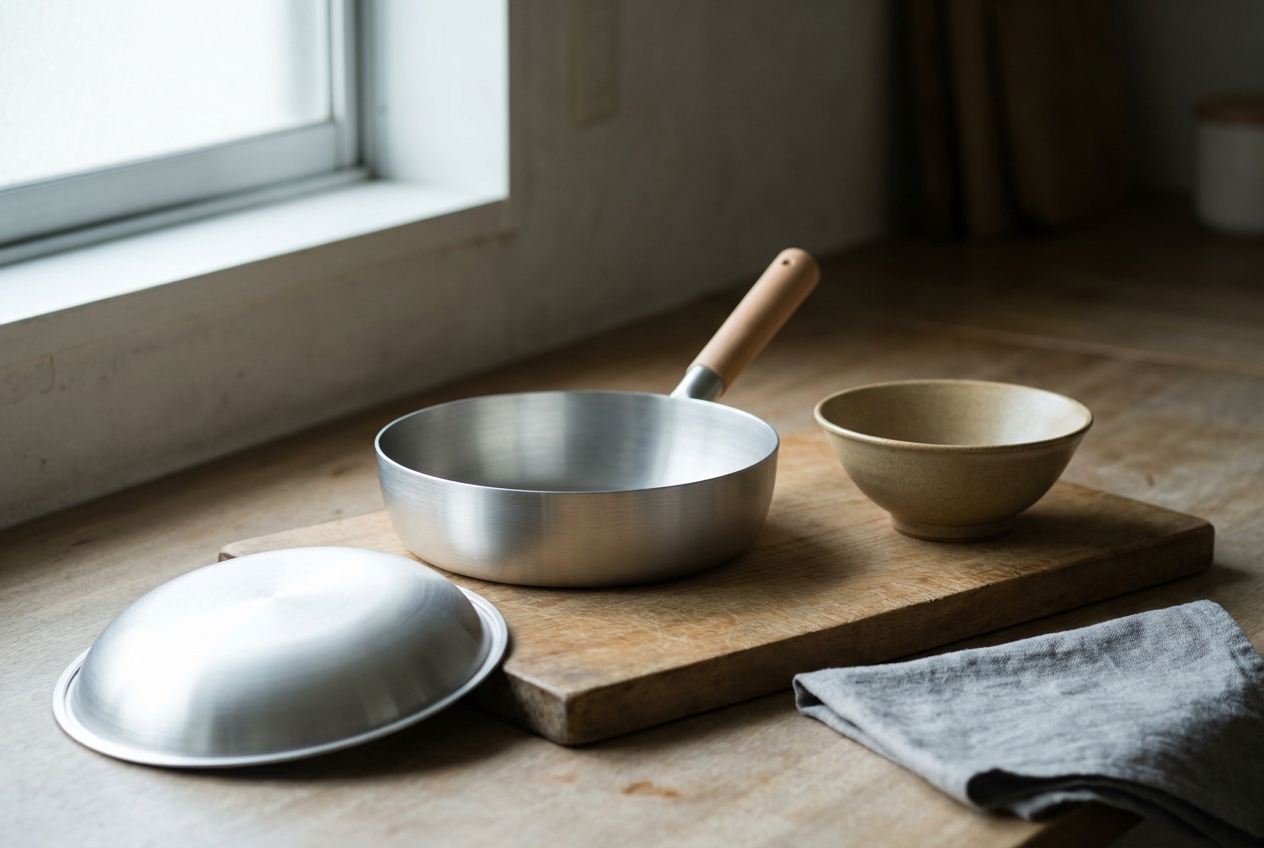
Buy 16 cm, and buy it because of your bowl, not your stove. An oyakodon pan has one job that an ordinary small saucepan cannot do: the set egg has to leave the pan in one disc and land on the rice intact. That only works if the pan is narrower than the mouth of the bowl you are serving into. Most donburi bowls used for oyakodon measure 15–17 cm across the inside of the mouth, so a pan sold as 18 cm is already too wide before you crack an egg.
Almost every English-language guide tells you 160 mm is “the size for one person,” which is true, and then tells you to match the pan to your bowl, which is also true, and then recommends a 14–16 cm bowl in the next paragraph — which makes the first two pieces of advice impossible to follow at the same time. Nobody runs the arithmetic. That is what this page is for.
The measurement that decides everything is not on the pan
Watch anyone make oyakodon in Japan and the last movement is the whole point. You take the pan off the heat, tilt it over the rice, and let the egg and chicken slide off in one piece, still in the shape of the pan. Nothing is spooned. Nothing is rearranged. The Japanese description of the pan says exactly this: the shape lets you slide the finished topping onto the rice with one hand.
So the egg leaves the pan as a disc roughly the width of the pan’s floor. For that disc to arrive whole, it has to pass through the mouth of the bowl. If the disc is wider than the opening, the edges catch on the rim and tear, and you end up pushing the rest in with chopsticks — which works, and looks like exactly what it is.
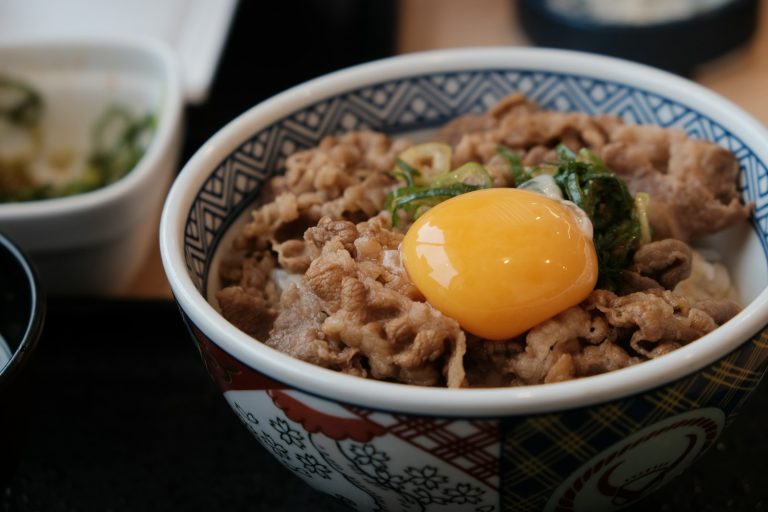
That gives you a rule with a number in it. Pan floor + about 1.5 cm ≤ the inner mouth of your bowl. In our donburi bowl guide the everyday rice donburi — the one people actually eat oyakodon and gyudon from — is 16–17 cm across and holds about 700 ml. Set a 15 cm pan against a 16.5 cm bowl and you have roughly 8 mm of clearance on each side. That is enough to aim with, and not so much that the egg falls in folded.
Why the number in the listing cannot be trusted
Here is where the rule gets difficult to apply: the diameter printed in a listing may be the inner diameter, the outer diameter, or neither consistently.
Japanese professional suppliers tend to be explicit. Endo Shoji’s restaurant-grade pan AOY11 is sold as 16.5 cm (inner diameter), with the measurement spelled out in the product name itself — three-layer clad body, beech handle, made in Japan. That is a number you can design around.
Consumer listings aimed at export are looser. One pan currently sold to English-speaking buyers is titled “178 mm” while the specification table on the same page gives φ18 cm as the outer diameter and a maximum capacity of 560 ml. Both numbers are probably honest — 178 mm inside, 180 mm outside — but a buyer reading only the title will shop for a 17.8 cm pan and receive something that measures 18 cm across the rim. Against a 16.5 cm bowl, those two numbers land on opposite sides of the line.
This is the same silence we described in how to read a Japanese tableware listing: nothing is being hidden, but nothing is being guaranteed either. Two habits fix it. First, when a listing gives one number and no label, assume it is the outer diameter and subtract 1 cm. Second, learn the two words that appear in Japanese specification tables — naikei (内径, inner) and gaikei (外径, outer). They show up constantly, and we collected the rest of them in our guide to Japanese tableware sizes and terms.
15, 16.5, 18 cm — what each one actually buys you
The traditional reference range for this pan is narrow. Japanese descriptions put the mouth at 14–16 cm and treat it as a single-serving tool, full stop. The consumer market has drifted upward to 16–18 cm, partly because home cooks want the option of stretching one pan to two servings. That drift is where the mismatch comes from.
| Pan (inner) | Eggs | Smallest bowl it empties into | Who it is for |
|---|---|---|---|
| 14–15 cm | 2 | 16 cm | One serving, every time. The safe default if your bowls are on the small side. |
| 16–16.5 cm | 2–3 | 18 cm | The restaurant standard. Needs a genuinely large donburi, not a rice bowl. |
| 17–18 cm | 3 | 19.5 cm | Noodle-bowl territory. Buy only if you already own a bowl that big and have measured it. |
Read the third column before the first. People buy the pan first because the pan is the interesting object, then discover that the bowl they have been eating rice out of for years is 15 cm and the whole plan was never going to work.
Buy this, not that
Take a ruler to the inside of your donburi bowl before you buy anything, then buy the pan 1.5 cm smaller than that number — for most people that means a 15–16 cm pan, not the 18 cm one with the better photographs. Don’t buy an oyakodon pan at all if you own a 20 cm frying pan and only make this once a month: you will get a slightly messier bowl and save the money and the cupboard space. The pan earns its place when you make donburi weekly, or when you care that it arrives looking like the picture.
The handle tells you which kitchen the pan was designed for
Oyakodon pans come with the handle attached two ways: rising almost straight up from the rim (tate-e, 立柄), or set at roughly 30 degrees like an ordinary frying pan (yoko-e, 横柄). Japanese retailers commonly label the vertical one the Kanto type and the angled one the Kansai type. Treat that as shop vocabulary rather than settled history — the regional naming is not in the reference descriptions of the pan, which note only that both forms exist.
The functional difference is real, though, and it is about floor space. A vertical handle points at the ceiling, so a row of pans can sit on adjacent burners without the handles crossing — which is the entire problem a lunch counter has when six bowls are ordered at once. It also stops a light pan from being knocked off the range by a passing elbow. An angled handle gives you the wrist position you already have from every other pan you own, which matters more at home, where you are making one bowl and nobody is in your way.
Copper, aluminium, stainless — and the induction trap
The pan is thin and small, which exaggerates whatever the metal does. Copper conducts heat at roughly 400 W/m·K, aluminium around 237, and stainless steel around 16 — a difference of more than twenty times between the ends of that range. In a 15 cm pan holding two beaten eggs, that is the difference between the egg setting evenly and the egg setting in a ring around a pale middle.
Copper is what professional kitchens use, and it is genuinely better here: it holds enough heat that the pan temperature barely dips when cold egg hits it, so the custard sets fast and stays soft. It is also expensive, needs retinning eventually, and will not work on induction. Aluminium is the cheap, light, perfectly serviceable middle. Stainless on its own is the worst conductor of the three and is almost always sold with a non-stick coating or a clad base to compensate.
Now the trap. If you cook on induction, the grade of stainless matters and the listing will tell you in a way that looks like decoration. 18-0 stainless (SUS430) is ferritic, magnetic, and works on induction. 18-8 and 18-10 (SUS304) are not reliably magnetic and generally do not. Plain aluminium does not work either unless it has been given a steel base plate. The 18 cm export pan mentioned above lists SUS430 18-0 and states 100 V / 200 V induction compatibility — those two facts belong together, and when a listing gives you one without the other, that is the thing to ask about. If you are not sure what you already own, hold a fridge magnet to the base: if it grips firmly, induction will heat it.
One more practical note: most of these pans have a bare wooden handle, usually beech. Wash it by hand and dry it standing up. Soaking swells the wood and loosens the ferrule, and a loose handle on a 260 g pan full of hot egg is a worse problem than a stained one.
The lid, and the hole in the middle of it
Pick up the lid of a proper oyakodon pan and it will have a raised centre with a hole through it, like a short chimney. That is deliberate. The lid is there for about forty seconds — long enough for the steam trapped above the egg to finish the top surface — and the vent keeps that from turning into a boil. Without the hole, condensation collects on the underside and rains back down, and the custard you were setting becomes a wet one.
This is the opposite job from the lid on a lidded donburi bowl, which exists to hold heat and aroma in at the table and is therefore solid. Seeing those two lids side by side is the quickest way to tell a cooking vessel from a serving vessel in a Japanese catalogue: holes mean heat is passing through, solid means heat is being kept.
Plenty of pans are sold without a lid. You can cover the pan with any flat lid or a plate for those forty seconds and get most of the way there; you can also simply leave it off and accept a slightly looser top. It is not the part worth paying extra for.
Can you make two servings in one pan?
Physically, a 16–18 cm pan will hold the ingredients for two. Whether it should is a different question, and the honest answer is that it costs you the thing you bought the pan for.
Double the volume in the same diameter means a deeper layer, which means the bottom overcooks while the top is still liquid — and then you have to divide the disc to serve it, which is precisely the single clean slide the pan exists to perform. Japanese reference descriptions call this a single-serving pan and leave it there. The vertical handle in the diagram above is the physical evidence of the same assumption: Japanese retailers recommend it specifically to people who want to run several pans at once, which is a thing you only need if one pan means one bowl.
If you regularly cook for two, buy two small pans rather than one large one, or use a yukihira nabe you probably already own and serve with a spatula. Don’t buy an 18 cm oyakodon pan as a compromise: it is too big for the one-bowl slide and too small to cook two portions well.
Frequently asked questions
What size oyakodon pan should I buy?
Measure the inside of the mouth of the bowl you will serve into and subtract about 1.5 cm. For the common 16–17 cm donburi bowl, that is a 15 cm pan. If you have no bowl yet, buy a 15–16 cm pan and an 18 cm bowl and the pairing will work for anything you put in it.
Is 160 mm or 180 mm better?
160 mm, for almost everyone. 180 mm only makes sense if you already own a noodle-sized donburi of 19.5 cm or more, which most people do not — and the extra width buys you nothing except a thinner, faster-cooking layer of egg.
Does the listed diameter mean the inside or the outside of the pan?
It depends on the seller, and the same page can use both. Japanese professional listings usually state naikei (inner) explicitly. Export listings often put one number in the title and a different one in the specification table. When in doubt, treat the number as the outer diameter and subtract a centimetre.
Can I use an oyakodon pan for anything else?
Yes — katsudon, tamagodon and gyudon are the same movement, and it is a good small pan for a single omelette or for poaching one egg. It is not a sauté pan; the sides are too straight and the floor too small to toss anything.
Do I need the lid?
No. A lid with a vent hole makes the top of the egg set a little more evenly, but any flat lid or plate held over the pan for thirty to forty seconds does the same job. Buy the pan for its diameter, not for its lid.
Related guides
- Donburi bowl guide — the size bands this page measures against.
- Japanese tableware sizes and terms — naikei, gaikei, sun and the rest of the specification vocabulary.
- How to read a Japanese tableware listing — what a product page is not telling you.
- Yukihira nabe sizes — the general-purpose small pan, if you decide you don’t need a dedicated one.
- Best Japanese rice bowls — why the bowl you eat rice from is not a donburi.
Disclosure: Nagori Ware is an independent editorial guide written from Japan. Some links elsewhere on the site are affiliate links. Parts of this site are drafted with AI assistance and checked against Japanese sources. General information, not legal or safety advice.