Tamagoyaki Pan Size: How Many Eggs Is Your Pan Actually For?
Multiply the floor of the pan, width by length in centimetres, and divide by 65. That is roughly how many eggs it was built for. A 12 × 12 cm pan is a two-egg pan. A 13 × 18 cm pan is a three-to-four-egg pan. An 18 × 18 cm square is a five-egg pan. If you cook two or three eggs at a time, which is what most home recipes call for, buy a pan of about 12–13 cm by 17–18 cm and stop reading size charts.
That rule exists because the size charts disagree with each other. One shop tells you a 12 cm pan is for two eggs; another lists a 15 cm square for three to four; a well-known American recipe uses a 19 × 14 cm pan for just two. Nobody is lying. They are each assuming a different thickness of egg. Once you know that, the numbers line up, and the question most people actually have — will this pan be too small? — gets a straight answer.
This page covers whether you need a tamagoyaki-ki at all, how to pick the size, the three shapes you will see in Japanese listings, and what nonstick, iron and copper each ask of you. Including the question that sits unanswered on Quora: how do you season an iron one?
Do you need a tamagoyaki pan, or will a regular frying pan do?
You do not need one. A round nonstick frying pan of about 20 cm makes a perfectly good rolled omelette: you pour a thin layer, roll it to one side, push it back, pour again, and trim the two rounded ends when it is done. Japanese cooking sites publish exactly this method for people without the square pan, and it works.
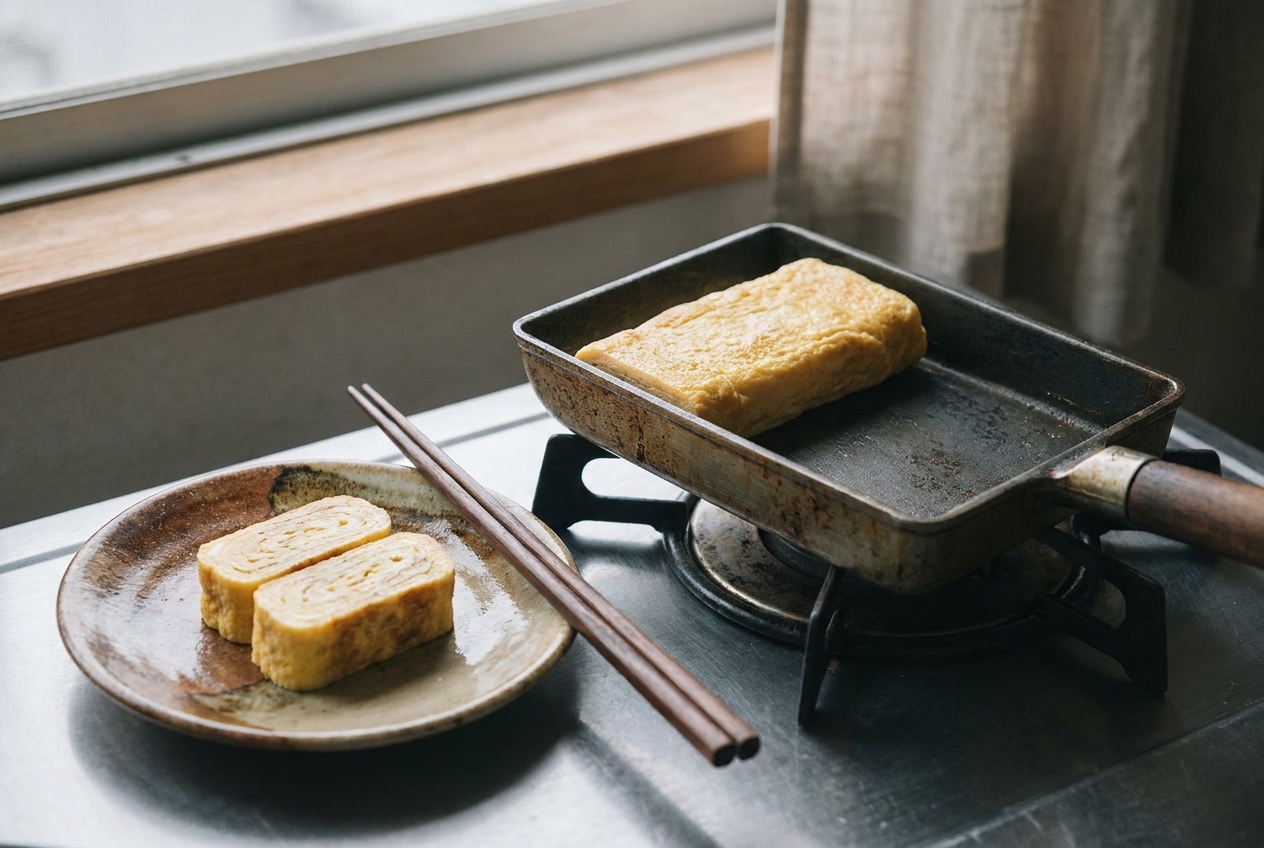
What the rectangular pan gives you is corners. In a round pan the egg is thin at the edges and thick in the middle, so every roll is a little lopsided and you lose the ends to trimming. In a rectangle, each layer is the same thickness from wall to wall, so the roll comes out as a block with flat sides — the shape that sits in a bento box without sliding around, and slices into even pieces.
So the honest answer depends on how often you will use it. If you make tamagoyaki a couple of times a month, use the pan you have and trim the ends. If you are packing it in a bento three mornings a week, the square pan pays for its drawer space within a fortnight, mostly in the minutes you stop spending on fixing lopsided rolls.
How big a tamagoyaki pan do you need? Count eggs, not centimetres
Here is where the “65” comes from. We took the egg counts that Japanese makers and Japanese shops publish for their own pans, multiplied out each pan’s floor, and divided. The makers who build these pans by hand — Nakamura Douki in Tokyo, the Tsubame copper workshops, and the copper pans sold by Musubi Kiln — land between about 55 and 75 cm² of floor per medium egg. The middle of that range is 65.
| Pan (as listed) | Floor | Eggs the seller recommends | cm² per egg |
|---|---|---|---|
| 12 × 12 cm square (Musubi Kiln, copper) | 144 cm² | 2 | 72 |
| 12.5 × 16.7 cm (Nakamura Douki S, copper) | 209 cm² | up to 3 | 70 |
| 15 × 15 cm square (Musubi Kiln, copper) | 225 cm² | 3 | 75 |
| 15 cm Kanto square (Marushin, copper) | 225 cm² | 3–4 | 56–75 |
| 13.8 × 18.2 cm (Nakamura Douki L, copper) | 251 cm² | about 4 | 63 |
| 18 cm Kanto square (Marushin, copper) | 324 cm² | 5–6 | 54–65 |
| 19 × 14 cm (7½ × 5½ in, US recipe pan) | 266 cm² | 2 | 133 |
The odd one out is the last row, and it explains the confusion. An American recipe that uses two eggs in a 19 × 14 cm pan is making thin layers — about four rolls, a lighter omelette. Japanese makers are sizing for the thick, many-layered block you see in a bento or at a sushi counter. Neither is wrong, but if you buy by the American chart and then follow a Japanese three-egg recipe, the pan will feel small. If you buy by the Japanese chart and follow the American recipe, you will spread two eggs too thin to roll.
Two practical warnings about the numbers on a listing. First, check whether the size is the inside floor or the outside of the pan including the rim; export listings mix them freely, and the difference on a 13 cm pan can be a centimetre a side. When the page does not say, assume it is the outside and take a centimetre off each dimension before you divide. Our guide to Japanese size terms covers the naikei (inside) and gaikei (outside) labels. Second, on the most-reviewed nonstick pan on Amazon, size is the single most-discussed point, and the reviews split between “just right” and “smaller than I expected” — some say it takes only one to one and a half eggs at a time. That is the same pan, judged against different recipes. Count your eggs before you read the reviews.
Square, long or wide: the three shapes in Japanese listings
Japanese shops sort these pans by region, and you will see the words in translated listings without any explanation. Kanto-gata (Tokyo style) is square. Kansai-gata (Osaka–Kyoto style) is a rectangle that runs long away from the handle. Nagoya-gata is a rectangle turned the other way, wide across the handle and short front to back.
The shape changes what the finished roll looks like. Most recipes roll the egg along the depth of the pan, toward you or away from you. In a long Kansai pan each pour is a long sheet that wraps around the roll several times, so the finished block is short and thick with many layers. In a wide Nagoya pan each sheet is short and wraps once or twice, so the block comes out long and slim — easy to slice into many thin pieces. The square sits between them.
If you are buying your first one and have no strong preference, take a rectangle of about 13 × 18 cm with the handle on the short side. It handles two to four eggs, fits a standard bento compartment once sliced, and is the size most Japanese home recipes quietly assume.
Nonstick, iron or copper: what each one asks of you
The material decides how much work the pan is, not how good the omelette is. All three make excellent tamagoyaki in practised hands. They differ in how forgiving they are on a Tuesday morning.
| Nonstick (coated aluminium) | Iron | Copper (tin-lined) | |
|---|---|---|---|
| First week | Easiest. Egg releases with almost no oil. | Needs seasoning before first use; may stick until it builds up. | Needs oiling before first use; sticks if underheated or under-oiled. |
| Heat | Even enough. Keep it at low to medium. | Slow to heat, holds heat well. | Fastest and most even. Use less heat than you think. |
| Induction | Only if the base is marked for it. | Usually works; check the listing. | No (copper pans like Nakamura Douki’s are not for induction). |
| Tools | Wood or silicone only. | Anything. | Wood; no metal scraping of the tin. |
| Lifespan | Until the coating wears; then replaced. | Decades, if kept dry and oiled. | Decades; the tin lining can be redone by a workshop. |
| Weight (approx.) | About 0.45 kg | Heavier; Iwachu’s long cast-iron pan is about 1.2 kg | About 0.6–0.7 kg |
Buy this, not that
If you are learning, buy a nonstick rectangle of about 13 × 18 cm and expect to replace it in a few years. Don’t start on copper: it rewards someone who already knows what the egg should sound like when it hits the pan, and a cold, dry copper pan is the fastest way to a torn first layer. And don’t buy the 18 × 18 cm square unless you regularly cook five eggs at once — two eggs in it spread too thin to roll.
How do you season an iron tamagoyaki pan?
Read the sheet in the box before you do anything, because iron pans ship in two different states and the instructions are opposite. Some come with a varnish against rust that the maker tells you to burn off over the flame. Others come with a clear protective coating that the maker tells you not to burn or scrub off. Treat the wrong one the wrong way and you are starting over.
Once the factory finish is dealt with, the makers’ instructions converge on a short routine:
- Wash the pan in hot water and put it back on the heat until every drop has gone.
- Pour in a few tablespoons of a neutral oil with a high smoke point and heat it on low to medium until it just begins to smoke. Open a window.
- Tip the oil out, then rub a thin film over the whole inside, corners included, with a folded paper towel held in tongs or chopsticks.
- Let it cool and repeat two or three more times. Cookware makers commonly suggest three to five rounds for an even surface.
After that, the pan seasons itself every time you use it. Rinse it in hot water, wipe it dry, put it on the heat for a few seconds to drive off the last of the moisture, and leave a thin film of oil before it goes away. A rusty spot is not the end of it: scrub the rust off, then re-season that area. What makes eggs stick in an iron pan is almost never the seasoning. It is a pan that is not hot enough when the first layer goes in.
Copper: the rule you cannot skip
Japanese copper tamagoyaki pans are lined with tin, which melts at about 232°C — well below what an empty pan on a gas flame reaches. Every copper maker we checked says the same thing: never heat one empty. Kama-asa, the Tokyo kitchenware shop, warns that an empty copper pan can warp and lose its tin. Oil it first, heat it gently — Musubi Kiln suggests low to medium heat for four to five minutes — and let it come up to temperature with the oil in it.
Wash it by hand with a soft sponge, never in the dishwasher, and dry it straight away. The tin will darken and look patchy within weeks. That is normal and is not damage. When the copper colour starts to show through the lining in the area you cook on most, a workshop can re-tin it — which is the whole reason a copper pan costs what it does. You are paying for something that is meant to be repaired rather than replaced.
Frequently asked questions
What can I use if I don’t have a tamagoyaki pan?
A round nonstick frying pan of about 20 cm. Pour each layer thin, roll to the side, and trim the two rounded ends when you are done. You can square the roll up by wrapping it in a bamboo sushi mat for a minute while it is still warm.
How many eggs go in a 14 × 18 cm or 15 × 20 cm pan?
Using the divide-by-65 rule, a 14 × 18 cm pan (252 cm²) suits about 4 medium eggs for a thick roll, and a 15 × 20 cm pan (300 cm²) about 4 to 5. For thin, lighter layers you can use as few as half that. If the listing gives outside measurements, take a centimetre off each side first.
What utensils do I need?
Long cooking chopsticks for lifting and rolling the edge of each layer, and a folded paper towel dipped in oil to wipe the pan between layers. A thin wooden or silicone spatula helps with the first roll. On nonstick, keep metal out of the pan entirely.
Is a tamagoyaki pan good for anything else?
Yes. Reviewers on the most popular nonstick pan use it for Korean rolled omelette, a square egg that fits a breakfast sandwich, and small portions for children. The straight sides make it a poor sauté pan, though, so it will not replace a small saucepan or a frying pan.
Related guides
- Japanese bento box guide — where a block-shaped tamagoyaki ends up, and how big the compartments are.
- Oyakodon pan size — the other single-purpose Japanese egg pan, sized by the bowl instead of the egg.
- Saibashi cooking chopsticks — the tool that does the rolling.
- Japanese tableware sizes and terms — inside and outside measurements on a listing.
- How to read a Japanese listing — what the product page is not telling you.
Disclosure: Nagori Ware is an independent editorial guide written from Japan. Some links elsewhere on the site are affiliate links. Parts of this site are drafted with AI assistance and checked against Japanese sources. General information, not legal or safety advice.