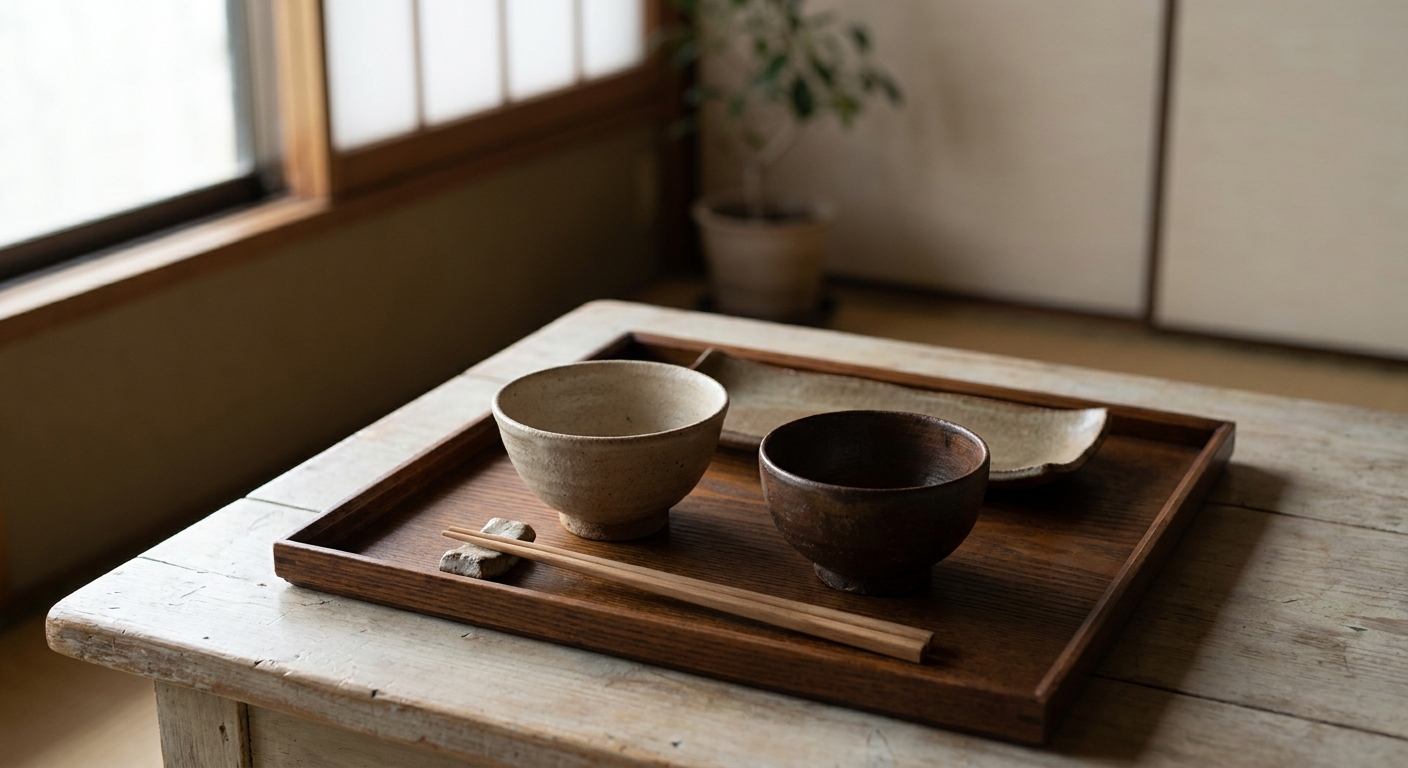
What Size Japanese Tray to Buy: Obon, Oshiki, Ozen, and the Depth Nobody Measures
Buy the tray that contains the dishes you already own, not the one that matches the number of people you feed. A Japanese tray is not a carrying device with a nice finish. It is the outer edge of one person’s meal, and its size was settled by what goes inside it several centuries before anyone had to write a product listing.
That is also why the sizes look arbitrary in English. A shop will offer 27.3 cm, 30.3 cm, 36.4 cm, 39.4 cm, and you assume someone converted from inches badly. Nobody converted anything. Those are whole numbers — nine sun, one shaku, one shaku two, one shaku three — in the unit the trade still uses. Once you can read them, the whole shelf sorts itself out.
One more thing to fix early: obon, oshiki and ozen are three different objects, and every English shop calls all three a tray.
Obon, oshiki, ozen: three objects, one English word
Obon (盆) is the carrying tray. It has a raised rim the whole way round, because its job is to get a wet bowl from the kitchen to the table without it travelling. Sizes follow the load, not the meal. This is the one most English shops mean when they say “Japanese tray.”
Oshiki (折敷) is a square board, flat or with a lip of only a few millimetres, that goes under one person’s setting. Japanese reference works describe it as a square tray made from thin split hinoki, and trace the name to the ancient practice of folding leaves down to serve food on — ori, to fold; shiki, to lay down. It has been in use for formal and everyday meals since the Heian period. English shops usually call it a placemat, which is close enough in function and misleading in price: a wooden oshiki costs several times what a cloth mat costs, and for a reason we will get to.
Ozen (膳) is an oshiki with legs — a table for one person, used when there was no shared table to sit at. The character is 膳, which means a served meal. It has nothing to do with Zen Buddhism, which is 禅. Different character, different word, and the coincidence in romaji has sold a great many “zen trays” to people looking for something meditative.
The three are a sequence, not alternatives. Japan ate off individual trays for most of its recorded history; the hakozen, a box holding one person’s dishes whose lid turned over to become their tray, carried the habit through the Edo period; and the shared low table, the chabudai, only overtook it at the very end of the Taishō era. That is recent — and when it happened the ozen lost its legs, leaving the oshiki on the table as the frame without the height.
Why Japanese tray sizes look random: shaku and sun
Japanese tableware is still sold in sun (寸), where one sun is 3.03 cm, and ten sun make one shaku (尺) of 30.3 cm. Trays are big enough that the trade mostly talks in shaku: a shaku-ni tray is one shaku two sun, which is 36.4 cm. Japanese sellers write 尺二 and 尺三 in the product name and then print “36 cm” or “39 cm” underneath, rounded. English sellers print only the rounded figure, so the pattern disappears and the sizes look like noise. The full unit key for plates, bowls and pots is here
| Traditional size | Centimetres | Inches | What it is in practice |
|---|---|---|---|
| 5寸 · go-sun | 15.2 cm | 6.0 in | Small square oshiki; a cup and one sweet |
| 8寸 · hassun | 24.2 cm | 9.5 in | The classic square oshiki. Reference works call the 8-sun square the daikaku, the large square |
| 9寸 · kyu-sun | 27.3 cm | 10.7 in | Tea, breakfast, a light one-plate meal |
| 1尺 · shaku | 30.3 cm | 11.9 in | The smallest round tray that holds a full setting — only just |
| 尺一 · shaku-ichi | 33.3 cm | 13.1 in | Comfortable round; tight rectangle |
| 尺二 · shaku-ni | 36.4 cm | 14.3 in | The everyday one-person rectangular tray |
| 尺三 · shaku-san | 39.4 cm | 15.5 in | The teishoku tray — what a Japanese set-meal restaurant puts in front of you |
| 尺四 · shaku-yon | 42.4 cm | 16.7 in | Serving several dishes for the table, or two light settings |
Two cautions on reading those numbers. First, as with plates, the figure is the outside edge, and on a rimmed obon the usable flat field inside the rim is one to two centimetres smaller in each direction. Second, rectangular trays are quoted long side first and the short side is not standardised: a 36.4 cm tray may be 26 cm deep or 29 cm deep, and that difference decides whether a bowl fits behind your chopsticks. If the listing gives one number for a rectangle, write and ask for the other. Reading what a Japanese listing leaves out is its own skill
What size Japanese tray do you need? Measure the dishes, not the people
Here is the step nearly every guide skips. The reason a Japanese tray is the size it is, is that a Japanese meal has a fixed footprint. Ichijū-sansai — one soup, three dishes, rice — is not a serving suggestion; it is a layout, with each piece in a known place. Rice in front left, soup in front right, the main dish behind. We set out the full placement, and what moves with the season, in the table-setting guide. The tray is the box that layout has to fit inside.
Run the arithmetic with real dishes rather than imagined ones, and do it in two directions, because they behave differently. A standard adult Japanese rice bowl is 11–12 cm across. A soup bowl is about the same. Chopsticks are 22–24 cm long and lie flat across the near edge on a chopstick rest.
Width is easy. Rice and soup side by side come to 24 cm, the chopsticks want 24 cm, and a couple of centimetres of margin each side puts you at 28–30 cm. Almost any tray sold as a tray clears that.
Depth is where it goes wrong, and almost nobody warns you. Work down from the front edge of a 27 cm tray: 1 cm of margin, 2 cm for the chopsticks and their rest, a 12 cm bowl, a centimetre of air, and a centimetre at the back. That leaves a band roughly 10.5 cm deep for everything behind the bowls. A round seven-sun plate is 21.2 cm across, and a circle is as deep as it is wide, so it needs twice the depth that exists. It does not fit. It will sit on your soup bowl.
This is the part worth carrying away, because it runs backwards as well as forwards. The Japanese main-dish plate is a long rectangle, or an oval, or a modest six-sun round, and the reason is not aesthetic restraint. It is that the tray it had to live on was 27 or 28 cm deep, and a large round plate has never fitted. The dishes were shaped by the frame. If you are furnishing a Japanese table with 26 cm Western dinner plates, no tray on the market will help you, and the honest advice is to change the plate rather than hunt for a bigger board.
From there the sizes sort into a simple rule. A shaku-ni at 36.4 × 27 cm carries rice, soup, one rectangular main dish and one small dish, and that is genuinely the everyday Japanese meal. A full four-dish ichijū-sansai wants a shaku-san at 39.4 × 28.7 cm — which is exactly the tray a Japanese set-meal restaurant hands you, and it is no coincidence. Musubi Kiln, which sells them, puts the recommendation at around 40 × 30 cm for a traditional meal; that is the same tray, described in round metric numbers instead of in shaku.
Round trays lose to the same depth problem twice over, because a circle wastes its corners exactly where a rectangular dish needs them. A 30.3 cm round holds a pot and two cups handsomely and cannot take a meal; 33 cm is the practical floor and 36 cm is comfortable. If a shop recommends a 30 cm round for a full setting, it is quoting the minimum rather than the workable size.
So: lay out the dishes you actually eat from, on a bare table, the way you actually arrange them. Measure the rectangle they make — both sides, and the depth is the one that will surprise you. Add 2 cm a side. Buy the next size up from the table above. This takes four minutes and it beats every recommendation on the internet, including this one, because it uses your dishes.
Rim or no rim: the one trade-off that is not about looks
A rim is not decoration and it is not neutral. It is a choice between two jobs the object cannot do at once.
- A raised rim carries. A full miso soup bowl on a flat board will slide if the board tilts three degrees. On a rimmed obon it will not. If the tray’s real life is a trip from the kitchen with somebody’s breakfast on it, buy the rim.
- A flat board serves. During the meal you slide a bowl off to lift it, and slide it back. On an oshiki that is one motion. Over a rim it is a lift, and with a hot bowl in one hand it is the motion that spills things. Japanese bowls are made to be picked up, which is exactly why the board under them stayed flat.
- A rim also decides how it stores. Rimmed trays nest but do not stack flush; flat oshiki stack like books. If you are buying four or six, measure the stack too.
The half-moon tray, hangetsu-bon, is the compromise that is everywhere in Japanese shops and rare in English ones: a low rim on the curve, a straight edge facing the diner so nothing has to be lifted over. Allow 36 cm and up, because the cut corners cost you the back of the tray.
Buy this, not that
If you are buying one tray and you eat Japanese food off it, buy a rectangular shaku-ni — 36.4 × 27 cm, flat or with a low lip. It is the size the meal is built around and it doubles as a placemat. Do not buy the 30 cm round tray that most English shops lead with: it photographs well, holds a teapot and two cups beautifully, and cannot take a main plate and a soup bowl at the same time. And do not buy the 46 × 35 cm family tray first — it will not fit your sink, your draining rack, or the gap beside the cupboard, and a tray you cannot store is a tray you stop using.
What it is made of, and what that commits you to
Most of what is sold in English falls into four groups, and the price gaps between them are larger than the photographs suggest. The figures below are what a Japanese specialist shipping to the United States was asking in September 2026, checked against Musubi Kiln’s tray and placemat listings; general marketplaces start well under these and antique dealers run well over.
| Type | Observed price | The honest summary |
|---|---|---|
| Plain hardwood or hinoki, oiled or bare | $25–200 | The original material for an oshiki. Light, and it marks. Water is the whole story: makers ask you to wipe it and let it dry rather than leave it standing wet. A plain ash tray from a Japanese specialist was $160–199; a generic one on a marketplace is a fraction of that, and so is the wood |
| Urethane-coated wood | $25–95 | What most “lacquer look” trays actually are. Hard-wearing and forgiving. The Japanese label says ウレタン塗装 and the English one frequently says nothing at all |
| Real urushi lacquer over wood | $93–420 | Deep, slightly soft-looking sheen; warms to the touch. Worth it if you will hand-wash it. How to tell it from the coated kind before you pay |
| Magewappa, bentwood | $60–200 | A single steamed strip of cedar bent round and stitched with cherry bark. Very light, and the grain is the decoration |
That price list also settles the placemat question from earlier. A two-sided hegi-me oshiki — the split-plank surface, the traditional one — was $121. You are not being overcharged for a mat; you are buying a piece of finished joinery that happens to sit flat.
Insist on the two lines Japanese sellers print as a matter of course and English resellers drop: material (素材) and finish (塗装). “Wood” alone tells you nothing — a urethane tray and an urushi tray are both wood at four times the price. Care instructions vary by finish and by maker, so follow what the maker states rather than any general rule, and see our general care notes for the pieces that go on top.
Which one should you actually buy
You want to eat Japanese meals properly at home
A rectangular oshiki, one per person, flat or with a lip of a few millimetres. Shaku-ni (36.4 × 27 cm) if your usual meal is rice, soup and a main; shaku-san (39.4 × 28.7 cm) if you put small dishes down too. Start with two even if you are four — they take up almost no space, and within a fortnight you will know whether you are the sort of household that sets places. If you are, buy the rest.
You want something to carry breakfast or tea on
A rimmed obon, sized by the load rather than the meal. A 27–30 cm round, or a 27 × 20 cm rectangle, handles a pot, two cups and a plate of something. This one lives in the kitchen, not on the table — buy the coated one, not the beautiful one.
You are setting a table for guests
Oshiki, one each, matched. This is where the object earns its price: five identical boards turn an ordinary table into five defined places without a tablecloth. Five rather than four is deliberate in Japan and we explain the counting here. A chataku under the teacup on each, and you have a setting.
You are buying a gift
A single good oshiki is a better gift than a cheap set, because it is the piece nobody buys for themselves and it fits any dishes the recipient already owns — which, for tableware, is a rare property. Avoid the ozen with legs unless you know the recipient sits on the floor to eat; as furniture it is charming and as a present it is a storage problem.
You want it for photographs
Then buy the round one, and ignore everything above. A 30 cm round tray in plain wood is the best-looking object in this entire category and the worst at holding a meal. Knowing which you are buying is the only thing that matters.
The useful idea here is that the tray came first. Before Japan had dining tables it had trays, one per person, and the dishes were designed to fit them rather than the other way round. That is why a Japanese rice bowl is 12 cm and not 16 cm, and why a main plate is seven sun. The tray is the last surviving piece of the furniture those dishes were made for. Buy the one your dishes came home to, and the rest of the table stops looking crowded.
Related guides
- Japanese tableware sizes and terms — sun, bu, gō and the rest of the unit key
- Seasonal Japanese table setting — where each piece goes, and what changes with the season
- Japanese tableware and dinnerware — the pillar guide to building a Japanese table from nothing
- Japanese lacquerware (urushi) — telling real lacquer from a coating before you pay four times the price
- Zaru and seiro soba trays — the other flat wooden thing you serve on, and why the mat is sold separately
- How to read a Japanese tableware listing — the sizes and silences in a Japanese product page
Disclosure: Nagori Ware is an independent editorial guide written from Japan. Some links elsewhere on the site are affiliate links. Parts of this site are drafted with AI assistance and checked against Japanese sources. General information, not legal or safety advice.