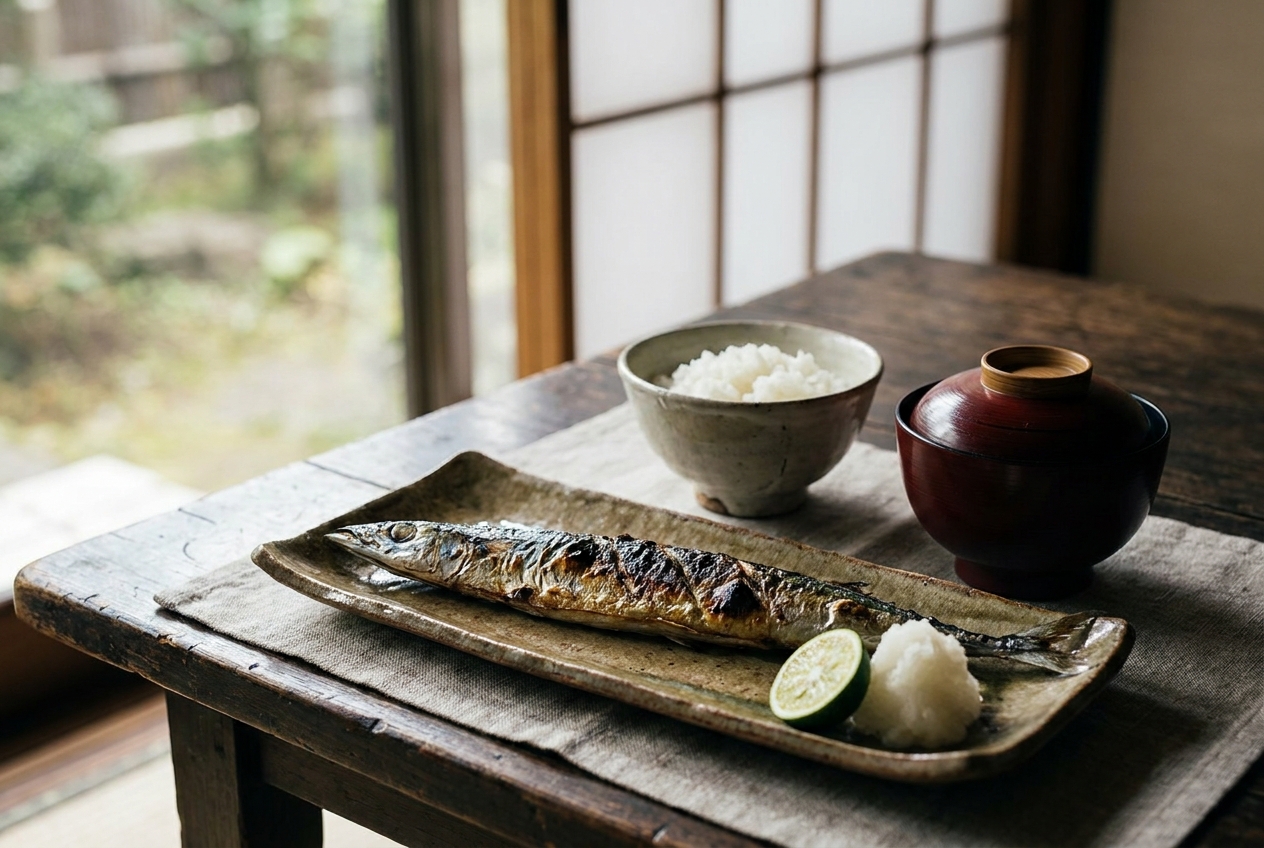
Japanese Long Plate Size: Why Every “Sanma Plate” Is Shorter Than a Sanma
A Pacific saury is about 30 cm of fish. The plates sold in the United States under the name sanma plate measure 26.6 cm, 28 cm and 29.3 cm. Every one of them is shorter than the thing it is named after, and none of the listings mention it.
That is not a scandal, it is a rounding error that nobody ever checks, and it is the whole reason this page exists. A Japanese long plate — nagazara — is one of the few pieces of Japanese tableware where the buying decision is genuinely arithmetic. Get the two numbers right and the plate works for twenty years. Get them wrong by three centimetres and you spend those twenty years cutting the heads off your fish.
The fish first, then the plate
A sanma in a Japanese supermarket in October is roughly 30 cm nose to tail for the body you are likely to buy, and the species runs to 35–40 cm at the top end. Japanese retailers who sell plates for it are blunt about what that requires: 30 cm is the floor and 32 cm is where it gets comfortable. Cotogoto, a Japanese homeware shop that publishes side-by-side measurements of the long plates it stocks, singles out a 32 cm plate as the one that takes a whole head-on saury “with ease” and notes that on the shorter plates in the same comparison you are halving the fish or removing the head.
Now line that up against what is actually on sale abroad under the fish’s own name.
Three of the four plates carrying the name are under 30 cm. The one that clears it — a plain 1 shaku plate at 30.3 cm — clears it by three millimetres, before the rim takes its cut.
What the rim takes back
The number on a Japanese listing is the outside dimension. It is measured across the widest point of the piece, which on a long plate means from one lip to the other, and the lip is not flat. Most long plates carry a raised or rolled edge somewhere between 8 mm and 2 cm on each side. Subtract both and a plate advertised at 30 cm has a flat well of around 26–28 cm.
This is the same silence that runs through every category on this site. An ohitsu is listed by its bowl volume, not by the rice it holds; an owan is listed at 340 ml when the soup is 160; a donabe is listed across its handles, which never touch anything. The general rule for reading these numbers is set out in our guide to what a Japanese tableware listing does and does not tell you, and the long plate is one of the cleanest examples of it. Buy 32–34 cm if you want 30 cm of usable plate.
Sun, shaku, and why the sizes jump the way they do
Japanese plates are still sized on the old carpenter’s measure. One sun is 3.03 cm and ten sun make one shaku, 30.3 cm. That is why long plates cluster at odd-looking centimetre figures rather than at round ones:
| Traditional size | Centimetres | What it actually holds |
|---|---|---|
| 6 sun | 18.2 cm | A cut fillet of salmon. Two pieces of tamagoyaki. |
| 8 sun | 24.2 cm | A fillet with garnish. A small whole horse mackerel. |
| 1 shaku | 30.3 cm | A whole sanma, only just, and nothing beside it. |
| 1 shaku 1 sun | 33.3 cm | A whole sanma with room at both ends and a garnish corner. |
| 1 shaku 2 sun | 36.4 cm | A whole mackerel or a grilled fish for two to share. |
If you have never met these units before, they run through everything on a Japanese table and we keep a reference for them in Japanese tableware sizes and terms. The practical point here is narrow: the gap between 1 shaku and 1 shaku 1 sun is exactly the three centimetres that decides whether a fish fits. It is one size step. It costs almost nothing. Almost everyone buys the smaller one.
The width nobody quotes
Length is the number people check. Width is the number that decides whether the plate is any use, and it has nothing to do with the fish.
Grilled fish in Japan is plated to a fixed arrangement: head to the left, belly toward the diner, and the garnish at the front right. The head-left rule is old — it comes out of the Heian court’s left-is-senior convention — but it survives because it works for a right-handed eater, who opens the fish from the head end and works down. The garnish goes front right for the same reason: that is where a right hand reaches without crossing the plate.
So the mound of grated daikon, the wedge of sudachi, the pink-and-white stem of pickled ginger — the ashirai — all need a corner of the plate that the fish is not using. On a 9 cm-wide plate there is no such corner. The fish is 4–5 cm deep across the shoulder and the rim takes the rest.
This is the same geometry problem we ran into measuring Japanese trays, which run out of depth long before they run out of width. A Japanese place setting is built from a rice bowl and a soup bowl at the front and the main dish behind them, and the main dish is a rectangle precisely because a circle is as deep as it is wide. The long plate is that rectangle. Eleven to thirteen centimetres of width is the working range. Below 10 cm you have bought a serving dish; above 15 cm you have bought a platter that will not sit in the row.
Four plates that all look like long plates
Japanese shops file several different things under “long plate”, and they are not substitutes for one another. Knowing the four names saves you buying the wrong one twice.
Nagakaku-zara — the long rectangular plate
The default. Squared corners, a low rim, usually 24–36 cm long and 11–15 cm wide. This is the plate to buy if you are buying one. It takes a whole fish, a rolled omelette, tempura, three pieces of grilled chicken, or a row of nigiri, which is its other career.
Tanzaku-zara — the strip plate
Named after the narrow paper strips people write poems on for Tanabata. Long and deliberately narrow: 30 cm by 7–10 cm is typical. Built for skewers, sliced sashimi, pickles, three small things in a line. It looks elegant and photographs beautifully and it is the plate most people regret buying first, because it cannot hold a meal.
Funa-zara — the boat plate
Ends that lift, like a boat. Around 31 by 11 cm is common. The lift is not decoration: it stops sauce and fish juice running off, which matters for anything cooked in a marinade. Harder to stack, harder to wash, better at its job.
Yakimono-zara — the grilled-dish plate
Not a shape but a role. In a formal meal the grilled course has its own plate, and it is often smaller than a long plate because the fish arrives as a cut fillet rather than whole. If a listing says yakimono but measures 20 cm, that is why — it is for a portion, not a fish.
The thing that will actually annoy you
A 34 cm plate does not fit in a standard dish rack, will not go flat in most Japanese sink baskets, and in a kitchen cupboard it eats a whole shelf on its own because nothing stacks with it. This is the real cost of buying the right length, and it is worth facing before you order rather than after.
Two ways round it. Buy the plate in a stackable form — flat rectangular plates with a simple low rim nest reasonably well, boat plates do not — or accept that the long plate lives on its edge in a plate rack, like a chopping board. What you should not do is buy the 28 cm plate because it fits the cupboard. You will use it three times a week for twenty years and resent it every October.
On care, a long plate is only as fussy as the ware it is made from. Glazed porcelain from Hasami or Mino is the low-maintenance choice and is what most of these plates are; unglazed or semi-glazed stoneware wants the seasoning and drying routine we set out separately. Whether any given piece can go in a microwave or dishwasher depends on the glaze and any metallic trim, and we keep that question in its own guide rather than guessing from a photograph.
Buy this, not that
Buy one long plate at 32–34 cm long and 11–13 cm wide. That is the smallest plate that takes a whole grilled fish with its head on and still has a corner free for grated daikon and a wedge of citrus. Don’t buy anything labelled a “sanma plate” without reading its measurements — the ones sold under that name in the United States run 26.6–29.3 cm, which is shorter than the fish. And skip the 9 cm-wide tanzaku strip unless you already own a plate for the fish: it is a serving dish for skewers and sliced things, not a dinner plate.
How to check a listing in thirty seconds
- Find the length. If the seller gives only a size name, convert it: sun × 3.03. “8 sun” is 24.2 cm, not 24.
- Subtract 3 cm for the rim and ask whether what is left still clears your fish.
- Find the width. Under 10 cm, it is a tanzaku strip whatever the listing calls it.
- Look at the photograph for direction. A pattern painted at one end, or a rim that is higher on one side, means the plate has a head end. You cannot rotate it to make the fish fit.
- Measure your dish rack before you press buy.
None of this is specialist knowledge. It is just that nobody selling a plate has any reason to tell you that their sanma plate is shorter than a sanma, and until you have stood in a kitchen trying to fold a fish, you have no reason to ask.
Disclosure: Nagori Ware is an independent editorial guide written from Japan. Some links elsewhere on the site are affiliate links. Parts of this site are drafted with AI assistance and checked against Japanese sources. General information, not legal or safety advice.