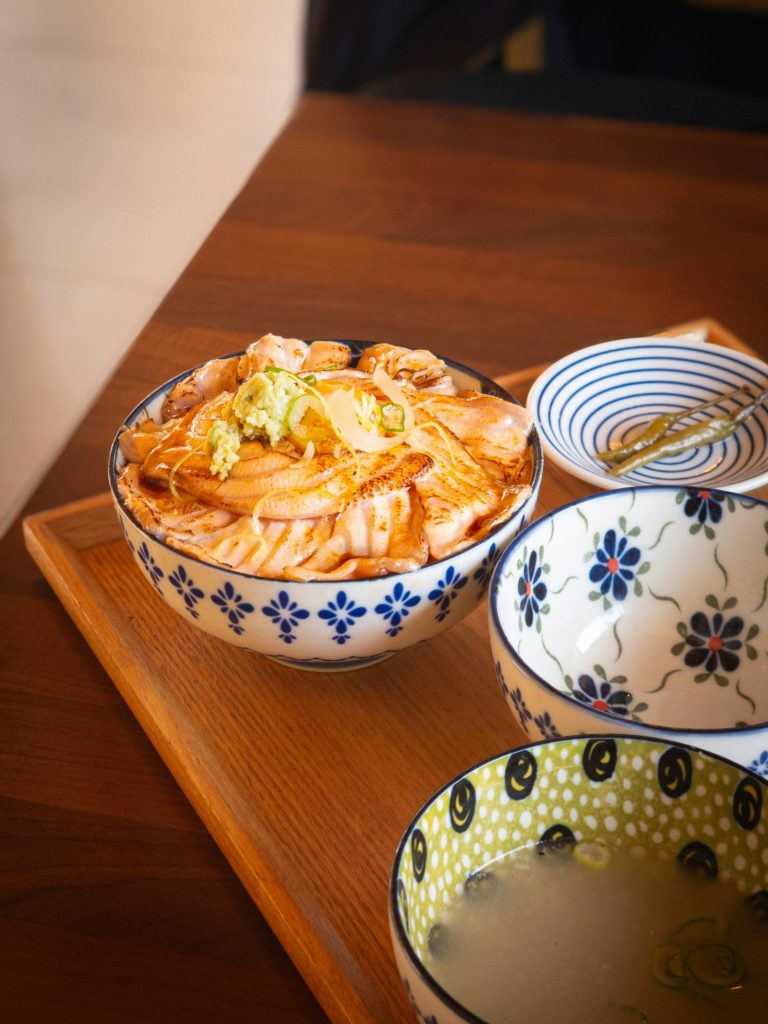
Miso Soup Bowl Size: What an Owan Actually Holds (and Why the ml Figure Misleads)
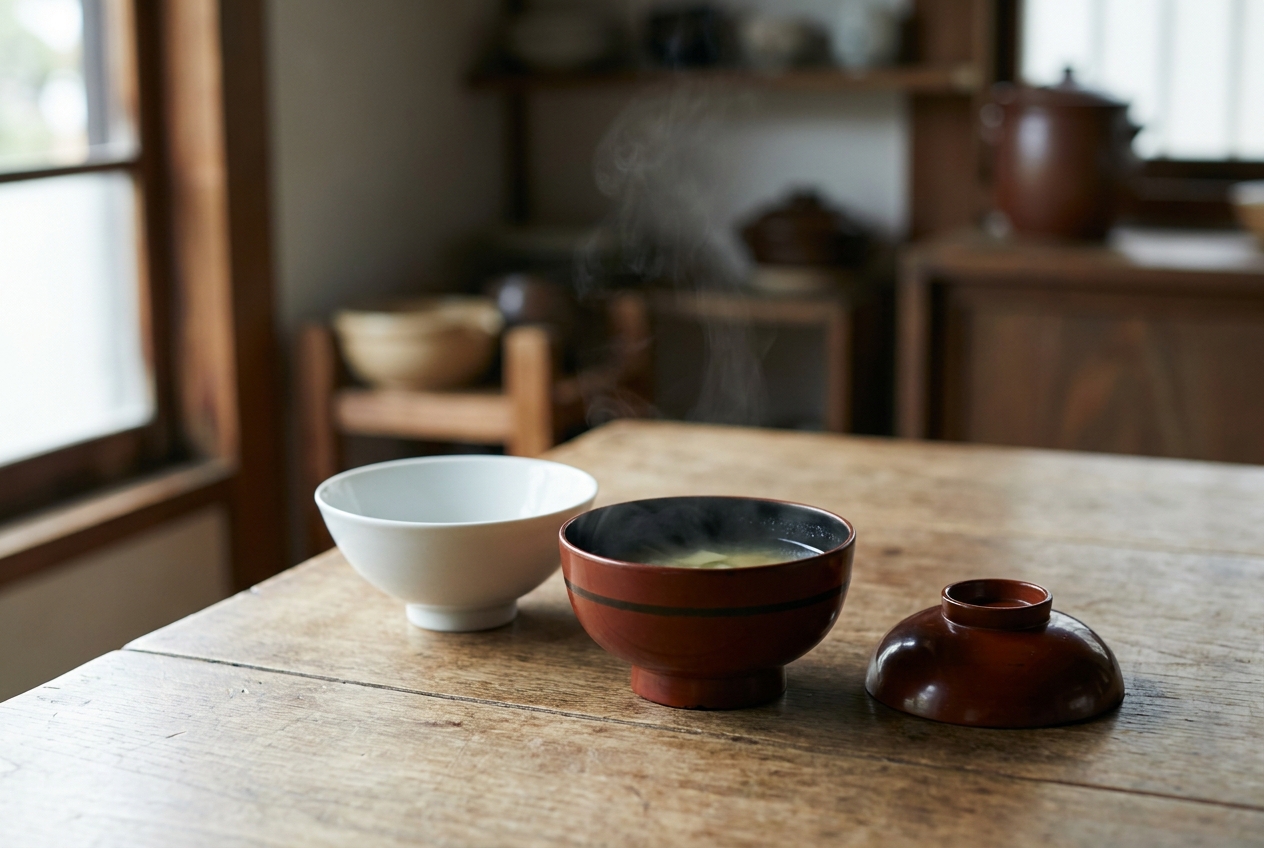
Buy a miso soup bowl by its diameter, not by the millilitres beside it. The everyday size is 11.7 to 12.1 cm across — 3 sun 9 bu to 4 sun, in the unit the Japanese trade still uses on the tag. The capacity figure is close to useless here: a 12 cm owan is listed at 340 ml, and a normal serving of miso soup is 160 ml of dashi. You will fill it under halfway, every time, deliberately.
That gap is the whole reason this is a confusing thing to shop for. Everywhere else on a Japanese tableware listing, the volume figure is at least a usable clue. On a soup bowl it points to the wrong bowl.
The one bowl where the 70 per cent rule breaks
Japanese listings quote mansui yōryō (満水容量) — the volume a vessel holds filled to the very edge. For most things you can knock about 30 per cent off and get the working figure: a kyusu listed at 300 ml brews roughly 210 ml. That rule, and the rest of the vocabulary on a Japanese product page, is in how to read a Japanese tableware listing.
A soup bowl is where the rule gives out. A 4-sun koshidaka shiruwan from a Kawatsura lacquer house measures 12.0 cm across and 6.9 cm tall, and is listed at 340 cc brim-full. A serving of miso soup is 150–200 ml of dashi, with 160 ml being the figure most Japanese recipes settle on, plus 15–18 g of miso. Add tofu and wakame and you are at perhaps 180–200 ml in the bowl. Against a 340 ml brim, that is 47 to 59 per cent.
The empty band above the soup is not slack. You drink from this bowl — there is no spoon in the Japanese place setting for miso soup — so the rim has to arrive at your lip while the bowl is tilting. And you are holding it in one hand with 80 °C liquid inside. Fill an owan to within a centimetre of the rim and you will find out immediately why nobody does.
So when a US shop lists a Japanese soup bowl at 10 oz or 12 oz — 296 and 355 ml — those are brim numbers too. A 12 oz bowl is not a generous bowl. It is an ordinary bowl, measured in a way that flatters it.
Miso soup bowl size, in the unit the tag actually uses
One sun (寸) is 3.03 cm, and one bu (分) is a tenth of that, 3.03 mm. Lacquer shops quote bowls to the bu, which is finer than they quote plates, because 3 mm at the rim of a bowl you hold is something your hand notices.
The old standard soup bowl was 3 sun 8 bu, about 11.4 cm. It moved. Kawatsura lacquerers now treat 3 sun 9 bu — about 11.7 cm, sold as the Tōkyō shiruwan — as the house standard, and 4 sun, about 12.1 cm, has become the popular size as portions grew. The drift is real but small: the whole history of the Japanese soup bowl fits inside seven millimetres.
Above 4 sun the bowl stops being a soup bowl, whatever the shop calls it. At 4 sun 5 bu (13.5 cm) the trade name changes to tayōwan, a multi-purpose bowl. At 5 sun (15.1 cm) it is a soba bowl. At 16 cm it is a daimyō-wan, a bowl with a name that tells you it is for show. Pour 160 ml of miso soup into any of them and you get a puddle with a wide cold surface.
| Size on the tag | Diameter | What it is | Worth buying for miso soup? |
|---|---|---|---|
| 3寸8分 (3 sun 8 bu) | ~11.4 cm | The older standard shiruwan | Yes, if you eat modest portions or have small hands |
| 3寸9分 (3 sun 9 bu) | ~11.7 cm | Tōkyō shiruwan — wide rim, shallow body | Yes — the safe default |
| 4寸 (4 sun) | ~12.0–12.1 cm | Today’s common size; often koshidaka, with a taller foot | Yes — buy this if you like chunky soups |
| 4寸2分 (4 sun 2 bu) | ~12.7 cm | Large shiruwan | Only for tonjiru and kenchinjiru |
| 4寸5分 (4 sun 5 bu) | 13.5 cm | Tayōwan — multi-purpose bowl | No — it is a different object |
| 5寸 (5 sun) | 15.1 cm | Soba bowl | No |
Two bowls can share a diameter and not share anything else
Diameter gets you to the right shelf. Height and profile decide which bowl you actually want off it, and lacquer shops name the profiles.
Koshidaka (腰高, “high-waisted”) sits on a taller foot ring and runs deeper. The 4-sun koshidaka above is 12.0 cm across and 6.9 cm tall. The tall foot is not decoration: it is the part your fingertips sit under, and it keeps them further from the hot wall. This is the shape to buy if you make soup with root vegetables in it.
Hasori (羽反) flares outward at the rim in a shallow S. It meets your lip cleanly and it photographs beautifully, and it holds noticeably less than its diameter suggests, because the widest part of the bowl is above the soup line rather than at it.
The Tōkyō shiruwan at 3 sun 9 bu is the odd one: wider than the 3 sun 8 bu it replaced, but the shallowest of the common shapes. Wider and shallower means more surface area, which means soup that cools faster. For a bowl with a lid this hardly matters. For a bowl without one, on a slow weekend breakfast, it does.
An empty lacquered owan of this size weighs around 100 g. Full, it is under 300 g — which is why it is a bowl you lift rather than a bowl you lean over. I worked through the weights of the whole place setting in which Japanese bowls you are meant to lift.
Decide from the soup, not from the bowl
The honest version of this decision takes about ten seconds, and it starts on the stove rather than on the shop page.
- Plain miso soup — dashi, miso, tofu, wakame, a little spring onion. 160 ml of stock. 11.7 cm is plenty, and the soup stays hot in it.
- Miso soup with real ingredients — mushrooms, daikon, aburaage, a poached egg. 180–200 ml once the solids go in. 12.0–12.1 cm, preferably koshidaka.
- Tonjiru or kenchinjiru — pork and root vegetables, a meal in itself. 12.7 cm, and accept that it is now a two-hand bowl at the table.
- You also want it for rice, or for small noodle portions. Then you are not buying a soup bowl. Buy a rice bowl or a small noodle bowl and let each do its job.
One more practical point that shop pages never mention: buy two, not one. A soup bowl is used at essentially every meal in a Japanese house, and lacquer wants to be washed and dried straight away rather than left in the sink. Owning a second bowl is the difference between doing that and not doing it.
Buy this, not that
If you are buying one soup bowl, buy a lacquered wooden owan of 3 sun 9 bu to 4 sun — 11.7 to 12.1 cm across — with no lid. That is the everyday size in Japanese homes, it takes a 160 ml serving with room to carry it, and the lid is a thing to wash rather than a thing you will use on a Tuesday. Don’t buy the 13.5 cm bowl because it looks generous: at that width the soup is a shallow puddle, the bowl has quietly become a tayōwan, and you will use it for noodles instead. And don’t buy the matching ceramic version of a lacquer design — porcelain conducts heat about ten times as fast as wood, which removes the one thing the shape was built around.
Lidded or not: what the lid is actually for
A lidded soup bowl is the formal version, and the lid does three real jobs. It holds the heat when the bowl is set down in front of you before you start. It keeps the aroma of the dashi under cover until the moment you open it, which in a kaiseki course is the point of the dish. And it keeps the soup clean on a tray that is carried some distance.
At home, on a weekday, none of those apply. You carry the bowl three metres from a stove that is still hot. What the lid adds instead is height in the cupboard — a lidded bowl is around 9.5 cm tall against 6.9 cm without — a second lacquered surface to dry by hand, and a rim-to-rim contact point that is the first place the finish will wear.
So: buy lidded if you serve guests, plate ahead, or want the bowls to look like the ones in the restaurant. Buy unlidded for the bowl you will use tomorrow morning. If you are choosing between the two on price, the lid is usually a third or more of it.
When the lid will not come off
This catches everyone the first time, and it is not a defect. Hot soup goes in near 80 °C and the air trapped between the soup and the lid goes in hot with it. As the bowl is carried and set down, that air cools and contracts, and the pressure outside the bowl is now greater than the pressure inside. The lid is being held down by the atmosphere. Pulling harder makes it worse, because you are also pulling the lid straight against its seat.
The move, which is ordinary Japanese table manners rather than a trick, is to let air in instead. Hold the knob of the lid with your right hand. With the thumb and forefinger of your left hand, squeeze the rim of the bowl gently — a wooden bowl flexes by a fraction of a millimetre, the seal breaks, air slips in, and the lid comes away with no force at all. Do it gently; you are asking the rim to bend, not testing whether it will.
Then there is a second half that nobody outside Japan is ever told. The underside of that lid is covered in condensation. Before you put it down, tilt it over the bowl and hold it there for a moment so the drops run back into the soup. Then set it down upside down, to the right of the bowl. That is the whole etiquette: turn it, drain it, park it. Doing it the other way round leaves a wet ring on the table and, over time, on the lacquer.
What not to do: do not lever the lid with a chopstick, and do not run the bowl under hot water to break the seal. The rim and the foot ring are the two places a lacquer bowl is built up most carefully, and they are the two places damage shows first — the reasoning behind that is in the guide to Japanese lacquerware.
Why it is wood, in one paragraph
Wood conducts heat at roughly 0.1–0.2 W/m·K. Porcelain is around 1.5. That factor of ten is the entire argument: a lacquered wooden bowl full of 80 °C soup warms to about the temperature of your hand and stops, while a ceramic bowl of the same shape delivers the soup’s heat to your fingertips. A ceramic soup bowl is not wrong — it is a bowl that stays on the table, which is a normal thing for a bowl to do. It is wrong for this bowl, because this is the one you drink from. If you are weighing up a lacquer bowl against its ceramic twin, or trying to tell real urushi from a sprayed film, that decision has its own guide: Japanese lacquerware and urushi.
Care follows from the material rather than from the shape, and it is short: hand wash, dry immediately, do not soak, do not leave it in the sink overnight. Whether any particular bowl can go in a microwave or a dishwasher is a question for the maker’s own label — the finishes differ, and the answer differs with them. Our general note on which Japanese vessels tolerate what is in are Japanese bowls microwave and dishwasher safe, and the maker’s instructions outrank it every time.
Where it goes on the table
Rice on the left, soup on the right, both at the front edge, closest to you. This is not decorative — the two bowls you lift are placed where your hands are. Dishes you do not lift go behind them. If you are setting a full tray, the arrangement and the tray itself are covered in what size obon tray you need and in seasonal Japanese table setting.
One detail people get wrong with a lidded bowl: once the lid is off and upside down to the right, it stays there for the whole meal. At the end, put it back on the bowl the right way up. Turning the lid over and balancing it on the bowl as a sign that you have finished is a habit that reads badly in Japan, and it can mark the lacquer where the two rims grind together.
Questions people actually ask
What size bowl is best for miso soup?
11.7–12.1 cm across — 3 sun 9 bu to 4 sun. That holds a 160 ml serving with the room you need to lift it. Go to 12.7 cm only if you regularly make soups thick with vegetables and pork.
How many ounces is a Japanese soup bowl?
Listings usually say 10–12 oz, which is 296–355 ml. That is brim-full capacity. The soup you put in it is about 5–7 oz. Both numbers are honest; they are answering different questions.
Can I just use a cereal bowl?
You can eat soup out of it, but not the way the soup is designed to be eaten. A Western cereal bowl is typically 15–18 cm across, too wide to bring to your lip and too wide to hold in one hand when it is hot, so you will end up using a spoon and leaving the bowl on the table. If that is how you want to eat, buy a ceramic bowl you like and stop worrying about it.
Is a rice bowl the same size as a soup bowl?
Very close, and they are not interchangeable. A rice bowl runs 11–13 cm at the rim and is usually ceramic, because rice is not hot enough to matter and ceramic holds a shape that rice releases cleanly. The soup bowl is the same width in wood. Put them side by side and the difference you notice is weight: about 100 g against about 250 g.
Do I need a lid?
For home use, no. Buy the lid when you are serving other people or plating before they sit down.
Why is my new lacquer bowl slightly sticky or smells faintly?
New urushi can carry a faint smell for a few weeks. Airing it, and using it, is the usual advice; a bowl that is washed and dried after every meal loses it faster than one that sits in a cupboard. If a bowl is genuinely tacky rather than smelling, that is a finish question for the shop you bought it from.
Related guides
- Japanese Lacquerware and Urushi — how to tell a $180 bowl from an $18 one that photographs the same.
- Which Japanese Bowls You Lift — the weights, and why the palm rule breaks.
- How to Read a Japanese Tableware Listing — sun, gō, and brim-full capacity, decoded.
- Japanese Tableware Sizes and Terms — the short reference version.
- Best Japanese Rice Bowls — the bowl that sits to the left of this one.
- Japanese Tableware: A Complete Guide — the whole table, in order.
Disclosure: Nagori Ware is an independent editorial guide written from Japan. Some links elsewhere on the site are affiliate links. Parts of this site are drafted with AI assistance and checked against Japanese sources. General information, not legal or safety advice.