Japanese Pickle Press Size: A 1.6 L Press Takes 400 g of Cabbage
The 1.6-litre Japanese pickle press sold in the United States comes with one instruction and one claim. The instruction: “Twist the press down on your vegetables, firmly press and soak with the force of springs and screws.” The claim: it “makes Japanese pickles or even sauerkraut.” Both are on the same listing, and the second one is where people lose twenty dollars.
A Japanese pickle press is sized in litres and used in kilograms, and the two differ by a factor of about four. The Japanese maker of the box prints the kilogram on the package. The listing abroad prints the litre and stops. Get that one conversion right and the rest of the decision falls out of it — which size, round or square, and the three Japanese pickles this container cannot make no matter how hard you turn the handle.
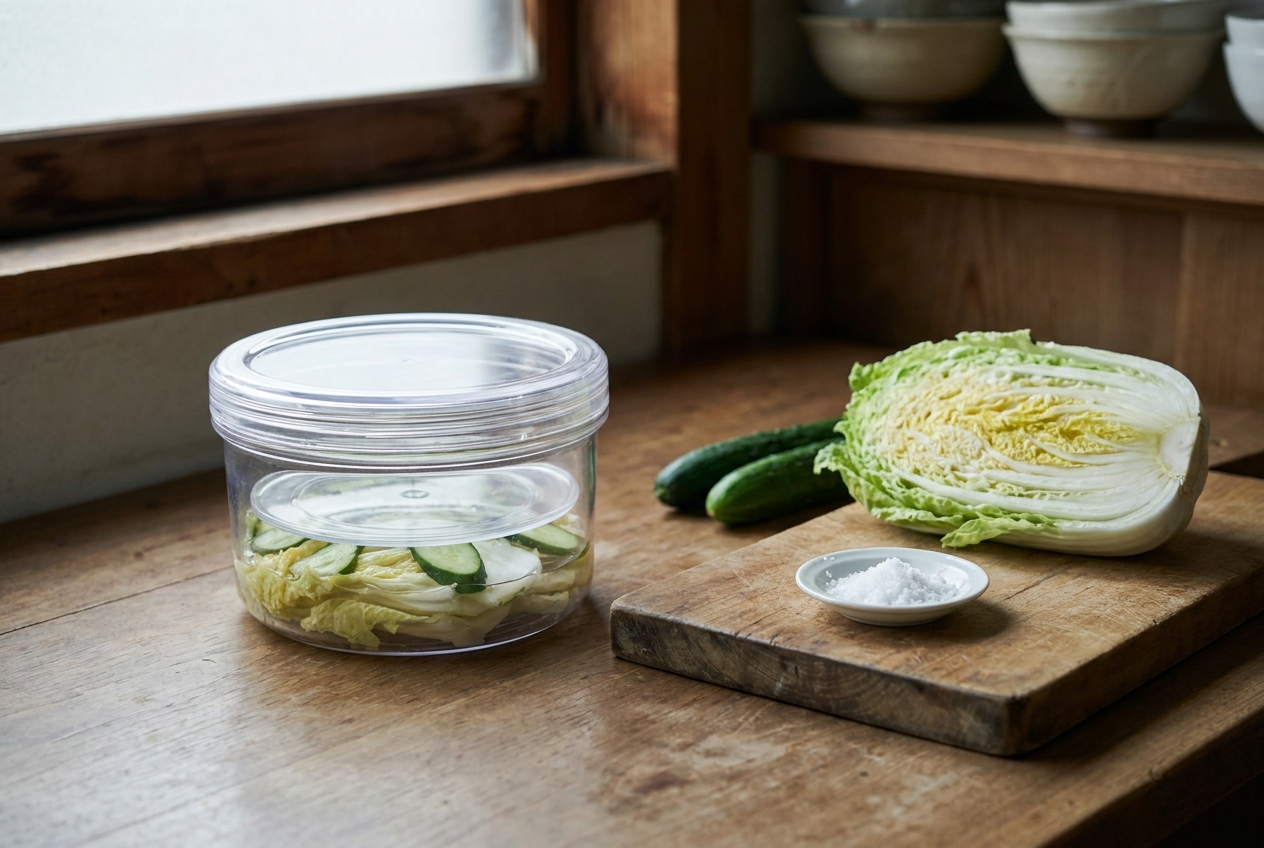
What 1.6 litres actually holds: 400 grams
TONBO, the housewares brand of Shinki Gosei, makes the presses most of these containers descend from. On the Japanese listing for its round 1.6-litre Mommy press, next to the dimensions, is a line most Western sellers drop: eggplant, 3–4; Chinese cabbage, 400 g.
Four hundred grams. The box is 1.6 litres and takes 400 g of cabbage. That is not the maker being cautious — it is what fits once the press plate has its headroom and the vegetables sit below the plate rather than level with the rim.
The 3.1-litre square model, NK3, publishes a fuller table: cucumber 7–10 (about 100 g each), eggplant 5–8, turnip 11–15 (about 70 g each), Chinese cabbage 600–900 g. And then, in the same breath, the number that makes the whole thing land — one whole head of Chinese cabbage is about 2.5 kg. The 3.1-litre press holds roughly a third of a cabbage.
Quarter of a litre, all the way up to a barrel
Japanese pickling guides size crocks by the cabbage, not by the litre. One head wants a 24 cm vessel, which is about 10 litres. Two heads — around 5 kg — want 29 cm, about 20 litres. Run those against the press figures and the same ratio appears: roughly 0.25 kg of vegetables per litre of container, from a 1.6-litre plastic box to a 20-litre crock.
| Container | Published vegetable load | Kg per litre |
|---|---|---|
| Screw press, 1.6 L | 400 g cabbage; 3–4 eggplant | 0.25 |
| Screw press, 3.1 L | 600–900 g cabbage; 7–10 cucumbers | 0.19–0.29 |
| Crock, 10 L | One head, 1.8–2.5 kg | 0.18–0.25 |
| Crock, 20 L | Two heads, about 5 kg | 0.25 |
This is the same silence that runs through every category of Japanese tableware. An owan is listed at 340 ml and serves 160; a donabe is measured across handles that never touch anything; an ohitsu is listed by its bowl volume rather than the rice it holds. The general habit, and how to read around it, is set out in our guide to what a Japanese tableware listing does and does not tell you. The pickle press is unusual only in that the maker already did the arithmetic for you and the reseller deleted it.
It is also, incidentally, one of the very few Japanese kitchen vessels sized in litres rather than in gō or sun. Rice tubs, sake cups and plates all still carry the older units — see our reference on Japanese sizes and terms if you need to convert those. The press is modern plastic, so it gets a modern number, and that number happens to be the least useful one on the box.
Why a screw is enough for 400 grams
These presses are sold in Japan as omoshi fuyō — “no weight stone required.” That sounds like marketing. The arithmetic says it is true, within the load the box actually takes.
JA Zen-Noh, the Japanese agricultural cooperative federation, gives the rule for a pickling stone plainly: use the same weight as the vegetables, up to twice their weight, and lighten it once the brine has risen. So 400 g of cabbage in the 1.6-litre press needs 400–800 g bearing down on it. For comparison, English-language recipes that improvise the setup reach for a bowl, a plate that fits inside it, and a 500 g weight — the middle of that range.
A stainless spring under a screwed-down plate handles a few hundred grams without difficulty. No maker publishes the actual spring force, which is mildly annoying, but it does not matter: the press and the stone rule are describing the same small quantity. The press is not an underpowered crock. It is a correctly sized tool for 400 grams. The mistake is never the press. It is buying 1.6 litres and expecting a crock’s output.
The three pickles this box cannot make
Once you accept the kilogram, the limits stop being mysterious.
Properly pickled hakusai. A whole head is 1.8–2.5 kg and wants 2–5 kg pressing on it for weeks. The 3.1-litre press takes a third of a head and has nowhere to put a stone. You are not short of pressure; you are short of volume by a factor of three.
Nukazuke, the rice-bran bed. A standard bed is 1 kg of bran to 1 litre of water and 100 g of salt, and Japanese guides tell you to fill the container only half to two-thirds so you can turn the bed over by hand every day. That puts the floor at about 3 litres — and the method needs no pressure at all. The press plate and screw are not merely unnecessary here; they occupy the space the one required daily motion needs.
Sauerkraut, which the American listing suggests by name. A kraut ferment is weeks under weight in a vessel you can leave alone. Everything about a 1.6-litre screw press — the capacity, the plate you have to keep re-tightening, the polystyrene body — is built for the opposite job.
Round or square: the refrigerator decides
Both shapes hold the same litres at the same price, so shape is purely a question of where the thing lives for the three hours it is working. Published outside dimensions:
- Round, 1.6 L — 18 × 15.5 × 14.5 cm. Wide footprint, short.
- Square, 1.57 L — 20 × 12 × 13 cm. Only 12 cm deep, so it goes on a door shelf or the narrow strip at the front of a crisper.
- Square, 3.1 L — 24.5 × 16 × 16.5 cm. The 3-litre press sold in the United States is listed at 9.25 × 6 × 6 inches, which is 23.5 × 15.2 × 15.2 cm — within a centimetre of the same thing.
Eight centimetres of difference in depth between the round and square 1.6-litre decides whether this is a container you reach for on a Tuesday or one you have to rearrange a shelf for. Measure the gap in your refrigerator before you choose the shape. Height matters too: the knob sits proud of the lid, so the quoted height is what you need, not the body.
The name on the Japanese box tells you the scope
In Japan these are not sold as pickle presses. They are sold as sokuseki tsukemono-ki (即席つけもの器) — instant pickle makers. And sokuseki-zuke (即席漬け) is simply another name for asazuke, the lightly salted pickle you eat the same day or the next; a third name for the same thing, oshinko, is what you will see on an izakaya menu.
So the Japanese box states its entire scope in its own name, and the English name — “Japanese pickle press” — throws that away and replaces it with a litre. That single translation loss is why people buy one of these hoping for takuan.
What asazuke actually involves, for scale: salt at 2–2.5% of the weight of the vegetables — so 8–10 g for the 400 g the small press takes — worked in by hand, then pressed, then one to three hours in the refrigerator, or overnight if you want it sharper. Follow a recipe for the seasoning. The container has no opinion about that part. Where the finished pickles go is a small deep dish: see our guide to kobachi and the other small Japanese dishes, which exist largely because a Japanese meal always has something pickled on the side.
Buy this, not that
Buy the 3.1-litre square press if you are buying one at all. It costs within a few dollars of the 1.6, takes 600–900 g instead of 400 g, and 400 g of cabbage is two small side dishes — you will out-grow the small one in a week. Don’t buy any screw press if what you actually want is pickled cabbage by the head, a bran bed, or sauerkraut: you need a 10-litre crock and a 2–5 kg stone, or a 3-litre tub and no pressure at all. And don’t buy the round 1.6 L unless you have measured 15.5 cm of refrigerator depth for it.
Living with the plastic
These are not heirloom objects and they do not pretend to be. TONBO lists the NK3 as polystyrene body, polypropylene inner lid, AS-resin press plate, stainless spring, with a stated heat limit of 70 °C. Three things follow from that spec sheet, and none of them are in the English listing.
Let any cooked brine cool before it goes in — 70 °C is well under boiling, and polystyrene is the brittle clear plastic, not the forgiving kind. Expect the body to cloud and craze with age; that is cosmetic, and it is also why these are cheap enough to replace rather than nurse. And stop turning the knob when the plate meets resistance. The spring is doing the work after that point, and the thread is the part that strips.
Worth distinguishing from a different Japanese lid that also presses down on food: the otoshibuta, or drop lid, sits on simmering food inside a pan to keep it submerged in hot liquid. Same idea, opposite temperature. If you want a pressing vessel with any real longevity, the equivalent is a coopered wooden tub — our guide to sushi tub sizing covers how those are built and why they are held together by hoops rather than glue.
Which size for your household
Japanese retailers do publish a sizing guide, and it is in litres, so translate it as you read: one to three people, 1–2 L; four to five, 3–5 L; six or more, or if you are batching, 8–10 L. In kilograms of vegetables, that is 250–500 g, 750 g–1.25 kg, and 2–2.5 kg.
Notice where the screw press runs out. The 1–5 litre band is press territory. Past that you are into crock-and-stone country, because 8–10 litres means 2 kg of vegetables and 2–4 kg of weight, and no spring under a plastic knob is in that business. The band is narrow and the press owns all of it, which is a perfectly respectable thing for a twenty-dollar box to be.
So: divide the litres by four, decide whether that many kilograms is a side dish or a project, and buy accordingly. The listing will keep telling you about litres. You now know what it is not saying. For the wider picture of how Japanese vessels are sized and named, start at our guide to Japanese tableware.
Disclosure: Nagori Ware is an independent editorial guide written from Japan. Some links elsewhere on the site are affiliate links. Parts of this site are drafted with AI assistance and checked against Japanese sources. General information, not legal or safety advice.