Donabe Rice vs a Rice Cooker: Is the Clay Pot Worth It, and How Many Does a 2-Cup Pot Feed?
Cooked in a donabe, a pot of rice takes about as long as it does in an electric rice cooker, roughly 55 to 70 minutes from rinsing to serving against the 50 to 65 minutes a Zojirushi manual gives for its white-rice setting. The difference is not the clock. It is the 13 to 25 minutes in the middle when you have to be standing near the stove. If you can give it that, a donabe is worth it. If you can’t, no amount of better flavour will get it used more than twice.
That is the question most people are really asking when they type “donabe vs rice cooker”. The answers online tend to split into two camps. Shops that sell clay pots say the rice is incomparably better. One long-time rice cook on Quora answers the question again and again the other way: a clay pot is lovely, “more trouble than it was worth”, and they have used a cooker for fifty years. Both are telling the truth. They just have different evenings. This guide puts numbers on the trade, minutes and grams and bowls, so you can tell which camp you will end up in before you spend the money.
Where the time actually goes
Both methods start the same way: rinse the rice until the water runs mostly clear, then let it soak. A rice cooker hides the soak inside its programme, which is why its white-rice cycle is close to an hour. A donabe makes you do it yourself, 20 to 30 minutes in room-temperature water, longer in winter. Then the two diverge.
| Step | Double-lid rice donabe (Kamado-san type) | Ordinary single-lid donabe | Electric rice cooker (white rice) |
|---|---|---|---|
| Rinse | 3–5 min, by hand | 3–5 min, by hand | 3–5 min, by hand |
| Soak | 20 min (you wait) | 20–30 min (you wait) | built into the cycle |
| Heat | 13–15 min, medium-high, then switch off when steam puffs from the lid | 10–12 min to a strong steam, then 15 min on low | automatic |
| Rest | 20 min, lids on (you wait) | 15 min, lid on (you wait) | automatic |
| Total | about 55–60 min | about 65–75 min | about 50–65 min |
| Time you must be near the stove | 13–15 min | 25–27 min | none |
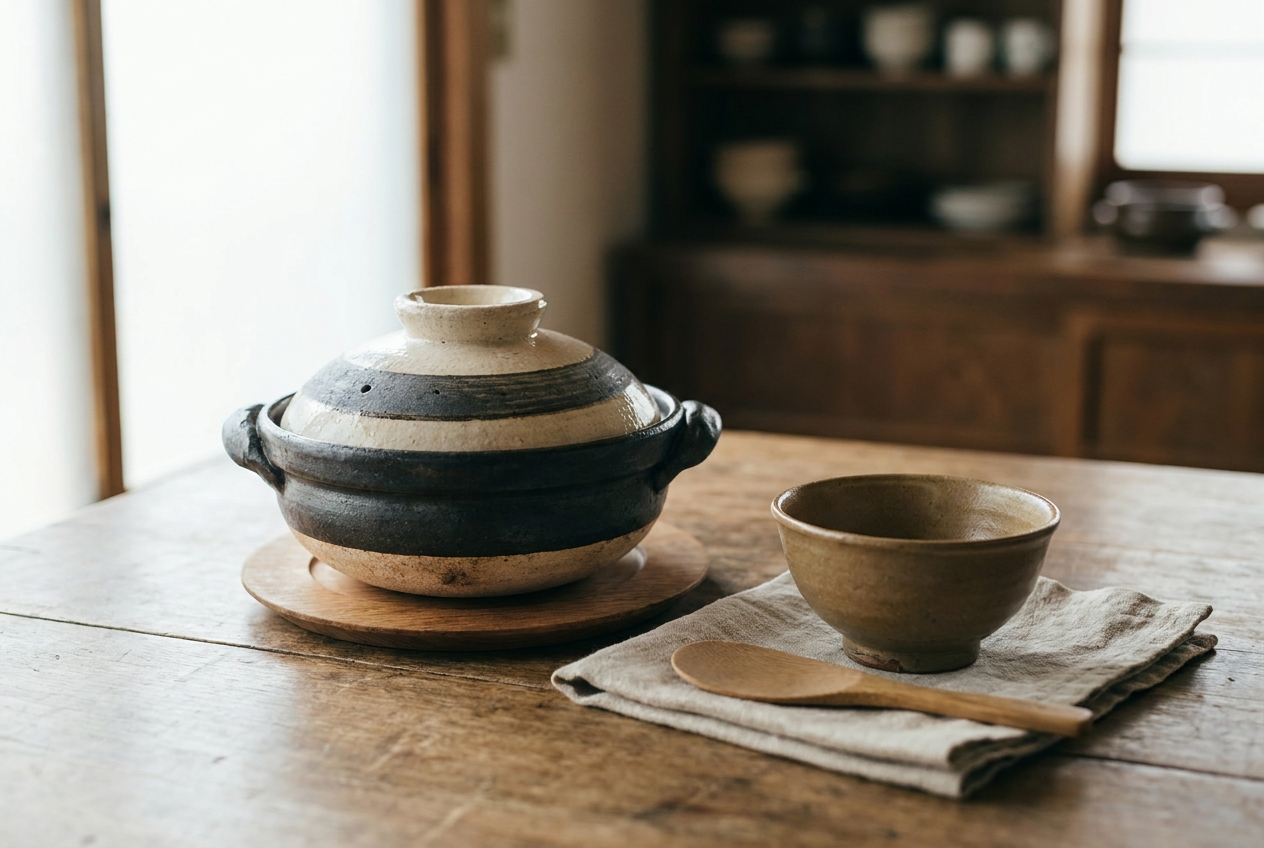
Look at the last row, not the total. The double-lid pot is the easiest of the clay options because it tells you when it is done: the steam starts to puff out of the hole in the top lid a couple of minutes before the rice is finished, and you turn the gas off. An ordinary donabe needs you to judge the boil, turn it down, and time a low simmer. That is why people who “tried a donabe and gave up” have very often been cooking rice in a hot-pot donabe rather than a rice one.
One more thing the clock hides: a rice cooker can start itself. Put the rice and water in at seven in the morning, set the timer, and dinner rice is ready when you walk in. A donabe can soak while you are out, but someone has to light the burner. If your rice nights are weeknights and you get home late, that single feature decides the whole question, and it decides it for the machine.
How many people a 2-cup or 3-cup donabe actually feeds
Rice donabe are sold by how much uncooked rice they take, counted in Japanese rice cups, gō (合), of 180 ml. A “2-cup” or “2-gō” pot takes 360 ml of dry rice, not 2 US cups. That small unit is where buyers go wrong. One reviewer of a popular 2-gō pot called it “just the right amount of rice for two people”; another found the same pot smaller than expected. Both are right, and the arithmetic shows why.
One gō of white rice is about 150 g dry, and Japanese cooking references put the cooked weight at about 330–340 g. An everyday Japanese rice bowl holds around 150 g of cooked rice. So one gō is a little over two bowls. Here is the ladder, using the importer’s listed sizes for the best-known double-lid pot:
| Pot size | Dry rice | Cooked rice (approx.) | 150 g bowls | Weight of the empty pot* | Who it suits |
|---|---|---|---|---|---|
| 1 gō | 180 ml | 330 g | 2 | about 2 kg | One person, one meal. Hard to cook well (see below) |
| 2 gō | 360 ml | 660 g | 4 | about 2.9 kg | Two people with rice as a side |
| 3 gō | 540 ml | 1 kg | 6–7 | about 3.6 kg | Two big eaters, or three to four with leftovers for lunch |
| 5 gō | 900 ml | 1.65 kg | 11 | about 5 kg | Five or more, or a household that freezes rice |
If rice is the main thing on the plate, as with curry, a donburi or a big bowl of something on top, people eat closer to 200–250 g each. That is our working figure, not a published one, but it is the gap the “smaller than expected” reviewer fell into. Measure your own: weigh the rice you serve one person on a normal night. Multiply by the people at the table, divide by 330, and round up to the next pot size. That number of gō is the pot you need.
Why the 1-gō pot is the one to skip
It looks like the sensible buy for one person. It is the hardest to get right. Just One Cookbook, whose donabe method is the most widely followed in English, gives no measurements for a single cup and says plainly that cooking two or three cups produces better-tasting rice than one. With a thin layer of rice, the heat the clay stores up has less to work on, and the margin between “done” and “scorched” gets small. If you live alone, buy the 2-gō, cook a full pot and freeze half in portions. Frozen rice from a good pot reheats better than freshly cooked rice from a bad one.
The opposite mistake is buying big for the rare dinner party. A 5-gō pot weighs about 5 kg empty, and it is heavier again with a kilo and a half of hot rice and water in it. You will lift it off a burner, over to a trivet, and later into a sink. If you would only fill it twice a year, a 3-gō pot that is full most nights is the better pot.
Buy this, not that
If you cook rice on weeknights and nobody is home until the evening, keep your rice cooker; its timer does something no clay pot can. If you can stand near the stove for 15 minutes, buy a double-lid rice donabe sized by the table above: 2 gō for one or two people, 3 gō for three or four. Don’t make a 1-gō pot your first, and don’t buy an ordinary hot-pot donabe expecting it to make rice as easily. It can, but it needs twice the watching.
The method, with the numbers
This is for white Japanese short-grain rice in a double-lid pot on gas, which is what most people buying a rice donabe outside Japan end up with. Season the pot first, the porridge step the maker describes, before the first rice; the donabe guide covers that medome in detail.
- Measure. 3 gō is 540 ml of rice. The importer’s instructions use 600 ml of water for that, a ratio of about 10 parts water to 9 of rice, and suggest going nearer 1:1 for new-crop rice. Just One Cookbook works at 1 to 1.1 and calls it a starting point.
- Rinse and soak. Rinse until the water runs mostly clear, then soak 20 minutes in the measured water, right in the pot.
- Dry the outside. Wipe the base completely dry before it goes on the flame. Both the importer and Just One Cookbook warn that a wet clay base can crack when heated, because the clay takes up water and then expands.
- Lids. Set both lids with their steam holes at right angles to each other.
- Heat. Medium-high on a domestic gas burner (medium on a powerful one) for 13–15 minutes. When steam starts puffing steadily from the top hole, turn the gas off. For the crisp crust, okoge, give it one or two minutes more.
- Rest. Leave both lids on for 20 minutes. Don’t peek: the stored heat in the clay is still cooking the rice.
- Serve and move it. Fluff with a rice paddle, and take whatever you won’t eat now out of the pot (see below).
For an ordinary single-lid donabe, Just One Cookbook’s version is medium to medium-high until steam escapes vigorously (10–12 minutes), then 15 minutes on low, then 15 minutes’ rest with the lid on. The extra low simmer is the step you have to time yourself.
What a donabe asks of you afterwards
The cooking is half of the ownership. The other half is what happens after dinner, and this is where the rice cooker quietly wins again for some households.
- No keep-warm, and no leaving rice in the pot. The importer’s care page asks you not to leave food in the pot overnight. Move leftovers to a container, or to an ohitsu if you eat in shifts. That is the job a rice cooker’s keep-warm setting does for you, though not as kindly to the rice.
- Let it cool before it meets cold water. Clay pot makers’ instructions (Marui’s English sheet, Musubi Kiln’s support page) warn against putting a hot donabe into cold water, because a sudden temperature change can crack it. Set the hot pot on a trivet, not a wet counter.
- Wash gently, dry upside down. Mild dish soap and lukewarm water, then dry base-up so the unglazed foot doesn’t stay damp and grow mildew.
- Check your hob. Most traditional donabe are made for a gas flame and do not work on induction unless they are sold as induction-compatible. For glass-top electric hobs, follow the maker’s own instructions for that pot.
Some readers come to a donabe because they would rather not cook in a coated inner pot. That is a fair preference to have and a common one in reviews. This guide doesn’t judge coatings either way; it only notes that a clay pot answers that wish with a different kind of care, not less of it.
So is it worth it?
Worth it, if three things are true: you cook rice at least a few times a week at a time when you are already in the kitchen, you buy a double-lid rice pot rather than a hot-pot one, and you size it so that it is full most nights. Then the cost is about a quarter of an hour of attention, and the return is rice that owners keep describing as better, plus a crust a machine doesn’t make. Even the sceptics on Quora concede the flavour; what they dispute is the trouble.
Not worth it, if your rice nights are rushed, if you were hoping the pot would be simpler than the cooker (it isn’t), or if you need a timer. Many cooks end up owning both: the cooker for Tuesday, the clay pot for Sunday, for guests, and for sushi rice, where a little more care pays off. That is not indecision. It is the sensible answer.
Once the rice is done, the bowl matters more than people expect; our guide to Japanese rice bowls explains the 150 g bowl used throughout this article. And if a lid ever breaks, the replacement lid guide explains which measurement to send the shop, which is not the size on the listing.
Quick answers
Is donabe rice faster than a rice cooker? No. Start to finish they are within about ten minutes of each other. The donabe needs 13–25 minutes of you near the stove; the cooker needs none.
How many people does a 2-cup donabe feed? A 2-gō pot makes about 660 g of cooked rice: four everyday Japanese bowls, or about three portions when rice is the main dish.
Can I cook one cup of rice in a donabe? You can, but it is the hardest amount to get right. Two or three cups cook more evenly.
Can I cook rice in a regular (hot-pot) donabe? Yes, with a longer, watched method: boil, then 15 minutes on low, then rest. A double-lid rice pot is easier because it signals when to switch off.
Does it work on induction? Only if the pot is sold as induction-compatible. Most traditional donabe are for gas.
Disclosure: Nagori Ware is an independent editorial guide written from Japan. Some links elsewhere on the site are affiliate links. Parts of this site are drafted with AI assistance and checked against Japanese sources. General information, not legal or safety advice.