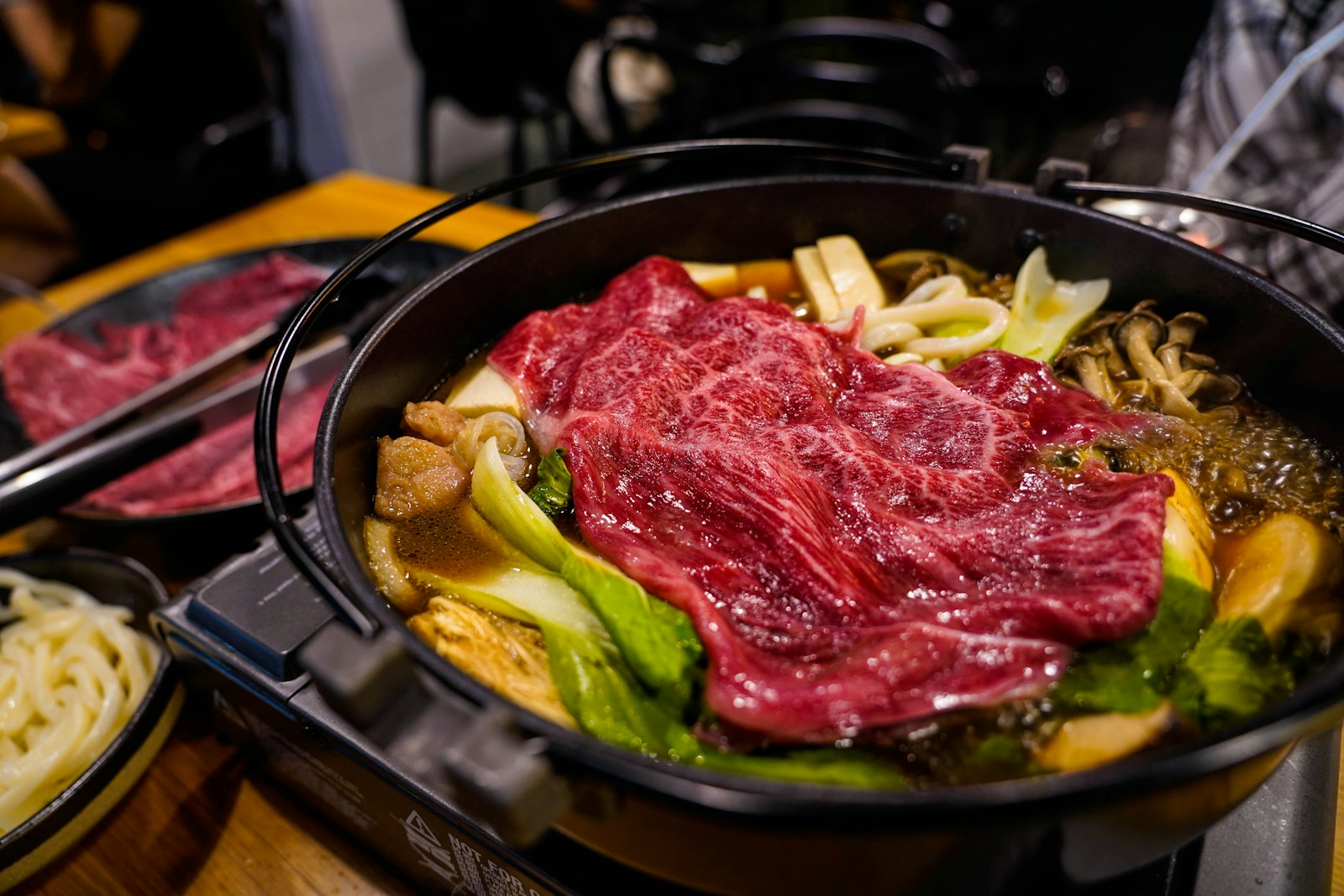
The Japanese Donabe (Clay Pot): A Beginner’s Guide to Buying, Seasoning, and Cooking
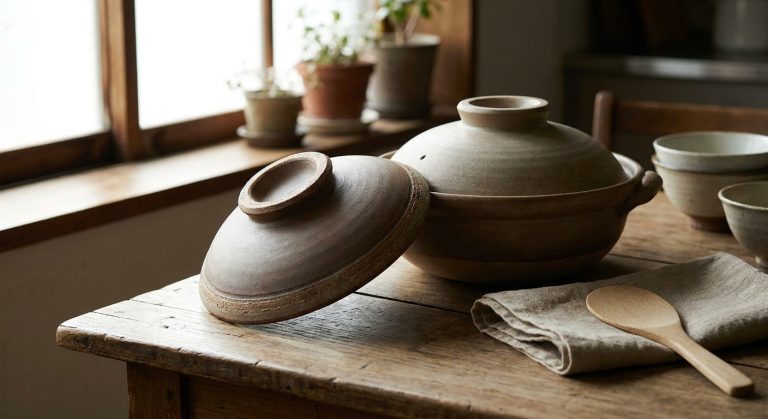
A donabe (土鍤) is the earthenware pot at the heart of the Japanese winter table — the vessel that carries a simmering hot pot from the stove to the center of the meal, still bubbling, and lets everyone serve themselves. It cooks rice with a faint crust at the bottom, holds a one-pot nabemono through a long dinner, and looks quietly beautiful doing it. It is also a piece of clay cookware with real rules, and getting those right from the first day is what separates a donabe that lasts a generation from one that cracks in a month.
This guide covers what a donabe actually is, the two clay traditions worth knowing, how to choose your first one, and — most important — how to season, cook with, and care for it safely.
What a donabe is, and what it is for
At its simplest, a donabe is a wide, lidded clay pot built to sit directly over a heat source. The porous earthenware heats slowly and holds that heat for a long time, which is exactly what a gentle simmer wants. That thermal inertia is the whole appeal: a nabe hot pot stays hot at the table, and rice cooked in a donabe steams evenly and develops the prized scorched layer called okoge at the base.
It is worth being clear about what a donabe is not. It is not a wok or a sauté pan. It is not built for high heat, dry heat, or fast searing, and treating it like a metal pot is the quickest way to ruin one.
Two clay traditions: Iga and Banko
Most quality donabe come from one of two pottery towns. Iga ware (Iga-yaki), from Mie Prefecture, is made from a coarse, ancient lakebed clay that is unusually heat-resistant and full of fine air pockets, which is why Iga donabe are so prized for slow cooking. Banko ware (Banko-yaki), from nearby Yokkaichi, produces the majority of Japan’s donabe; its clay is blended with a heat-tolerant mineral (petalite) that gives excellent resistance to thermal shock. Both are excellent. Iga tends to be more rustic and collectible, Banko more everyday and forgiving.
For a wider view of the regions behind Japanese ceramics, our guide to Japanese tableware maps out the main pottery centers and what each is known for.
Choosing your first donabe
Size. Donabe are measured by go (a traditional unit) or by diameter. A 8–9 go pot (roughly 25–27 cm) suits two to four people for hot pot; a smaller 5–6 go is better for rice or for cooking for one or two. Buy for the meals you actually make, since a half-empty pot cooks less evenly.
Glazed or unglazed interior. Most modern donabe are glazed inside, which makes them far easier to clean and less prone to absorbing odors. A few traditional pieces have a raw, unglazed interior; these are wonderful but demand more careful seasoning and washing.
Heat source. This is the detail people miss. A standard donabe is made for a gas flame. It will not work on an induction (IH) cooktop unless it is specifically sold as IH-compatible — some are made with a built-in metal disc or a separate induction plate for exactly this reason. If your kitchen is induction only, confirm compatibility before buying, or plan to use a portable gas burner at the table.
What size donabe to buy, and what the go number actually measures
Donabe are sold by a go number (号), and almost every listing leaves you to guess what it means. It is not a volume. One go is one sun — 3.03 cm — and the number is the pot’s outside diameter. An 8-go pot is about 24 cm across, a 9-go about 27 cm. That is the same traditional module used for plates and trays across the rest of the Japanese cupboard, which the sizes and terms reference sets out in full.
Knowing it is a diameter changes how you read the ladder. Because the number measures a length, the capacity does not climb in step with it — going from 8-go to 9-go is a 12% wider pot but roughly a quarter more floor area, and the walls get deeper too. That is why the servings jump the way they do, and why sizing up costs you more cupboard than you expect.
| Go (号) | Diameter | Capacity | People (hot pot) |
|---|---|---|---|
| 5–6 | 15–18 cm | about 0.6–1 L | 1–2, or rice for two |
| 7 | 20–22 cm | about 1–1.5 L | 2–3 |
| 8 | 23–25 cm | about 1–3 L | 3–4 |
| 9 | 26–28 cm | about 2–4 L | 3–5 |
| 10 | 29–31 cm | about 3–4 L | 5–6 |
Two cautions about that table. First, sources disagree at the edges, and honestly so — a pot that feeds four people a hot pot as the whole meal will feed six if the nabe is one dish among several. Treat the people column as a band, not a specification. Second, Japanese retailers consistently advise sizing up for nabe specifically, because you load the pot with raw ingredients heaped well above the finished level. A rough working figure is about 500 ml of capacity per person.
If you are buying one donabe and want it to earn its shelf, 8-go is the honest default for most households: big enough for four at a push, still liftable when full, and it will still cook rice for two without the half-empty problem noted above. Buy 9-go or larger only if you actually host — a 4-litre clay pot full of broth is heavy, slow to heat, and awkward to store. Buy 5–6-go if what you really want is a rice pot rather than a communal pot — and if you do cook rice in it, where the rice goes afterwards matters as much as the pot.
Seasoning before the first use (medome)
A new unglazed or porous donabe should be seasoned before you cook in it, a process called medome (目止め). Sealing the clay’s pores with starch strengthens the pot against heat and helps prevent cracking, leaking, and stubborn odors. Many fully glazed donabe do not strictly need it, but the maker’s instructions are the final word — follow them if they came with the pot.
The common method: make sure the pot is clean and completely dry, then fill it about eighty percent with water and stir in cooked rice or rice-washing water — roughly a fifth as much rice as water. Cover, and cook over low to medium-low heat until it comes to a gentle simmer, which takes twenty to thirty minutes for a mid-sized pot, then keep it at low heat until the mixture turns to a loose paste. Turn off the heat and let the donabe cool completely on its own — about an hour — before you discard the porridge, rinse, and dry it thoroughly.
The one rule you cannot break: never heat a donabe that is wet on the outside, and never heat it empty. Moisture on the base or an empty, dry pot on a flame can crack it immediately. Dry the outside fully every time before it goes near heat.
Cooking with a donabe, safely
Start low and raise the heat gradually; clay hates a sudden thermal jolt. Keep the flame within the footprint of the base rather than licking up the sides, and never move a hot donabe straight onto a cold or wet surface — set it on a dry trivet or a thick folded cloth. As a rule, low to medium heat is the working range; high heat and dry, oil-based frying are not what this pot is for.
Within those limits a donabe is wonderfully versatile: nabemono hot pots, steamed rice, congee, gentle braises, and simmered vegetables all suit it. Because the pot keeps cooking with residual heat after the flame is off, it is normal — and economical — to finish a dish with the burner already switched off.
Cleaning and storing
Let the pot cool completely before it meets water; pouring cold water into a hot donabe, or the reverse, is a classic way to crack it. Then wash by hand with a soft sponge and, for glazed interiors, a little mild soap. Unglazed clay should be rinsed with plain water only, since porous earthenware absorbs detergent and holds the taste.
Drying is not optional. A donabe that goes into the cupboard damp will grow mildew and turn musty, because the clay holds water deep in its body. Air-dry it fully — ideally upside down and overnight, and if the base still feels cool or heavy the next morning, give it longer. Store it with the lid off or set ajar so air keeps moving through. Our guide to caring for Japanese ceramics goes deeper on drying, stains, and odors.
Cracks, crazing, and a long life
Fine crackle lines in the glaze (kannyu) are normal and not a defect. A small hairline can often be sealed the same way you seasoned the pot: simmer rice porridge in it and let it cool slowly, and the starch works into the crack. A pot that has split through, leaks steadily, or shows a crack across the base, though, should be retired from the stove — a compromised donabe can fail under heat.
Cared for with these habits, a good donabe becomes one of the most-used pieces in a kitchen, darkening and softening with the years into exactly the kind of well-worn object the Japanese prize.
Related reading
- How to Care for Japanese Ceramics — seasoning, washing, and everyday habits.
- A Guide to Japanese Tableware — the pieces and pottery regions at a glance.
- The Best Japanese Rice Bowls — where donabe-cooked rice belongs.
The rice donabe is a different pot, and the second lid is the reason
Everything above describes the pot you simmer in. There is a second kind, built only for rice, and it is different enough that buying the wrong one is the most common expensive mistake on this shelf. You can spot it in one glance: it has two lids.
The best known is Nagatani‑en’s Kamado‑san, made in Iga since the workshop’s founding in 1832 and in production as this design since 2000. The makers describe the mechanism plainly: the inner lid has two steam holes and the outer lid one, so steam leaves the inner chamber faster than it leaves the outer. Pressure accumulates in the gap between the two lids and presses down on the rice. The base is built much thicker than a hot‑pot donabe for the same reason a cast pot is thick — it holds heat steadily rather than following the flame.
This matters at the moment of purchase because of a collision between two words that are romanised identically. A hot‑pot donabe is sold in gō written 号, which is the outside diameter in sun, as described above. A rice donabe is sold in gō written 合, which is a measure of uncooked rice — about 180 ml, one rice cup. They sound the same, they are written differently, and English listings translate both as “size.” A 3‑gō rice donabe and a 3‑gō nabe donabe have nothing to do with each other.
| What you are reading | Written | Actually measures | A ‘3’ means |
|---|---|---|---|
| Hot-pot donabe | 号 (gō) | Outside diameter, in sun (3.03 cm each) | About 9 cm across — a size that is not really sold |
| Rice donabe | 合 (gō) | Uncooked rice, about 180 ml per gō | Three rice cups, roughly three to four bowls of cooked rice |
So: if what you actually want is rice, buy the double‑lidded pot in the rice measure you eat, and read the diameter figure only to check it fits your shelf. If you want one pot for the table, buy the single‑lidded one by diameter. The double‑lidded pots can do both — the makers say to take the inner lid out to use them for soups and hot pots — but the reverse is not true, and that asymmetry is worth the extra money if rice is the point. Heat source, first use and care are unchanged either way: follow the sections above and whatever the maker packed in the box.
Disclosure: Nagori Ware is an independent editorial guide written from Japan. Some links elsewhere on the site are affiliate links. Parts of this site are drafted with AI assistance and checked against Japanese sources. General information, not legal or safety advice.