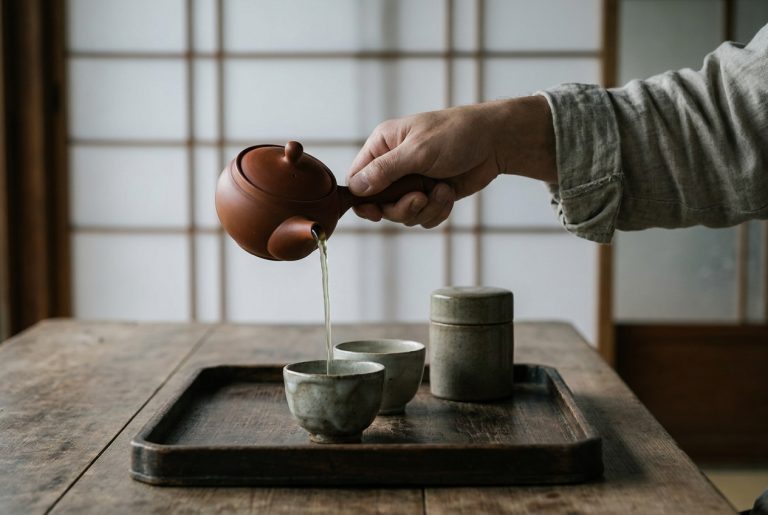
Yuzamashi: Do You Need a Japanese Water Cooler, or Just the Cups You Own?
A yuzamashi does not cool water. Cold ceramic cools water, and a yuzamashi is simply the largest, coldest, most repeatable piece of ceramic in a Japanese tea set. That distinction sounds like pedantry until you brew a second pot, at which point the bowl is warm, the arithmetic everybody quotes stops working, and your gyokuro comes out bitter for reasons nobody warned you about.
The rule you will read everywhere — including on this site — is that water loses roughly 10°C every time you pour it from one vessel into another. It is a good rule. It is also a single number standing in for a ratio, and the ratio moves between about 6°C and 33°C depending on how much water you pour and how heavy the bowl is. This guide works out where the number comes from, when it holds, when it collapses, and whether you need to buy anything at all.
Buy this, not that
If you drink hojicha, bancha or black tea, do not buy a yuzamashi. Those are brewed at 90–100°C and the bowl has nothing to do. Buy one — 200–300 ml, unglazed, around ¥2,000–5,000 — if you brew gyokuro or top-grade sencha more than about twice a week. Between those two cases, your own teacups do the job for free, and warm themselves in the process.
What a yuzamashi is
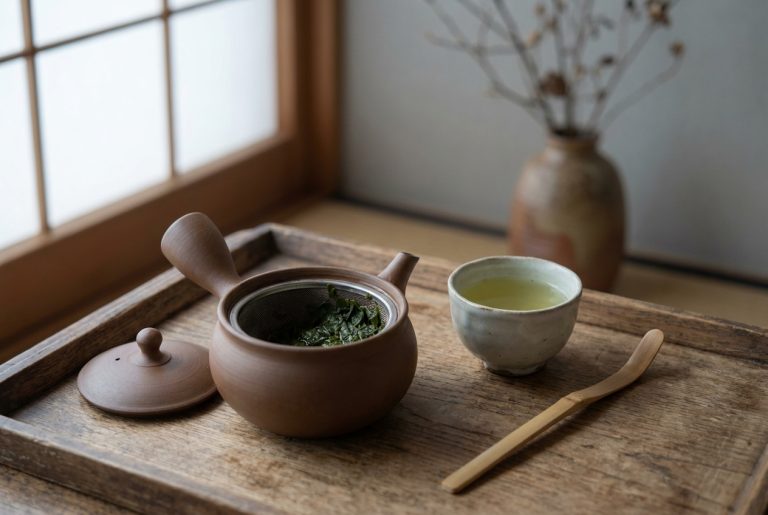
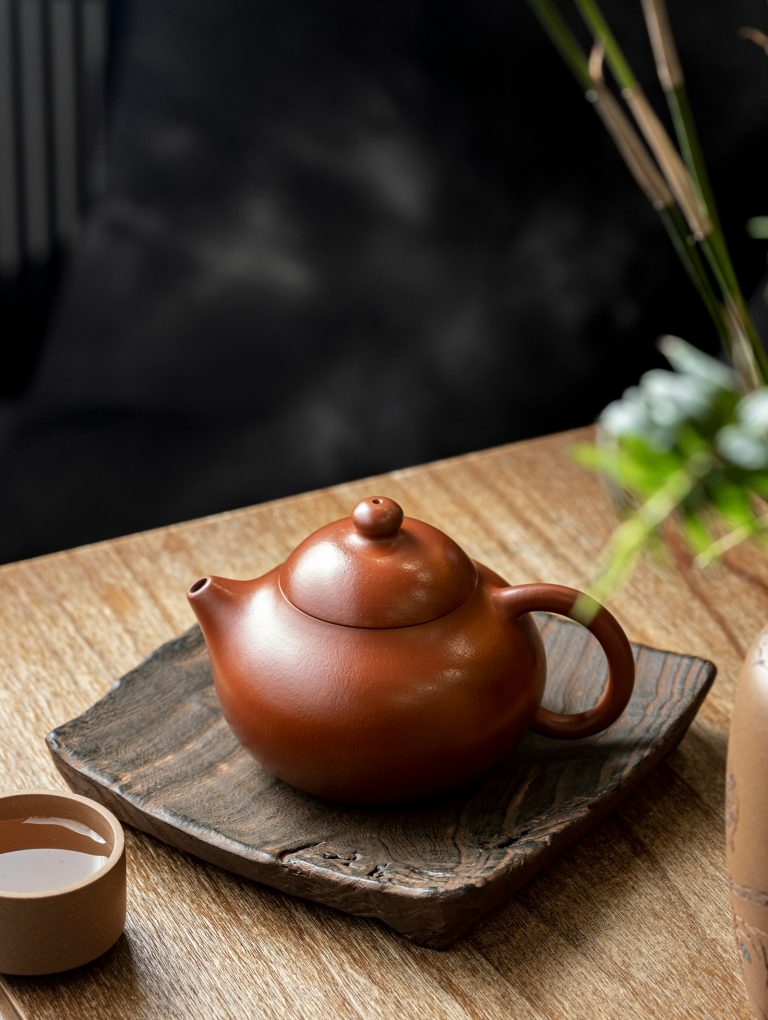
A yuzamashi (湯冷まし, literally “hot-water cooler”) is a wide, shallow bowl with a lip for pouring. Most are Tokoname stoneware from Aichi, in unglazed red shudei clay or its green and black variants; you will also find them in porcelain and in glass. Common capacities run 100–300 ml, with 280–300 ml the standard size on most shop shelves and 80–125 ml pieces sold for single-serving gyokuro.
Some are sold as katakuchi — the same spouted-bowl shape used across the Japanese table for serving sake and dressings. It is the same object with a different label, and the price is often lower under the second name. Worth knowing before you pay a teaware premium for a shape that is not exclusive to tea.
The shape is doing two jobs at once. Wide and shallow means a large surface area, so heat leaves the water quickly while it stands. Thick-walled and unglazed means a lot of cold mass, so heat leaves the water instantly on contact. The second job is much larger than the first, and it is the one nobody explains.
Where the 10°C rule comes from
When boiling water hits a room-temperature bowl, the two settle at a shared temperature almost immediately. Where they settle is decided by a straight ratio: the mass of the water against the mass of the ceramic, weighted by how much heat each material holds. Water holds about 4.18 J/(g·K). Fired porcelain and stoneware hold roughly 0.76–0.90 — call it 0.85. So gram for gram, water carries nearly five times the heat that clay does, and a bowl needs to be heavy relative to the water before it takes a serious bite.
Read the top-left corner and the bottom-right corner of that grid together and the rule falls apart. A single 100 ml gyokuro pour into a heavy cold bowl loses over 30°C. A generous 300 ml pour into a warm one loses about 6°C. Both of those are “one transfer.”
Three things follow, and they are the whole practical content of this guide.
- The drop is a ratio, not a property. Less water in the same bowl means a bigger drop. This is why the rule of thumb happens to serve gyokuro drinkers well: they pour the smallest volumes and need the coldest water, and the same bowl obligingly takes more off.
- The drop shrinks every round. Your second brew meets a bowl that is already warm from the first. Same vessel, same pour, roughly half the cooling.
- Warming your teaware and counting transfers are opposite instructions. Every guide tells you to do both. They cancel.
The contradiction in the standard advice
Open any careful brewing guide and you will find two instructions a few lines apart. Warm the pot and the cups first, so the water does not lose heat to cold ceramic. Then pour kettle to yuzamashi to pot, losing 10°C at each step.
Both are sound. Together they are incoherent, because the heat loss the first instruction eliminates is the same heat loss the second instruction is counting on. Preheating does not merely reduce the drop a little; on the numbers above it roughly halves it. Follow both faithfully with a kettle at a fresh boil and you will land near 92°C thinking you are at 80°C, and your sencha will taste harsh in a way you will blame on the leaf.
The resolution is not complicated once you say it out loud. Preheat the pot and the cups. Never preheat the yuzamashi. The pot and the cups are there to hold temperature; the bowl is there to remove it. They are opposite tools and they should not be treated alike.
If you brew several rounds in a sitting, the bowl will warm up regardless, and resetting it is the single most useful habit in this guide. Empty it and let it stand between pots — a wide, thin bowl gives up its heat quickly on its own — or wipe it out and rinse with tepid water. Do not put a hot piece of stoneware under a cold tap. The temperature difference is exactly the kind of shock that finds an existing flaw in a fired body, and there is no reason to take that risk when waiting a minute does the same job.
Do you need a yuzamashi?
The honest answer depends entirely on what is in your cupboard, and for most people the answer is no. Cooling only matters when the tea wants water meaningfully below boiling. Half of the Japanese teas people actually drink do not.
Buy one if
- Gyokuro or top-grade shaded sencha is a regular purchase, not an occasional treat. These want 50–70°C, which is two controlled stages down from a boil, and doing that in cups you then have to dry and reuse gets tiresome fast.
- You brew for more than yourself. Three cups is 300–450 ml, and juggling that volume through teacups is how water ends up on the table.
- You want the temperature to be repeatable rather than approximately right. A bowl you use the same way every day, with the same volume, becomes a measuring instrument. Cups you grab at random do not.
Skip it if
- You drink hojicha, bancha, black tea or herbal infusions. All want 90–100°C, so there is nothing to cool. Genmaicha sits a little lower at around 80°C, which is one transfer — and a teacup does that for you.
- You drink one cup of everyday sencha at a time. Pour the boil into your yunomi, wait while it warms in your hands, tip it into the kyusu. You have cooled the water, warmed the cup and measured the dose with one movement, and washed up nothing extra.
- You already own a variable-temperature kettle. It solves the same problem more precisely and you are buying decoration.
- You are shopping for a gift and do not know what the recipient drinks. A yuzamashi is useless to a hojicha drinker, and there is no way to tell from the box.
That middle case deserves emphasis, because it is the most common one and the industry has no reason to tell you about it. The cup you already own is a perfectly good cooling vessel. It is the traditional method, not a compromise: pouring through the cups is how sencha was served long before anyone sold a dedicated bowl for it, and it warms the cup as a free side effect. What you are buying with a yuzamashi is convenience and repeatability at volume — not a result you cannot otherwise get.
How to choose one, if you are buying
Size: match it to the pot, not to the shelf
A yuzamashi should hold at least as much as your teapot, with room to pour without slopping. Most kyusu run 200–350 ml, which is why 280–300 ml is the size on every shop shelf. If your pot is a 120–150 ml single-serving piece — a houhin, or a small gyokuro kyusu — buy the 100–150 ml bowl instead. An oversized bowl is not a neutral choice: 100 ml of water in a 300 ml bowl loses close to 30°C in one go, which overshoots straight past sencha range.
Weight: the number that decides everything, and the one nobody publishes
Weight is what sets the size of the drop, as the grid above shows. It is also, almost without exception, missing from the listing. Sellers publish capacity in millilitres and dimensions in centimetres; the mass of the thing is left out. That is a real gap, and it is the same species of silence covered in our guide to reading a Japanese tableware listing — the specification that matters most is the one not printed.
Two practical moves. If you can handle the piece in a shop, pick it up: a bowl that feels substantial for its size is the one that will cool hard, which is what you want for gyokuro and too much for everyday sencha. If you are buying online, ask, or accept that you will calibrate after it arrives — put your own bowl on a kitchen scale and read the grid above against the real number. Thirty seconds, once, and you stop guessing forever.
Material and finish
- Unglazed Tokoname stoneware is the default and a good one. It is the same iron-rich shudei clay as the classic kyusu, so it looks like the rest of the set. Unglazed means no soap, ever — the porous body holds it. Rinse hot, dry completely, store uncovered.
- Glazed porcelain washes more easily and shows no staining. Slightly lower mass for the same size, so a slightly smaller drop.
- Glass lets you watch the steam thin out, which is a genuinely useful cue. It is also the lightest option, so it cools least — the worst choice for the gyokuro drinker who most needs a cooling bowl.
The lip
Pour a little water through it in the shop if you can. The spout should release cleanly rather than run back down the outside; a bowl that dribbles will dribble every day for years. This is the same test that separates a good soy sauce dispenser from a bad one, and it fails for the same reason — an under-cut lip that lets surface tension pull the stream back against the wall.
Using one, in the order that actually works
For everyday sencha at 70–80°C, brewing about 200 ml in a mid-weight bowl:
- Warm the kyusu and the cups with hot water and tip it out. Leave the yuzamashi cold.
- Pour the fresh boil into the yuzamashi. You are now somewhere near 84°C.
- Wait while you measure the leaf — 2–3 g per cup. Half a minute of standing takes off a few degrees more and lands you in range.
- Pour into the pot, steep 60–90 seconds, and pour out to the last drop.
- Empty the yuzamashi and let it stand before the next round, so it is cool again when you need it.
For gyokuro at 50–60°C, add a stage: kettle into the cups, cups into the yuzamashi, yuzamashi into the pot. Three vessels, two drops of 15–25°C each depending on your weights, and you arrive low enough. This is the case where a dedicated bowl earns its keep, and it is exactly the case our houhin guide points at when it says the cheaper half of the pair is the one to buy first.
One caution that applies to every step: none of this is worth much if the water itself is wrong. Hard water flattens Japanese green tea regardless of temperature, which is why the same leaf tastes different outside Japan. Fix the water before you optimise the thermometry.
Care
Unglazed clay takes no soap. Rinse with hot water, wipe the outside, and let it dry fully with nothing covering it — a damp bowl put away in a cupboard is how a musty smell starts. Mineral film from hard water will build a pale ring at the waterline over months; it is cosmetic, and a soak in warm water with a little citric acid clears it. The general rules are in our guide to caring for Japanese ceramics.
A yuzamashi never meets a flame and never holds anything for long, so it leads an easy life. Barring a drop onto a hard floor, it will outlast the pot.
Common questions
Can I just use a thermometer?
Yes, and it is more accurate. What it is not is faster: you still have to wait for the water to come down, and standing in a narrow kettle it comes down slowly. The bowl works by moving the water into something cold, which is close to instant. Most people who own both end up using the bowl on weekdays and the thermometer when they open an expensive packet.
Is a katakuchi the same thing?
Physically, yes — a spouted bowl of the right size will cool water exactly as well. The only difference is what it was sold as, and sometimes the price. If a katakuchi in the 200–300 ml range appeals to you, it will serve.
Can I use a measuring jug or a mug?
A ceramic mug, yes. A thin glass jug will cool very little, and a metal one will cool a lot and then give it back fast. If you are improvising, reach for the heaviest ceramic vessel you own that you can pour from.
Why does my second pot taste different from my first?
Most likely because the bowl warmed up and stopped cooling. That is the single most useful thing in this guide. Empty it and let it cool between rounds.
Does a fukamushi kyusu change any of this?
Not the temperature, no. Deep-steamed sencha does have its own equipment problem, but it sits in the strainer rather than the water — covered in our guide to which kyusu strainer survives deep-steamed sencha.
The short version: a yuzamashi is a lump of cold clay you pour through, and it is worth owning if — and only if — you regularly brew tea that wants water well under boiling. Buy it to match your pot, weigh it when it arrives, keep it cold, and stop preheating it because a guide told you to warm everything. If you drink hojicha, put the money into better leaf. That will change your cup more than any bowl will.
Related guides
- How to brew sencha vs gyokuro — the temperatures and times this bowl exists to hit
- The best Japanese teapots (kyusu) — the pot the water goes into next, and how to size it
- Houhin and shiboridashi — the handleless pots, and why a yuzamashi is the cheaper half of the pair
- How to choose a Japanese tea set — what belongs in a set and what is padding
- Water for Japanese green tea — the variable that beats temperature
- Yunomi: the everyday Japanese teacup — the vessel that can do this job for free
- Tetsubin vs kyusu — where the boiling water comes from in the first place
- Japanese tea: a complete beginner’s guide
Disclosure: Nagori Ware is an independent editorial guide written from Japan. Some links elsewhere on the site are affiliate links. Parts of this site are drafted with AI assistance and checked against Japanese sources. The temperature figures in this guide are calculated from published heat-capacity values, not measured in a laboratory. Prices quoted are what sellers listed when this guide was written and will move. General information, not legal or safety advice.