Chasen and Chashaku: How to Choose a Matcha Whisk, and Why the Prong Count Counts Half
The 120-prong whisk is the wrong first purchase, and not because of the price. It is wrong because 120 prongs is a specification for a job you are almost certainly not doing.
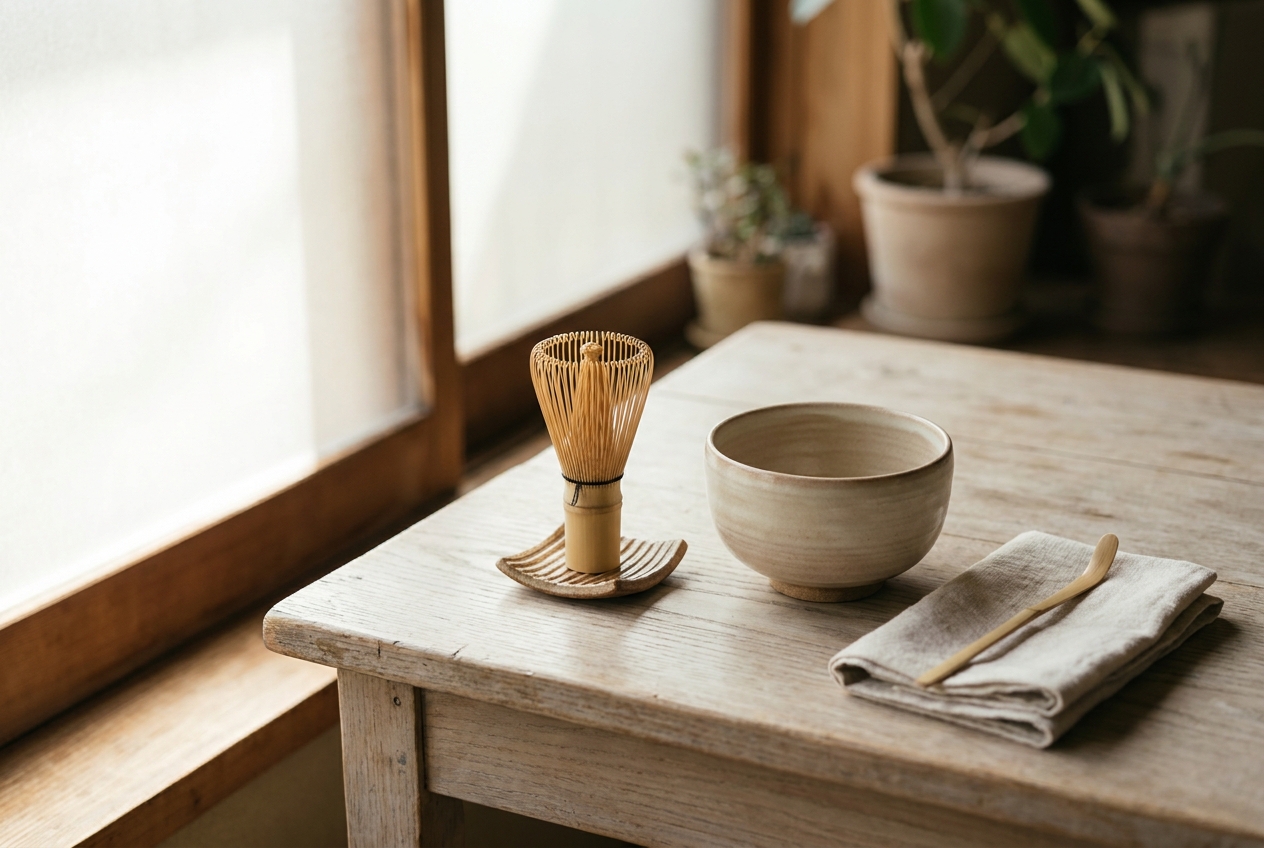
Here is the fact that makes the rest of this make sense. A chasen — the bamboo matcha whisk — is not assembled. It has no parts. It is one length of bamboo, roughly as thick as your thumb, that a person in a village in Nara split into a hundred and sixty filaments at one end and left whole at the other. The thread you can see near the base is not holding pieces together. It is holding two rings of prongs apart. Once you know that, the price stops being mysterious, the prong count stops being a quality score, the fact that it wears out stops being a defect, and every rule about washing it stops sounding like superstition.
One cane, nine steps, and no glue
The making goes in a fixed order, and each step has a name: koro-giri (cutting the cane to length), kawa-muki (peeling the skin), ō-wari (the coarse split, into twelve to twenty-four), hegi, ko-wari (splitting each of those again, alternately thick and thin), aji-kezuri — shaving the inner face of every prong, which is what gives it spring — mentori (chamfering the edges), shita-ami and uwa-ami (the lower and upper threading), and shiage, the finishing. Nine stages, one cane, no adhesive and no fastener.
Nearly all of it happens in one place. Takayama, in Ikoma City, Nara Prefecture, makes eighty to ninety per cent of Japan’s tea whisks; the craft there is around five hundred years old, was transmitted isshi-sōden — to one heir per generation — and was designated a national traditional craft in 1975. What is left of it is small: roughly nineteen workshops, about 300,000 whisks a year between them, and a maker who works all day finishes seven to ten.
Divide those numbers and you have the honest answer to why a good whisk costs $25–45 and a supermarket one costs $8. One of them is about an hour of one person’s hands. The other is not.
The number on the box counts half the prongs
A whisk sold as 64-prong has sixty-four outer prongs. The inner ring has sixty-four more, so the head carries 128 tips. An 80-prong whisk carries 160. This is not a marketing trick — it is simply how the craft counts, and it has never been explained to English-speaking buyers, who reasonably assume the number is the total.
It matters for one practical reason. Two whisks advertised at the same number can feel completely different in the bowl, because the count says nothing about the thickness ratio between the two rings (traditionally about 6:4, outer to inner) or about how much aji-kezuri the maker put in. When you compare a $12 whisk and a $35 whisk with the same number printed on the sleeve, the number is the one thing they genuinely have in common. This is the same problem that runs through most Japanese product pages, and I have written separately about how to read what a Japanese listing does and does not tell you.
How many prongs should a matcha whisk have?
Start at 80 or 100. That is the short answer and it covers almost everyone reading this.
The long answer is that the count maps to a technique. Koicha — thick tea — is about 4 g of matcha worked into roughly 30 ml of water until it is a paste. You are kneading, not whipping, and you need prongs stiff enough to push against. That is what the araho (16) and chū-araho (36) whisks are for: few prongs, thick prongs. Usucha — thin tea, the one you are making at home — is about 2 g into 60 ml, whisked briskly until the surface carries a fine foam. Finer, more numerous prongs beat more air in and make a smaller bubble. Hence 80, 100, 120. In between sits the kazuho at around seventy prongs, the general practice whisk.
One correction, because this one is worth being blunt about: a number of English shopping pages, and at least one Japanese retailer’s buying guide I read while writing this, tell you that 120-prong whisks are the advanced choice “for koicha.” They have it backwards. The delicate many-pronged whisk is the easier one, and it is built for thin tea. If a shop tells you to buy 120 prongs so you can graduate to thick tea, the shop does not know what it sells.
White, smoked, black: bamboo, and the schools that ask for it
Chasen are made mostly from hachiku bamboo, and the version you will see most often is shiratake, white bamboo, sun-bleached until it is pale. Urasenke and most other schools use it. Omotesenke asks instead for susudake — smoke-darkened bamboo pulled from the rafters of old thatched farmhouses, coloured over decades by the hearth below, which is expensive for the unglamorous reason that the supply depends on old houses coming down. Mushakōji-senke uses shichiku or kurotake, the purple-black bamboo. Green aodake appears at the first kettle of the new year and is used once.
If you study under a school, your teacher has already told you which one to bring. If you do not, this is an aesthetic decision and nothing else. Buy the white one, and put the difference toward better matcha — which, unlike the whisk, you will taste.
Buy this, not that
Buy an 80- or 100-prong shiratake chasen made in Takayama, $25–45, plus a plain ceramic whisk rest. Don’t buy the 120-prong “professional” whisk first, and don’t buy the $8 unbranded one if you drink matcha more than once a week — its prongs are fewer and coarser than the sleeve implies and they snap early. If you drink matcha twice a year, though, the $8 whisk is genuinely the right answer, and I would rather you spent the difference on a fresher tin.
It is a consumable. That is the design, not a defect.
A chasen was originally a single-use object: made for one gathering, used, retired. Even treated well, the Japanese description is that after a few dozen bowls the tips begin to break. A whisk is not furniture. It is bamboo doing one job under repeated bending stress until the fibres give.
Replace yours when any of these is true:
- Two or more outer prongs have snapped or gone missing.
- The tips no longer curl inward. Straightened prongs still move tea around, but the foam turns coarse and large-bubbled, and no amount of technique brings it back.
- There is dark spotting that does not rinse away. Don’t try to rescue it — replace it.
Do the arithmetic before you flinch at that. A $30 whisk that survives two hundred bowls costs about fifteen cents a bowl, which is a rounding error next to the matcha itself. The mistake is not spending $30. The mistake is spending $30 and then nursing a dead whisk for a year because it felt too expensive to throw away.
Washing it: three rules, and one that everyone breaks
Before the first use, stand the head in warm — not boiling — water for a few minutes, turn it gently, and let the curled tips relax and the maker’s starch sizing come away. Wipe it and it is ready.
Before each bowl, dip the tips in warm water and swirl for a few seconds. Damp bamboo bends; dry bamboo snaps. This one habit does more for the lifespan of a whisk than anything else on this page.
After each bowl, swirl it hard in warm water in the chawan itself and work any residue out with your fingers. No detergent. No scrubbing pad. Bamboo is porous, and soap goes into it and comes back out into the next bowl — the same reason unglazed ceramics are washed with water alone, which I go into in the guide to caring for Japanese ceramics. And no, not the dishwasher and not the microwave; those questions are answered for the rest of the table in the microwave and dishwasher guide, but for bamboo the answer is simply never.
Then dry it standing on a kusenaoshi, the ridged ceramic whisk rest, somewhere with moving air. The rest is sold as a shape-keeper and it does hold the prongs open, but the more important thing it does is keep the head off a wet surface. Practitioners argue about whether leaving a whisk on the rest permanently stretches the prongs. I think that argument is a distraction: what actually kills whisks is a damp head shut inside a cupboard.
The chashaku comes from the same village — and the same idea
Takayama does not only make whisks. The same secret-handed workshops have long produced chashaku (tea scoops), hishaku (water ladles), flower vessels and incense containers. And the chashaku repeats the lesson exactly: it is one piece of bamboo, shaved thin, bent at the tip, with nothing added.
Which means the node — the hard ring where the bamboo grew a joint — is not decoration. Its position is the design, and it sets the formality grade:
| Node position | Grade | Length | What it means in practice |
|---|---|---|---|
| 無節 mubushi — no node | 真 shin, formal | 7 sun (~21 cm) | The highest grade; historically ivory rather than bamboo. |
| 止節 tomebushi — node at the cut end | 行 gyō, semi-formal | 6 sun 5 bu (~19.7 cm) | The middle register. |
| 中節 nakabushi — node in the middle | 草 sō, informal | 6 sun 5 bu (~19.7 cm) | Standardised by Sen no Rikyū and now the default. This is the one to buy. |
Those lengths are given in sun, the old Japanese unit of 3.03 cm, which turns up all over Japanese tableware listings once you start looking — there is a conversion table in the sizes and terms reference if you want it to hand.
What a chashaku actually measures
One scoop is conventionally about 1 g of matcha. So usucha is two scoops, around 2 g, to 60 ml of water at roughly 80 °C; koicha is three, around 4 g, to 30 ml. Those are the numbers to start from, and if your matcha tastes thin or bitter it is usually because one of them has drifted.
But be clear about what the tool is. A chashaku is a shape, not a volume. Two scoops from a generous hand and two from a cautious one differ by nearly a gram, which is half a bowl’s worth of strength. If you want matcha that tastes the same on Thursday as it did on Monday, weigh it on a 0.1 g scale and use the scoop for what it is good at, which is lifting a fine powder out of a narrow caddy without compacting it.
That is also the honest answer to whether you need one. You do not — a half-teaspoon measure moves the same 1 g. You may still want one, and the reason is not efficiency. A chashaku is the one utensil in tea that is routinely given a poetic name by the person who carved it and stored in its own signed bamboo tube, and it is a strange and good thing to own an object whose maker thought it deserved a name. If that is why you are buying, buy a nakabushi in plain white bamboo and skip the boxed sets.
Care takes one sentence: wipe it with a dry cloth and never wash it. A thin shaved blade of bamboo that gets wet will warp, and unlike the whisk it is not supposed to be a consumable. Keep it in its tube, away from the sink. The same instinct applies to any lacquered caddy it sits beside — dry cloth, no soaking — which I cover in the guide to Japanese lacquerware.
Where this leaves you
One 80- or 100-prong white bamboo whisk, one ceramic rest, one nakabushi scoop if you want it, and the discipline to wet the whisk before it goes near the tea and to let it dry in open air afterwards. If you are building outward from there, the matcha set guide covers what a boxed set should and should not include, the chawan guide covers bowl width and why it matters to the whisk, and the tea set guide handles the leaf-tea side of the cupboard. If your matcha still refuses to foam properly after all of this, the culprit may not be the whisk at all — the hardness of your water changes what green tea does in the bowl, and no whisk compensates for it. Matcha also stales faster than anything else in the house, which is why the tea storage guide argues for buying it in 20–30 g tins. For everything else — kyusu, yunomi, the temperatures for sencha and gyokuro — start at the Japanese tea guide.
Of everything on a Japanese tea table, the whisk is the only object designed to be used up. The bowl outlives you. The scoop outlives you and gets a name. The whisk is one cane of bamboo doing a single job until the fibres give out, and then you buy another. That is not a flaw in the design. It is the part of the design people find hardest to accept.
Disclosure: Nagori Ware is an independent editorial guide written from Japan. Some links elsewhere on the site are affiliate links. Parts of this site are drafted with AI assistance and checked against Japanese sources. General information, not legal or safety advice.