How to Store Green Tea: Your Tea Caddy Is a Decanter, Not a Vault
Turn the bag over. The date printed on it is a best-before date, and it was set for the bag while it was still sealed — usually gas-flushed or vacuum-packed, light-proof, untouched. It says nothing at all about the bag on your counter: the one you opened five weeks ago and have been rolling shut ever since. Those are two different clocks, and only the second one is running in your kitchen.
Once you see them as two clocks, most storage advice stops being the answer. An opaque airtight tin, a cool dark cupboard, distance from the coffee — all correct, all worth doing, and none of it preserves green tea. It slows the loss. The only decision that meaningfully changes how your tea tastes six weeks from now is how much of it you bought at once.
So this is mostly a guide about arithmetic: how fast each clock actually runs, how much leaf you get through in a week, what bag size that implies, and what a Japanese tea caddy is genuinely for — which is not storage.
Two clocks, and the label only knows one
Almost all single-harvest Japanese green tea is picked in a narrow window in spring. The season is marked by hachijūhachiya, the eighty-eighth night counted from the first day of spring in the old calendar — it lands on 1–3 May, usually the 2nd, and tea picked around then is sold as shincha, new tea. Whatever is in your cupboard was almost certainly leaf from that spring, steamed and dried within hours of picking, and everything that has happened to it since is a slow decline.
Sealed, kept cool and dark, that decline is gentle: producers print best-before dates roughly six to twelve months out from packing, and the tea holds up reasonably well across that span. Which means a bag you open in October may well have been picked in May. Five months of the first clock are already spent before you touch it. That is normal and the tea is fine — but it is also why “it says best before March” is a poor reason to keep an opened bag going until March.
Ask a tea shop in Japan how long an opened bag lasts and the answer is startlingly short. Two weeks to a month is the standard reply. In midsummer some shops say a week; in winter, ten days. They are not answering the same question as the label. The label answers how long may we sell this. The shop is answering how long will this taste like the thing you paid for.
Five things take it, and four of them live in your kitchen
Japanese green tea is defined by something not happening. The leaf is steamed within hours of picking to stop the enzymes that would otherwise turn it brown — that arrested state is the whole category, and it is what separates sencha, gyokuro, hōjicha and the rest from black tea, which is the same plant allowed to finish the job. Storage is simply the business of not letting the job resume.
Five things restart it: oxygen, moisture, heat, light and odour. The last one surprises people. Dried tea leaf is used as a deodoriser in Japanese homes precisely because it is so good at pulling smells out of the air, and it does not stop doing that when it is your tea. A bag stored beside ground coffee, curry powder or a cut onion will taste of its neighbours within days. This is also the reason the refrigerator is a more complicated recommendation than it sounds — more on that below.
Which makes the real decision a purchase size
Here is the arithmetic almost no one does. A pot of sencha for two small cups takes about 5 g of leaf — the standard measure behind the brewing ratios for sencha and gyokuro. Drink one pot most mornings and you are using around 35 g a week. A 100 g bag is three weeks of tea. A 200 g bag, which almost always looks better per gram, is six — and the back half of it will be drunk at eight, ten, twelve weeks after opening, in exactly the condition the second clock predicts.
| How you actually drink | Leaf per week | Buy this size | It lasts about |
|---|---|---|---|
| Sencha, a pot most mornings | ~35 g | 100 g | 3 weeks |
| Sencha, weekends and guests | ~10–15 g | 50 g | 4 weeks |
| Gyokuro, occasionally and slowly | ~10 g | 20–50 g | 2–5 weeks |
| Matcha, a bowl a day (2 g) | ~14 g | 20–30 g tin | 10 days–2 weeks |
| Hōjicha or genmaicha, a pot all afternoon | 30–50 g | 100–200 g | 3–6 weeks |
Read that table as a shopping rule rather than a schedule. If a size would take you more than about a month to finish, it is the wrong size, however good the per-gram price looks. Two 50 g bags bought six weeks apart cost a little more and taste considerably better than one 100 g bag opened once.
Buy this, not that
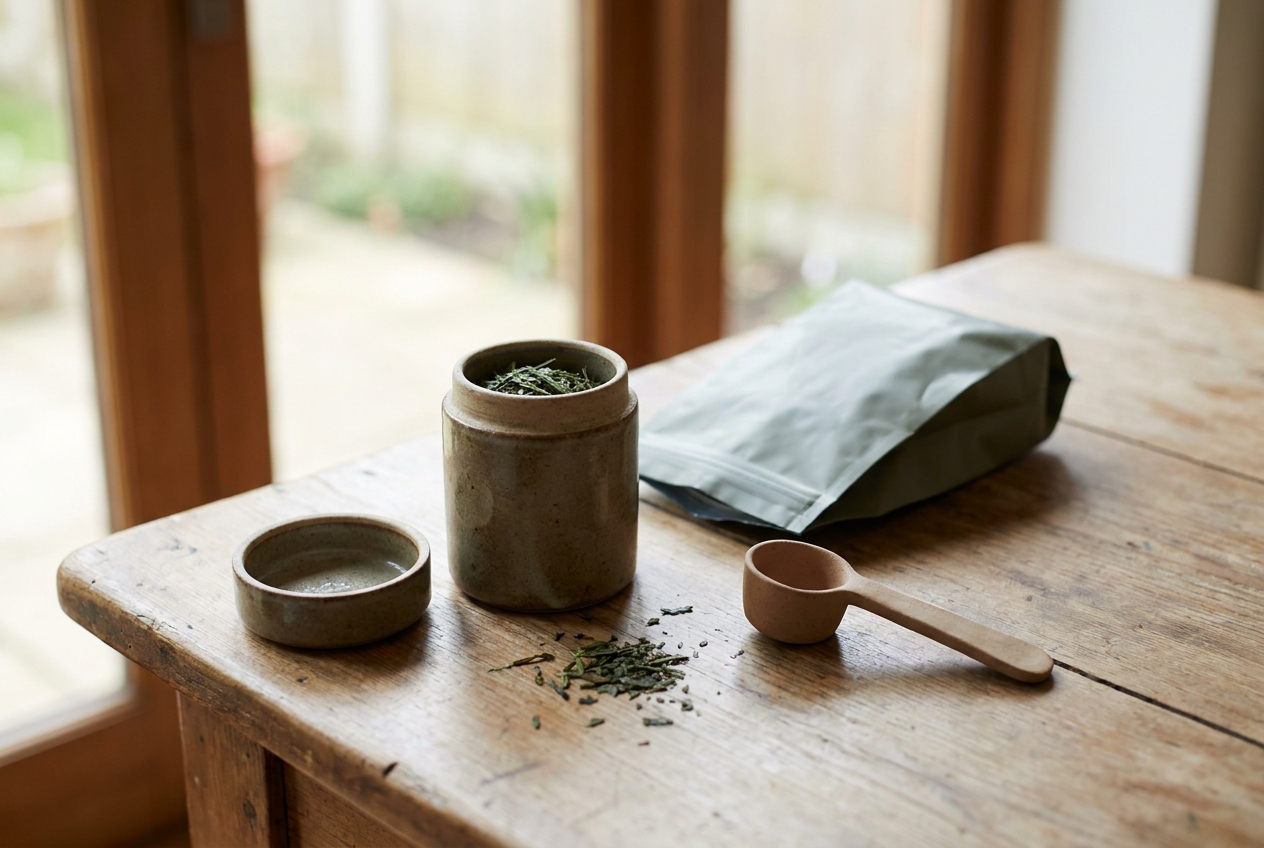
Buy the size you can finish in a month — two 50 g bags six weeks apart, not one 100 g bag, and never the 200 g “value” bag unless tea is your daily habit. And don’t let a beautiful ceramic jar be your only container: if the lid lifts with one finger and there is no gasket, it is a lid, not a seal. Keep 7–10 days of leaf in it and leave the rest sealed in the foil pouch it arrived in.
A tea caddy is a decanter, not a vault
The Japanese tea canister — chazutsu — is one of the most quietly satisfying objects on the tea tray, and it is routinely sold to English-speaking buyers as long-term storage. It is not, quite. Japanese tea sellers describe the caddy as the container for the leaf you are drinking now: seven to ten days’ worth, kept where you can reach it. The bulk stays sealed somewhere darker and colder.
What separates a good caddy from a decorative one is a second lid. The best tins have an inner lid that sits down inside the neck and an outer lid over it — two seals in series, so that air has to defeat both. Kaikado in Kyoto, founded in 1875 and still making tin, copper and brass caddies through roughly 130 hand steps, is the reference point here: their lids are fitted so precisely that a lid set on the neck sinks under its own weight, letting the air out with a faint hiss as it goes. That is not a party trick. It is the seal being demonstrated.
Caddies are sold by the weight of leaf they hold — 40 g, 100 g, 120 g, 200 g are the usual steps — and that number should match your week, not your ambition. A 40 g caddy suits a weekend drinker; 100 g suits a daily one. Tins are wiped, not washed: water inside a metal caddy is the one thing it cannot forgive. Ceramic canisters can be lovely and work well if the lid carries a silicone gasket, but an unglazed or porous interior will hold onto smells the way any low-fired porous ware does, and the usual care rules for Japanese ceramics apply: dry it completely before it goes back into service. A well-made caddy is also, incidentally, one of the better gifts to give a tea drinker — it is useful on day one and does not need to match anything they own.
The refrigerator is not free
Cold storage genuinely slows the decline, and Japanese producers use it at scale. In a domestic kitchen it comes with one rule that is not optional: bring the container back to room temperature before you open it. Cold leaf meets warm air, moisture condenses on the surface, and you have introduced the one enemy that is irreversible. Take the sealed bag out, leave it on the counter until it is no longer cold to the touch, then open it.
Which rules out the habit most people fall into — keeping the working caddy in the fridge and dipping into it every morning. Every dip is a condensation cycle, plus a chance to collect whatever else is in there. Store the unopened bulk cold and sealed; keep the caddy at room temperature in a dark cupboard; refill it every week or so. That two-container split is the whole system, and it costs nothing.
The freezer works on the same terms and is worth it only for tea you are not going to open for months — an extra bag of shincha bought in season, for instance. Once thawed and opened, it is on the counter clock like everything else.
Matcha runs on a shorter clock than any of it
Matcha is the same leaf with its surface area multiplied. Stone-milled matcha comes off the wheel at roughly 5–10 micrometres — fine enough to stay suspended in water, which is the point, and fine enough that essentially every particle is exposed on all sides, which is the cost. It stales in weeks, not months.
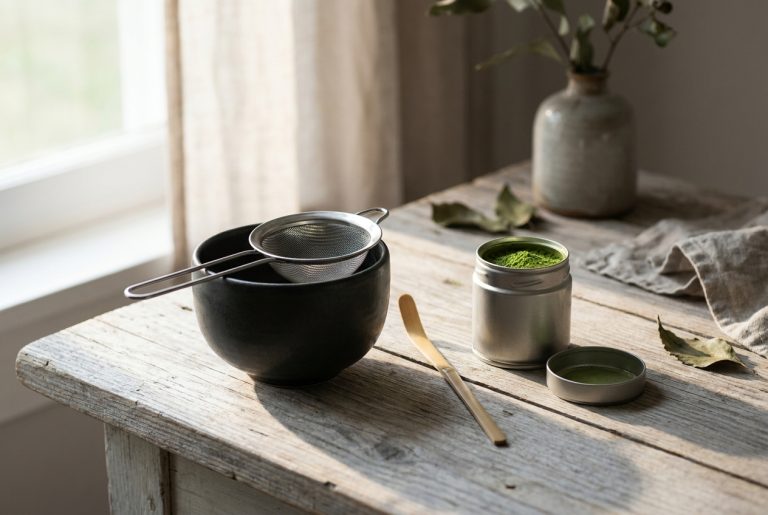
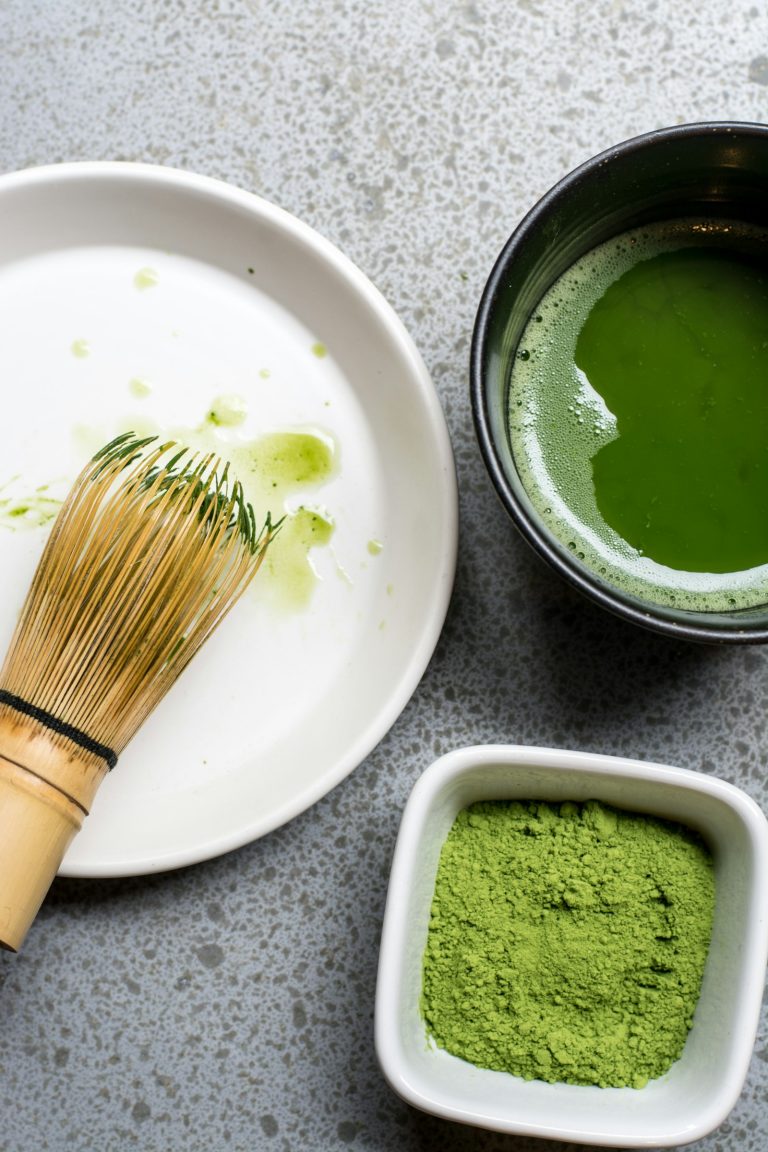
You can see it before you taste it. Fresh matcha is an intense jade; as chlorophyll degrades it moves olive, then yellowish-brown, and the flavour follows with a flat, dusty edge that no amount of whisking recovers. Once a tin is open, a month is a fair working limit — which is why a 30 g tin at a daily bowl is about right and a 100 g bag is a mistake at any price. Keep the open tin sealed at room temperature in a dark cupboard, or cold with the same warm-it-first rule, and sift before you whisk: clumping is a moisture signal as much as a texture one. If you are still assembling your kit, this is worth weighing when you compare beginner matcha sets — a set built around a large tin is worth less than it looks — and it matters more than the choice between one chawan and another.
Buy this, not that
For matcha, buy the 20–30 g tin even though the per-gram price is worse. At one bowl a day (about 2 g) a 30 g tin is two weeks; a 100 g bag is seven, and you will drink the last third of it olive-coloured. If a shop sells matcha without a milling or packing date on the tin, treat that as information about the shop.
When it has gone flat
Flat tea is a flavour problem, not a spoilage one, and it has uses. Tired sencha makes very good hōjicha at home: a dry pan over medium heat, leaves in a single layer, stirred constantly for three to five minutes until they turn brown and the kitchen smells of toast, then off the heat immediately — the difference between roasted and burnt is about twenty seconds. Old leaf is also fine for cooking rice with, and dried leaves left in a small dish will deodorise a cupboard, which is the same property that ruined them in the first place.
The one signal to act on is smell. If the leaf smells damp, musty or of the cupboard rather than of tea, it has taken on moisture and it will not come back. Retire it.
The one thing on the tray that is supposed to run out
Most of what we write about here is built to outlast the person who bought it. A kyusu seasons with use, a yunomi gets a patina, and the whole logic of a Japanese table is that the objects accumulate. The tea inside them is the exception. It arrives already at its best and gets no better, which makes it the one purchase where restraint is the entire technique — buy less, more often, and let the caddy be exactly what it is: the vessel that carries a week. If you are still choosing the vessels themselves, our guide to everyday and guest tea sets is the place to start.
Disclosure: Nagori Ware is an independent editorial guide written from Japan. Some links elsewhere on the site are affiliate links. Parts of this site are drafted with AI assistance and checked against Japanese sources. The photograph is AI-generated and illustrative. General information, not legal or safety advice. Storage windows are flavour guidance, not safety rules, and they vary with the tea, the packing and your climate; where a producer or shop prints its own guidance, follow that.