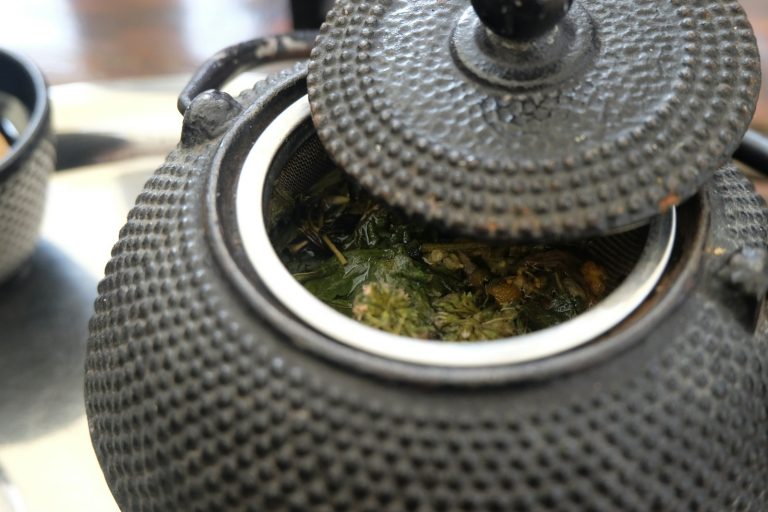
Houhin and Shiboridashi: The Handleless Japanese Teapots, and Who Actually Needs One
A houhin is usually introduced as a teapot without a handle, as though the handle simply fell off somewhere between China and Uji. That gets it backwards. The handle is missing on purpose, and the absence is the specification. A vessel you have to pick up by its body can only be used with water cool enough to touch — and that, not the shape or the clay or the name, is what you are actually buying.
Which means the honest first question is not “which houhin should I buy.” It is whether you drink the kind of tea that a houhin exists for. Most people who land on this page do not, yet, and a good shop will not tell you that.
What a houhin actually is
宝瓶 (houhin) is a small lidded brewing vessel with a triangular pouring lip, a flared body, and no handle of any kind. You will also see it written 泡瓶 and 方瓶 — the same object, different characters, which is a reliable sign that a word entered the language by sound before anyone settled the spelling.
It is also newer than the marketing suggests. English listings like to file the houhin next to tea ceremony, but Japanese sources place it in the late Edo period and into Meiji, and one common account traces the shape back to the Chinese gaiwan — a covered cup you pour from by tilting the lid. That descent is a plausible theory rather than a settled fact, and I will not present it as more. Against the long run of Japanese ceramics, the houhin is a recent arrival.
The kiln that made the form its own is Asahi-yaki in Uji, one of the Enshū Seven Kilns, making handleless pots since the eighth Chōbei in the late Edo period and still making them today. That is the closest thing this vessel has to a canonical version — for reasons that become obvious when we get to the holes.
Why there is no handle
Gyokuro is brewed at 50–60 °C. Premium lots go lower still. That number is not a preference, it is chemistry: theanine and the amino acids that read as sweetness dissolve readily in cool water, while catechins and caffeine — the bitterness and the edge — need heat to come out. We walk through the whole logic in our guide to brewing sencha versus gyokuro, but the short version is that with gyokuro you are deliberately leaving the harsh compounds in the leaf.
Water at 55 °C in a thin-walled ceramic vessel is warm in the hand. Not pleasant, not painful — warm. You can hold it, tip it, and set it down. Water at 90 °C in the same vessel is not something you want to be gripping by the sides, which is precisely why every teapot meant for hojicha, bancha and the everyday teas has a handle bolted to it somewhere.
So the houhin enforces its own brewing rule. Fill it with water that is too hot and the vessel tells you immediately, before the tea is ruined, in the only language a piece of pottery has. No other item of Japanese teaware does this. A kyusu will happily let you scald a $60 packet of gyokuro and say nothing.
Houhin, shiboridashi and kyusu: the sizes that separate them
Three vessels get recommended for gyokuro and they are not interchangeable. The clearest way to tell them apart is by volume, because volume is downstream of what each one is for.
| Vessel | Typical capacity | Strainer | Brewed at | Best for |
|---|---|---|---|---|
| Shiboridashi | 50–100 ml | None — the lid gap | 50–60 °C | Tiny, concentrated gyokuro pours |
| Houhin | 120–200 ml | Holes in the body or spout | 50–60 °C | Gyokuro and top-grade shaded sencha, two to five small cups |
| Kyusu | 250–400 ml | Ceramic or mesh, side handle | 70–90 °C | Everyday sencha, genmaicha, hojicha, bancha |
Real examples, so the ranges are not abstract. Asahi-yaki’s celadon houhin comes in S at 120 ml and M at 150 ml; the version in Uji clay is 150 ml and measures 100 mm across by 75 mm tall, spout excluded. That is a small object — roughly the footprint of a teacup saucer.
The shiboridashi (絞り出し, “to squeeze out to the last drop”) is the same idea taken further: shallower, wider, closer to a dish than a pot, with grooves cut into the lip and no strainer at all. It is made in Hoshino-yaki in Yame, Asahi-yaki in Uji, and Tokoname. At 50–70 ml a full pour is a few mouthfuls.
Now the outlier. Shops do sell things labelled houhin at 280 ml — a Tokoname example with a ceramic strainer runs about ¥4,180 at that size. It will make tea. But a 280 ml handleless pot is a kyusu with the handle deleted: too big to be a concentrated gyokuro pour, and holding a nearly full one by the body is exactly the discomfort the form was shaped to avoid. If a listing gives you a capacity above roughly 200 ml, read it as a wide-mouth pot for leisurely sencha rather than the gyokuro vessel you came looking for. Our guide to reading a Japanese tableware listing covers the rest of what these product pages leave unsaid, and the sizes and terms reference has the vocabulary.
Where the strainer is, and why it is the thing you are paying for
Here is where English writing on the houhin goes thin. You will read that the strainer is “built into the spout,” or that it is a sasame — a patch of pierced holes behind the pouring lip. Both descriptions exist in the wild, and both are true of some pots.
They are not true of the pot that defined the form. Asahi-yaki publishes what it does: more than 150 holes, each about 1.5 mm across, opened through the body and carried right down to the base, with the pouring lip flared outward below. The kiln is explicit about why. The strongest, sweetest liquor pools at the bottom of the vessel, and holes that stop at the rim cannot reach it. A wall of holes running to the base can. The 1.5 mm figure is chosen against the small, soft leaf of sencha and gyokuro specifically.
That single detail reorganises the whole buying decision. Every other variable — clay, glaze, kiln name, the gold on the lid — is decoration compared to where the holes are and how far down they go. It is also, conveniently, something you can check from a photograph. Ask a shop for a picture of the inside. A good one will have it already.
And it explains the price ladder honestly. The Uji-clay Asahi-yaki houhin is ¥22,000. The 280 ml Tokoname pot is ¥4,180. The gap is not five times the tea. It is a hundred and fifty hand-opened holes, a clay body from a specific place, and a kiln that has been refining one shape since the late Edo period. Whether that is worth it depends entirely on what you pour into it.
How to use a houhin
The grip is three fingers. Index finger flat on the lid knob, thumb and middle finger on the rim, and you tilt the whole thing forward. The finger on the lid is not ceremony — it holds the lid against the rim so the gap stays constant while you pour. On a shiboridashi that gap is the strainer, so the pressure of one finger is the difference between clear tea and a mouthful of leaf.
For gyokuro: a generous amount of leaf against very little water, 50–60 °C, and a steep of roughly 45 seconds to two minutes depending on the leaf and how low you have taken the temperature. Kyoto growers commonly work at the short end. If you want the reasoning behind the ratios rather than the numbers alone, that is in the sencha and gyokuro brewing guide.
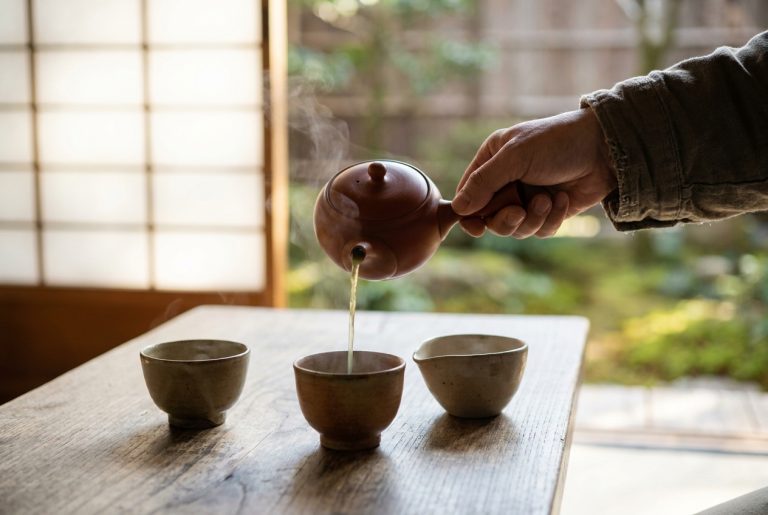
Then pour round-robin — 回しつぎ. Never fill one cup and move on. Go a little into each cup, come back, go a little more, until all are level. The liquor changes strength continuously as it leaves the pot, so the only way to give five people the same tea is to build all five cups in passes. This is the practical reason gyokuro is served in small cups rather than mugs, and why houhin sets are sold with two or five of them rather than one.
The second infusion surprises people. You do not wait, and you do not cool the water — pour straight from the kettle and serve immediately. The leaf is already open and fully wetted, so it gives up everything at once; another two-minute steep at low temperature would only make it thin. Hot and fast on the second brew, cool and slow on the first.
One caveat worth repeating because Japanese tea shops say it themselves: on pots with a fine pierced strainer, small fragments of leaf do get through. Fukamushi and other deep-steamed teas break up in the pot and will cloud the cup. That is a limitation of the design, not a defect in your pot.
What to look for, and what to ignore
In rough order of how much it will change your tea:
- Where the holes are. Down the body to the base beats a patch behind the spout. This is the single biggest difference between pots at the same price.
- Capacity, honestly assessed. 120–150 ml for gyokuro with one or two people. Under 100 ml means you are buying a shiboridashi, whatever the listing calls it. Over 200 ml and the form has stopped making sense.
- How the lid sits. Set it on, tilt it, look along the join. An even gap all the way round means an even pour. A lid that rocks was fired carelessly and will dribble down the outside forever.
- Glazed or unglazed. Unglazed clay from Tokoname or Banko takes on the character of whatever you brew and should be dedicated to one tea. Porcelain and glazed bodies stay neutral and let you switch. Neither is better; they are different commitments.
- The decoration. Ignore it, or buy it purely because you like it. Hand-painted Kutani gold changes the price a great deal and the tea not at all.
Buy this, not that
If you do not already drink gyokuro or top-grade shaded sencha, do not buy a houhin — buy a yuzamashi (a cooling bowl, usually ¥2,000–5,000) and keep the kyusu you own. It solves the same problem, works with every tea you actually drink, and costs a fraction of a ¥22,000 pot. Come back for the houhin when a 100 g packet of gyokuro is a normal purchase for you. And if you do buy one, spend on a body pierced with 150-odd holes down to the base at 120–150 ml, not on gold decoration at 280 ml.
Who should skip it
Skip the houhin if your daily cup is genmaicha, hojicha or bancha. Those teas are brewed hot on purpose — hojicha near boiling, because roasting has already driven off most of what would turn bitter — and a handleless pot is simply the wrong tool held the wrong way. A side-handle kyusu is better in every respect. So, differently, is a cast iron pot if what you want is heat retention.
Skip it if you are buying a first set of Japanese teaware — the order that works is kettle, kyusu, two or three cups, good leaf, and our guide to choosing a Japanese tea set puts a houhin nowhere near the opening move. Skip it as a gift for someone whose tea habits you do not know; it is a specialist’s object and the odds are poor, and the gift guide has safer ground.
And skip it if you have never brewed gyokuro at all. Buy the tea first and brew it in what you own, using cups to knock the temperature down — poured from one vessel to another, boiling water loses roughly 10 °C per transfer. If you end up doing that daily and resenting the washing up, the houhin is the answer to a question you now actually have. Your water will change the result more than your pot does, in any case.
Care
Rinse with hot water, never soap, and let it dry completely with the lid off. This matters more on a houhin than on most pots: the strainer is a hundred and fifty small holes, and soap residue and trapped moisture both live in holes. On unglazed clay, soap is out entirely — it soaks into the body and you will taste it for months. Our guide to caring for Japanese ceramics covers drying and storage in more detail, and for the dishwasher and microwave question generally, see what actually determines whether a Japanese piece can go in either.
Empty the leaf out promptly. If the pour slows over months the holes are partly blocked; a soak in plain hot water and a soft brush from the inside usually clears them, and nothing metal ever goes near them. Store the tea itself properly too, which is a separate problem with its own rules — gyokuro is the tea most punished by careless storage.
Frequently asked questions
Is a houhin the same as a shiboridashi?
No, though they are close relatives and shops use the words loosely. A houhin is deeper, holds 120–200 ml, and has a pierced strainer. A shiboridashi is shallower and dish-like, holds 50–100 ml, and has no strainer at all — the gap between lid and rim, helped by grooves cut into the lip, does the work. If you want one vessel for gyokuro, the houhin is the more forgiving choice.
Can I brew sencha in a houhin?
Good shaded sencha, yes, and it is a pleasure. Ordinary everyday sencha at 70–80 °C, technically yes but you will not enjoy the handling, and a kyusu pours better. Deep-steamed fukamushi is the one to avoid: the leaf breaks up and passes through the strainer.
Why is my houhin dribbling down the outside?
Usually the lid, not the spout. Press the lid firmly with your index finger and tilt further and faster than feels polite — a timid, half-tilted pour clings to the lip. If it still runs down the body with a confident pour, the lid and rim were not trued to each other, and that is a manufacturing fault worth returning.
How much should I spend?
Working pots start around ¥4,000–6,000; a kiln-made piece from a named workshop runs ¥15,000–25,000. Spend at the lower end until you know you will use it weekly.
Do I still need a yuzamashi?
Probably, and it is why good sets include one. The houhin tells you when the water is too hot; it does not cool the water for you. A yuzamashi does that job deliberately and repeatably, and it is the cheaper half of the pair.
The short version
A houhin is a vessel with the handle removed so that the only tea you can comfortably brew in it is the tea it was made for. Buy one at 120–150 ml, with holes running down the body rather than a patch behind the spout, and a lid that sits evenly. Ignore the decoration. And if the tea in your cupboard is brewed above 70 °C, the honest advice is that you are looking at a beautiful solution to somebody else’s problem — a yuzamashi and the kyusu you already own will serve you better, and the tea itself is where the money is best spent anyway.
Disclosure: Nagori Ware is an independent editorial guide written from Japan. Some links elsewhere on the site are affiliate links. Parts of this site are drafted with AI assistance and checked against Japanese sources. General information, not legal or safety advice. Temperatures here are about flavour and comfort in the hand, not food safety.