How to Choose a Japanese Tea Set: Everyday Sets vs Guest Sets
A friend of ours bought her first Japanese tea set the way most people do: she searched the phrase, sorted by reviews, and clicked the handsome one. What arrived was a fifteen-piece box — a teapot, six cups, six saucers, a lacquered tray — and it has lived in a cupboard ever since, because she drinks tea alone on weekday mornings and the pot is too big to brew one good cup.
Nothing was wrong with the set. It simply answered a question she had not asked. Japanese teaware is built around a specific number of drinkers, and the pot that serves five people badly overshoots the person who mostly drinks alone. So before materials, before kilns, before price: who is going to be holding the cups?
Two sets, two entirely different jobs
Almost every Japanese tea set sold today descends from one of two household objects, and they are not interchangeable.
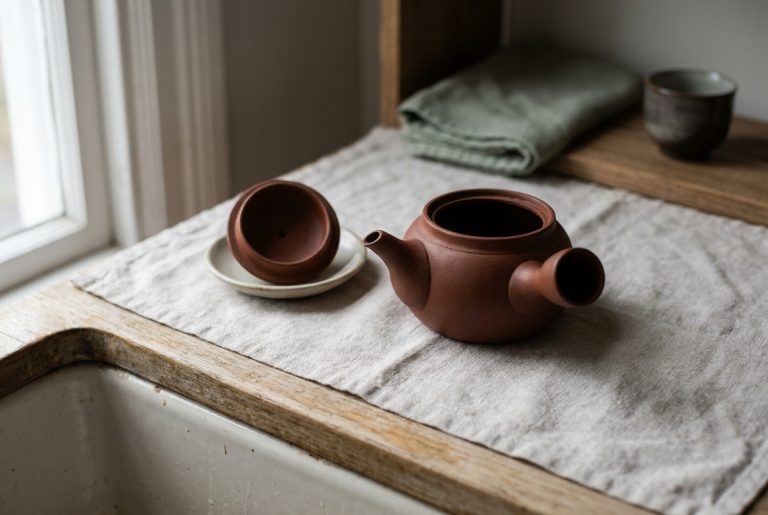
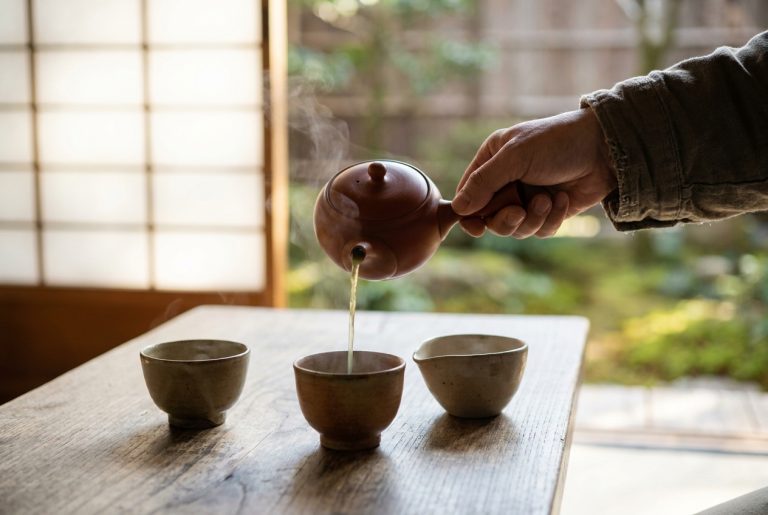
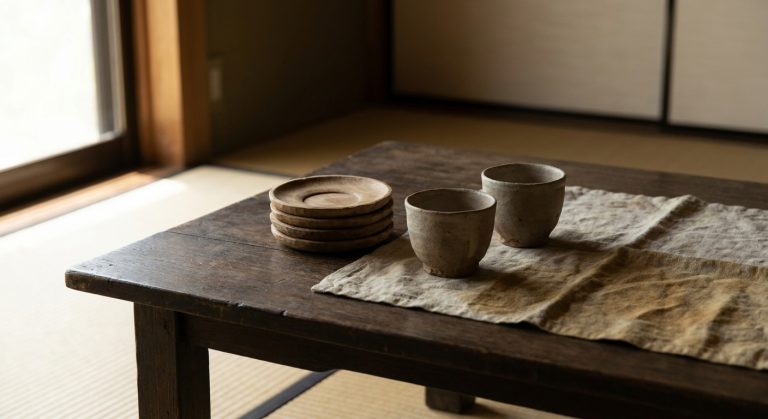
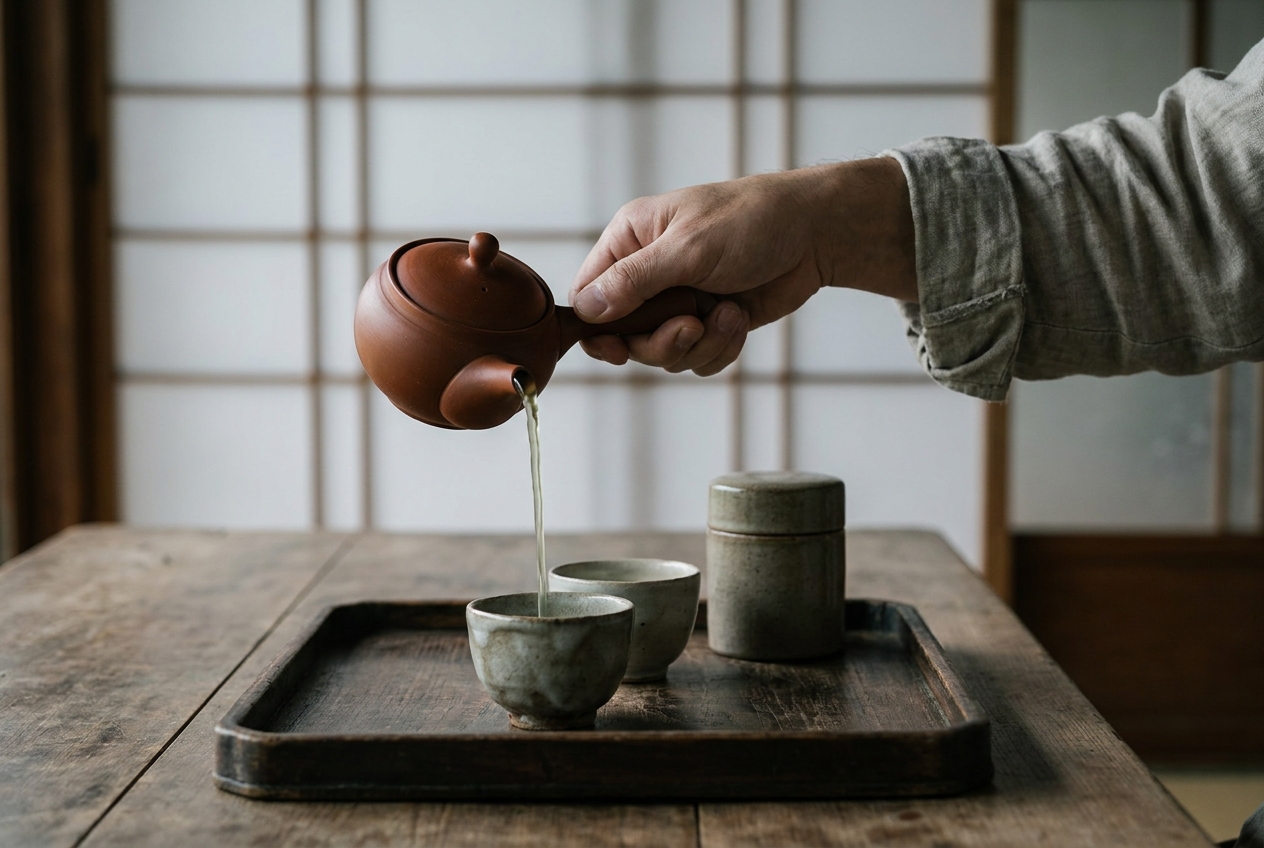
The everyday set is what sits within arm’s reach of a Japanese kitchen counter: a small side-handled teapot — a kyusu (急須) — and two tall, handleless cups called yunomi (湯呑). It is used two or three times a day, re-steeped, rinsed, and put back. Nothing about it is ceremonial.
The guest set comes out of a cabinet. It is a slightly larger pot with five shallow, wide-mouthed cups — kumidashi (汲み出し) — usually on a tray, and often a little more decorated than anything the household uses on a Tuesday. The shallow cup is deliberate: it cools a small pour of good tea quickly and shows the color of the liquor, which is the point when you are serving gyokuro or a high-grade sencha to someone you want to impress.
Why the guest set has five cups, not six
Western dinnerware arrives in fours, sixes, and eights. Japanese tableware arrives in fives, and the reason is linguistic before it is aesthetic: one reading of the number four, shi, is a homophone for death, so sets of four are avoided. Guests were invited in parties of five or multiples of five, and five became the standard count for both ceramic and lacquered service — cups, plates, rice bowls alike. Odd numbers are also simply preferred in Japanese arrangement, in flowers as in food.
This trips people up when they try to buy a set “for six.” You usually cannot, not from a Japanese kiln. Buy five, or buy two sets of five, or buy singles that do not match — which, as it happens, is what a lot of Japanese homes actually do.
The cup decides more than the pot
Most buying guides fixate on the teapot. In daily use the cup matters more, because the cup sets the temperature the tea reaches your mouth at, and Japanese green tea is unusually sensitive to temperature. A tall yunomi holds heat; a shallow kumidashi sheds it. That is the entire design argument between them.
That last column is worth saying plainly, because it is the most common mix-up we see: a chawan for matcha belongs to a different system entirely. Matcha is whisked, not steeped, so it needs a wide floor and no teapot at all. If matcha is what you want, you want a whisk, a scoop and a bowl — a different purchase, covered in our guide to beginner matcha sets.
Reading the product page: four numbers and one word
Pot capacity, in milliliters. Listings love to say “small” and “traditional.” Ignore that and find the number. For one or two drinkers, 200–350 ml is the working range; a 320 ml pot fills two modest cups with enough left for a second steep. For a table of five, look at 300–400 ml and accept that you will pour twice. Much past 500 ml you have left kyusu territory altogether, and single servings brewed in a pot that size tend to come out flat, because the leaf sits in water longer than it wants to.
Cup capacity, also in milliliters. A yunomi at 150–220 ml is the everyday size; 90–120 ml cups are for concentrated, high-grade leaf and will feel stingy with your morning bancha.
The number of cups. Five is the traditional count; two-cup sets are now common and are usually the better buy for a Western household.
The filter. This is the one word to look for, and the one most sets bury. A ceramic filter — a patch of fine holes fired into the clay where the spout meets the pot, called sasame, or its flatter modern version sold as ceramesh — is part of the pot body itself, so it adds nothing to the flavor and handles fine, deep-steamed leaf well. A stainless mesh filter, including the obi-ami band that wraps around the inside wall, has finer holes still and pours fast, but steel can corrode over years and a cheap one leaves a faint metallic edge. Neither is wrong. Knowing which one you are buying is the difference between a set you keep and a set you replace.
Material comes last, honestly, because most of the sets you will consider are one of three things: unglazed Tokoname red clay (the classic, said to soften the astringency of green tea), glazed Banko or Mino stoneware (warm, forgiving, dishwasher tolerance varies), or Hasami and Arita porcelain (bright, hard, easy). Cast iron is its own conversation — a tetsubin is a kettle first, and an unlined one should not be used to steep leaf tea.
Which set fits which household
| You are… | Buy | Pot size | Cups | Typical price* |
|---|---|---|---|---|
| Drinking alone, most days | Kyusu + 2 yunomi | 200–300 ml | 150–200 ml | $45–120 |
| A household of two | Kyusu + 2 yunomi, one size up | 300–350 ml | 180–220 ml | $60–160 |
| Hosting four or five | Kyusu + 5 kumidashi + tray | 300–400 ml | 100–150 ml | $120–350 |
| Buying a gift | Boxed matched set, five cups | 300–400 ml | 100–150 ml | $120–300 |
| Chasing gyokuro | Hohin (handleless pot) + small cups | 120–200 ml | 60–100 ml | $80–250 |
| After matcha | Chawan, chasen, chashaku | — | 350–500 ml bowl | $50–150 |
The matched set versus the collected one
There is a quiet argument for not buying a set at all.
A matched set gives you coherence, a box, and a solved gift. It is the right answer when the tea things are going to someone else, or when you want your table to look composed without thinking about it. The trade-off is that matched sets are usually made in larger runs, and the cups tend to be the least interesting piece in the box.
Assembling your own — a Tokoname pot here, two cups from a different kiln there — costs a little more per piece and looks less tidy in a photograph. What you get is the thing Japanese households actually have: cups that differ, one of which becomes yours by habit, another that guests are given. Over years the mismatched shelf reads as lived in rather than bought.
If you go the collected route, buy the pot first and live with it for a month before choosing cups. The pot is the piece you will notice every day, and it is the piece worth spending on. Our kyusu buyer’s guide covers handle styles and filters in more detail, and the yunomi guide does the same for cups.
One accessory worth the money
Skip the bamboo tea scoop, the strainer stand, the tiny lidded canister that comes bundled to inflate the piece count. The one extra worth buying is a yuzamashi (湯冷まし) — a wide, low pitcher whose only job is to cool water.
It matters because Japanese green tea is brewed cool. Sencha wants roughly 70–80°C (158–176°F); gyokuro is lower still, around 50–60°C (122–140°F). Boiling water scorches both into bitterness. A yuzamashi solves this without a thermometer: each transfer between vessels drops the water temperature by roughly 10°C, so kettle to yuzamashi to pot lands you in sencha range from a fresh boil. Pour, watch the steam thin out, pour again. The tea will taste sweeter and you will not have measured anything.
The temperatures themselves, and how long to steep at each, are laid out in our guide to brewing sencha and gyokuro.
A few things people ask before buying
Can I use a Japanese tea set for black tea or herbal tea?
Yes, though the pot is small for a long Western steep and unglazed clay will pick up strong flavors over time. If you drink both, keep the kyusu for green tea and use something glazed for everything else.
Do the cups come with saucers?
Traditional Japanese sets often do not. Saucers appear as chataku — small wooden or lacquered coasters used for guests, not for daily drinking. Many sets sold abroad add Western-style saucers to look complete.
Is a bigger pot safer if I am not sure?
The reverse. An oversized pot makes weak, over-extracted tea when you brew a single serving in it, and small pots are meant to be re-steeped two or three times anyway. Size for your ordinary day, not your busiest one.
Are these dishwasher-safe?
Glazed porcelain sets usually are. Unglazed Tokoname and any pot with a fine ceramic filter should be hand-washed — the filter clogs and the clay body does not need detergent. Details are in our care guide for Japanese ceramics.
What if I want one set that does everything?
A 300–350 ml glazed kyusu with four to five cups in the 130–160 ml range is the most flexible compromise: large enough to serve company, small enough to brew for one without ruining the leaf.
Where to start
Count the people who will drink from it on an ordinary Tuesday. Buy for that number, in milliliters, and let the beautiful five-cup set wait until you are the kind of household that pours for five.
Related guides
- Japanese Tea: a complete beginner’s guide — types, brewing and teaware in one place
- The best Japanese teapots (kyusu) — handles, filters and clays
- Yunomi: the everyday Japanese teacup
- The best matcha sets for beginners — if matcha, not leaf tea, is the goal
- How to brew sencha vs gyokuro — temperatures and steep times
- Japanese tableware: a complete guide — how teaware fits the wider table
About this guide
Nagori Ware is an independent guide to Japanese tableware and tea. We research materials, regions and makers so you can buy once and buy well. We do not sell products; we point you to the specialist shops that make and stock them, and may earn a referral fee if you buy.
Disclosure: Nagori Ware is an independent editorial guide written from Japan. Some links elsewhere on the site are affiliate links. Parts of this site are drafted with AI assistance and checked against Japanese sources. General information, not legal or safety advice.