Japanese Seasonal Motifs: Momiji, and the Rule of Running Early
There is a rule about seasonal patterns in Japan that almost nobody writing in English says out loud, and it changes what you should buy: you put the motif on the table before the season arrives, and you put it away once the season is at its peak. A maple-leaf plate is not for the day you go see the maples. It is for the three or four weeks while you are still waiting for them.
The habit has a name — sakidori (先取り), “taking it early” — and it comes out of kimono and tea practice, where wearing cherry blossoms to a cherry blossom viewing was considered slightly graceless. You do not compete with the tree. You anticipate it, and then you let the real thing have the room.
Once you accept that, a decorated Japanese plate stops being decoration and starts being a date. The question underneath everything below is not “which pattern is prettiest,” but how many days a year each piece is allowed to exist — and what that means for the order you buy in.
Momiji: the motif, and the moving target behind it
Momiji (紅葉) and kōyō are written with the same two characters and mean different things in practice. Kōyō is autumn colour in general. Momiji is the Japanese maple specifically — Acer palmatum, the small-palmed one — and, by extension, the whole autumn ritual of going to look at it.
The reason the timing gets confusing is that the season itself moves. The colour front starts in the Hokkaidō mountains in mid-to-late September, reaches Tokyo and Kyoto in late November, and finishes in Kyushu in early December. Nearly three months from end to end, in one country. Higher elevations turn first; the lowlands lag.
So a momiji dish has a usable window of roughly late September through November, shifted earlier the further north you live. If you are in Vermont or Bavaria rather than Kyoto, use your own trees as the clock and start about three weeks before they turn. Adapt the clock, not the rule — nothing here is Japan-specific except the plates.
There is one momiji pattern with a much narrower window, and it is worth knowing because it is common on good pieces: Tatsutagawa — scattered maple leaves drifting on flowing water (ryūsui). It comes from a ninth-century poem by Ariwara no Narihira about the Tatsuta River near Nara running crimson with fallen leaves, and it is not a picture of autumn. It is a picture of autumn ending. Leaves on a branch are early autumn; leaves on water are late. If you own both, the branch version comes out in October and the river version replaces it in November.
The motif year, drawn
Written out, this all sounds like a lot to memorise. Drawn, it is one shape repeated: the bar you care about sits to the left of the season it refers to.
Two exceptions keep this from being tyranny. Motifs tied to a specific event rather than a natural season are fine right up to and including the day — a chrysanthemum dish on 9 September, Chōyō no Sekku, the chrysanthemum festival and the last of Japan’s five seasonal festivals, is exactly right rather than late. And composite patterns that pile all four seasons into one design are deliberately season-proof; that is what they are for.
The autumn shortlist, in the order I would actually buy it
Autumn is the deepest bench in the Japanese motif year, which makes it the easiest season to overbuy. Ranked by how many meals each one will genuinely earn:
- Momiji — the longest autumn window and the most legible to a Western table, because a red maple leaf reads as autumn everywhere. Best on a small plate (mamezara or kozara, roughly 9–15 cm) where it does not have to carry a whole meal.
- Kiku (chrysanthemum) — longevity, the imperial crest, and a genuine festival date. One caveat worth taking seriously: white chrysanthemums are the flower of Japanese funerals. Coloured or stylised kiku on tableware is entirely ordinary; a stark white kiku on a white ground reads differently to a Japanese guest than it does to you. If it is a gift, choose a coloured one.
- Susuki and the moon — pampas grass, often with a rabbit, for tsukimi moon-viewing in mid-autumn. Short window, but it is the one autumn motif that also works on a teacup rather than a plate.
- Ichō (ginkgo) and kaki (persimmon) — later, warmer, less photographed, and consequently cheaper for the same quality of painting.
- Tombo (dragonfly) — autumn, and historically a samurai favourite: the dragonfly was the kachimushi, the “victory insect,” because it was believed never to fly backwards. It appears on sake cups more than on plates.
Buy this, not that
Do not let a seasonal motif be your first decorated piece. A momiji plate earns roughly 50 days a year; five plain mamezara earn 365 and cost about the same. Buy the calendar-locked piece third or fourth, once the everyday shelf already works — and when you do, buy it small. A 12 cm momiji dish is a seasonal accent you can slip onto any table. A 26 cm momiji dinner plate is a beautiful object you will resent in February.
What a motif actually costs you, in days
This is the part the shops have no reason to tell you, so here it is as arithmetic. The same money buys either three seasonal plates that spend most of the year in a box, or five undated ones that never leave the shelf.
Using one piece well
The mistake I see most often on English-language tables is the matched seasonal set: four momiji plates, four momiji bowls, momiji chopstick rests, all at once. It reads as a theme, and Japanese table setting is not built on themes. It is built on one thing changing while everything else stays put — the same principle behind building a dinnerware set around shared colour or material rather than a matching service.
So: one seasonal piece per table. The small dish holding pickles, or the sauce dish, or a single serving plate in the centre. Everything around it stays undated. The seasonal piece is the sentence in italics; you do not italicise the paragraph. If you want the whole table to move with the year, the lever is colour, height and empty space, not more maple leaves.
Storage follows from this. A seasonal piece spends ten months of the year put away, which is why good Japanese pieces still arrive in fitted paulownia (kiri) boxes — light, insect-resistant, and buffering humidity. Keep the box. Wrap each piece so glazed surfaces do not grind against each other, and store the box somewhere that does not swing between damp and dry.
Before you buy: two things to check on the listing
How the pattern was applied. Painted-under-the-glaze blue (sometsuke) is sealed under a glass layer and behaves like plain porcelain. Overglaze enamels — the bright reds, greens and golds of Kutani and much decorated Arita — sit on top, fired lower, and wear with abrasion. Autumn motifs attract gold more than any other season, and metallic decoration must not go in a microwave: it arcs. If the dish will live near one, check the listing or assume the answer is no.
What the body is. Porcelain is dense and forgiving. Porous earthenware and stoneware want hand-washing, thorough drying, and in some cases seasoning before first use — the whole logic of caring for Japanese ceramics is set by the body, not the picture on it. A seasonal piece that comes out twice a year and goes back into a box is exactly the piece most likely to be put away damp. Do not.
Buy this, not that
If you can only justify one seasonal purchase this autumn, make it a set of five momiji mamezara at 9–12 cm — five because that is how Japanese small plates are boxed and sold, and because it lets you seat four with a spare. Skip the gold-rimmed momiji dinner plate, however good it looks in the photograph: it is the piece that cannot go in the microwave, cannot go in the dishwasher, and cannot come out in March.
Why the leaves are on the water
It is worth saying what the Tatsutagawa pattern is doing, because it explains the whole system better than any rule.
Japanese seasonal aesthetics are not organised around the peak of things. They are organised around the approach and the aftermath. In the tea year there is a whole named season for this — nagori (名残), October, when the jar of last year’s tea is nearly empty and the new one has not been opened yet. The word means the trace something leaves behind. A nagori gathering is deliberately held on the thin, late, almost-finished side of the season, and it is considered one of the most beautiful moments in the calendar.
The same instinct puts the maple plate away in December, and paints the leaves already floating downstream rather than still burning on the branch. Not the height of the thing — the edge of it.
Which is a long way of saying: buy the small plate, use it for six weeks, and let it go. That restraint is not a limitation of the object. It is the object.
More on the ideas here: the complete guide to Japanese tableware for how the pieces fit together, and Japanese tea for the calendar the tea year runs on.
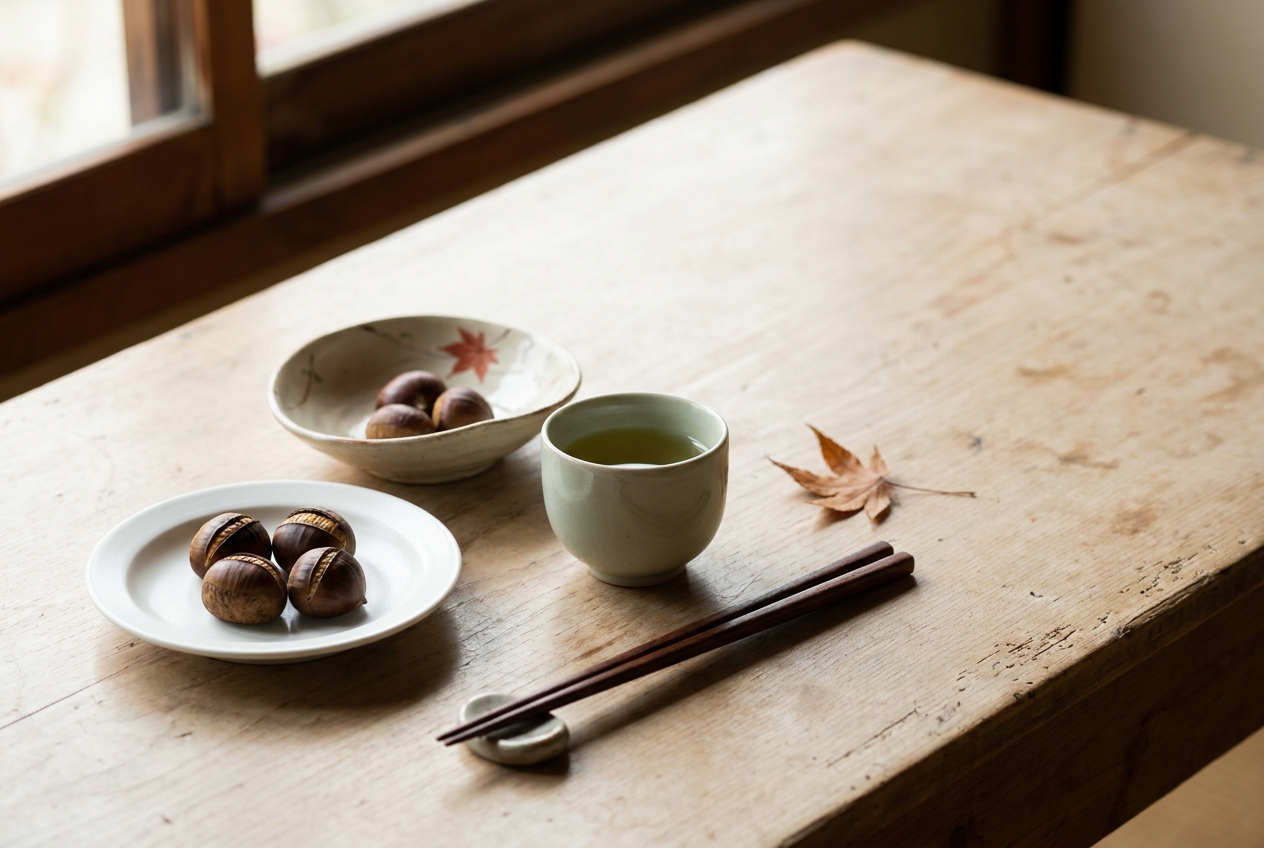
Disclosure: Nagori Ware is an independent editorial guide written from Japan. Some links elsewhere on the site are affiliate links. Parts of this site are drafted with AI assistance and checked against Japanese sources. The photograph is AI-generated and illustrative. General information, not legal or safety advice. Seasonal conventions vary by region, household and formality, and have loosened considerably in recent decades — treat them as useful context, not as rules.