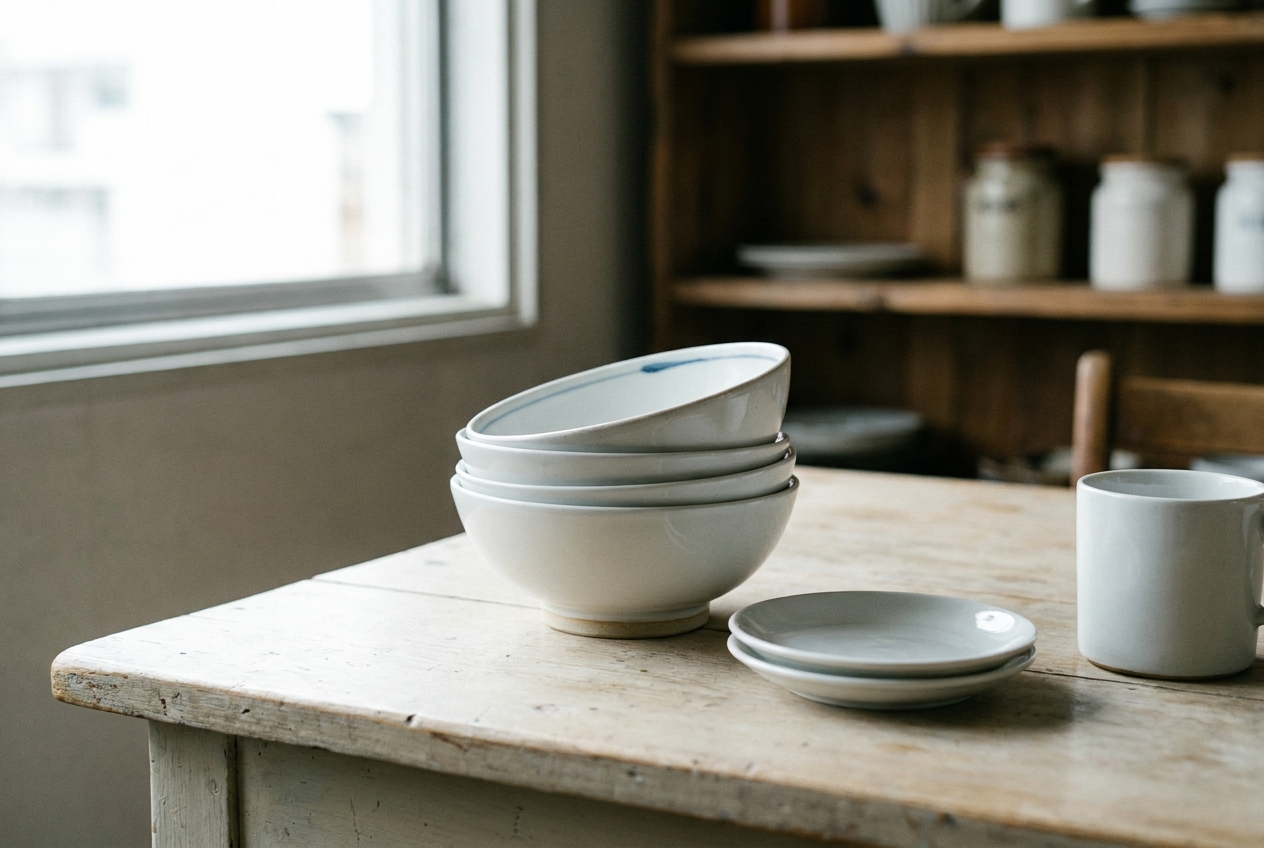
Hasami Ware: Why Japan’s Best-Value Porcelain Spent 400 Years Under Another Town’s Name
Two rice bowls on the same shelf. Same white porcelain, same weight in the hand, same thin cobalt line around the rim. One is $16. The other is $44. The $44 bowl says Arita on the box. The $16 bowl says Hasami — and twenty-five years ago, it would have said Arita too.
That is not a scandal and it is not a knock-off. It is a shipping arrangement that lasted a century, and the price gap it left behind is probably the most useful single fact an English-speaking buyer can hold about Japanese porcelain right now.
Everything else in this guide hangs on one sentence: Hasami is not a style. It is a supply chain. Why the town has no signature look, why almost nothing is signed on the base, why a brand called Hasami Porcelain is not the same thing as Hasami-yaki, why the price is what it is — all of it comes out of that.
What Hasami ware actually is
Hasami is a town of roughly 15,000 people in Nagasaki Prefecture, tucked against the prefectural border. Walk about half an hour east and you are in Arita, in Saga Prefecture. Two towns, two prefectures, one hill of porcelain stone between them. Kilns were built in the Hasami valley in 1599, by potters brought over from the Korean peninsula under the Ōmura domain — the same wave of forced migration that started porcelain in Arita a few years later.
What comes out is jiki — true porcelain. Fired hot, vitrified, effectively non-absorbent, which is why it never needs the starch-sealing ritual that soft earthenware does. If you want the underlying logic of why one Japanese bowl needs babying and another does not, it is all in how the clay and the firing temperature sort the country’s kilns, and it is worth reading before you spend anything.
But here is the thing that trips up every English-language guide I have read on this. There is no Hasami look. The town makes matte black modernist plates. It makes stackable cylindrical mugs that would pass for Scandinavian. It makes blue karakusa scrollwork rice bowls that look four hundred years old, because the pattern is. It makes a soy sauce dispenser that has been in production, unaltered, since 1958. All of that is Hasami ware. So “is this Hasami?” is almost never the right question. “Which workshop in Hasami?” is.
The kurawanka bowl, and the habit it left behind
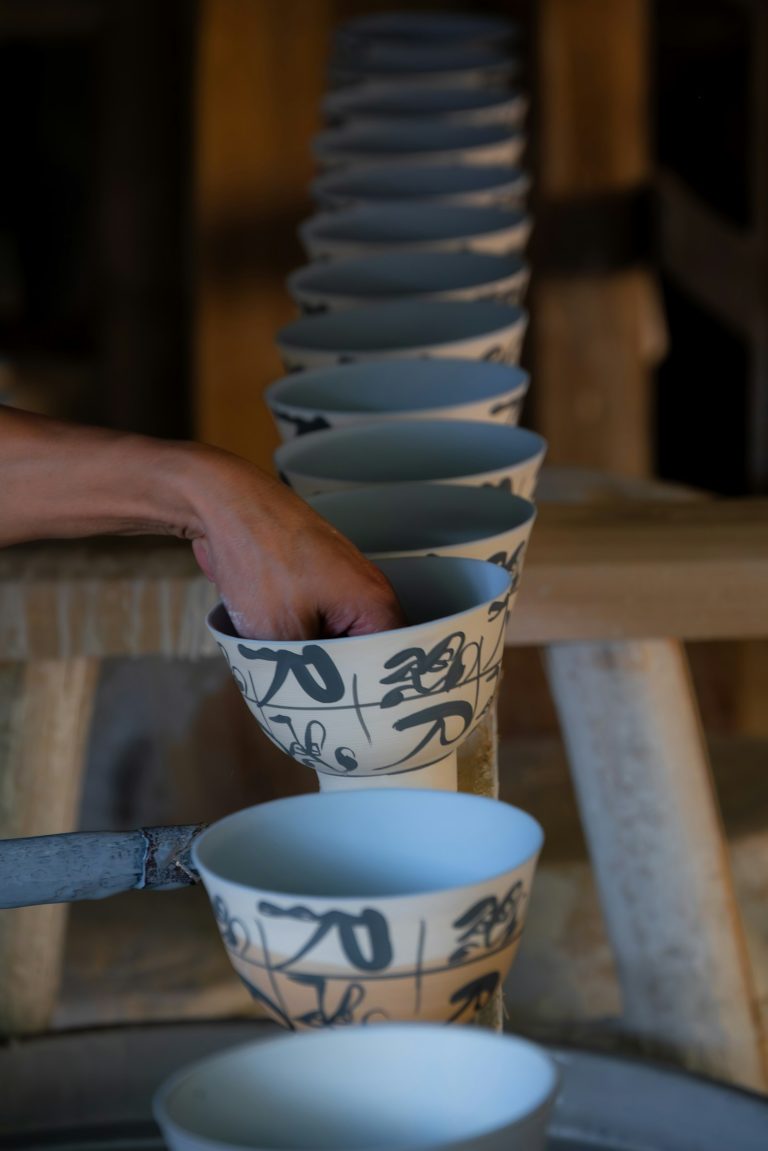
By the late Edo period, Hasami was the largest producer of blue-and-white porcelain in Japan. Not the most prestigious. The largest. The town’s signature product was the kurawanka bowl: thick-walled, unfussy, decorated with a few fast strokes of scrollwork, sold cheaply from boats to travellers who wanted rice and did not care who made the bowl. The name comes from the hawkers’ shout — roughly, “won’t you eat?”
At the same time the town was making compra bottles: squat, thick, glazed containers of soy sauce and sake that went out through Dejima to the Dutch trade. Volume production for export, in the 1700s and 1800s, from a valley in Nagasaki.
Four hundred years of that leaves a habit. Hasami’s specialism is not the one-off piece and never has been. It is everyday ware, made to a price, made to be replaced. That puts it at the exact opposite end of the shelf from ware that is bought precisely because it will change on you — and knowing which end of that shelf you are shopping on saves more money than any other decision here.
Why Hasami porcelain is cheaper than Arita
In the Meiji era the railway arrived, and the station was in Arita. Hasami’s output went into crates, rode out of Arita station, and was sold — legitimately, as the trade then worked — as Arita ware. Over generations the town’s kilns settled into being subcontractors. They made the thing; someone else’s name went on the box. By the twentieth century, “Hasami-yaki” was a name that meant something to wholesalers and almost nothing to shoppers.
Then in 2002 a food-mislabelling scandal broke in an entirely unrelated industry, and Japan tightened regional origin labelling across the board. The arrangement stopped being viable. A town with four centuries of production and no consumer brand had to start putting its own name on its own bowls, from a standing start. The formal seal on that only came in November 2022, when Hasami-yaki was registered as a regional collective trademark, number 6631984 — twenty years after it was forced to stand on its own, four hundred and twenty-three years after the first kiln was lit.
So part of the price gap is simply brand age. Arita has had its name on the box for centuries. Hasami has had roughly twenty-four years. Part of it is method: the town leans on mould-formed bodies and transfer-printed decoration at volume, where the upper end of Arita’s range carries more hand-painting, and hand-painting is hours.
What I am not going to tell you is that Hasami is Arita for less. At the top of its range Arita makes finely hand-painted work that Hasami mostly does not chase, and if that is what you want, that is what you should buy. The honest claim is narrower and more useful: at the everyday end — the rice bowl, the small plate, the mug you will run through a dishwasher twice a week — the two towns’ output was interchangeable enough to ship under one name for a hundred years. And the everyday end is most of what you are buying.
Who touches the bowl before you do
The Hasami ceramics cooperative describes the town’s production chain plainly, and it is worth reading it as a buyer rather than as a tourist. A clay merchant blends and sells the porcelain body. A mould maker carves the plaster master — this is where the shape is actually designed. A body maker casts or presses the raw form and trims the foot ring. A kiln glazes and fires it. A decorator prints and applies the transfer sheets. A wholesaler consolidates the orders and ships. Six workshops, six invoices, one bowl.
Two consequences follow, and they are the practical heart of this whole guide.
The first is good for you. Mould-formed work is dimensionally consistent, which means it stacks, it nests, and it is replaceable. Break one plate out of a set of five and you can very often buy exactly that plate again three years later. That is not true of hand-thrown work, and if you are assembling a dinnerware set you intend to actually live with, replaceability is worth more than character.
The second is the trade you make. When six specialists share a bowl, no one of them can sign it. Turn most Hasami pieces over and the foot ring is blank, or carries a small kiln stamp and nothing else. There is no maker’s story, no studio, no photograph of someone at a wheel. English-language retail hates this, because the story is what justifies the markup. Hasami’s answer is the object.
Division of labour is not a shortcut around craft. It is a different craft — the craft of making the ten-thousandth bowl as good as the tenth.
“Hasami Porcelain” the brand is not Hasami ware the place
This is the single most common mix-up in English, and it costs people money.
HASAMI PORCELAIN is a specific design line: modular, stackable, natural-toned, with a slightly rough matte body. It was created by Takuhiro Shinomoto, who moved from Tokyo to Los Angeles and opened Tortoise General Store in Venice; the line launched in the United States in 2011 and went on sale in Japan in 2013. It is genuinely made in the town. It is also one brand out of a town full of workshops.
Hasami-yaki, meanwhile, is a place name — a regional collective trademark, the same category of thing as the other -yaki names you see on listings. It tells you where the piece was made and nothing whatsoever about who designed it, how it was formed, or what it should cost.
The practical consequence: search in English for “hasami porcelain” and you get one brand’s catalogue at that brand’s prices. Search Japanese retailers for the town’s output and you are looking at a much wider range at a much wider spread. Neither is wrong. But you should know which one you are looking at, and the listing itself will tell you if you know how to read it.
| What the listing says | What it tells you | What it does not tell you |
|---|---|---|
| 波佐見焼 / Hasami ware | Made in the town of Hasami, Nagasaki | Any style, clay grade, price tier, or maker |
| HASAMI PORCELAIN | One design line, made in the town, sold internationally | That other Hasami ware is inferior to it |
| 白山陶器 / Hakusan | One named manufacturer in the town, with its own design history | Nothing about it is generic to Hasami |
| A kiln name (窯 / 窯元) | Who glazed and fired it | That the same workshop formed or decorated it |
| 転写 / 印判 (transfer) | The pattern was printed, then applied | That it is low quality — most everyday ware is printed |
| くらわんか | A nod to the historic thick-walled everyday bowl | That the piece is old, or hand-painted |
One object explains the whole town
If I had to hand somebody a single piece of Hasami ware to make the argument, it would not be a bowl. It would be a soy sauce dispenser.
Masahiro Mori joined Hakusan Porcelain, in Hasami, in 1956, and in 1958 he designed what is known as the G-type soy sauce dispenser. It took the first Good Design selection in 1960 and a Good Design Long Life award in 1977, and it is still made — same design, same method. A wide lid so you can refill it without a funnel. A waist that sits in the fingers. A lip cut so it stops cleanly instead of running down the side.
It is mould-made. It is unsigned. It cost, and costs, very little. And it has outlived essentially every self-consciously artistic ceramic object designed in Japan the same year. That is the Hasami case, made in one object: the town’s ambition was never to be collected. It was to still be on your table in fifty years.
What Hasami is good at, and what it is not
Good at: the pieces you use without thinking. Rice bowls, small plates, mugs, the plain white things that have to disappear behind the food. Good at consistency, so that a set looks like a set. Good at being replaced without ceremony.
Not good at: being interesting on its own. If you want a bowl with a kiln’s fingerprints on it — ash landing where it fell, a glaze pooling differently on every piece, a surface that will look different in five years — Hasami is the wrong town and the right answer is Bizen, Hagi, Shigaraki. Buying Hasami and hoping for that is the most common disappointment I see, and it is entirely avoidable.
Buy this, not that
Buy Hasami for the working layer of your table — rice bowls, 15–18 cm plates, mugs — where consistency and replaceability beat character, and where the money you save is real. On Japanese retail sites as I write this in August 2026, everyday Hasami pieces commonly sit in a band roughly half to two-thirds of comparably sized branded Arita, though prices move and you should check current listings rather than trust my number. Don’t pay hand-painted money for a transfer-printed pattern — the line width is perfectly even and the motif lands in the same place on every piece in the photo. And don’t buy Hasami expecting kiln variation; that is a different shelf entirely.
How to actually buy it
Decide first whether you are buying a design line or a town. If a specific silhouette is the point — the stacking cylinders, a particular matte finish — you are buying a brand, and you should pay brand prices without resentment. If you want good plain porcelain, you are buying the town, and the name on the listing matters much less than the dimensions.
Then read the numbers rather than the adjectives. Japanese listings give diameter and height in centimetres, and volumes as brim-full capacity rather than usable capacity — a distinction that quietly ruins a lot of first orders. The conversions, the sun measurements and the seventy-per-cent rule are all in the sizes and terms reference; it takes two minutes and it is the difference between a rice bowl and a soup bowl arriving.
Buy in fives if it is a gift. Japanese sets run to five, not four or six, and the reason is worth understanding before you wrap anything. Buy in whatever number you like for yourself, but buy one extra of whatever you will break.
On care: porcelain absorbs essentially nothing, so there is no seasoning step and no soaking anxiety — the general routine in the care guide is all you need. On microwave and dishwasher, do not reason from the word “porcelain” alone, because overglaze gold and silver change the answer completely regardless of the body underneath; that question has its own guide and this one defers to it entirely.
And if you are working out where any of this sits in the wider landscape of Japanese tableware, the main guide maps the categories, while the donburi guide covers the one Hasami form most people get wrong on size.
Turn it over
The last thing I would tell anyone about Hasami is to pick a piece up and look at the base. The foot ring is the part of a Japanese bowl that does the most work — it keeps the heat off the table and gives your fingers somewhere to sit — and on a Hasami piece it is usually blank. No signature. Maybe a small stamp.
For most of the century and a half after the railway came, that blank ring was a business model: someone else’s name was going on the crate anyway. For the twenty years after 2002 it was a liability, a town with no story to sell. Now it reads as something closer to honesty. Six workshops made this, none of them will claim it, and it costs sixteen dollars. Use it until you break it, then buy the same one again.
Disclosure: Nagori Ware is an independent editorial guide written from Japan. Some links elsewhere on the site are affiliate links. Parts of this site are drafted with AI assistance and checked against Japanese sources. General information, not legal or safety advice.