Japanese Bowl Etiquette: Why Some Bowls Are Made to Be Lifted
Lift the rice bowl. Leave the big one on the table. That is nearly all of Japanese bowl etiquette — and you do not have to memorize which bowl is which, because the bowl tells you. A vessel meant to be lifted is built to be lifted: it has a carved foot ring you can pinch, it weighs under roughly 500 g when full, and its rim is finished to meet a lip. A vessel meant to stay down is wide, heavy, and often has almost no foot at all.
That is a more useful rule than the one most guides give you, because it survives contact with a shopping cart. Etiquette advice tells you what to do at the table. Construction tells you what to buy — and a bowl you never lift is a bowl doing half its job.
The palm rule, and where it breaks
The traditional shorthand goes: if the dish is bigger than your palm, keep it on the table. Rice bowls and soup bowls come up; flat plates holding grilled fish stay down; communal dishes never move. Donburi is the famous exception people argue about.
It works, roughly. It breaks in two places. Palms differ by ten centimetres between a small adult and a large one, and — the bigger problem — width is not the variable that matters. A lacquered wooden soup bowl and a stoneware bowl can both measure 12 cm across the rim and be completely different objects in your hand: one weighs about 100 g, the other three times that, and one of them conducts heat straight into your fingertips.
What actually decides whether a bowl gets lifted is the foot ring and the full weight. Both are things you can check before you buy.
What the kodai is actually for
The kodai (高台) is the ring-shaped foot carved into the underside of a bowl. Collectors talk about it as the place where a potter’s character shows — the trimming marks, the width, whether the glaze stops short of it. That is true, and it is the second reason it exists. The first is that it is a handle.
Fill a bowl with rice at 90 °C. The wall is hot. The base is hot. The foot ring lifts the base off your fingers and off the table, so you grip a narrow band of clay that never touched the food, with air on both sides of it. That is the whole mechanism, and it is why a bowl with a proper foot can be held comfortably through an entire meal while a flat-bottomed one cannot.
Two practical consequences follow. First, a foot ring is expensive: a potter needs about 10 mm of clay left in the base to trim one, which is material, weight and a second pass on the wheel. Nobody adds that by accident. Second, the inverse signal is weaker than people think. A flat, footless base can mean “this stays on the table” — or it can just mean cheap production ware. Read the foot together with the weight, never alone. If the foot ring is unglazed, that also changes how you wash and dry the piece, which I cover in the guide to caring for Japanese ceramics.
The weight test: put the bowl on a kitchen scale
This is the test I would use if I could only use one. Weigh the bowl empty, add a realistic serving, and look at the total.
Under about 500 g full, a bowl sits in one hand for a whole meal without your wrist complaining. Between 500 g and 1 kg, you can lift it briefly with two hands — to drink the last of a broth — but not hold it. Over 1 kg, it stays on the table, and no etiquette rule is going to argue with your forearm.
Some real numbers to anchor that. A Japanese rice bowl typically measures 11–13 cm across the rim and 5–7 cm tall, with a brim capacity of 300–400 ml. You never fill it to the brim — about 70 % is the normal serving, which is the same convention that makes listed capacities so confusing to read, and one I unpack in how to read a Japanese tableware listing. So a rice bowl carries roughly 150 g of rice, and a mid-weight ceramic one lands near 350 g full. Comfortably one hand.
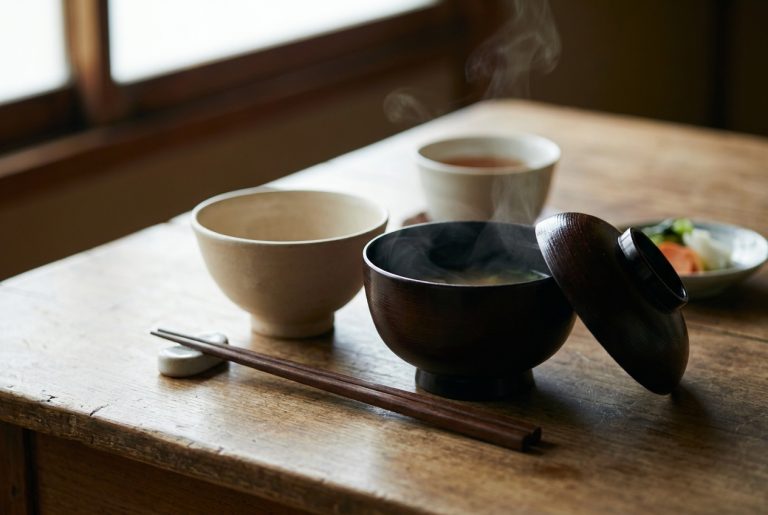
Now the soup bowl. A lacquered wooden owan about 12 cm wide and 5.5 cm tall weighs around 102 g. Add 180 ml of miso soup and you are still under 300 g — and because urushi-coated wood insulates rather than conducts, the outside stays holdable while the soup stays hot. That is not nostalgia. It is the reason lacquer remained the standard for soup bowls long after ceramics became cheap, and it is worth knowing before you buy the ceramic version. If you want to tell real lacquer from a plastic imitation, that is its own skill: see the guide to Japanese lacquerware.
And the donburi. At 900–1,000 ml of capacity — the range I recommend in the donburi bowl guide — a full one clears a kilogram. It is not that lifting it is forbidden. It is that you would not want to.
Lift or leave, vessel by vessel
| Vessel | Typical size | Roughly, full | Lift it? |
|---|---|---|---|
| Rice bowl (gohan-jawan) | 11–13 cm rim, 5–7 cm tall | ~350 g | Yes — one hand, whenever you eat from it |
| Soup bowl (owan, lacquer) | ~12 cm rim, ~5.5 cm tall | ~280 g | Yes — and drink straight from the rim |
| Yunomi teacup | 150–220 ml | ~270 g | Yes — both hands is the polite form for guests |
| Small dishes (kobachi, mamezara) | Under a palm | Light | Yes — lift it rather than leaning over it |
| Donburi | 900–1,000 ml | ~1,300 g | No while eating; a small one is a fair exception |
| Ramen bowl | 1,200 ml and up | ~1,600 g | No — except two hands at the end, for the broth |
| Grilled fish plate, flat plates | Any | — | Never |
| Communal or serving dishes | Any | — | Never |
If you want the vocabulary and dimensions behind that table in one place, I keep them in the sizes and terms reference.
How to actually hold it
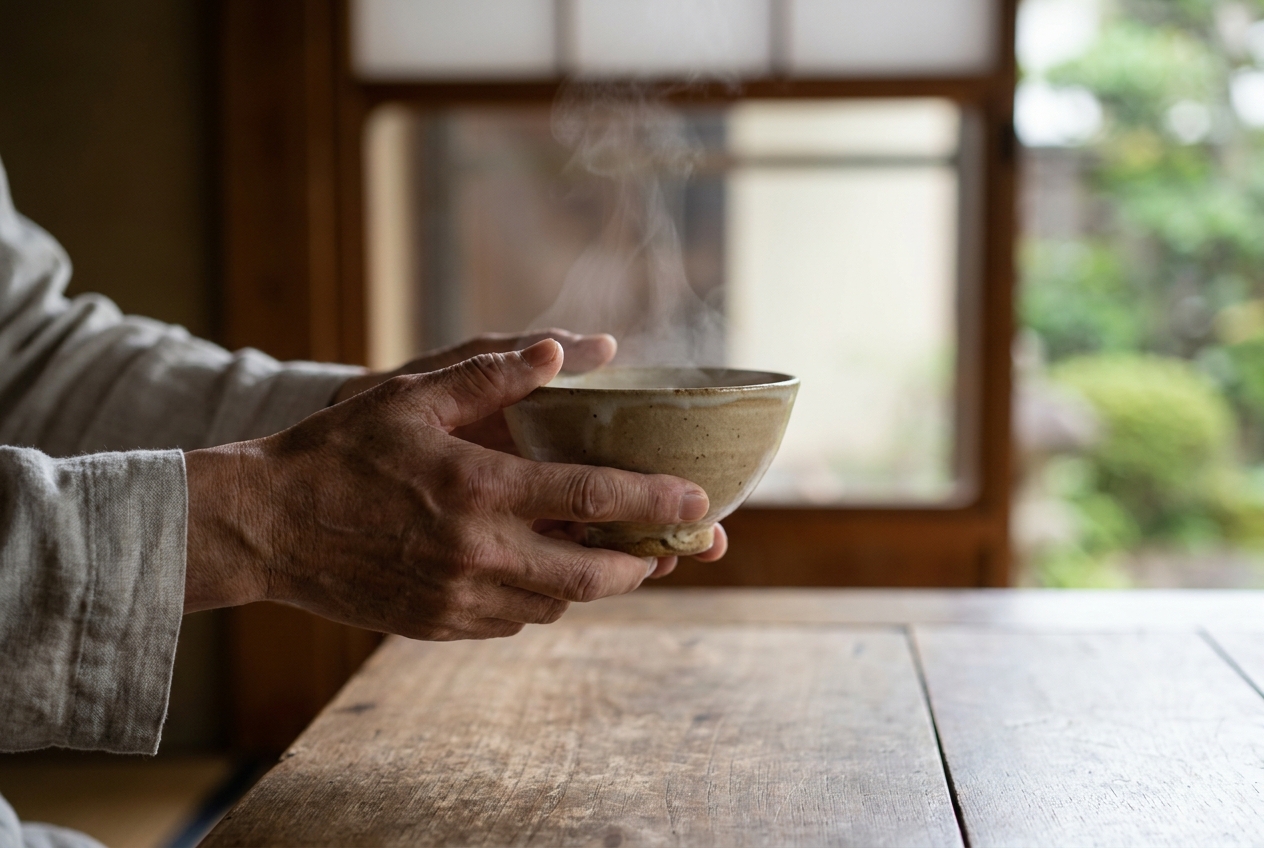
Non-dominant hand. Thumb resting lightly on the rim, four fingers spread under the foot ring, bowl at chest height rather than chin height — high enough that the chopsticks travel a short distance, low enough that you are not hiding behind it. Chopsticks in the other hand, working with the grip and etiquette I describe here.
The mistake I see most often from people new to it: cupping the wall of the bowl with the whole palm, the way you would hold a mug of coffee. That is how you find out exactly how well porcelain conducts heat. The foot ring exists so your hand never has to touch the wall. Use it.
Put the bowl down when you are not eating from it. Holding it constantly through a conversation is not a rule, and it looks anxious.
Buy this, not that
Buy a rice bowl with a foot ring wide enough to pinch and a body that weighs under about 250 g empty — that is the piece that will actually get picked up three times a day for ten years. Don’t buy heavy “Japanese-style” stoneware rice bowls over roughly 350 g empty for daily use: they cross 600 g full, quietly end up staying on the table, and you lose the thing you bought them for. And if you are buying one soup bowl, make it lacquered wood at around 100 g, not ceramic — ceramic passes the heat of the soup straight into your fingertips, which is fine for a bowl that sits, and wrong for a bowl you drink from.
Inu-gui, and why the rule outlived the reason
There is a word for the failure mode: inu-gui (犬食い), “dog eating” — leaving the bowl flat on the table and lowering your face to it. It is the one thing at a Japanese table that reads unmistakably as bad manners, more than any chopstick error, because it is visible from across the room.
The rule is not arbitrary. Before dining tables were common, meals were eaten seated on tatami from an individual lacquered tray — an ozen — set low, near the floor. The food was a long way below your chest. You either brought the bowl up or you folded yourself down over it, and only one of those lets you keep an upright posture for an hour. There is a mechanical reason too: short-grain rice eaten with chopsticks needs the bowl close, or it lands in your lap.
Tables changed the geometry. The form stayed, and so did the equipment built for it. That is the honest answer to “why do Japanese people lift their bowls” — the bowls were made for a lower table, and they kept the feature that made that work.
Two things I will not overstate. Nobody at a family dinner is going to correct you. And these are conventions, not laws — regions and households vary, and the older generation is generally stricter than the younger one.
The modern exceptions
Ramen. The bowl stays down while you eat the noodles — see the sizes in the ramen bowl guide, which is exactly why. At the end, lifting it with both hands to drink the last of the broth is normal and not rude. Slurping is fine.
Donburi. The genuinely contested case. A small katsudon bowl gets lifted by plenty of people; a 1,000 ml one does not. Weight settles it, not tradition. If you are choosing between the two forms, I compare them directly in ramen bowl vs donburi bowl.
Curry rice, omurice, anything eaten with a spoon. These arrived with Western dining and kept Western manners. The plate stays down.
Buying for a table where bowls get lifted
Four things I check, in order, and none of them require expertise:
- Turn it over. Is there a real foot ring — a band you could hook a fingertip under — or a decorative bump? The rice bowls I recommend all have one.
- Weigh it. Under 250 g empty for a rice bowl, under 150 g for a soup bowl. Listings rarely publish weight; ask, or weigh it when it arrives and return it if it is a brick.
- Feel the rim. Thin enough to meet your lip cleanly, thick enough not to chip. This matters more on soup bowls, which you drink from directly.
- Check the balance when full. Pour 200 ml of water in and hold it one-handed for thirty seconds. A well-made bowl feels lighter than it is because the mass sits low.
The trap to avoid is the heavy bowl with a beautifully carved foot — the maker gave it the handle and then made it too heavy to use the handle for. It happens most with thick rustic stoneware sold to Western markets, where weight reads as quality. In a bowl you hold, it is the opposite.
One thing this article deliberately does not cover: whether any of these pieces can go in your microwave or dishwasher. That answer depends on glaze and material rather than on shape, and I have written it out separately in are Japanese bowls microwave and dishwasher safe. For how the whole table fits together, start from the Japanese tableware guide.
Quick answers
Do I lift my bowl in a restaurant, or only at home?
Both. Rice and miso soup get lifted anywhere — a set meal at a train station counter, a formal kaiseki room, a family kitchen. The vessel decides, not the venue.
Which hand holds the bowl?
The non-dominant one, so your chopsticks are free. For right-handed people that is the left. Left-handed eaters mirror it, and no one minds.
Is it rude to lift a flat plate?
Yes — that one is a clearer error than failing to lift a bowl. Plates for grilled fish, tempura and sashimi stay on the table. Small deep dishes are the borderline case, and lifting those is fine.
What if the bowl is too hot to hold?
Then you are holding the wall instead of the foot ring, or the bowl was not built for it. Move your fingers to the foot. If it is still too hot, leave it down — no rule of etiquette asks you to burn yourself, and a bowl that cannot be held is telling you what it is.
The short version
Turn the bowl over. If it has a carved foot ring and weighs under about 500 g when full, it was made to be picked up, and picking it up is the whole of the etiquette. If it does not, leave it on the table and bring the food to your mouth with chopsticks. Everything else — palm rules, regional variations, the argument about donburi — is commentary on that one line.
Disclosure: Nagori Ware is an independent editorial guide written from Japan. Some links elsewhere on the site are affiliate links. Parts of this site are drafted with AI assistance and checked against Japanese sources. General information, not legal or safety advice.