A Child’s First Japanese Rice Bowl: What Size to Buy, and Why the Label Won’t Tell You
One Japanese shop I checked this week sells a bowl called an Indigo Blue Rabbit Children’s Large Japanese Rice Bowl. It measures 12 cm across. Two rows down the same children’s page is a cat-and-yarn bowl with no mention of children anywhere in its description, and the shop says plainly that it holds “an average portion of rice for daily use.” That one is 11.4 cm.
So the children’s bowl is the bigger one. Both are Hasami porcelain, both weigh about 150 grams, both cost $25. The word children’s is doing no work at all.
This is worth knowing before you spend anything, because Japanese rice bowls are not sized by age. They are sized by hand, in an old unit that was taken from the hand itself. Once you can read that unit you stop shopping by label and start shopping by number, and the number you want for a small child is narrower than most people guess and closer to the adult bowl than they expect.
The size is a hand measurement, not an age
Japanese tableware is still sold in sun (寸), a traditional unit of 3.03 cm. For rice bowls the rungs are tight: 3.5 sun is about 10.5 cm across, 3.8 sun about 11.5 cm, 4 sun about 12 cm, 4.2 sun about 13 cm. Japanese shops call 4 sun the men’s standard and 3.8 sun the women’s. Our general guide to Japanese tableware sizes and terms covers the unit in more detail.
What makes that ladder useful rather than arbitrary is where 4 sun comes from. The old Japanese units were shindoshaku — the body used as the ruler. A Japanese design writer explaining the system puts the bowl case exactly: a rim of 4 sun is, in bodily terms, the circle that drops neatly inside the half‑circle your thumb and index finger make. Twelve centimetres is not a tradition. It is a grip.
Which gives you a free fitting test and no shopping required. Have the child make that half‑circle and look at how wide it is. One Japanese pottery shop suggests the same thing for adults with the thumb and middle finger. For a four- or five-year-old you will land somewhere around 10 cm, which is 3.5 sun, which is the bottom rung of a ladder that ends two rungs later at the bowl they will use for the rest of their life.
Three rungs, and the whole of childhood fits in the first two. That is the part that surprises people who come from a kitchen where a child’s bowl and an adult’s bowl are different objects.
Capacity is not the variable — and this is the part the listings hide
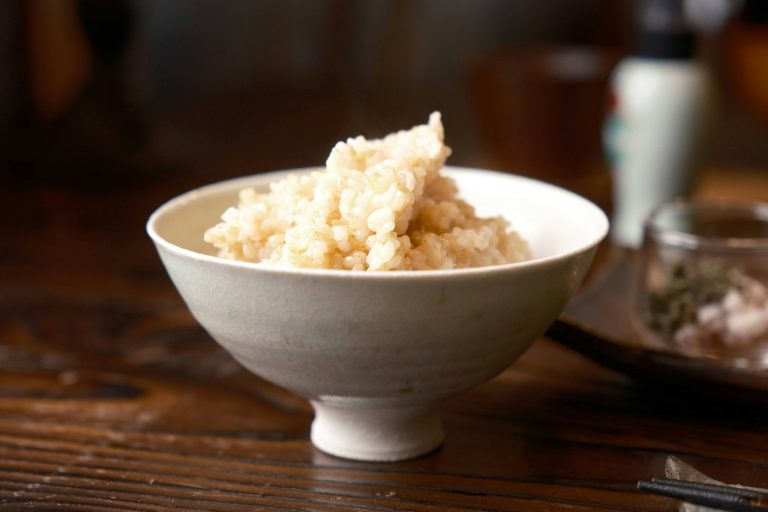
Hakusan Toki, a Hasami maker, publishes something unusually honest: it puts 150 g of cooked rice into every bowl in its range and photographs the result. Its 3.5 sun bowl (φ10.5 × 4.5 cm) takes 150 g comfortably. So does its 4 sun bowl (φ12 × 5.5 cm). So do both of its children’s lines — the Child series at φ11 × 5 cm and the PiPi series at φ10.5 × 5 cm.
Now put the portions next to that. Hakusan’s own figures for how much rice a child actually eats are about 100 g at three to five years old and about 130 g in the first years of primary school, against 150 g for an adult serving. Every bowl on the ladder already holds more than any child needs.
The child’s bowl is therefore not a smaller container. It is the same capacity packed into a narrower, shorter, thicker body. Hakusan says why it builds its children’s lines the way it does, and the reason is not volume: a low centre of gravity and a thick wall, so the bowl stays where it is put.
The weights say the same thing from another direction. Across the bowls I measured from listings — a children’s 12 cm bowl at 140 g, an everyday 11.4 cm bowl at 150 g, a fine Mikawachi 11 cm bowl at 160 g, a reinforced-porcelain nursery bowl of 11.6 cm at 120 g — the whole range sits between 120 and 160 grams no matter what the label says. A Japanese rice bowl is already a one‑hand object, because the Japanese table expects the bowl to be picked up at every mouthful. There is no heavy version to step down from. That is exactly why the step for a child is one or two centimetres and not a separate category of crockery.
So what does a real children’s bowl give you?
Three things, none of them capacity.
Grip. The best example I found is a Hasami bowl from Oshin Kiln at φ10 × 5 cm, with shallow grooves moulded into the outside wall specifically so a child can hold it. That is a real feature and you cannot retrofit it. A rounded rim. The children’s bowls that are honestly made say so in the description — a smooth, rolled rim rather than a crisp edge, which matters when the thing is being banged against a table twice a day. A lower wall. Five centimetres against the seven of a typical adult bowl. A child eating with chopsticks held low needs to see the rice and reach under it, and two centimetres of wall is the difference between scooping and fishing.
Everything else in a children’s listing is decoration, and it is worth saying out loud that decoration is not a defect — a child who likes their bowl uses their bowl. But you should know which line of the listing is the specification and which is the sales copy. Our note on how to read a Japanese tableware listing is the longer version of that habit.
Porcelain or plastic: what Japan actually did about this
The honest answer to “will they break it” is yes, eventually. The interesting answer is that one Japanese town ran the experiment on its own children and published what happened.
Hasami, in Nagasaki, is a pottery town — it is the source of most of the affordable Japanese porcelain in this article, and we have a longer guide to Hasami ware if you want the background. In 1988 its schools replaced the aluminium school-lunch bowls with reinforced porcelain rice bowls made locally. Plates followed in 1992. By 2000 every dish in every school lunch in the town was porcelain. The material was developed with the Nagasaki Prefectural Pottery Technology Center to be roughly three times stronger than ordinary porcelain while staying light.
The town’s stated reason was not durability. It was mono‑iku — literally “object education,” the idea that handling something that can break is how a child learns to handle things at all. The reporting on it does not pretend the bowls survive: it says the children broke some, and that holding the dish firmly with both hands became a habit because it had to.
Reinforced porcelain (強化磁器, kyoka jiki) is a real category you can buy, not a marketing flourish. A typical example sold in Japan for nursery use is 10.8 × 4.5 cm, 210 cc, around ¥1,188, published as both dishwasher- and microwave-safe and oven-safe but not for direct flame.
And here is the caveat nobody selling it will give you. The city of Toki — itself a pottery city — publishes a buyer’s warning on its own website: products labelled reinforced porcelain range from about 1.2 times to about 3 times the strength of ordinary porcelain, and buyers should ask for measurements taken by a certified institution under the Ceramic Society of Japan’s JCRS‑203 standard rather than trust a manufacturer’s brochure. “Reinforced” is a word, not a number. If the listing gives you no figure, treat it as ordinary porcelain and decide on that basis.
Melamine is the other road. It is lighter, it does not shatter, and Japanese nurseries use plenty of it. The trade-off that matters daily is the one Japanese tableware sellers state in their own product guidance: melamine resin absorbs microwaves, so the dish itself heats rather than the food, and melamine tableware is therefore sold as not for microwave use. We do not issue a ruling of our own here — the ceramic side of that question has its own page, whether Japanese bowls are microwave and dishwasher safe, and a child’s bowl gets reheated more often than anything else in the house, so read it before you choose.
What this actually costs
I priced one Western-facing Japanese shop’s whole children’s range to see where the money goes, and the shape of it is instructive. Children’s rice bowls: $19 to $33. Children’s teacups: $20 to $34. Then the artisan pieces — a children’s divided plate at $169 (marked down from $282), a children’s bowl at $120, a soup bowl from $65, a lacquer-style fork at $27.
The rice bowl is the cheapest real thing in the collection, and it is also the piece that gets used three times a day for years. The divided plate is the piece a child grows out of fastest. If you buy one item, buy the bowl. In Japan the unglamorous option is the nursery-grade reinforced porcelain at a little over a thousand yen, which is what the schools use and what survives a sibling.
If this is a gift rather than a daily bowl, the calculus changes and our gift guide goes into it, but one rule carries over: a smaller bowl gets used, a larger one gets admired.
Buy this, not that
Buy one bowl of 10–11 cm — 3.5 sun — with a rounded rim, and buy it in porcelain. That is the whole decision. Don’t buy a bowl because the listing says “children’s”: the one in this article’s own research labelled a children’s large bowl is 12 cm, wider than two adult bowls in the same shop. Don’t buy the matching children’s set — in the collection we priced, the rice bowl is $19–33 and the divided plate is $169, and the plate is the piece they will outgrow first. And don’t buy up a size to save money later: 12 cm is an adult hand, so a 12 cm bowl bought for a four‑year‑old is simply the wrong bowl for the next decade.
Moving them up, and where it stops
Two bowls over a childhood, not five. Start at 3.5 sun, around 10 to 10.5 cm, while the half‑circle of their hand is still small. Move to 3.8 or 4 sun — 11.5 to 12 cm — when the rim they can span has caught up, which for most children is somewhere in primary school rather than on a birthday. Then stop, because 12 cm is an adult hand and there is nowhere further to go. The bowls above it are donburi bowls, which are a different vessel for a different meal, not the next size up.
Buying ahead is the one move that genuinely does not work. A 12 cm bowl handed to a four-year-old is not an investment; it is the wrong bowl for ten years and then the right one. Meanwhile 100 g of rice in a 12 cm bowl spreads over a wider floor and sits that much further below the rim, which is exactly the arrangement that makes a child push food around instead of eating it.
The rest of a child’s Japanese place setting follows the same logic of fitting the hand rather than the age: our pages on soup bowl sizes, chopstick lengths and bento box capacity by age each give the numbers. For the adult bowl at the end of the ladder, our guide to choosing a Japanese rice bowl covers the wares and the materials, and care and repair covers what to do the first time one chips.
What this page does not answer, deliberately: how long a bowl of rice can sit out, and whether any particular piece can go in a microwave. The first is about food, not vessels. The second depends on the glaze and the decoration and belongs on its own page.
Disclosure: Nagori Ware is an independent editorial guide written from Japan. Some links elsewhere on the site are affiliate links. Parts of this site are drafted with AI assistance and checked against Japanese sources. General information, not legal or safety advice.