The Best Japanese Noodle Bowls: Hot, Cold and Everything Between
“Noodle bowl” is really a small family of vessels, because Japanese noodles are not one dish. Hot ramen and udon want a deep bowl that holds heat; cold soba and somen want a tray, a little ice, and a cup of dipping broth; tsukemen splits the difference with noodles in one bowl and hot broth in another. Buy for the noodles you actually eat, and the choice gets simple.
This guide walks through the vessels — hot bowls, cold-noodle trays, and the small dipping cup that ties it all together — with the sizes and materials that matter, and a shortlist by how you eat.
First question: hot or cold noodles?
It is the decision that shapes everything else. Hot noodles (ramen, kake udon, kake soba, nabeyaki) live in a deep bowl that keeps broth hot. Cold noodles (zaru soba, mori, somen, hiyashi) are drained and served on or in something that keeps them from sitting in water, then dipped into a cup of chilled or room-temperature tsuyu. Many households own a little of both.
Hot noodle bowls: size and material
For soup noodles, size is the thing people underestimate. A comfortable udon or ramen bowl runs about 18–22 cm (7–8.5 in) across and 900–1,500 ml in capacity — enough for a full portion of noodles, broth, and toppings without crowding. Udon bowls are often a touch wider and shallower than ramen bowls; soba bowls sit in the same range.
Porcelain (jiki 磁器) is the everyday choice — hard, hot-holding, dishwasher- and microwave-friendly, and easy to clean after oily or soy-rich broth. Stoneware (tōki 陶器) is heavier and warmer to the hand for a slower table. Both are at home here; the deciding factor is care, not noodles.
Cold noodle service: the zaru and the tray
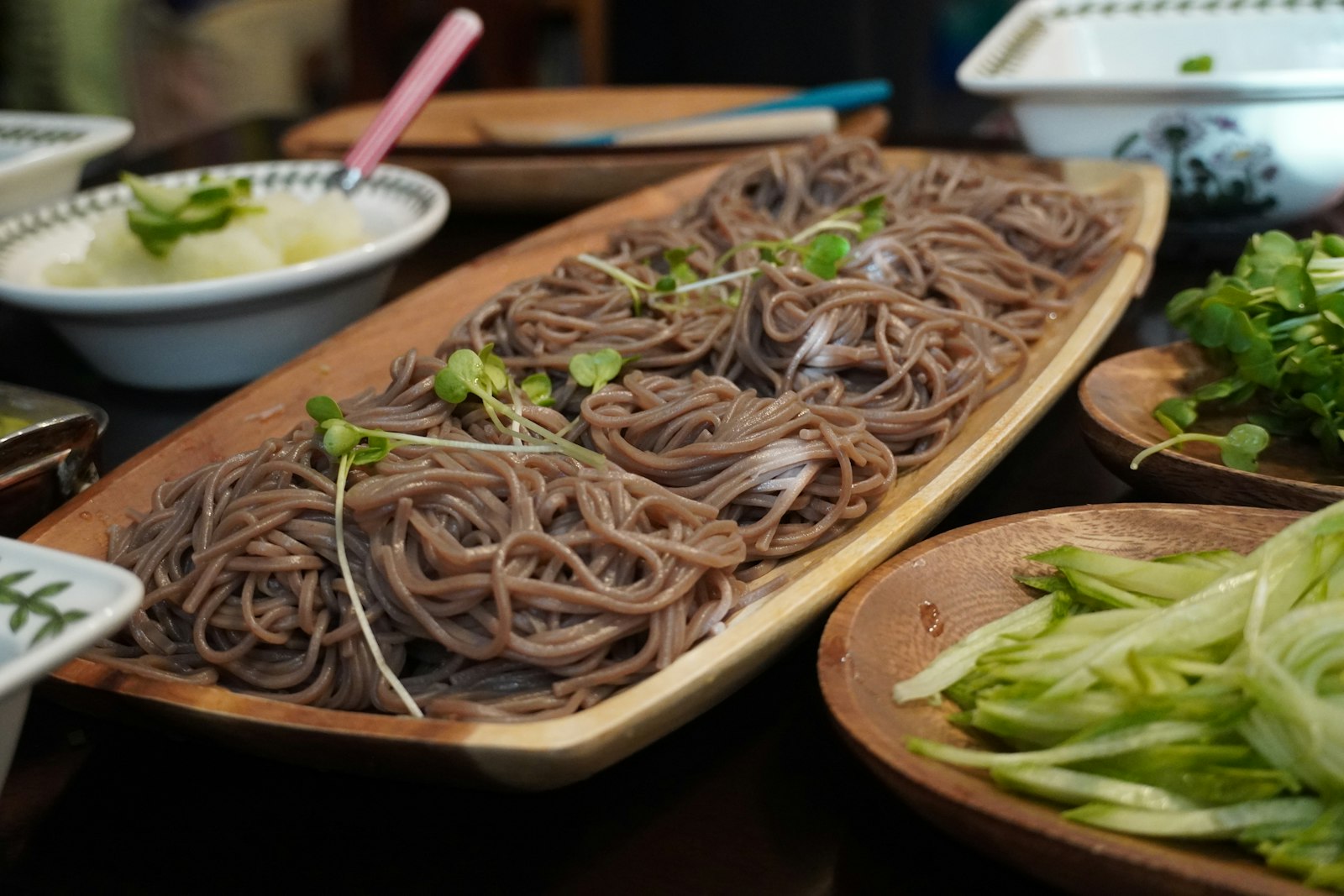
Cold soba and somen are traditionally served on a zaru — a slatted bamboo basket or a lacquer/ceramic tray with a raised grate — so the drained noodles never sit in their own water. A seiro (the square boxed version) does the same job. The point is drainage and presentation: cool, separate strands you lift and dip. For somen in summer, a wide glass bowl with ice and water is the classic alternative.
The piece that ties it together: the dipping cup
The small cup that holds your dipping broth is a soba choko (蕎麦猪口) — a cylindrical cup, usually 150–250 ml, that you hold in one hand while you dip. It is one of the most versatile pieces in a Japanese kitchen: it doubles as a tea cup, a small dessert bowl, or a vessel for a few pickles. If you buy one thing for cold noodles, buy a good soba choko. Tsukemen uses a larger, deeper version to hold its hot, concentrated broth.
Comparison at a glance
| Pick (by need) | Vessel / Material | Best for | Care | Typical price* |
|---|---|---|---|---|
| Best hot-noodle bowl | Mino porcelain, deep | Ramen, udon, kake soba | Dishwasher & microwave safe | $$ |
| Best cold-noodle set | Bamboo zaru + soba choko | Zaru soba, mori, somen | Bamboo hand-wash, cup dishwasher | $$ |
| Best all-purpose cup | Porcelain soba choko | Dipping, tea, small servings | Dishwasher-safe | $ |
| Best summer somen bowl | Glass | Iced somen, hiyashi | Hand-wash preferred | $$ |
| Best tsukemen set | Porcelain bowl + deep dip bowl | Dipping ramen | Dishwasher-safe | $$$ |
Buy this, not that
If you buy one piece for cold noodles, make it a porcelain soba choko of 150–250 ml — it dips noodles, pours tea and holds a small dessert, and it costs the least of anything here. Don’t buy a bamboo zaru unless you will hand-wash it and stand it up to dry every time; the water that pools in it is what breeds mould. For hot noodles, one deep 1,000–1,300 ml porcelain bowl covers ramen, udon and kake soba together — there is no reason to own a separate bowl for each.
Our picks
Where to buy: for authentic, Japan-shipped pieces we point you to specialist shops rather than generic marketplaces. Purchase and payment complete on their site.
1. The everyday hot-noodle bowl. A deep Mino porcelain bowl around 1,000–1,300 ml that handles ramen, udon and hot soba equally well. The workhorse.
2. The cold-noodle set. A bamboo zaru with a matching soba choko — everything you need for zaru soba or somen on a hot day.
3. The versatile soba choko. One beautiful cup that dips noodles, pours tea, and holds a small dessert. The most-used piece you will own.
4. The summer glass bowl. A wide, clear bowl for iced somen — cooling to look at and to eat from.
5. The tsukemen pair. A noodle bowl plus a deep, heat-holding dipping bowl for concentrated broth. For the dedicated ramen cook.
Caring for your noodle ware
- Porcelain bowls and cups are dishwasher- and usually microwave-safe; avoid metallic or gold decoration in the microwave.
- Bamboo zaru must be hand-washed and fully air-dried standing up; trapped moisture leads to mold. Never soak or dishwasher it.
- Glass prefers hand-washing and dislikes thermal shock — no boiling water straight into a chilled bowl.
- Lacquer trays are hand-wash only, no soaking, no abrasives.
Frequently asked questions
What is the small cup that comes with soba?
A soba choko — a cylindrical dipping cup, usually 150–250 ml. It holds the tsuyu you dip cold noodles into, and doubles neatly as a tea or dessert cup.
Do I need a bamboo zaru for cold noodles?
It is traditional and keeps noodles out of standing water, which matters for texture. A ceramic plate with a draining grate or a simple colander-then-plate works too.
Can one bowl do both hot and cold noodles?
A deep porcelain noodle bowl handles all hot noodles and can serve cold noodles in a pinch, but cold service is nicer on a draining tray with a separate dipping cup.
Is a udon bowl different from a ramen bowl?
They overlap. Udon bowls are often slightly wider and shallower, ramen bowls a little deeper for broth, but a good deep noodle bowl serves both.
About this guide
Nagori Ware is an independent guide to Japanese tableware and tea. We research materials, regions and makers so you can buy once and buy well. We do not sell products; we point you to the specialist shops that make and stock them, and may earn a referral fee if you buy.
Disclosure: Nagori Ware is an independent editorial guide written from Japan. Some links elsewhere on the site are affiliate links. Parts of this site are drafted with AI assistance and checked against Japanese sources. General information, not legal or safety advice.