Zaru or Seiro: How to Buy a Cold Soba Tray, and Why the Mat Is Sold Separately
The slatted mat under a plate of cold soba is a spare part. In Japan it is stocked on its own, in fixed sizes — 16.5 cm and 19 cm — and usually sold two to a pack. Once you know that, the purchase reorganises itself: you are not buying a dish. You are buying a frame and a wear part, and the wear part is the one doing the work.
That is also why the names make so little sense. A shop will sell you the same object as a zaru, a seiro or a soba plate, and none of those three words was coined to describe it. This guide is about what is actually in the box, what size to get, and which version you will still be able to repair in three years. If your question is the broader one — which bowl for hot noodles, which vessel for cold — the noodle bowl guide covers that ground, including why a tray with a raised grate beats a flat plate.
Seiro, mori and zaru: the words are older than the object
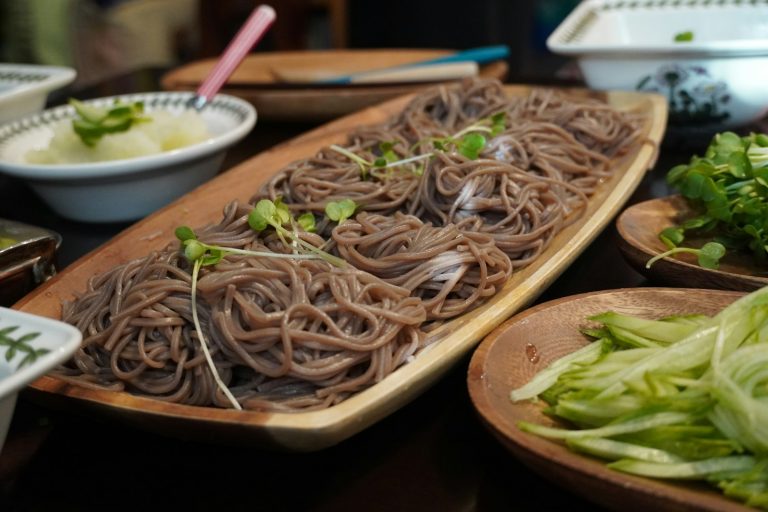
Three words survive on Japanese menus for what is, to a modern eye, one dish: cold buckwheat noodles with a cup of dipping broth. English guides usually settle it in a sentence — zaru has nori on top, mori does not — and move on. That is true of the menu today. It is not what the words are.
Seiro (蒸籠) is a steamer. The name is on the dish because soba used to be steamed. In the early Edo period, confectioners steaming manjū would serve steamed soba out of the same basket, and the dish was called mori-seiro before it was shortened. The reason to steam rather than boil was mechanical: before binding technique was established, dough that is all buckwheat and no wheat has no gluten to hold it together, and thin-cut noodles tore apart in moving water.
Zaru (笊) is a colander. It arrives later, from the middle of the Edo period, and it arrives because the noodle changed. Nihachi soba — the 80:20 ratio of buckwheat to wheat flour that is still the default — put gluten in the dough, and soba that can be boiled has to be drained. Japanese sources give a second, less romantic reason alongside it: one shop served its soba in a bamboo zaru to stand apart from its neighbours, and pushed the same dish upmarket with mirin in the broth, which was expensive then, and flour milled from the centre of the seed.
Mori is not a vessel at all. It named a way of eating, coined to separate soba you dip from bukkake soba, where the broth is poured straight over the noodles. And the nori, the detail the English internet hangs the whole distinction on, is the newest part of the story: it was added to zaru soba from the Meiji era, not in Edo.
So the three words settle three different arguments — how the noodle was cooked, how the broth was served, and what the noodles were piled on. Only the last one is about an object. This matters at the moment of purchase for a plain reason: the word in the product title does not tell you what you are getting. The dimensions do.
What a shop means by “seiro” today
Almost never a steamer. The object sold as a soba seiro is a shallow four-sided frame — lacquered wood, or more often moulded resin finished to look like it — with a slatted insert dropped into the bottom. Nothing about it steams. A typical one runs around 16.7 × 15 × 5.3 cm, and the listings will often say igeta (井桁), meaning the frame is built like the crossed strokes of a well curb.
Real bamboo steamers exist and are excellent, but they are kitchen equipment, not tableware, and they are taller, rounder and considerably more expensive. If you buy one intending to serve soba on it, you will have bought a steamer. If you buy a soba seiro intending to steam buns in it, you will melt it.
The resin point deserves a flag, because it is where most of the money decisions on this shelf are made. A great many of these trays are ABS or similar, finished in a lacquer-look coating, and they photograph identically to the real thing. That is not automatically a bad buy — for a wet, daily, hand-washed object there is a real case for it — but you should know which one you are paying for. The guide to reading a lacquerware label is the method for telling them apart before you order, and it applies here without modification.
The mat is the part that wears out
Everything above the mat is a frame: it holds a shape and it catches water. The mat is what keeps the noodles up out of the water they shed, and it is the only component that is repeatedly wetted, repeatedly loaded and never quite dries in the middle. It goes first. Japanese retailers treat this as normal and sell replacements as a stock item, in bamboo and in polypropylene, in 16.5 cm and 19 cm, in round and square, usually two to a pack.
Two consequences follow, and they are the practical core of this article.
- Measure the mat, not the tray. A 21 cm round tray does not take a 21 cm mat; it takes the one that drops inside its rim. Listings for replacements are titled by the mat’s own dimension, so the tray’s diameter is the wrong number to shop with. Round and square are not interchangeable.
- Check that the mat lifts out at all. Some trays have the slats moulded in or fixed down. Those are a single disposable object wearing a tableware price: when the working surface goes, the whole thing goes. A loose insert in a stock size is repairable indefinitely.
On material, the honest position is that the trade is convenience against character. Bamboo is the traditional answer and the better-looking one. The plastic versions are sold in Japan specifically on the claim that they will not mould, and they are frankly easier to live with; what the retailers themselves concede is that they have none of the absorbency of the natural material. Bamboo needs to be washed, shaken out and stood on edge to dry every single time — the same discipline the wooden hangiri used for sushi rice asks for, and for the same reason.
Buy this, not that
Buy the tray whose mat lifts out and matches a stock size — 16.5 cm or 19 cm, round or square. Do not buy the handsome one with the slats moulded into the base, however good the photograph is: you are buying a consumable at a furniture price, and in two summers it will be the only thing wrong with an otherwise perfect tray. If you know you will not stand a bamboo mat up to dry after every use, buy the frame you like and put a polypropylene mat in it. Nobody at the table can see it.
The four things actually sold
Strip away the naming and the shelf has four shapes on it. Prices are the usual overseas retail bands for a single setting, not Japanese domestic prices.
| Form | What it is | Typical size | Mat replaceable? | Best for |
|---|---|---|---|---|
| Bamboo zaru basket | A woven basket, drainage through the whole floor | Ø 21 cm × 3 cm deep | It is the mat | The traditional look; people who will dry it properly |
| Tray + loose sunoko | Lacquer, wood or resin tray with a slatted insert | Ø 21 cm, mat Ø 19 cm | Yes — the normal case | Everyday use; the default recommendation |
| Igeta seiro box | Four-sided frame, open or closed base, mat inside | 16.7 × 15 × 5.3 cm | Usually | Restaurant look; deepest clearance under the noodles |
| Flat soba plate | A plate, no mat — ceramic or lacquer-look | Ø 21.5 cm × 1.8 cm | No mat at all | Somen, tsukemen sides; not a good first choice for soba |
The flat plate is the one to be careful with, and it is the one that photographs best. Without a raised surface the noodles sit in the water they release, which is the exact problem the vessel exists to solve. Porcelain versions from Hasami turn up constantly in the English-language shops and are lovely objects; just buy the version that comes with the bamboo insert rather than the bare plate.
How much soba actually goes on a 21 cm tray
One portion, and not generously. The Japanese figures are consistent enough to plan from:
- Dried soba: 80–100 g per person, which comes back to roughly 260–300 g cooked — dried noodles take up about 2.6 to 3 times their weight.
- Fresh soba: 100–130 g per person before boiling, landing around 250–300 g.
- What a Tokyo soba shop calls one mai: older establishments build it from about 80 g of fresh noodle, near 120 g cooked. Neighbourhood shops are more generous, at 100–130 g fresh.
If your own portions run to the top of that range, or you are eating soba as a full meal rather than alongside tempura, take the larger tray. A restaurant portion looks small on a 21 cm round because a restaurant portion is small — a first serving, with a second expected.
The 21 cm figure is not arbitrary, and it is worth recognising because it recurs across the whole cupboard. Traditional Japanese tableware is dimensioned in sun (寸), one sun being 3.03 cm. A 7-sun piece is 21.2 cm; the 16.5 cm mat is 5.5 sun. What looks like a jumble of odd metric numbers is a single module, which is why a soba tray, a dinner plate and a lid so often turn out to share a diameter. The sizes and terms reference converts the whole ladder, and the guide to reading a listing covers what a Japanese listing is telling you when it gives the size this way.
What goes around it
The tray is half of a two-piece service and the cheaper half. The other is the dipping cup, which is where the broth lives and where most of the pleasure of the meal is; the soba choko is the piece to spend on, and the one you will keep using long after soba season, because it is the most versatile vessel on the Japanese table.
Beyond that the additions are small and specific. Condiments — grated daikon, spring onion, wasabi — go in a separate dish rather than on the noodles, which is what the smallest pieces in the small dishes set are for. If you are grating the daikon and wasabi yourself, the tool matters more than the ingredient does; the guide to Japanese graters explains why. And the tray itself belongs to a family of Japanese serveware built around raised, slatted or footed surfaces, of which the sushi geta is the closest relative.
Care, and the one habit that decides everything
Stand the mat on its edge to dry, every time, away from the tray. That single habit is the difference between a bamboo mat that lasts years and one that is unpleasant by the end of a humid August. Water does not sit on bamboo; it sits in the joints where the slats are strung, and a mat left flat on a draining board keeps those joints wet from both sides.
- Rinse and wash by hand, with a soft brush along the direction of the slats rather than across them.
- Do not soak, and do not leave it in the sink under other washing-up.
- Separate the mat from the tray before drying — the gap between them is the slowest part of the whole object to dry.
- Lacquer and lacquer-look frames stay out of the dishwasher and the microwave; the microwave and dishwasher guide sets out why, and the care guide gives the general rules for everything else on the table.
This is the same problem the Japanese kitchen solves over and over with wood: get the water out, or the object turns against you. It is the logic behind the ohitsu, behind the shape of the shamoji, and behind the wooden bento box.
Questions people actually ask
Is zaru soba different food from seiro soba?
Not meaningfully, now. Modern Japanese sources are blunt that many shops no longer distinguish them in ingredients or flavour at all, and the naming varies from shop to shop — some serve soba heaped on a seiro and call it zaru, others serve it in a basket and call it seiro. Where a difference survives, it is the nori, and sometimes a richer broth on the zaru.
Can I just use a plate?
You can, and for somen it is common. For soba it costs you the texture you boiled and iced the noodles to get. The reason is drainage, and the noodle bowl guide works through it properly.
Bamboo or plastic mat?
Bamboo if you will stand it up to dry after every use. Polypropylene if you will not — it is sold in Japan precisely for that reason, in the same 16.5 and 19 cm sizes, and nobody at the table sees it under the noodles.
What size for two people?
Two trays, not one large one. Cold soba is served per person with a dipping cup each; a shared platter turns the meal into something else and puts the noodles back in standing water while the second person eats.
Do I need the nori?
No. Shredded nori goes on at the last second or it goes limp, and it changes the dish noticeably. Leave it off and you have mori soba, which is what most Tokyo soba specialists would serve you anyway.
The short version
Buy a tray with a loose slatted insert in a standard size, get a soba choko to go with it, and treat the mat as the consumable it is. The names on the product page are three centuries of argument about how to cook and serve a noodle, and they will not help you choose; the two measurements — the tray’s and the mat’s — will.
If you are assembling a Japanese table from scratch rather than solving one meal, the main tableware guide is the map, and the seasonal table guide is where the seasonal side of it starts.
Disclosure: Nagori Ware is an independent editorial guide written from Japan. Some links elsewhere on the site are affiliate links. Parts of this site are drafted with AI assistance and checked against Japanese sources. General information, not legal or safety advice.