Why Your Kyusu Dribbles Down Its Own Side
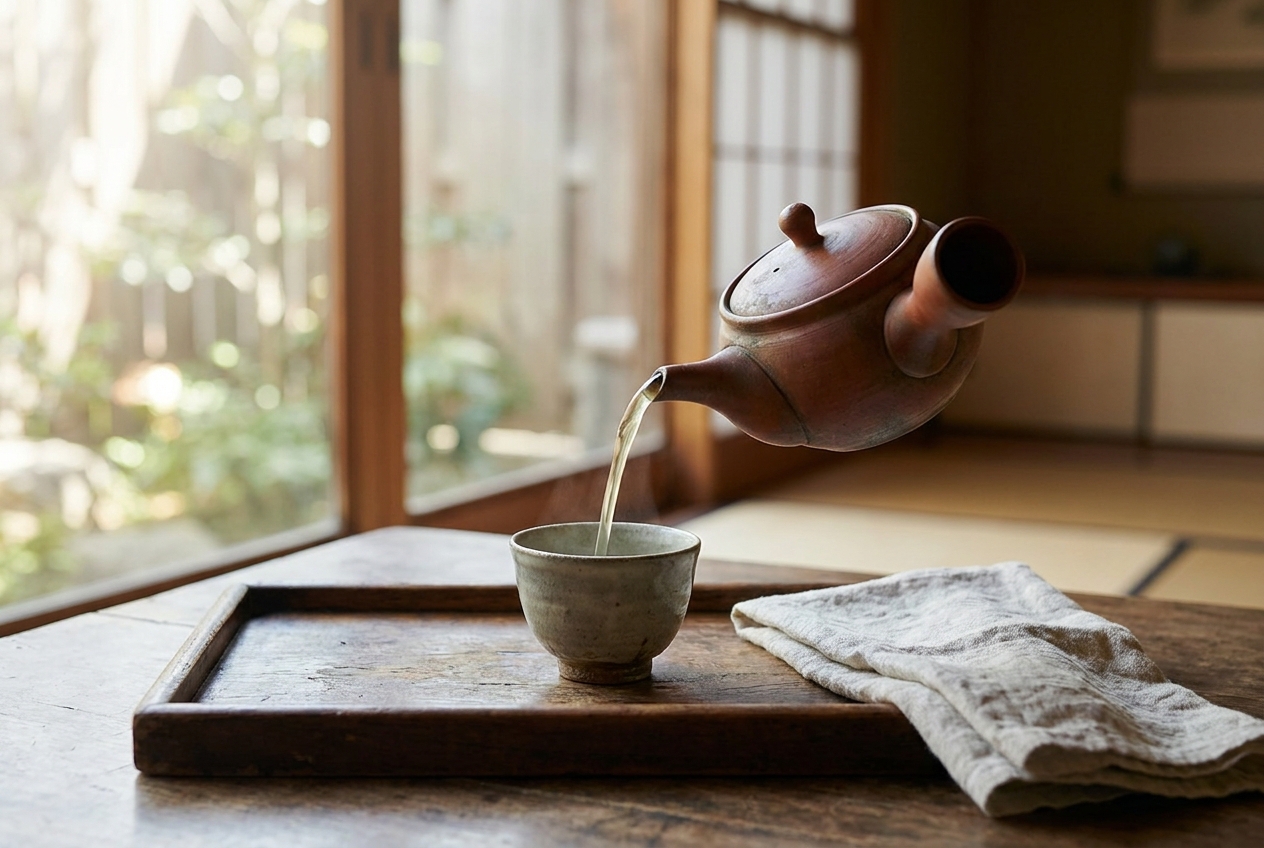
Your kyusu does not dribble because you are pouring it wrong, and in most cases it does not dribble because it is faulty. It dribbles because of the shape of a strip of clay on the underside of the spout lip, roughly a millimetre wide, which either ends in a corner or rolls over into a curve. If it ends in a corner, the tea tears off and arcs into the cup. If it rolls over, one bead of tea stays wet under the curve and steers the rest of the pour back onto the body of the pot.
Everything worth knowing — what to do with the pot you already own, what to look at before buying the next one, what counts as a defect — comes out of that one place, so this guide stays there. Starting with the advice you will find everywhere and which is backwards: pouring more slowly and carefully makes it worse.
The dribble has a name, and it is not your fault
The phenomenon is called the teapot effect. Markus Reiner named it in 1956, and for decades the standard explanation was Bernoulli’s principle — tea speeds up in the narrowing spout, its pressure drops, and that pulls the stream against the clay. That turned out to be wrong.
In September 2021, Bernhard Scheichl of the Institute of Fluid Mechanics and Heat Transfer at TU Wien, with colleagues there and in the mathematics department at University College London, published a treatment in the Journal of Fluid Mechanics putting the cause elsewhere: an interaction between the liquid’s inertia and capillary forces. They filmed water leaving a tilted pot at a range of flow rates with high-speed cameras, and the film matched the theory.
The sentence that matters if you own a teapot is Scheichl’s: the sharp edge on the underside of the beak plays the most important role, because a drop forms there and the area directly below the edge always stays wet. Below a critical pouring rate, that permanently wet patch walks the whole stream around the edge and down the outside wall.
Two consequences fall out of that, both the reverse of the usual advice. First, the effect only takes hold below a critical rate. Pour decisively and the liquid leaves too fast for the wet patch to catch it. Pour in a thin, cautious trickle — exactly what a careful person does with a pot that has just embarrassed them — and you are pouring inside the window where it happens. No published number exists for where that threshold sits on a 300 ml kyusu, and I am not going to invent one; the direction is not in doubt.
Second, a more wettable surface makes it worse. The more readily the material takes water, the more slowly the liquid lets go of the edge — which is why the same work points to glass and Teflon, and why the one fix nobody can sell you is a different material.
A Tokoname maker wipes the glaze off exactly that spot
Here is the part I find genuinely satisfying, because it was arrived at from the other end.
In an interview with the Japanese tea retailer Chanoma, Tsuchihira Eiichi of the Isshin Tōbō workshop in Tokoname is described mid-build, checking the spout he has just attached to the body and stroking the inside of it several times with a brush. His reason, in his words: 「注いだときにお茶切れがよくなるんです」 — it makes the tea cut off better when you pour.
Then the glazing. He coats the whole pot evenly, and after that he deliberately wipes the glaze back off the underside of the lip — 「全体に均一に鏃Uをかけたのち、あえて口の裏側を拖き取る」. His stated reason is the plain one: with no glaze on the lip, tea is less likely to run down the outside.
So a workshop in Tokoname and a fluid-mechanics group in Vienna are both pointing at the same square centimetre of a teapot, from opposite directions, without citing each other.
Why wiping helps is worth being careful about, because two explanations are available and they disagree. The physics says a more wettable surface is worse, and bare stoneware is more wettable than glass, which argues the other way. The explanation I find more convincing is mechanical: glaze is glass, it melts and flows in the kiln, and where it gathers along a thin edge it pools and rounds it off. Wiping it back keeps the corner a corner. That is my inference, not a tested finding — I have not found anyone who has put a glazed and a bare lip side by side and measured them, and Tsuchihira’s own stated reason is simply the one quoted above. Either way the instruction survives: on a good pot that underside is bare, and it is bare on purpose.
Japanese shops say out loud that this is hard to make
Marumitsu, which runs the web store for the Japanese tableware brand studio M’, keeps a customer question on its site titled, more or less, “it bothers me that my pot pours badly.” The answer does not reach for a technique or blame the buyer. It says that with a ceramic body there is a certain amount of wall thickness to work with, and that making a piece where the drop cuts off cleanly is, in practice, difficult: 「陸器素材となると、ある程度生地の厚みもあり、ぴたっと水滴が切れる商品を作るのが難しいのが実際のところ」.
Read that against an English product page and the asymmetry is hard to miss. Japanese sellers will name a limit of the material; the English listing tends to say the spout “pours cleanly” and stop, because the specifications that get published are the ones that are easy to publish, and spout geometry is never among them. So, the correction: a thick-walled ceramic spout that beads a little is inside the normal range of the craft and is not what a return is for. A pot that runs down its own side in a sheet every time, from half full, poured briskly, is a different matter — that is a shape, and the shape was decided before the kiln.
Three things to check before you buy a kyusu
Two of these are visible in an ordinary product photograph. The third is the one that decides the outcome, and it is the one you will usually have to ask for.
1. Does the spout rise above horizontal?
Draw a line from where the spout leaves the body to its tip; on a pot that pours well it points upward. Sellers on the tea forums are blunt about the failure case — one, looking at a photograph of a pot a buyer was considering, wrote that you need at least some angle from the body up to the rim, and that this spout was almost horizontal. A flat spout sits low, so the pot has to be tipped much further before anything comes out, so the tea arrives at the lip slowly. See above for why slow is the problem.
2. Does it taper?
The root, where the spout joins the body, should be wider than the opening at the tip. Sellers explain this as building pressure at the exit; either way, a tapered spout gives you a faster, tighter stream for the same tilt, and a tube of constant width gives you a slow fat one. It works with the body shape covered in the kyusu buying guide: a round pot funnels the last of the tea toward the spout on its own, so the taper has something to work with.
3. Is the underside of the lip thin and bare?
This is the one. You want the lower lip cut down thin, ending in an edge rather than a roll, with no bead of glaze gathered underneath — and you cannot see that from the side or from above, which is every photograph on every listing. It needs the camera below the tip, looking up. Which gives you something concrete to do: ask. A shop selling hand-finished Tokoname pots will send that frame, and the willingness tells you as much as the picture; a marketplace seller with a thousand listings will not, which is also information. Buying in person, run a fingertip along the underside of the lip. You are feeling for an edge, and you will know in a second whether there is one.
Buy this, not that
Buy the pot whose spout rises from the body and tapers to the tip, and ask the shop for one photograph looking up at the underside of the lip before you pay. If they send it and the lip is cut thin and left bare, buy it; a hand-finished Tokoname pot at roughly $40–150 is where that finish lives.
Don’t buy the pot whose spout is a straight horizontal tube of even width with a fat glazed lip — it will dribble on the tray every day for years and no technique will fix it. And don’t buy a dripless insert before you have simply tried pouring faster: that costs nothing and solves most cases.
What to do with the pot you already have
In rough order of how much I would actually bother.
| What to change | Why it works | What it costs you |
|---|---|---|
| Pour faster, and commit to it | The effect lives below a critical pouring rate. Above it the stream detaches and leaves. | Nothing. It feels wrong for about three pours. |
| Pour from higher, in an arc, and finish by lifting the spout | Height gives you speed without extra tilt; the lift at the end breaks the stream while it is still moving. | Nothing, though a 50 ml cup and a tall pour do not mix. |
| Stop filling it to the brim | A full pot needs less tilt to start pouring, so tea creeps out slowly. Forum users report pots that dribble full and pour perfectly at half. | Fewer cups per brew — which for sencha you were doing anyway. |
| Dry the underside of the lip before the second pour | The mechanism needs a wetted patch under the edge. Starting dry starts you outside it. | A cloth on the tray. Fiddly, but it tells you whether the diagnosis is right. |
| A stainless dripless insert (Japanese: kyūsu skipper / skitter) | It puts a thin metal edge where your clay one is too round, moving the tear-off point off the ceramic. | See below. It is not free of consequences. |
| Sanding the lip yourself | In principle it is the right fix. | One slip and the pot is finished. Don’t. |
The insert deserves a note, because it is an ordinary Japanese household object and almost unknown in English: a small fitting in 18-8 stainless, around 5.5 cm long, made in Japan, sold in pairs for pocket change, that pushes into the spout and gives the stream a thin metal edge to leave from. Marumitsu recommends one in the very answer quoted above, which tells you how normal a solution it is here. Two caveats, though. It turns the pour into a finer, slower stream, which is not what you want when you are emptying a 300 ml pot across three cups. And it puts metal in the path of the tea — if you chose a pot with a ceramic strainer so that nothing but clay touches your gyokuro, a steel fitting in the spout undoes the thing you paid for. For everyday genmaicha and hojicha it is a non-issue.
Make sure you are fixing the right leak
Two quite different faults get described with the same sentence — “my teapot leaks down the outside” — and the fixes have nothing in common. If the tea appears at the spout and tracks back along the underside, that is everything above. If it appears at the rim, running from the gap between lid and body while you tilt, the spout is innocent. That is a lid that does not sit evenly, and on a houhin or shiboridashi — where the lid gap is the strainer — it is usually the lid rather than the spout. It matters more than it sounds, because a lid that will not seal takes away your ability to cut the pour off at a set number of seconds, which is the whole game with fine fukamushi sencha.
English shops sometimes claim that a pot made with suriawase — lid and body ground in until they seat without a gap — will drastically cut down on dripping. That is true of the rim leak and has nothing to do with the spout, and the two get conflated often enough to be worth separating before you pay for the wrong feature. If the lid is the problem and the lid is broken, read why a kyusu lid has no spare before you start searching; the answer there is not the one you want.
The little plastic cap: take it off
New Japanese teapots often arrive with a clear vinyl cap over the tip of the spout. Senchadō Tokyo explains what it is for — it is there to stop the tip breaking in transit — and says plainly that it is unnecessary once the pot is yours, so take it off. People do leave them on, and the gap between cap and clay collects tea stain.
Why that cap exists at all is the interesting part. Of everything in the box, the thing the maker armours is the last few millimetres of the spout — the thinnest, most exposed, most easily knocked part of the pot, and precisely the part that decides whether it dribbles. A chip there is the one bit of damage that permanently ruins the pour, because it turns a clean edge into a notch, and a notch is a curve. Everything else about a kyusu can be lived with or looked after; not that. Which is also an argument about where the pot dries: on a crowded drainer a side-handle pot naturally leans spout-down against something. Set it on its base instead.
Frequently asked questions
Is a dribbling kyusu a defect I can return?
Usually not, and Japanese retailers say so openly: a ceramic wall has thickness, and a perfectly clean cut-off is hard to make. A slight bead is within the craft. A pot that runs down its own side in a sheet every time, poured briskly from half full, is a shape problem rather than a matter of degree, and that is worth raising with the shop.
Does pouring slowly really make it worse?
Yes, and this is the most commonly given piece of bad advice about teapots. The 2021 fluid-mechanics work found the effect takes hold below a critical pouring rate. Above it, the stream detaches from the edge and leaves the pot. Pour decisively.
Do unglazed Tokoname pots pour better than glazed ones?
I cannot tell you that they do as a general rule, and I have not found a comparison that tests it. What is documented is narrower and more useful: at least one Tokoname maker glazes the whole pot and then deliberately wipes the glaze off the underside of the spout lip, for the stated reason that tea is then less likely to run down the outside. So look at the lip, not at the pot.
Do glass or metal pots dribble less?
Less readily, for two reasons: both can be brought to a thinner, sharper edge than stoneware, and both let go of water more easily. That is a real advantage, and a real reason to keep a glass pot for lighter teas. It is not a reason to give up on a clay kyusu, which you bought for what it does to the leaf. If you are left-handed, note that a right-handed side handle makes a decisive pour harder, and hesitation shows up as dribbling.
What I would do, in order
If you own the pot: pour the next cup faster than feels polite, from a little higher, and lift the spout at the end. That settles a good share of cases and costs nothing. If it still tracks back, fill to two-thirds and dry the lip before the second pour. If it still tracks back after that you have a shape, not a habit — buy the ¥110 stainless insert and stop thinking about it, unless you bought the pot for its ceramic strainer, in which case live with the bead and keep a cloth on the tray.
If you are choosing one: a side-on photograph to see whether the spout rises and tapers, plus one request for a shot looking up at the underside of the tip. Any shop worth buying a hand-finished piece from will send it.
And keep the failure in proportion. A pot that beads at the lip is still doing the one job that cannot be delegated — holding leaf and water at the right temperature for the right number of seconds, which is what the brewing temperatures are about. A cloth solves a bead. Nothing solves a pot you do not want to pick up.
Disclosure: Nagori Ware is an independent editorial guide written from Japan. Some links elsewhere on the site are affiliate links. Parts of this site are drafted with AI assistance and checked against Japanese sources. General information, not legal or safety advice.