Gifts for a Ramen Lover: The Bowl Size Most Gift Sets Get Wrong, by Budget
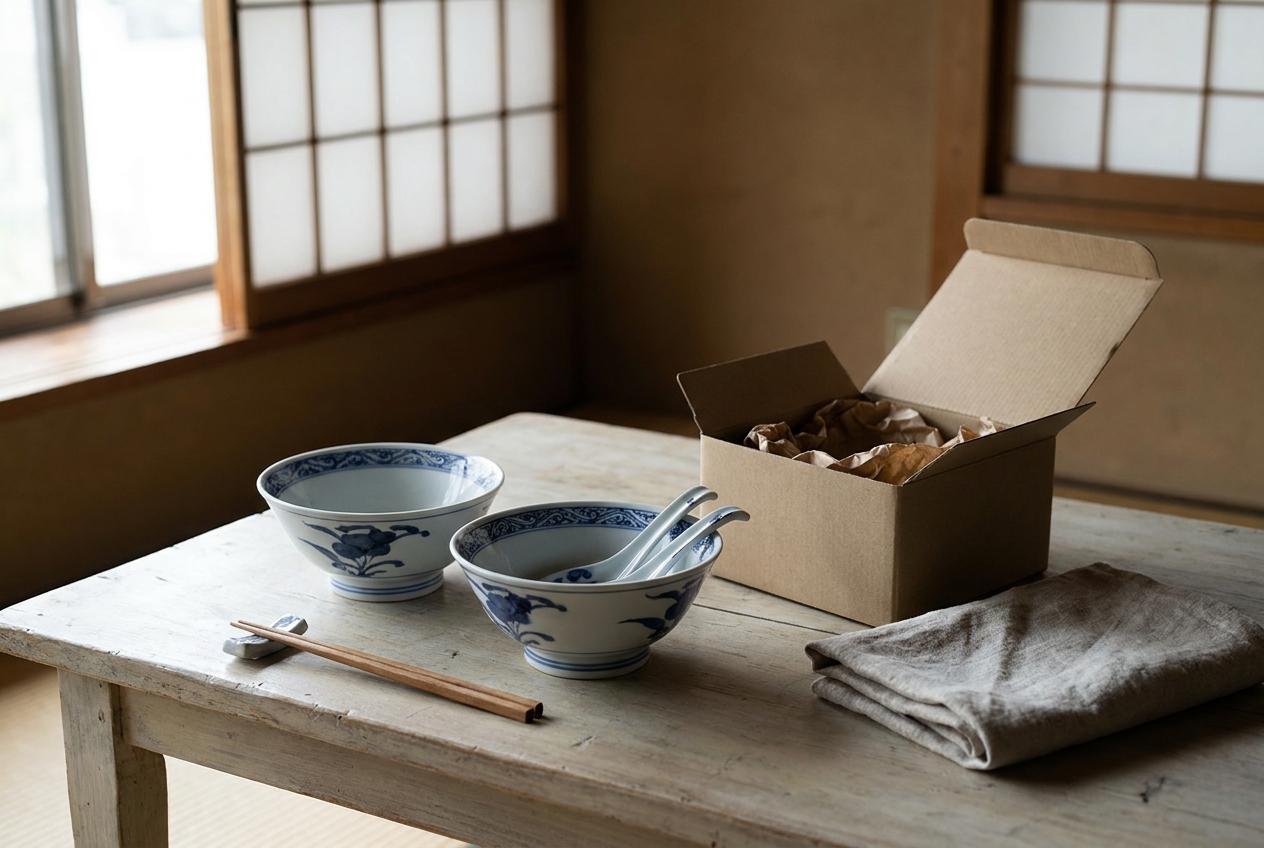
For someone who loves ramen, give one good bowl of the right size before you give anything ramen-themed: Japanese porcelain, about 1,100–1,300 ml, 20–23 cm across the rim. Add a ceramic spoon and a pair of grooved noodle chopsticks, and, if you want something to open on the night, a take-home kit from a ramen shop. That costs about $50–90. Most boxed “ramen gift sets” fail on the first number, so check the size before the pattern.
A ramen gift has a way of going wrong that a mug or a scarf does not. It arrives, it is admired, and then it gets used once, because the bowl turns out to be a large cereal bowl. Broth to the rim, noodles folded over the edge, toppings pushed to one side. The person goes back to the old bowl they always use, and your gift goes to the back of the cupboard.
That is a size problem, not a taste problem, and it is easy to avoid if you know two numbers. So this guide is built around one test: would this hold a full bowl of ramen as a ramen shop serves it? Everything below either passes that test, or helps whatever does pass it.
How these were chosen. I have not used the specific products below and won’t pretend otherwise. I chose them from the sellers’ own listings (capacity, rim diameter, maker, where made, what the shop says about the dishwasher and microwave), the review counts and ratings shown on those pages, and each shop’s shipping terms. Prices are what the shops listed on 16 November 2026. They will change, and some items will sell out before December. None of the links on this page earn us anything.
The two numbers that decide the gift
A ramen shop serves roughly 500–700 ml of broth, then adds noodles, chashu, an egg and greens on top. Japanese restaurant suppliers sell the standard bowl at about 21 cm and 1,200 ml, and the large one at about 22.5 cm and 1,400 ml. For a home bowl, that gives you a working range of 1,000–1,600 ml and 20–23 cm across the rim. Our ramen bowl buyer’s guide explains where those figures come from, including the sizes in sun that the trade still uses.
Gift sets are sold in ounces, and that is where it goes wrong. An ounce figure on a US listing is usually the brim-full figure, the amount of water the bowl holds filled to the very top. You serve about a fifth less than that. So a set sold as “35 oz” holds about 1,035 ml filled to the brim and serves about 830 ml. That is the broth plus a little. A 20–25 oz bowl, which looks like a sensible size on the box, is 590–740 ml, which is less than the broth alone.
The 60 oz sets that dominate gift searches are the opposite problem. They hold about 1,770 ml, which is more than a ramen shop uses. That is not a fault. Plenty of people mainly use a ramen bowl for pasta, salad and stew, and a 60 oz bowl is good for that. But if the person you are buying for cooks ramen properly, a 1,100–1,300 ml bowl keeps the broth deeper and hotter, and it is what they would see in a shop in Japan.
Under $35: one bowl that passes the test, or the small things around it
If you have a small budget, spend it on the bowl. One bowl of the right size is better than a boxed set of two that is too small.
- Ridged White Noodle Bowl, 40 fl oz, MTC Kitchen, $17.50. 1,200 ml, 20.7 cm across, 8.2 cm tall, Mino ware, made in Japan. The listing says dishwasher and microwave safe, oven not. It sells from a New York restaurant-supply shop, and it is the trade’s standard bowl at a trade price. Only two reviews on the page, so you are trusting the spec rather than the crowd, but the spec is exactly right. Plain white, ridged on the outside: it looks like a bowl from a ramen counter, not from a souvenir shop. Buy two and you have a gift for a couple for $35.
- Kyo Abstract Bowl, 8 in, Korin, $26.50. 8 in across, 4 in tall, 36 oz (about 1,065 ml brim-full), made in Japan, dishwasher and microwave safe per the listing. Korin supplies Japanese restaurants in the US. This one has a painted pattern, if they would like something less plain. It is at the small end of the range, so it suits someone who eats a normal portion rather than an extra-large one. The page gives no capacity in millilitres and does not state the material.
- Kikka ramen spoon, Musubi Kiln, $14. A ceramic renge, 15 cm long and 5 cm wide, Banko ware from Yokkaichi in Mie, by the maker Ginpo. Rated 5.0 from six reviews. Dishwasher and microwave safe per the shop. At 15 cm it is the everyday length. Ramen shops often use a longer 17–18 cm spoon in a deep bowl. A Japanese-made long one with a step on the handle (so it stays put on the rim) is what I looked for first, and I could not find one on a US-facing shop today. Why a ramen spoon is shaped the way it is, and why it should be ceramic rather than steel, is in our renge guide.
- Grooved-tip chopsticks, Musubi Kiln, $16. 23 cm, wood, with lacquered tips cut with fine grooves, from a maker in Obama, Fukui, where Wakasa lacquer chopsticks are made. The shop recommends them for udon and soba, and dishwasher safe is stated. Six colours. Grooved tips are the answer to the problem every noodle lover has with smooth lacquered chopsticks: noodles slide off them. If you want the words “made in Japan” printed on the page, Fujiei’s 23 cm non-slip pair at Japanese Taste ($19.95) does the same job and says so.
- ICHIRAN Take-Home Ramen Kit, $29. Three servings: concentrated tonkotsu soup, thin Hakata noodles and the chain’s red spice powder, best-by date 31 March 2027. It ships from California and Pennsylvania. Shipping is free from $80, otherwise $11.99. The product page says 2–5 business days and the shop’s FAQ says 7–15 days, so order early. This is the “something to open” part of the gift. It is not the gift on its own.
Buy this, not that
Two 1,200 ml Mino bowls ($35), two ceramic spoons ($28) and a pair of grooved chopsticks ($16): about $80, and every piece passes the size test. Not a 25 oz “ramen bowl” set with a plastic spoon at any price. It photographs well and serves less than a ramen shop’s broth.
$35–80: a bowl with a maker’s name, or the tool that makes it a kitchen
- Snow Shino ramen bowl, 8.4 in, Musubi Kiln, $42. 1,150 ml, 21.3 cm across, 8.7 cm tall, Mino ware with a soft white Shino-style glaze. Rated 5.0 from 32 reviews, the most reviews of any bowl here. The listing says dishwasher and microwave safe. One honest caution: the spec line says porcelain, while the shop’s own answer in the Q&A calls it earthenware. Until they clear it up, treat it as the more delicate of the two: warm it with hot tap water rather than pouring boiling broth into it cold. It ships from Japan, and shipping is free only from $250, so it makes most sense if you are buying two bowls and the spoons together.
- Noodle strainer (tebo), Korin, $29.95. A one-portion mesh basket on a wooden handle, about 5.3 in across and 14 in long, with a hook to hang it on the pot. Made in Japan. This is the gift for the person who already owns good bowls. It lets you cook each portion separately in one big pot of water and shake it hard to drain, which is how ramen shops drain noodles. A colander leaves too much water on the noodles, and the broth gets watered down. The listing’s care icons contradict each other, so wash the wooden handle by hand.
- Premium Iwate Ramen Assortment, Bokksu Boutique, $44.99. Eight servings in four flavours, including Maezawa beef and Iwate pork, from Oyama Seimen, a noodle maker in Oshu, Iwate. Only two reviews, so this is a regional curiosity rather than a sure thing. Choose it over the ICHIRAN kit if they already know ICHIRAN, or if you want eight dinners rather than three.
Two combinations that work as one present: the Snow Shino bowl with a Kikka spoon and a pair of grooved chopsticks (about $72), or two MTC bowls with the strainer and an ICHIRAN kit (about $94, shipped from US shops).
What about the boxed “ramen bowl gift set”?
Most “ramen bowl gift set” searches end at a box like this one: JH JIEMEI HOME ramen bowl set, $33.99, two 35 oz ceramic bowls, 7 in across and 4.5 in tall, with two 9.45 in chopsticks and two 6.7 in spoons. It is rated 4.7 from 1,442 ratings, and the listing says dishwasher, microwave and oven safe. Country of manufacture is not stated.
It is a reasonable set, and the reviews are mostly happy. Run the test, though. 35 oz brim-full is about 830 ml to serve, and 7 in is about 18 cm across, so this is a small-portion bowl. The complaints that come up in the reviews are a bowl cracking within days, chopsticks broken in the box, and disappointment that the spoon is plastic. If they mostly make instant noodles, this set is fine, and the box is ready to give. If they make a full bowl with toppings, the $17.50 MTC bowl above holds more and is made in Japan.
The country-of-origin check is not snobbery. A bowl made outside Japan can be perfectly good. It matters because a listing that says “Japanese style” and names no country usually leaves out the other numbers as well, and those are the numbers you need. How to read a Japanese tableware listing goes through the rest of a listing line by line.
Shipping, and the date to order by
MTC Kitchen and Korin are New York shops, and Korin says orders usually ship the next business day. ICHIRAN ships inside the US. Musubi Kiln ships from Japan, so give it more time. Its shipping page is the place to check delivery times and whether import charges apply before you order. None of these shops gave a holiday cut-off date on the pages I read. To be safe, order a gift from Japan by early December, and leave a week or two of slack on the US shops.
Ceramics do break in transit. That shows up in the reviews of every boxed set, from every seller. Open the box when it arrives, not on the day you give it, so there is time to get a replacement. If you are giving it in person, take the bowl out of the shipping carton and wrap it again yourself. If you want to give it the Japanese way, give two bowls, not four. Four (shi) sounds like the word for death, and our gift customs guide explains that and the other number rules.
What not to buy a ramen lover
- A bowl under 1,000 ml sold as a ramen bowl. The 800 ml bowl looks right in the photo. It is too small to use for a full bowl.
- A steel soup spoon “to match”. Steel carries heat about ten times faster than porcelain, and it sits in broth close to boiling. Ceramic is the right material here.
- Melamine, for a home. Restaurants use it because it survives being dropped. It is light, it has little heat in reserve, and a gift should feel better than restaurant equipment.
- A gold-rimmed bowl, if they use the microwave. Metallic decoration rules out the microwave. We explain which bowls can go in the microwave and dishwasher in this guide.
- A tsukemen eater’s ramen bowl. If they mostly eat dipping noodles, a big bowl is the wrong gift. Tsukemen uses a wide shallow plate for the noodles and a small deep cup for the dip.
One habit you can include in the gift, and it costs nothing: tell them to fill the bowl with hot tap water for two or three minutes before serving. A heavy, cold porcelain bowl takes heat out of the broth. A warmed one keeps the broth hot to the end. The numbers are in the ramen bowl guide. If you are unsure whether they would want a ramen bowl or a rice-dish bowl, ramen bowl vs donburi bowl explains the difference. For noodle chopsticks with a rest to go with them, see our chopsticks and hashioki guide. If the person you are shopping for drinks tea rather than slurps broth, we have a green tea gift guide and one for matcha lovers.
Quick answers
Will an instant ramen block fit?
Reviewers of an 800 ml straight-sided bowl report that a square instant block sits flat on the bottom, so a 20–23 cm ramen bowl leaves room to spare. In a strongly flared bowl the block can sit a little higher until it softens. That is a reason to prefer straight sides if instant noodles are most of what they eat.
One bowl or a pair?
A pair, if they live with someone. Ramen at home is usually made for two, and in Japan, pairs are a common way to give tableware. One bowl is a fine gift for someone who lives alone. Avoid sets of four for anyone who knows Japanese gift customs.
Is a 60 oz bowl too big?
For ramen as a shop serves it, it is bigger than needed (about 1,770 ml against a 1,200 ml standard). The broth sits shallower and cools faster. For someone who uses one big bowl for pasta, salad and stew, it is a good size.
Disclosure: Nagori Ware is an independent editorial guide written from Japan. Some links elsewhere on the site are affiliate links. Parts of this site are drafted with AI assistance and checked against Japanese sources. General information, not legal or safety advice.