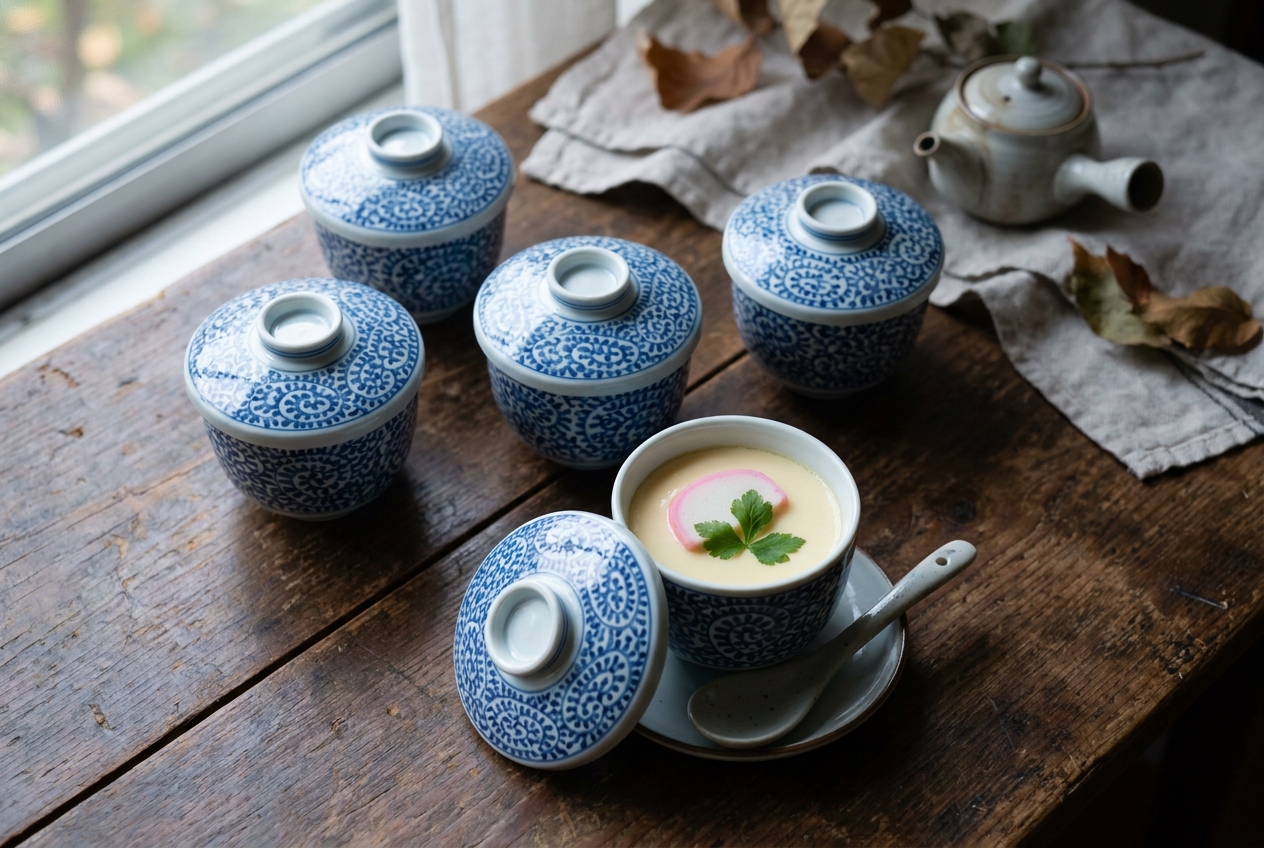
Chawanmushi Cups: What the Lid Is Really For, and What Size to Buy
A chawanmushi cup is a serving vessel, and almost everything that decides whether the custard comes out silky or full of holes happens somewhere else — in the steamer, at 85–90 °C, with a cooking chopstick wedged under the lid. Buy the cup for the table and for the arithmetic: 200–275 ml, filled to eight-tenths, and a diameter your steamer can actually hold. Do not buy it because a listing tells you the lid traps steam for a silky texture. It does not do that job, and one of the shops selling these cups says so on its own spec line.
This is a guide to choosing the cup, not to making the custard. What follows is the part the recipes skip: what the vessel is, what sizes are really sold, what the lid earns its money doing, and when you should not buy one at all.
What a chawanmushi cup is, and why the dish is named after it
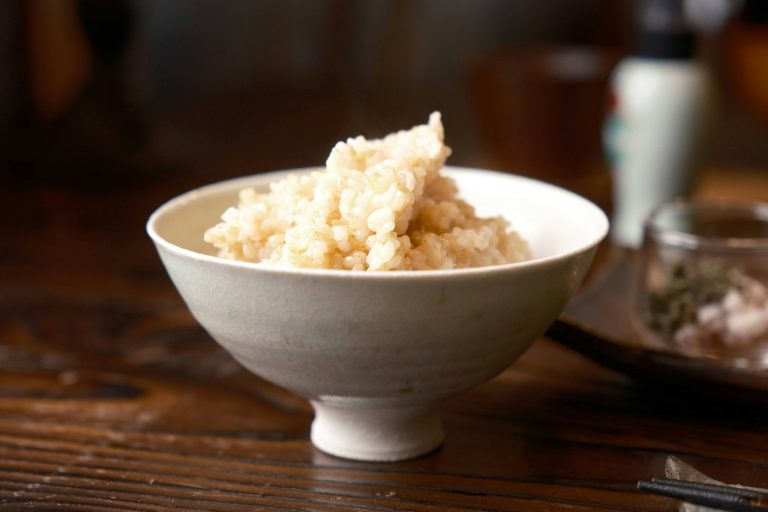
The words say it plainly. Chawan (茶碗) is a tea bowl; mushi (蒸し) is steaming. Chawanmushi is not a dish that acquired a cup — it is a dish named after the cup it was steamed in. That is why the vessel has no separate English name and why the trade name in Japan, mushi-jawan (蒸し茶碗), still calls it a tea bowl. If you have read our reference of Japanese tableware sizes and terms, this is the same habit that gives a rice bowl and a matcha bowl the same word.
Yossou, the Nagasaki restaurant that has sold chawanmushi as its speciality since 1866, dates the dish to the Kansei era (1789–1801) in Kyoto and Osaka and describes it reaching Nagasaki through shippoku cooking, the Chinese-influenced banquet style that grew up around the city’s foreign quarter. There is a small coincidence worth noticing when you shop: a good share of the porcelain chawanmushi sets sold in the West are Hasami ware — made in Hasami, in the same prefecture.
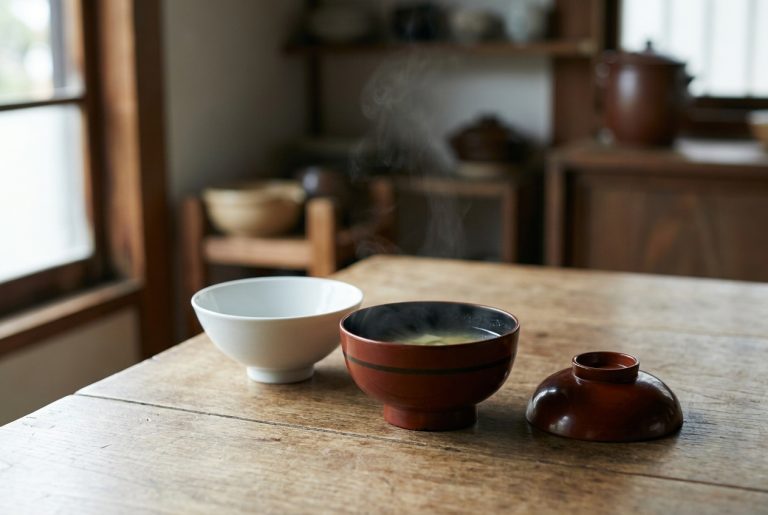
Physically, it sits between two cups you may already own. It is taller and narrower than a yunomi, and unlike a soba choko it is not a cup you put your mouth to. It is a small, deep, lidded container, and you eat out of it with a spoon.
Chawanmushi cup size: what is actually sold, and the arithmetic that follows
Japanese kitchenware guidance puts a single serving at 200–250 ml, and 250–300 ml if you like it packed with ingredients. Depth is given as 5–8 cm. Against that, here are figures quoted on real listings.
| Listed size | Capacity | What that is |
|---|---|---|
| 8.2 × 8 cm | 150 ml | Small. A restaurant-style portion, or a starter for four out of one recipe. |
| 8.5 × 8.5 cm | 225 ml | The middle of the range, and the size that steams in numbers. |
| 9.5 × 9 cm | — | Quoted in inches as 3.7 × 3.5″. Capacity often left off entirely. |
| 10 × 8 cm | 275 ml | Wide-mouthed, sold for “hearty fillings.” Hasami porcelain, set of five with five lids, about $55. |
Two things in that table are worth slowing down for.
The first is that the outside numbers do not predict the inside ones. A cup 8.2 cm across and 8 cm tall holds 150 ml; one 8.5 cm across and 8.5 cm tall holds 225 ml. Three millimetres in each direction, half again as much custard. Run the arithmetic on the 275 ml cup and the figures only meet if the quoted 10 cm is the rim of the lid rather than the bore of the bowl — a straight cylinder 10 cm wide and 8 cm deep would hold 628 ml, more than twice what is claimed. The diameter on the listing is the widest point, which is the lid. That is the general habit in Japanese listings and we go through it properly in how to read a Japanese tableware listing.
The second is the fill line. Japanese method pages are specific: pour the egg mixture to hachi-bunme, eight-tenths of the way up. So a 275 ml cup takes about 220 ml and a 150 ml cup about 120 ml. That one habit turns the cup into the thing that rewrites your recipe:
A standard Japanese ratio is two eggs to 300 ml of dashi — roughly 400 ml of liquid once the eggs are in. In the big cups that is under two servings. In the small ones it is three. Nothing about the recipe changed; the cup did. Once you own a set, stop reading recipes by how many people they claim to feed and start reading them in millilitres.
What the lid actually does (and the sentence to ignore)
Here is the claim you will meet while shopping: the lids are “designed to trap steam for a silky texture.” And here is what another shop — selling Japanese porcelain, describing the cups it stocks — writes on its own specification line: the lids are for covering the cups during serving and storage.
The second sentence matches how the dish is actually cooked in Japan. Two standard method pages — sirogohan.com, a widely used Japanese home-cooking site, and the recipe published by the soy sauce maker Higashimaru — both treat condensation as a steamer problem and solve it at the steamer. Wrap the steamer’s lid in a cloth, or cover the mouth of each cup with a square of foil. Then hold the temperature down: two to three minutes on high to get the steam going, then wedge a cooking chopstick between pot and lid and keep it low for the rest. Neither one asks you to put the cup’s own lid on while it cooks.
And the defect people are actually afraid of is not a drip at all. Su (す) — the honeycomb of holes that turns custard into scrambled egg with a puddle under it — comes from heat, not water. Higashimaru says it in one line: it happens because the temperature was too high. A drip leaves a crater on the surface. Heat ruins the whole cup. A lid addresses the crater and can do nothing about the heat, which is the entire reason to be careful about what you are paying for.
So what does the lid earn? Two things, both at the table. It holds the heat in a small vessel that would otherwise go lukewarm while people finish talking — the same reason a lidded soup bowl exists. And it makes the dish arrive closed, which is a real part of how chawanmushi is served. Those are good reasons. They are just not cooking reasons.
Buy this, not that
Buy the plain white or blue-and-white porcelain set at roughly $11–14 a cup, and buy it in the size that fits your steamer — 8.5 cm if you want to serve more than two people from one batch. Do not pay a premium for a lid on the promise that it makes the custard silky; that is bought from the burner. And if you are cooking for one or two and own a steamer with a cloth-wrapped lid, you can skip the lidded set entirely and put the money into a piece you will use weekly.
Do you need chawanmushi cups at all?
An honest answer from the Japanese side: sirogohan’s own recipe says the dish can be made in a rice bowl, a soba choko, any small cylindrical vessel, or a mug. Cover the mouth with foil and steam it. That is not a compromise offered to foreigners — it is printed on one of the most-used home cooking sites in Japan.
So the case for buying the cups is narrow and specific, and it is worth stating plainly rather than dressing up:
- You serve guests. The closed lid arriving at the table, and the heat it holds while five of them are placed, is the whole value. This is a hosting object.
- You want the shape. Depth changes the dish, which is the next section.
- You will use them for other things. They work as dessert cups, and the small lidded format is genuinely useful — the same argument that makes the soba choko the most versatile cup on a Japanese table.
If none of those is true, use the mug. You will not be able to taste the difference, and you will not have five more objects in a cupboard.
Depth, and why a ramekin is a slightly different dish
This is the one argument for the dedicated cup that holds up under arithmetic. A chawanmushi cup is tall and narrow. A ramekin is wide and shallow. Put the same 275 ml in each and the exposed surface changes by more than double: about 50 cm² in a cup with an 8 cm bore against 113 cm² in a 12 cm ramekin, where the custard would sit only 2.4 cm deep.
Three consequences, in the order you will notice them. A surface twice the size loses heat roughly twice as fast, and this dish is served hot enough that the difference is obvious. A shallow layer cannot hold anything in suspension, so the ginkgo nut, the shrimp and the slice of kamaboko sit on the floor in a layer instead of being found at different depths — which is what the eating of chawanmushi largely consists of. And a wide open surface is a wider target for a drip, which pushes you back towards the foil.
The spoon follows from the same geometry. A deep, narrow cup wants the standard renge rather than a dessert spoon; the short-handled shape is one of the things it is explicitly sold for.
How many to buy: the number your steamer allows, not the number on the box
Japanese sets are traditionally fives. The porcelain set above is five cups with five lids; other shops break the rule and sell twos, threes and fours. Before you decide by guest count, measure the floor of your steamer, because that is the real limit — the same reversal we came to in what size seiro to buy, where the pot decides the basket rather than the number of people.
Cups are round and steamer floors are round, so this is a packing problem with known answers. A 21 cm basket has about 17.5 cm of clear floor, a 24 cm basket about 20.5, a 27 cm about 23.5. Equal circles in a circle need a floor 2.00 times the cup diameter to take two, 2.155 for three, 2.414 for four and 2.701 for five. Put those together and the result is uncomfortable for anyone who just bought five big cups:
| Clear floor | Cups 10 cm across | Cups 8.5 cm across |
|---|---|---|
| 17.5 cm · 21 cm basket | 1 | 2 |
| about 20.5 cm · 24 cm basket | 2 | 3 |
| about 23.5 cm · 27 cm basket | 3 | 5 |
A set of five 10 cm cups cannot be steamed in one batch in any ordinary domestic basket — five of them need 27 cm of clear floor, which is a commercial size. Fifteen millimetres off the cup diameter, and the same 27 cm basket takes all five. Steaming in two batches is not a disaster; it does mean the first two cups are sitting while the second two cook, and that the “set of five” you bought is a set of five plates and a set of two-or-three cooking sessions.
One more thing about the number itself, if this is a gift. Four is the count to think about, for the reason set out in our guide to Japanese tableware and tea gifts. Shops in the West sell sets of four freely; in Japan it is the one number in a gift that gets noticed.
Care, and the part of the set that ends it
Read the maker’s line, because it does not follow the pattern you expect. The Hasami porcelain set quoted above is labelled microwave and oven safe but not dishwasher safe — a combination that surprises people who assume the dishwasher is the gentler of the three. Labels vary piece by piece and the maker’s instruction always beats a general rule; our guide to whether Japanese bowls are microwave and dishwasher safe covers what the categories mean and why they differ.
The thing most likely to end the set is not the cup. It is the lid. Lids are thin, they are the part that gets stacked, and they are almost never sold separately — the same trap we went through in detail for a broken kyusu lid. A cup with no lid is still a small bowl and can go on living among your kobachi and other small dishes. A lid with no cup is nothing. Wash them separately, and do not stack five lids in a tower on a wet draining rack.
Buy this, not that
Buy 8.5 cm cups over 10 cm ones unless you have measured 23.5 cm of clear steamer floor — the smaller cup is the difference between cooking for five in one go and cooking for two. Do not buy an unlidded “chawanmushi cup” at a lidded price; without the lid it is a tall kobachi, and should be priced like one.
At a glance
| Decision | The answer, short |
|---|---|
| Size | 200–250 ml is one serving; 8.5 cm across is the size that steams in numbers |
| How full | Eight-tenths — so a 275 ml cup takes about 220 ml |
| How many | Whatever fits the clear floor of your steamer in one layer |
| The lid | Heat retention and service. Not texture, not a cooking tool |
| Texture | 85–90 °C in the steamer, chopstick under the lid |
| Material | Porcelain, plain. Hasami is the common and sensible origin |
| Price | About $11–14 a cup with its lid; sets of 2–5 |
| Skip it if | You cook for one or two — a mug and a square of foil is the Japanese answer too |
If you are assembling a Japanese table rather than solving one dish, the cups sit near the end of the list, not the beginning — our complete guide to Japanese tableware puts them in order.
One last line on safety, said plainly because this dish is made of egg: everything above is about texture and about the vessel. For how long to cook eggs and whether they are done, follow your recipe and the food safety guidance where you live, not a diagram on a website.
Disclosure: Nagori Ware is an independent editorial guide written from Japan. Some links elsewhere on the site are affiliate links. Parts of this site are drafted with AI assistance and checked against Japanese sources. General information, not legal or safety advice.