Katakuchi: How to Choose a Japanese Spouted Bowl (Size, Material, What You’ll Pour)
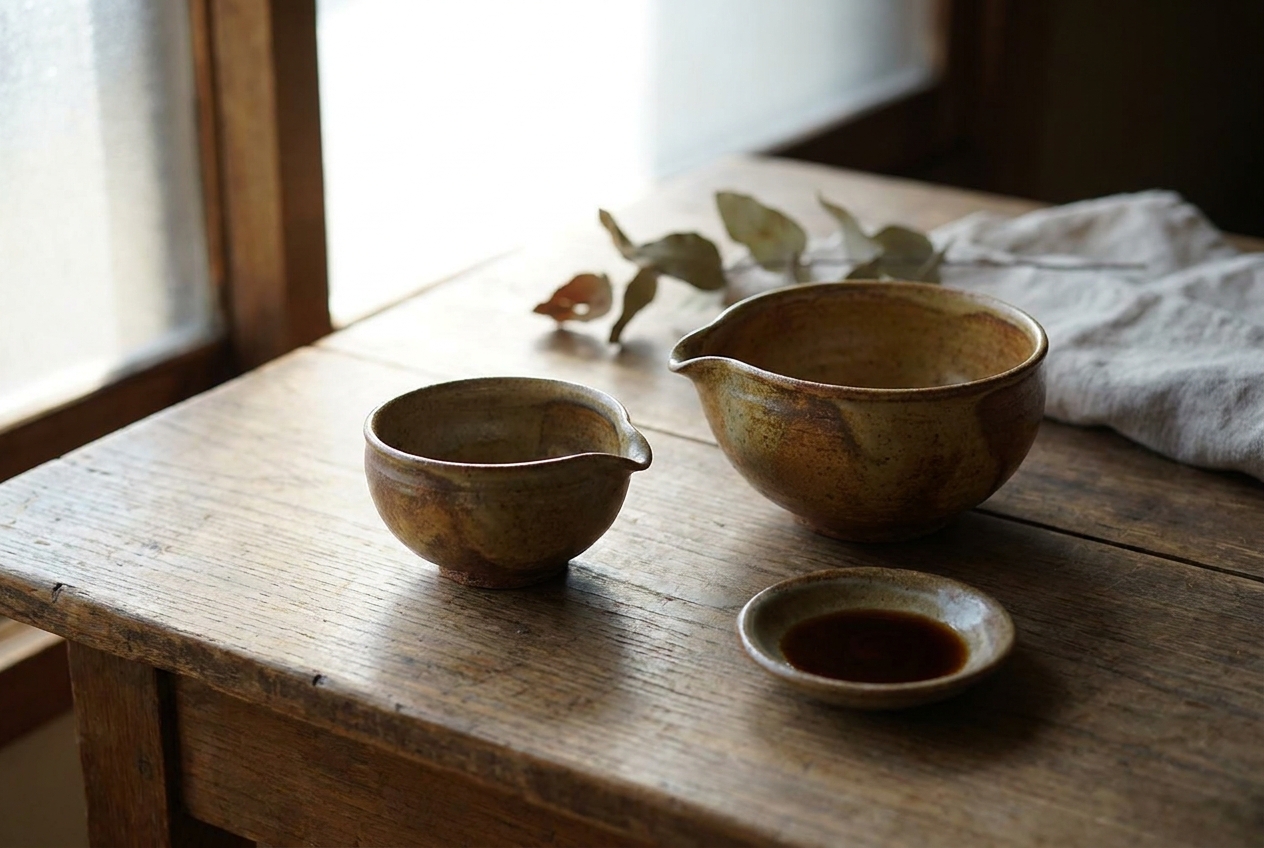
A katakuchi is a bowl with a spout on one side of the rim. That is the whole definition, and it is also why the shopping is confusing: the same word is used for a 150 ml tin sake server and a 700 ml ceramic bowl, and the only thing that decides which one you need is what you plan to pour. Pick the liquid first. The size, the material and the shape of the spout follow from it.
How this was put together. I did not buy and test a stack of katakuchi for this. It is built from Kikkoman’s kitchen-tool glossary, the size and volume figures printed on shop listings (Tezumi, Nousaku tinware sellers, a Shigaraki-style matcha bowl), and what buyers wrote in reviews on a US teaware shop’s katakuchi pages. Sizes below are examples from those listings, not standards. Where something is my reading of how the shape works rather than a sourced fact, I say so.
What a katakuchi is for: four jobs, one shape
The word breaks into kata (one side) and kuchi (mouth, spout). Kikkoman’s glossary describes it as a vessel with a spout on one side of the rim, originally a sake vessel similar to a tokkuri, and now used for many other things. It lists noodle soup, soba broth, dressings and sauces as things the spout suits, and notes that the vessel is made in ceramics, lacquerware, tin, glass and other materials.
In practice, the listings you will meet in a US search sort into four jobs:
- Serving sake. Small, often tin or ceramic, in the 150–280 ml range on the listings I read. The older job. A tokkuri is the other option; the sake set guide covers how the two differ.
- Pouring sauces, dressings and dipping broth. A small katakuchi on the table lets each person pour a little soba sauce or dressing instead of everything arriving already poured. Kikkoman groups these under serving noodle soup, soba broth, dressings and sauces.
- Matcha. Most of what is sold in English as a “katakuchi” today is a matcha bowl with a spout. One listing says the spout lets you whisk for several people at once and pour into your own bowls; others call them latte bowls, because you whisk, then pour over milk or ice.
- Everyday small bowl. Kikkoman says smaller pieces can hold condiments, deeper ones work as small bowls for side dishes and desserts, and larger ones serve simmered dishes. In that use the spout is almost incidental.
The jobs overlap, but the buying advice does not. A bowl that is perfect for whisking matcha is too big to hand around at the table. A tin server that is lovely for sake is not what you want for 400 ml of matcha latte.
Size: what the listings actually say
There is no standard katakuchi size, and I found none stated by any seller. What you can do is read the volume figures sellers print and group them by job. Here are the ones I found, converted to ounces so US readers can compare them with the Amazon-style listings:
Two things in that chart are worth pulling out. First, the Shigaraki-style matcha bowl lists a maximum of 400 ml but a recommended volume of about 320 ml, with a width of about 12 cm and a height of about 7.8 cm. A spouted bowl is not meant to be filled to the brim: the gap between “recommended” and “maximum” is the room you need to tilt without spilling. When a listing prints only the brim-full number, assume the useful volume is smaller. That 80% figure is my arithmetic from this one listing, not a rule from a maker.
Second, the bowl in the 700 ml row is 15.9 cm wide and 8.5 cm high, by its listing. That is a bowl you hold with two hands, and it is a different object from a 200 ml vintage-style piece listed at 13.8 cm long and 6.1 cm high. If you have been comparing them as if the word “katakuchi” made them substitutes, that is the mistake. For the conversion between centimetres, inches and the sun/shaku numbers on Japanese pages, see the tableware size chart.
Buy this, not that
If you want one katakuchi to leave on the table, buy a ceramic one of roughly 250–450 ml on the listings above: big enough for a pitcher of dressing or two servings of matcha, small enough to lift with one hand. Do not buy the 700 ml bowl for sauces, and do not buy a 150 ml tin server for matcha. If the listing does not give a volume or a height, skip it. Sellers who print the numbers are the ones who measured.
The spout is the product: what to look at
A katakuchi pours or it does not, and the photos rarely show which. Here is what I would look at, split into what is sourced and what is my own reasoning about how the shape works.
What sellers claim. Tin katakuchi listings describe the lip as made for controlled, drip-free pouring. A glass matcha katakuchi advertises a spout that pours “every last drop” without dripping. These are manufacturer claims, not independent tests, and I found no independent test.
What buyers report. On one US teaware shop’s katakuchi pages, the reviews I read included a buyer disappointed in the pour from the spout and one who received a bowl with a crack near the spout and a chipped base. That is a small sample from one shop, so I read it as a prompt to check, not as a verdict. The spout is the thinnest, most stressed part of the bowl; if a katakuchi is going to arrive damaged, it is a reasonable place for it to show.
My reading, not a sourced rule. A shallow notch with a thick, rounded lip is the more likely to dribble down the outside of the bowl; a defined, thinner lip tends to break the stream. I have not tested this across bowls, so treat it as a thing to look for in close-up photos, and ask the seller for one if there is none. Also check that the rim opposite the spout is smooth, since that is the edge your hand will meet.
Material: what each is good for
Kikkoman names ceramics, lacquerware, tin and glass. The listings I read show roughly this split by job, and the care rules differ enough that it is worth choosing the material before the colour.
| Material | Where it appears in listings | Think about |
|---|---|---|
| Ceramic / stoneware | Matcha bowls, serving bowls, sauce pourers (about 250–700 ml) | The widest choice of sizes. Check the glaze and the spout edge in close-ups. |
| Tin | Sake servers (150 ml and 280 ml on the listings above) | Sold as sake vessels. Read the seller’s care notes before using it for anything else. |
| Glass | Matcha pouring bowls, one with a “pour every last drop” spout claim | You can see the matcha and the pour. Read the seller’s temperature guidance if you plan to use it hot. |
| Lacquerware | Vintage pouring bowls | An older, more delicate category. Not where to start for a daily bowl. |
Whether any of these can go in a microwave or dishwasher is a separate question, and one with real safety edges. This article does not answer it for specific bowls; the general rules, and why “microwave safe” on a Japanese listing needs reading, are in the microwave and dishwasher guide. For a specific katakuchi, follow the seller’s own care instructions.
Which to buy, by job
You make matcha and want to pour it. Look for a bowl that states a recommended volume, not only a maximum, and a width you can whisk in. The listing I read at about 12 cm wide, 7.8 cm high and 320 ml recommended is the kind of number to look for. If you only own a standard chawan, the matcha bowl guide covers what size works for whisking, and the whisk and scoop guide covers the tools. A spout does not replace either.
You want something for soba sauce or dressing at the table. Think small. A 200–300 ml ceramic piece is enough for a household. This is also a case where a katakuchi competes with a soba choko, the small cup for dipping broth; the soba choko guide explains the cup, and the katakuchi is the pourer that sits beside it.
You want to serve sake. A tin or ceramic server in the 150–280 ml range matches the listings I found. Compare it against a tokkuri in the sake set guide, and see the tin sake cups guide if tin is what you are leaning toward.
You already own a yuzamashi. A water-cooling pitcher for gyokuro overlaps in shape with a katakuchi. Some large katakuchi are used for cooling water before brewing, according to the listings. If you already have one, the yuzamashi guide may save you a purchase.
Before you click buy: five checks
- Is a volume printed, and is it to the brim or recommended? If only to the brim, plan on using a smaller amount.
- Are height and width printed? Without them you cannot tell a 450 ml pourer from a 700 ml bowl.
- Is there a close-up of the spout? If not, ask. Hesitation from the seller is information.
- What do the reviews say about the pour and about arrival? Look for “crack,” “chip” and “drip” in the text, not just the star rating.
- Where is it made, and by whom? A listing that says “Japanese style” tells you nothing about origin; how to check a bowl really is from Japan and how to read a Japanese tableware listing go through the places on a page that do.
Questions people ask
Is a katakuchi just a matcha bowl with a spout?
That is how most English-language shops sell it now, but it started as a sake vessel, and Kikkoman describes it as a general serving vessel for sauces, soups and small dishes. The matcha version is one use.
Can I whisk matcha in a katakuchi?
One matcha-bowl listing says katakuchi bowls were traditionally used for whisking and pouring matcha. If you plan to whisk, check that the width is enough for your whisk to move and that the listing gives a recommended volume.
What size should I buy first?
If you are not sure, a ceramic piece of roughly 250–450 ml with printed dimensions. It covers sauces, dressings and a couple of servings of matcha, and it is small enough to pour from one hand.
Prices change, so this guide gives none. Check the current listing, and compare the printed volume and dimensions rather than the photo.
Disclosure: Nagori Ware is an independent editorial guide written from Japan. Some links elsewhere on the site are affiliate links. Parts of this site are drafted with AI assistance and checked against Japanese sources. General information, not legal or safety advice.