Japanese Green Tea Bags: Which Kind to Buy, and Why Yours Tastes Bitter
A Japanese green tea bag is a measured dose with a timer attached, and most bitter cups come from ignoring the timer. Ippodo, the Kyoto tea house, writes its one-cup sencha bag for 150 ml of water just off the boil and 90 seconds, then out. Drop the same 2 g bag into a 12 oz office mug, forget it for five minutes, and you have made a different drink: weaker at first, then harsh. The bag was fine. The cup and the clock were wrong.
This guide is for the person who does not own a teapot yet, or does not want one at work, and is standing in front of a shelf of boxes that all say “Japanese green tea.” It covers the four kinds you will actually find, how to read the box (including the Japanese side), and the three habits that turn a good bag bitter.
How this was put together. I did not taste a row of brands side by side for this. It is built from the brewing instructions the makers publish (Ippodo and Yamamotoyama), the Japan Tea Central Council’s labeling standard for green tea (the ryokucha no hyōji kijun, in Japanese), advice from a Japanese tea sommelier published on Japan’s Ministry of Agriculture site, and the product listings US shops show for Ito En, Yamamotoyama and Ippodo bags, read in November 2026. Where a number is the maker’s, I say which maker. Prices move, so treat them as a rough guide and check the shop.
Are Japanese green tea bags worth buying?
Yes, if you buy them for what they are. A bag holds a small, fixed amount of finely cut leaf, about 2 g in a one-cup bag. Fine leaf gives up its flavor fast, which is the point: you get a full cup in a minute or two with no teapot and no strainer. The same speed is why a bag punishes you for leaving it in.
What a bag will not do is give you several good infusions from one portion, the way loose sencha in a kyusu does. Every maker instruction I read is written for a single steep. If you drink three or four cups a day at a desk, bags cost more per cup than loose leaf but save you the pot, the rinse and the soggy leaves in the office sink. That trade is worth it for a lot of people.
Who should skip them: anyone who already enjoys loose sencha at home. You will notice the difference, and a small teapot with a fine strainer is not much more work than a bag once you have the habit.
The four kinds on the shelf, and who each one is for
Nearly every Japanese tea bag sold in the US is one of four things. The Japan Tea Central Council’s labeling standard defines them, and the definitions are more useful than the marketing.
| On the box | What it is (by the Japanese standard) | Taste | Good for | Skip it if |
|---|---|---|---|---|
| Sencha | Steamed, rolled green tea; the everyday tea of Japan | Fresh, grassy, a clean bitter edge | A morning cup; the reference point for everything else | You add milk and sugar to tea; it does not suit either |
| Sencha with matcha (matcha-iri sencha) | A blend. The tea named last is the one there is most of by weight, so this is mostly sencha | Greener color, rounder body, slightly cloudy | People who want a fuller cup from a bag | You want matcha. This is not matcha |
| Genmaicha | Sencha or bancha with roasted rice added | Toasty, savory, mild | With food; people who find plain sencha too sharp | You want a pure green tea flavor |
| Hojicha | Sencha or bancha roasted over strong heat | Brown, nutty, almost no bitterness | Evenings, and anyone who keeps getting bitter cups | You want the fresh green taste |
If you are buying one box and do not know your taste, buy genmaicha or hojicha first. Both are forgiving: roasting and rice soften the bitter side, so a bag left in a little long still tastes like tea. Buy sencha when you already know you like a green, grassy cup and are willing to watch the clock.
Gyokuro bags exist too. Gyokuro is the shaded, sweet, expensive tea covered in our sencha vs gyokuro guide, and its appeal is the slow, cool brew. A bag in a mug of hot water throws most of that away. Unless the box is a gift, spend the gyokuro money on loose leaf.
Why your tea bag tastes bitter: three habits
1. The mug is too big for the bag. This is the one nobody mentions. A one-cup bag is dosed for a small Japanese cup, and Ippodo’s one-cup recipe uses 150 ml. A 12 oz mug holds about 355 ml, so the same 2 g of leaf is working in more than twice the water. The cup tastes thin at 90 seconds, so you leave the bag in, and by four or five minutes the bitter side has caught up with the flavor. The fix is not a longer steep. Use two bags in a big mug for the time on the box, or drink from a smaller cup. A yunomi of 150–220 ml is the size these bags expect.
2. The bag stays in. Fine leaf keeps giving. Hotter water and longer time both pull out more of the bitter, astringent part of green tea, and a bag sitting in the cup while you answer email is a long time. Set a timer for the box time and lift the bag out. If you like it stronger, add a second bag next time rather than another three minutes.
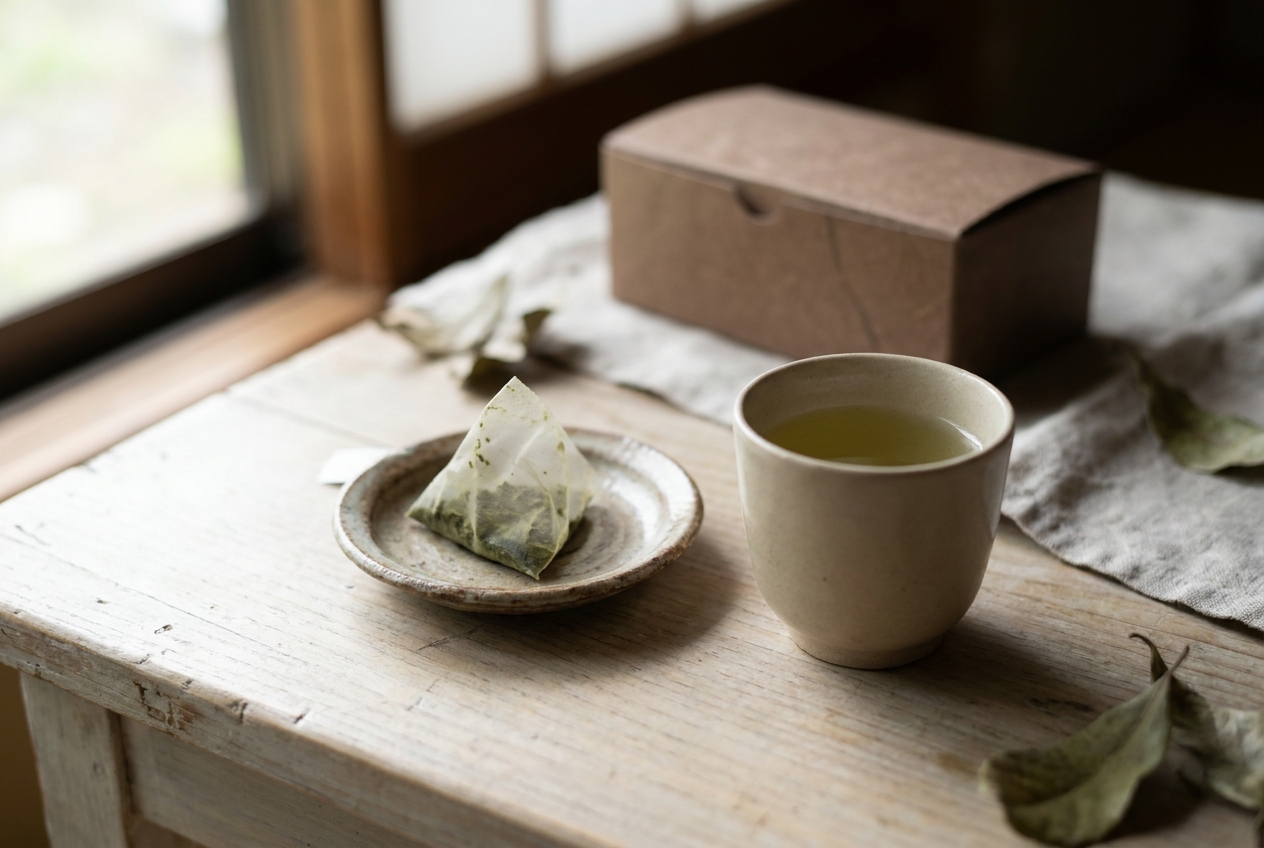
3. You squeeze or shake it. A Japanese tea sommelier quoted on the Ministry of Agriculture’s site says it plainly: when you lift the bag out, do not shake it or squeeze it, because that brings out off-flavors. Pressing the bag against the cup with a spoon does the same thing. Lift it, let it drip for a second, and put it on a small dish.
What about water temperature?
This is where advice online and the makers disagree, and you should side with the box. Loose sencha is usually brewed around 70–80°C; Yamamotoyama’s own guide gives 70°C for premium sencha and 80°C for regular, with genmaicha, bancha and hojicha at 90°C. But Ippodo writes its one-cup sencha and gyokuro bags for water “just off the boil,” and its hojicha bag for fully boiling water for 60 seconds. A bag is designed around its own time, and the maker has already chosen the water to match.
So the order to fix a bitter bag is: first take it out on time, then use a smaller cup or two bags, and only then try cooler water. If you want a simple way to cool water without a thermometer, pour it into the empty cup first and then add the bag; each transfer drops it several degrees. Our yuzamashi guide has the numbers for that trick. Hard tap water can also flatten green tea; the water guide explains why.
How to read the box, including the Japanese side
Most bags sold in US stores carry an English label, and many imported boxes also keep the Japanese one. Four lines tell you more than the front of the box.
Grams per bag, and the count. Divide the net weight by the number of bags. Yamamotoyama’s sencha pyramid box is listed at 10 bags and 23 g, about 2.3 g a bag. Ippodo’s one-cup sencha is sold as 2 g × 25 bags, and its one-pot bags run 7–10 g each for a 300 ml pot. Japanese shop listings show Ito En’s Oi Ocha sencha bags at 1.8 g, though I could not confirm that figure on Ito En’s own site. A one-pot bag in a single mug will be strong and bitter fast; a one-cup bag in a teapot will be weak. Match the dose to the vessel.
The name, and the word order in a blend. Under the Japanese standard, a blend is named with the main tea last: 抹茶入り煎茶 (matcha-iri sencha) means “sencha with matcha in it,” and sencha is the larger share by weight. The standard does not set a minimum amount of matcha, and I found no rule that says how much “with matcha” has to mean. If a bag says “matcha” in big letters and “green tea” in small ones, it is a sencha bag with a dusting of powder for color and body, not a substitute for whisked matcha. If matcha is what you want, our matcha starter guide is the place to begin.
The ingredients line. The Japanese standard lists ingredients in descending order of weight, and US labels do the same. Ito En’s matcha genmaicha bags are shown with “Rice, Green Tea, Matcha” in that order on the listing I read, which tells you more rice than tea by weight. That is normal for genmaicha and it is why genmaicha is so mild. It is also why genmaicha is a poor way to judge whether you like green tea.
The small Japanese words. On an imported box, 名称 (meishō) is the product name, 原材料名 (genzairyō-mei) the ingredients, and 内容量 (naiyōryō) the contents, often written as “2g×25袋” (2 g × 25 bags). The standard lets makers add ティーバッグ in brackets after the name, as in 煎茶(ティーバッグ). 産地 or a prefecture name such as 静岡 (Shizuoka), 鹿児島 (Kagoshima) or 宇治 (Uji) tells you where the leaf came from. Our guide to reading Japanese product listings covers the same habit for tableware.
Pyramid bag or flat paper bag?
You will see two shapes. The flat paper bag is the older style and is built for finely cut leaf. The pyramid (tetrahedral) mesh bag has more room inside, which is the reason makers give for it: the leaf has space to open as it brews. In practice the shape matters less than the time and the cup size above. A pyramid bag left in a big mug for five minutes is still bitter.
If the material matters to you, look it up for the brand you are buying rather than assuming. Ippodo says its cup and pot bags are made of PLA, a plastic made from plant starch such as corn. I could not find a published statement on bag material from Ito En or Yamamotoyama, so I am not going to guess at theirs.
Buy this, not that
For a desk drawer, buy one box of genmaicha or hojicha and one of plain sencha, one-cup bags of about 2 g, and keep a 150–220 ml cup at work to drink them from. Don’t buy one-pot bags (7–10 g) for a single mug, and don’t buy gyokuro or “matcha” bags expecting gyokuro or matcha. Sencha with matcha is a nice sencha. It is not a shortcut to a whisked bowl.
What it costs, roughly
The spread is wide. In November 2026, US shop listings showed Ito En’s 20-bag Oi Ocha boxes at around $5–6, Yamamotoyama’s 16-bag genmaicha from about $4 to $10 depending on the store, and Ippodo’s 25-bag one-cup sencha at about $26–28 (¥1,500 on Ippodo’s Japanese site). That works out to roughly 30 cents a bag at the low end and about a dollar a bag at the top. These are listing prices I saw, not prices I paid, and they change, so check before you buy.
The dollar bag is not four times better. What you are paying for at the top is fresher, better leaf from a named Kyoto house and a short, exact recipe. If you drink one careful cup a day and follow the time, you will taste it. If the bag sits in a mug while you work, buy the cheap box and spend the difference on a smaller cup.
Keeping the box fresh
Green tea goes stale from air, light, heat and moisture, and a box of loose bags on an office shelf gets all four. Keep the bags in their inner foil pouch or move them to an airtight tin, and finish an opened box within a few weeks rather than months. Our green tea storage guide goes through the details, and they apply to bags as much as to loose leaf.
When to move on from bags
Bags are a fine place to stay. But if you find you like sencha and want more than one good cup from your tea, the next step is small: a 200–350 ml kyusu and a bag of loose sencha. If summer is coming, sencha bags made for cold water are a staple in Japan, and the cold brew guide explains how they differ. For a gift, a good box of bags with a pair of cups is one of the easier ideas in our green tea gift guide, and the Japanese tea guide maps where each tea fits.
Questions people ask
Can I reuse a green tea bag?
You can pour water over it again, but none of the maker instructions I read suggest a second steep, and fine leaf gives up most of its flavor in the first one. If you want several cups from one portion, that is what loose leaf in a teapot is for.
Is the tea in a bag the same as loose tea?
It is the same plant and often the same kind of tea, cut finer so it brews fast in a small space. That is why the times on a bag box are short, and why a bag is less forgiving than a pot of loose leaf.
What is the best Japanese green tea bag at a grocery store?
For a first box, a genmaicha or hojicha from Ito En or Yamamotoyama, both widely stocked in US supermarkets and Asian grocers, because they are hard to make bitter. For plain sencha, read the grams per bag and match it to your cup before you look at the brand.
Disclosure: Nagori Ware is an independent editorial guide written from Japan. Some links elsewhere on the site are affiliate links. Parts of this site are drafted with AI assistance and checked against Japanese sources. General information, not legal or safety advice.