Skip to content

Nagori Ware

  • Bowls
  • Tea
  • Tableware
Nagori Ware
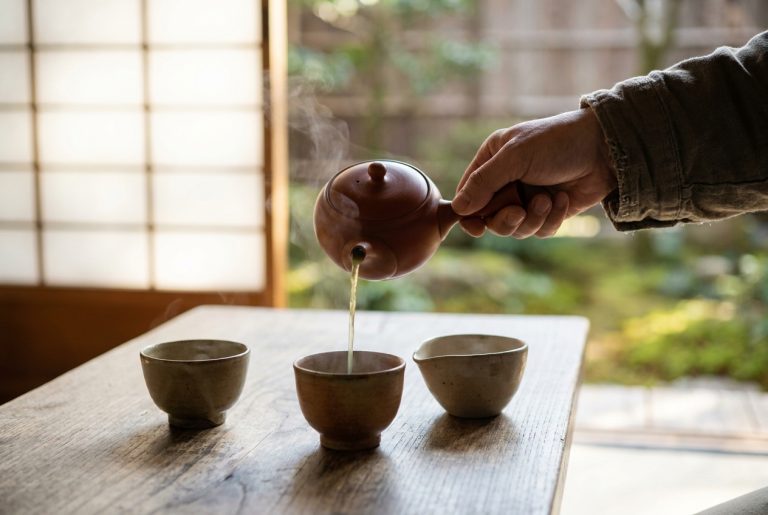
  • A handleless Japanese houhin teapot with a lid and triangular pouring lip on a wooden table, beside two small cups of green tea, a shallow cooling bowl and loose tea leaves
    Tea

    Houhin and Shiboridashi: The Handleless Japanese Teapots, and Who Actually Needs One

    ByMitsuru Kobayashi August 26, 2026September 11, 2026

    A houhin is usually introduced as a teapot without a handle, as though the handle simply fell off somewhere between China and Uji. That gets it backwards. The handle is missing on purpose, and the absence is the specification. A vessel you have to pick up by its body can only be used with water…

    Read More Houhin and Shiboridashi: The Handleless Japanese Teapots, and Who Actually Needs OneContinue

  • A Japanese earthenware grating plate holding freshly grated ginger, with a knob of ginger, a piece of daikon and a metal grating paddle on a wooden board
    Tableware

    Oroshigane: How to Choose a Japanese Grater, and Why the Teeth Matter More Than the Metal

    ByMitsuru Kobayashi August 25, 2026

    Two Japanese kitchen sites, two sets of instructions, and they read almost identically: go slowly, move in circles, don’t lean on it. One of them is teaching you to make wasabi as hot and as fragrant as it will ever get. The other is teaching you to make grated daikon mild enough that a child…

    Read More Oroshigane: How to Choose a Japanese Grater, and Why the Teeth Matter More Than the MetalContinue

  • A Japanese suribachi grinding bowl with radial comb grooves, a wooden surikogi pestle resting on the rim and sesame seeds in the base
    Bowls

    Suribachi: How to Choose a Japanese Mortar and Pestle, and Why the Bowl Does the Grinding

    ByMitsuru Kobayashi August 24, 2026

    The first time most people use a suribachi, they lift the pestle, bring it down, and almost nothing happens. The sesame skitters up the side of the bowl and sits there, whole. Nothing is wrong with the bowl. You are simply using the wrong half of the tool. In a stone mortar the pestle does…

    Read More Suribachi: How to Choose a Japanese Mortar and Pestle, and Why the Bowl Does the GrindingContinue

  • A white porcelain renge, the Japanese soup spoon, resting on the rim of a steaming noodle bowl on a wooden table, with chopsticks on a ceramic rest beside it
    Tableware

    Renge: How to Choose a Japanese Soup Spoon, and Why It Is Hollow All the Way Into the Handle

    ByMitsuru Kobayashi August 23, 2026

    A renge is not a spoon with a handle attached. Cut one down the middle and you find a single hollow that begins at the lip and runs all the way to the end of the thing you have been calling the handle. It is a scoop, not a shovel. That one fact decides everything…

    Read More Renge: How to Choose a Japanese Soup Spoon, and Why It Is Hollow All the Way Into the HandleContinue

  • A bamboo chasen matcha whisk drying on a ridged ceramic whisk rest beside a stoneware matcha bowl and a bamboo chashaku scoop on a wooden table in morning light
    Tea

    Chasen and Chashaku: How to Choose a Matcha Whisk, and Why the Prong Count Counts Half

    ByMitsuru Kobayashi August 22, 2026

    The 120-prong whisk is the wrong first purchase, and not because of the price. It is wrong because 120 prongs is a specification for a job you are almost certainly not doing. Here is the fact that makes the rest of this make sense. A chasen — the bamboo matcha whisk — is not assembled….

    Read More Chasen and Chashaku: How to Choose a Matcha Whisk, and Why the Prong Count Counts HalfContinue

  • Hot water poured from a plain clay kettle into a small ceramic teacup, with loose sencha leaves in a shallow dish alongside
    Tea

    Water for Japanese Green Tea: Why the Same Leaf Tastes Different Outside Japan

    ByMitsuru Kobayashi August 21, 2026August 22, 2026

    You brought back a bag of sencha from Kyoto. At the shop it tasted like sweet grass and broth. At home it tastes like hot water with a bitter edge, and you have been blaming yourself — the temperature, the timing, the leaf-to-water ratio, the pot. Change all four and it will still taste wrong,…

    Read More Water for Japanese Green Tea: Why the Same Leaf Tastes Different Outside JapanContinue

  • A stack of plain white Japanese porcelain rice bowls, two small plates and a white mug on a worn wooden kitchen table in morning light. Illustrative AI-generated image; not a photograph of a specific kiln's work.
    Tableware

    Hasami Ware: Why Japan’s Best-Value Porcelain Spent 400 Years Under Another Town’s Name

    ByMitsuru Kobayashi August 20, 2026September 7, 2026

    Two rice bowls on the same shelf. Same white porcelain, same weight in the hand, same thin cobalt line around the rim. One is $16. The other is $44. The $44 bowl says Arita on the box. The $16 bowl says Hasami — and twenty-five years ago, it would have said Arita too. That is…

    Read More Hasami Ware: Why Japan’s Best-Value Porcelain Spent 400 Years Under Another Town’s NameContinue

  • Hands lifting a small ceramic rice bowl from a wooden table, fingers supporting the foot ring
    Tableware

    Japanese Bowl Etiquette: Why Some Bowls Are Made to Be Lifted

    ByMitsuru Kobayashi August 20, 2026September 7, 2026

    Lift the rice bowl. Leave the big one on the table. That is nearly all of Japanese bowl etiquette — and you do not have to memorize which bowl is which, because the bowl tells you. A vessel meant to be lifted is built to be lifted: it has a carved foot ring you can…

    Read More Japanese Bowl Etiquette: Why Some Bowls Are Made to Be LiftedContinue

  • Japanese ceramic bowls and small dishes in graduated sizes lined up on a wooden table by a window, from a tiny sauce dish to a wide bowl
    Tableware

    Japanese Tableware Sizes & Terms: A Reference

    ByMitsuru Kobayashi August 13, 2026September 10, 2026

    This is a reference page. Most guides to Japanese pottery translate the words; almost none translate the measurements — and the measurements are where buyers abroad get surprised: a bowl smaller than expected, a “300ml” teapot that pours two thirds of that, two pots both sold as “8-gō” that are visibly different sizes. None of…

    Read More Japanese Tableware Sizes & Terms: A ReferenceContinue

  • Hands turning a plain Japanese ceramic bowl to examine its unglazed foot ring, with a folding ruler on a wooden table
    Tableware

    How to Read a Japanese Tableware Listing: Sizes, Materials, and What the Silences Mean

    ByMitsuru Kobayashi August 12, 2026September 10, 2026

    A teapot listed at 300 ml that pours two cups and stops. An 8-gō donabe that turns out to be two centimetres narrower than your friend’s 8-gō donabe. A plate whose size is given in a unit you can’t convert, from a place you can’t find on a map, with nothing written anywhere about the microwave….

    Read More How to Read a Japanese Tableware Listing: Sizes, Materials, and What the Silences MeanContinue

Page navigation

Previous PagePrevious 1 2 3 4 … 6 Next PageNext
  • Privacy Policy
  • Contact
  • Disclosure
  • About
  • About Nagori Ware — Who Writes This, and How

© 2026 Nagori Ware - WordPress Theme by Kadence WP

  • Bowls
  • Tea
  • Tableware