The Best Matcha Bowls (Chawan) for Beginners: How to Choose
A matcha bowl is the one piece of tea ware you actually work in. You whisk in it, drink from it, cradle it in both hands. Get the shape right and the whisk moves freely and the froth comes easily; get it wrong and you are fighting the bowl. For a beginner, that fit matters far more than the name on the box.
Here is what to look for — size, interior, and ware — plus why a matcha bowl and a rice bowl share a name, and a shortlist of sensible first bowls.
A note on the word: a matcha bowl is a chawan (茶碗) — the very same word used for a rice bowl. One character, two vessels, both meant to be held in the hand. Where a rice chawan is small, a matcha chawan is wider, made to whisk in.
Matcha bowl size: how big a chawan has to be to whisk in
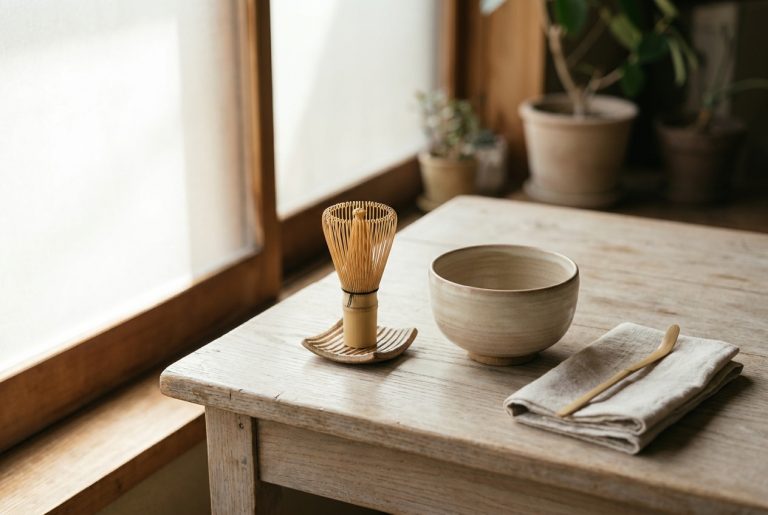
A usable matcha bowl is roughly 11–13 cm (4.3–5 in) across and 7–8 cm tall — wide enough that a bamboo whisk (chasen) can move in a brisk motion without hitting the walls, and deep enough that thin matcha does not slop over. The interior should curve to a rounded bottom, with no sharp corner where powder can hide and the whisk can catch.
Traditionally, shape follows the season: a wide, shallow bowl (hira-jawan) cools the tea and feels right in summer; a deep, narrow bowl (tsutsu-jawan) holds heat in winter. As a beginner you do not need both — a standard medium bowl serves the whole year.
What the millilitres on a chawan listing actually tell you
Every shop lists a capacity and almost nobody explains it, so here is the conversion you need. A standard beginner’s chawan is listed at 350–400 ml, and that figure is the bowl filled to the brim — the Japanese convention of manpai, full to the rim, the same convention that makes teapots look bigger than they are. You will never put 400 ml of anything into it. A normal bowl of usucha is about 2 g of matcha in 60–80 ml of water, which is roughly a fifth of the stated number.
So the millilitres are not a serving size. They are a proxy for how much room the whisk has above the tea, which is the whole reason a chawan is so much larger than the drink it holds: the chasen needs to move fast and flat across the bottom without throwing tea over the side. Read the capacity as headroom.
What that looks like in real listings, for the same 12 cm class of bowl:
| Stated capacity | Typical width × height | What it means in the hand |
|---|---|---|
| 350 ml | 12.0–12.6 × 7.1–7.9 cm | Fine. Whisk with a little care at first. |
| 400 ml | 12.0–12.6 × 7.4–7.7 cm | The forgiving end of normal. Start here. |
| Under 300 ml | usually under 11 cm wide | A tea cup being sold as a matcha bowl. The whisk will hit the wall. |
| Over 500 ml | 13 cm and up | A summer bowl or a serving bowl. Heavy in two hands, and the tea cools fast. |
Notice that the height barely moves between 350 and 400 ml — about half a centimetre. That is how little the capacity figure is really telling you, and why the width of the floor matters more than the number in the title. If you want the general version of this habit, the 70% rule for Japanese listings is the same arithmetic applied to teapots, rice bowls and sake flasks: the stated volume is the brim, and the working volume is well under it.
How heavy should a matcha bowl be? Weight, the foot, and what actually keeps a chawan still
Weight is the one specification that almost never appears on a chawan listing, and when it does the numbers are wild. One plain white bowl sold in English is given as 0.5 lb — about 230 g. A celadon one on the same kind of page is given as just under 1.5 lb, near 680 g. Threefold, for the same object, with no standard anywhere in between.
English buying guides tend to resolve this in one direction: heavier is better, because a heavy bowl will not shift when you whisk hard. Japanese sellers of tea utensils say close to the opposite — choose a size and weight you can lift comfortably in one hand, because lifting the bowl one-handed is part of how it is used, and a bowl that is too heavy for that is simply the wrong bowl.
Both are describing something real, and the way to settle it is to notice that mass is not what holds a bowl still. The foot is. A kōdai that sits flat keeps the bowl planted under a brisk whisk; one that is slightly out of true lets the bowl rock, and no amount of weight fixes that. Put a bowl on a flat table and press down on one side of the rim before you pay for it. If it knocks, it will knock every time you whisk, and you will be holding it with your other hand for the rest of its life.
There is one honest argument for not going too light, and it is not stability. A very light chawan is usually a thin-walled one, and thin walls hand you the heat: water in the seventies or eighties goes through to your fingers in seconds, which is uncomfortable exactly when you are trying to hold the bowl steady. Japanese guides make this point explicitly about lightweight bowls. This is the same trade-off in the other direction from the one we set out in why some Japanese bowls are made to be lifted.
So: ignore the gram figure if you are given one. Lift it with one hand, set it down and press the rim, and buy the one that stays where you put it.
Matcha bowl shapes: the types of chawan, and what each is called
The seasonal pair above — the flat bowl and the cylinder — are the two shapes everybody quotes. The one this guide keeps telling you to buy has a name too, and it is the name missing from most English write-ups: wan-nari (椒形), the standard curve that rises smoothly from the foot to a slightly turned lip. Around 12 cm across, around 8 cm tall. If a shop lists a bowl without a shape name, this is almost always what it is.
Two more are worth recognising. Hantsutsu (半筒), the half-cylinder, sits between the standard curve and the winter bowl and is a genuinely good year-round compromise if you like a deeper bowl in the hand; the deepest cylinders, at the other end, are fukazutsu. And tenmoku (天目) is the steep cone with a groove worked into the lip and a small foot, in dark iron glazes that carry their own names — nogime (hare’s fur), yuteki (oil spot), yōhen (the iridescent one). It is the most formal bowl in the room and it is originally Chinese, which is why it turns up in every museum list and almost never in a beginner’s cupboard.
It is also worth knowing why the summer-and-winter rule is not merely poetic. A 12 cm bowl presents about 113 cm² of tea to the open air. A 15 cm hira-jawan presents about 177 cm² — roughly 1.6 times as much surface, from the same tea. Rikyū’s instruction that summer should feel cool and winter warm is an aesthetic, but the bowls that carry it out are doing straightforward thermodynamics. A summer bowl is engineered to lose heat. A winter bowl is engineered to hold it. Neither is engineered for the person who owns one bowl, which is the case for nearly everyone reading this, and that is the real argument for the standard curve.
So: shape name first, then ware, then glaze. If the hira-jawan eventually joins the shelf, it will earn its place on a summer table that is already set for the season — not as the bowl you learn in.
Buy this, not that
Buy a wan-nari bowl of about 12 cm across and 8 cm tall as your first chawan: enough floor for the whisk to work against, enough depth that the tea is still hot at the last mouthful. Don’t start with a hira-jawan — at 15 cm it puts about 1.6× as much tea in contact with the air, which is the whole purpose of a summer bowl and the wrong property for the only bowl you own. And don’t learn in a tenmoku: it is the most formal shape on the shelf, its cone leaves the least flat floor for the whisk, and you will pay for the glaze rather than the practice.
The named forms you meet once you start looking: ido, kutsu and the rest
Everything above is the shape vocabulary a first bowl needs. There is a second layer of names that you will run into the moment you browse a Japanese shop or a museum label, and it is worth being able to read even if you never buy one.
Ido-gata (井戸形), the well form, is a Korean bowl: high-fired, standing on a tall foot, the wall opening outward from it like a mortar. It was the most prized shape among the tea men of the sixteenth century, and that history is still priced into it. A bowl sold under this name is a collector’s object before it is a whisking vessel.
Kutsugata (靵形), the shoe form, is the deliberately warped one. The name comes from the wooden shoes court nobles wore to play kemari, and the distortion is made on purpose: the potter presses the finished bowl gently between both palms so the rim goes oval. It belongs to Oribe taste and became fashionable in the Keichō years, around 1600. Surviving Oribe examples run about 8.2–8.7 cm tall with a mouth of 12 cm or more — so, dimensionally, an ordinary bowl that has been squashed. It is the one irregular shape that is not mere affectation: the oval sits in the palm better than the circle does.
Two more names turn up in listings without much explanation: sugi-nari (杉形), the cedar form, a cone that tapers toward the foot, and dōjime (胴締), the waisted bowl that narrows at the belly and opens again at the lip.
None of these is a first bowl. Say it plainly: an ido is bought for what it is, not for what it does, and a kutsu rim makes the whisk’s circuit uneven in exactly the way a beginner does not need. They are listed here because the English guides that enumerate chawan shapes mostly stop at the seasonal pair, and then you meet one of these on a product page and cannot tell whether the price is for the clay or for the name. It is usually for the name.
Spouted or not? The katakuchi question, before anything else
There is a fork here that decides the whole purchase, and it comes before ware, price or shape: are you going to drink out of this bowl, or pour out of it?
A chawan with a small lip formed into one side is a katakuchi (片口) — kata, one side, and kuchi, mouth or spout. It is the same word Japanese kitchens use for a spouted serving bowl, and it has become the default recommendation on English matcha sites in the last couple of years for a simple reason: most people buying their first matcha bowl abroad are not sitting down to drink thin matcha. They are whisking a concentrate and pouring it over milk or ice.
| If this is what you make | Buy | Roughly |
|---|---|---|
| Matcha lattes, iced matcha, anything poured into a glass | Katakuchi — spouted, ceramic or glass | $20–45 |
| Usucha you drink straight from the bowl | A plain chawan, no spout | see the picks below |
| Both, and you only want one | A plain chawan; pour with a spoon under the rim | — |
The reason the spout is not simply a free upgrade is geometry, and it is the same geometry as the section above. A spout is taken out of the whisking floor: it narrows the circle the tines can sweep, and on a small bowl it puts a corner where the whisk catches. On a bowl already at the bottom of the 11–13 cm range, that matters. The other half of it is that a chawan’s rim is a drinking edge — shaped, finished and, on good bowls, the part the maker cared about most. A spout is a thing you put your hand near, not your mouth.
So: don’t buy a spouted bowl as your only bowl if you drink matcha straight. And don’t buy a beautiful hand‑made chawan if what you actually do every morning is tip the tea into a glass of oat milk — you will be pouring over an unspouted rim twice a day, dripping down the outside, and slowly resenting an object that has done nothing wrong. Handmade katakuchi from named potters run $60–200, but at that price you are buying an object rather than equipment; the $20–45 ceramic or glass one does the job.
If you are still assembling the rest of the kit, the chasen and chashaku guide covers the whisk that has to fit in whichever bowl you choose, and the matcha set guide is the guide to buying the pieces together.
The wares, and what tea people prize
There is an old ranking of tea ceramics — ichi Raku, ni Hagi, san Karatsu (“first Raku, second Hagi, third Karatsu”). It is worth knowing, but it is about the tea ceremony, not about your first bowl.
- Raku ware (楽焼, Kyoto) — hand-shaped, low-fired, soft and warm to hold. Prized in tea, but porous, fragile, and needs careful hand-washing. A special bowl, not a rugged one.
- Hagi ware (萩焼, Yamaguchi) — a soft, crackled glaze that slowly changes color with use (the celebrated Hagi no nanabake). Absorbent; asks for seasoning and gentle care.
- Mino & Seto ware (美濃焼 / 瀬戸焼, Gifu & Aichi) — practical, widely made, and affordable. The most sensible place for a beginner to start: a solid, whisk-friendly bowl you will not be afraid to use daily.
- Karatsu ware (唐津焼, Saga) — rustic and understated, a step toward the tea aesthetic when you are ready.
Stoneware or porcelain? The material question, and one claim I cannot verify
The shape section above already tells you to look for a rounded chadamari and enough width across the chasen-zuri. That is the geometry, and it is checkable by looking into the bowl. What no listing settles for you is the other half of the inside: what the floor is actually made of, and whether that changes anything.
Nearly every guide that currently outranks this page answers it the same way. A slightly rough stoneware interior, they say, builds better foam; a smooth, glassy porcelain one makes froth harder for a beginner. It is repeated by sellers of stoneware bowls, by tea shops, and by matcha brands. I went looking for the comparison behind it and could not find one. No controlled test, no measurement — a consistent trade opinion, restated. So I am not going to tell you a rough bowl whisks better, because I do not know that it does, and neither does anyone who has written it down.
What I can tell you is what the material decides for certain, which is how much the bowl asks of you. A fully glazed porcelain or glazed stoneware floor is sealed: it does not take up tea, it does not stain, it washes and dries in seconds and looks the same in five years. An unglazed or crackle-glazed floor — Hagi, Raku — is porous. It absorbs, it darkens, and it needs the soaking and drying routine set out further down and in caring for Japanese ceramics. That change is celebrated in tea circles and it is genuinely lovely, but it is a commitment, and it is the buy-the-piece-that-will-change decision rather than a whisking one.
So the material question is real, but it is not the question the guides are answering. Ask it as: do I want a bowl that stays as it is, or one that records every bowl of tea I make in it? Then buy the shape, which is the part that demonstrably affects the whisk. If somebody shows me a side-by-side foam test one day, I will put it here.
Comparison at a glance
| Pick (by need) | Ware / Material | Feel | Care | Typical price* |
|---|---|---|---|---|
| Best first bowl | Mino/Seto stoneware | Practical, whisk-friendly | Hand-wash preferred | $$ |
| Best everyday value | Mino, glazed | Sturdy, forgiving | Hand-wash | $ |
| Best for the tea aesthetic | Hagi | Soft glaze, ages beautifully | Season it, hand-wash | $$$ |
| Best special / gift bowl | Raku | Warm, hand-formed | Delicate, hand-wash only | $$$ |
| Best summer (wide) bowl | Mino hira-jawan | Cooling, open | Hand-wash | $$ |
What a chawan costs, and what the money actually buys
Every page that ranks for “best matcha bowl” shows you pieces. Almost none of them tell you what the range is, so here it is. An everyday Mino or Seto bowl on a general marketplace runs roughly $25–60. A specialist Japanese shop is a different market: MUSUBI KILN’s chawan collection starts at $75 and runs to $951, with most of the forty-odd pieces between $100 and $250.
What the extra money buys is not performance. A $40 bowl of the right diameter whisks matcha exactly as well as a $400 one, and anyone who tells you otherwise is selling the $400 one. What changes with price is authorship — whether a named potter threw it, whether the glaze is one kiln’s and not a factory’s, whether the piece is one of a kind.
There is one functional exception, and it is worth knowing because it is visible in a photograph. Cheap bowls are often glazed all the way over the foot ring. A bowl with a bare, unglazed kodai grips a wet counter; a fully glazed base slides on one. That single detail is a better guide to how a bowl was made than the price is, and it costs nothing to check before you buy.
Our picks: the best chawan for a beginner
Where to buy: for authentic, Japan-shipped pieces we point you to specialist shops rather than generic marketplaces. Purchase and payment complete on their site.
1. The practical first bowl. A medium Mino or Seto chawan, wide enough to whisk with ease. Start here — it teaches you the motion without the worry.
2. The everyday value bowl. A sturdy glazed Mino bowl you can use every morning. Forgiving and inexpensive.
3. The Hagi bowl to grow into. A soft-glazed bowl that will change color over years of use — a bowl that records your tea. For when you are ready to care for one.
4. The Raku gift bowl. Hand-formed and warm, the classic tea bowl to give or keep for special bowls of matcha. Handle it gently.
5. The summer hira-jawan. A wide, shallow bowl that cools thin matcha and feels open and light in warm months.
Caring for a matcha bowl
- Hand-wash matcha bowls — no dishwasher — with warm water and, if needed, a soft sponge. Most need no soap.
- Dry the bowl fully before adding matcha; even a little water clumps the powder. Air-dry completely before storing to prevent odor or mold, especially with absorbent wares.
- Season absorbent bowls (Hagi, Raku): soak or rinse before first use as the maker directs, and expect the surface to change with time — that patina is the point.
- Avoid thermal shock; do not pour boiling water into a cold, dry bowl straight from a cabinet.
Frequently asked questions
What size matcha bowl should a beginner buy?
About 11–13 cm across and 7–8 cm tall — wide enough to whisk freely. A standard medium bowl works for both thin and thick matcha.
What is a matcha bowl called, and is it the same as a rice bowl?
They share the name chawan, but a matcha chawan is wider and made to whisk in, while a rice chawan is small and made to hold in one hand. Use the right one for the job.
Which ware is best to start with?
Mino or Seto — practical, affordable, and whisk-friendly. Save Raku and Hagi for when you want a special bowl and are ready to care for it.
Can I put a matcha bowl in the dishwasher?
Best not to. Hand-wash and air-dry; absorbent and hand-formed wares in particular can be damaged by dishwashers.
About this guide
Nagori Ware is an independent guide to Japanese tableware and tea. We research materials, regions and makers so you can buy once and buy well. We do not sell products; we point you to the specialist shops that make and stock them, and may earn a referral fee if you buy.
Disclosure: Nagori Ware is an independent editorial guide written from Japan. Some links elsewhere on the site are affiliate links. Parts of this site are drafted with AI assistance and checked against Japanese sources. General information, not legal or safety advice.