Jubako: What Size Osechi Box to Buy When It Lives in a Cupboard for 364 Days
Buy a jubako by the shelf it will live on, not by the number of people you plan to feed. The headcount printed on the listing is not a measurement — the same 6.5‑sun three‑tier box is sold as feeding three people, four, five and six, depending on who is writing the page. The width is the only figure in the description that was arrived at with a ruler.
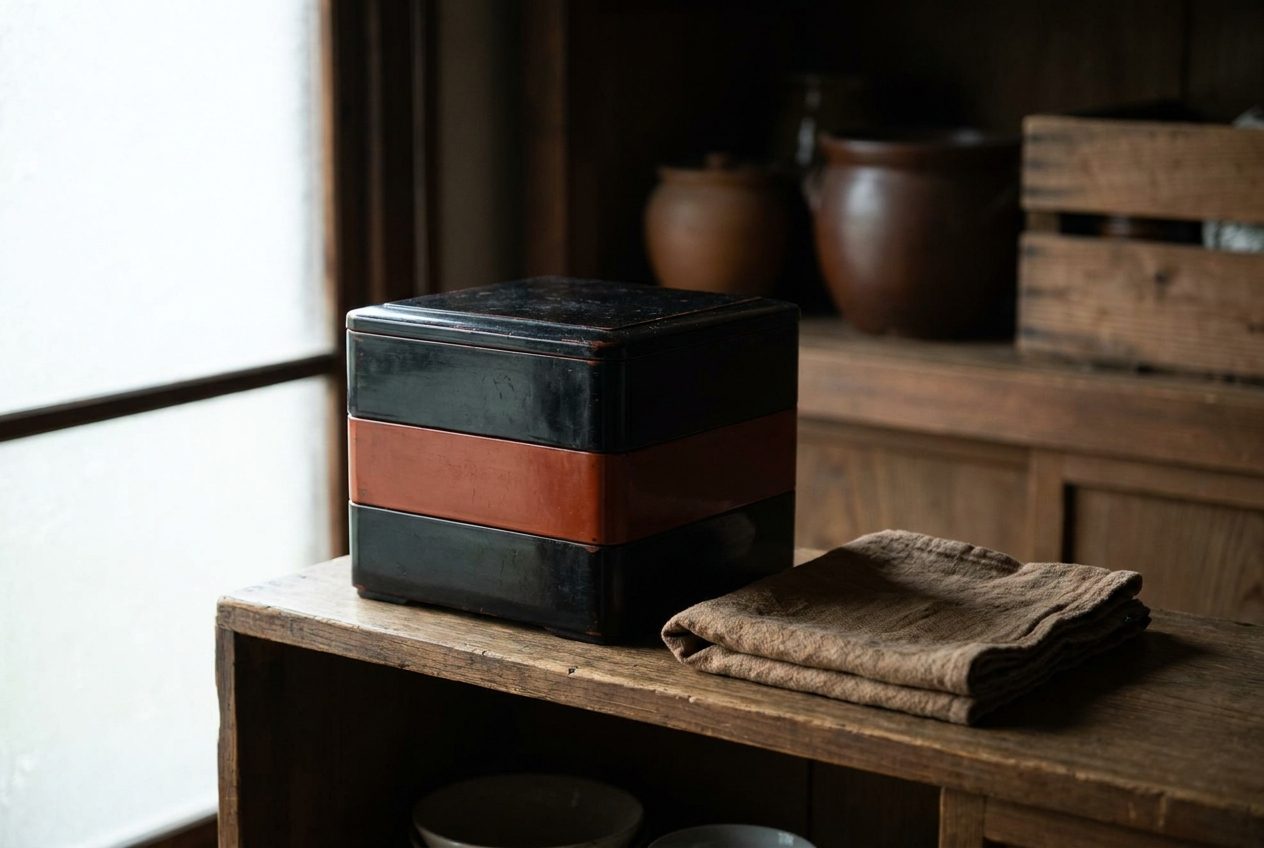
And the shelf matters more here than for anything else in a Japanese kitchen, because this is the one piece you buy knowing it will be idle. A jubako comes out for New Year, and the lacquerware guide on this site puts it plainly: stacked boxes are beautiful and are used, honestly, about twice a year. The other 364 days it sits in a cupboard at exactly the same size it was on January 1st. It does not fold. The tiers do not nest inside one another. Whatever volume it takes up full, it takes up empty.
So this guide does the sizing in that order: what the numbers on the listing actually mean, what the box costs you in cupboard, and only then how many tiers to buy. If you want the whole New Year table rather than the box, the main tableware guide is the wider map, and the gift guide covers the gift‑giving side, including why the number of pieces matters.
Four shops, one box, four answers
Line up the serving claims for a 6.5‑sun three‑tier box — the single most common osechi size — and they do not converge. An English craft guide puts it at four to five people. A Japanese design retailer selling the same class of box calls the large size good for three to four. Japanese lacquer shops publishing sizing tables say five to six. Consumer buying guides land on three to five.
That is a spread of three people to six. A factor of two, for an object whose dimensions nobody disputes.
The advice on top of it disagrees too, and not subtly. One camp tells you to size up when in doubt, on the grounds that people eat more osechi than they expect and a box that is too small is the regret you hear about. Another tells you to deliberately order a size below your headcount, because the failure mode they see is a half‑eaten box in the fridge on January 3rd. Both are describing real outcomes. Neither is describing the box.
This is the same problem as the ohitsu problem, where a stated capacity in millilitres turns out to be measured to the brim on a vessel nobody fills to the brim. The number is real; the thing it implies is not. With a jubako it is worse, because the quantity being estimated — how much a family eats of a once‑a‑year feast — is not a property of the box at all.
What the sun number is, and what it is not
Japanese boxes are sized in sun (寸), the traditional unit. One sun is 3.03 cm, so the ladder runs cleanly once you stop treating the numbers as product codes:
| Size | Width (one tier, square) | Commonly sold as |
|---|---|---|
| 4.5 sun | 13.6 cm | one or two people, or a bento |
| 5 sun | 15.2 cm | two people |
| 5.5 sun | 16.7 cm | two to three |
| 6 sun | 18.2 cm | three to four |
| 6.5 sun | 19.7 cm | three to six, depending who you ask |
| 7 sun | 21.2 cm | five to six |
| 7.5 sun | 22.7 cm | six to seven |
| 8 sun | 24.2 cm | seven to eight |
Two things about that table are worth more than the rest of it. First, shops round: a 6.5‑sun box is written as “about 19.5 cm” almost everywhere, and 19.7 is the arithmetic. Either number is close enough for a cupboard, and neither is close enough for a drawer you are measuring to the millimetre. Second, and more usefully: the sun figure is an outside dimension. The wall of a wooden box with lacquer on both faces is not thin, and the food sits inside it. One Echizen listing is explicit about the gap — 15.2 cm on the outside, 14.2 cm on the inside. A centimetre lost across the width sounds trivial until you remember it comes off both directions, which is about 13 per cent of the usable floor.
That habit — checking whether a stated size is the outside or the inside — is the single most valuable thing to carry into any Japanese listing, and the listing guide goes through the other places it bites. The sizes and terms page is the reference table if you want to convert sun, go, and the rest without coming back here.
If you want a capacity rather than a width, Japanese lacquer retailers quote roughly one and a half to two go of rice for a single 6.5‑sun tier. A go is 180.39 ml, which is the same unit doing the work in the ohitsu sizing guide. It is a rough figure and it is quoted for rice specifically, so treat it as an order of magnitude, not a spec.
The 364 days: what a jubako actually costs you
Here is the arithmetic almost nobody does before buying one. Take a real listing — an Echizen lacquer three‑tier box, 15.2 cm square and 16.2 cm tall, with each tier holding 550 ml. Stacked, it occupies 15.2 × 15.2 × 16.2 cm, which is 3.7 litres of cupboard. The food it carries is 3 × 550 ml, or 1.65 litres. You are storing 3.7 litres to serve 1.65.
Now a larger and much cheaper one: a three‑tier box finished in cashew lacquer over MDF, listed at 20 × 20 × 20 cm and 1,570 g. That is an eight‑litre cube weighing over a kilo and a half, and it wants 20 cm of clear headroom, which a lot of kitchen shelves do not have once the dinner plates are in.
The reason this matters more than it would for, say, a stack of plates is that a jubako has no second job in your kitchen unless you give it one. A donburi bowl that sits unused is still a bowl you could reach for on a Tuesday. An eight‑litre cube that only makes sense in January is dead shelf for eleven months, and dead shelf is what quietly makes people stop opening that cupboard.
Worth saying plainly, because a lot of English writing quietly implies otherwise: on a normal jubako the tiers do not nest. They are the same size as each other by design, because the point is that any tier can sit on any other. Buying the three‑tier and only filling two does not give you a smaller box in the cupboard. It gives you the same box with a tier of air in it.
The exception: ireko boxes, which do collapse
There is a version that solves this, and I have never seen it mentioned in an English buying guide. An ireko (入れ子) jubako is built so the tiers step down in size and sit inside one another for storage. A Kishu lacquer example — a three‑tier square box from a Wakayama workshop — stows at roughly a third of the height of a conventional three‑tier of the same footprint. Because the tiers have to be usable on their own once they are not stacked, these usually come with a lid for every tier rather than one lid on top, which quietly makes them the more useful object for the rest of the year as well.
The trade‑offs are real: the tiers are not interchangeable, the stacked silhouette is slightly stepped rather than a clean column, and they are a specialist item rather than the default. But if the honest constraint on your purchase is cupboard depth, ireko is the word to search for, and almost nobody will tell you it exists.
The tradition already budgeted for a tier you never fill
Tiers are counted from the top and named: ichi no ju, ni no ju, san no ju, and then — not shi no ju — yo no ju. Four is written and spoken around, because shi (四) is also how you say death. That avoidance runs through Japanese gift and tableware conventions generally, which is why the gift guide spends time on the number of pieces in a set.
The four‑tier box was the old standard; three and four are both normal now. But the formal arrangement is five tiers — and in the formal arrangement, the fifth is left empty. It is called the hikae no ju, the reserve tier, and the explanations given for it are that it holds the fortune received from the year deity, or that it represents room still left to grow. Some households instead use it for spares of what is in the other tiers.
I find that genuinely lovely, and also the most practical argument in this whole guide. The tradition is not embarrassed about an unfilled tier — it is the point. What the tradition assumed, though, was a house with a storehouse. In an apartment, the empty tier is still a fifth of the cupboard. You can keep the gesture and pay less for it by buying fewer tiers and leaving the top one light, which is what most Japanese households with a three‑tier box do anyway.
Buy this, not that
Buy the two‑tier at 6 to 6.5 sun (18–19.7 cm) unless you are regularly feeding six or more. It is the size that also works for hanami, a school sports day or a picnic, so it earns its shelf more than once a year. Don’t buy the three‑tier because three is the traditional number — the third tier is the one that ends up holding a layer of air, and on the boxes measured above it costs you 5 to 7 cm of cupboard height whether it is full or not. And if the only storage you have is above the fridge or beside the stove, don’t buy real urushi at all: buy the finished‑resin or cashew box and spend the difference on something you use weekly.
Where the box can actually live, which narrows the choice
Storage is not a neutral question for lacquer, and this is where the material decision gets made for you. A long‑established Kyoto lacquer house gives three instructions worth repeating: keep it in a cabinet out of direct sunlight, because ultraviolet light is bad for the lacquer film; do not let it get extremely dry, and if it is going away for a long stretch, stand a cup with a little water in the cabinet with it; and when pieces are stacked against each other, slip cloth or paper between them so they do not scuff. An English craft guide puts a number on the middle one and suggests keeping storage humidity around 50–60 per cent, away from temperature extremes, with some ventilation.
Read that as a specification and it rules places out. The cupboard above the stove is hot and dry. The top of the fridge is warm. A sunlit open shelf is the worst of the three. If those are your options, the honest answer is that a cashew‑ or urethane‑finished box stored badly will outlast a genuine urushi box stored badly, and you should buy accordingly. The lacquerware guide is the guide to telling the two apart before you pay for one.
The same Kyoto shop adds the line I would put above all of it: lacquer would rather be used than shut away, and keeping it in daily life is better for the piece than keeping it in a box. Which is an argument for a smaller jubako you will actually bring out, over a larger one you will not.
Washing, microwaves and dishwashers
Take the maker at their word rather than mine. The Echizen boxes above are listed as neither microwave safe nor dishwasher safe; the instruction given is to wipe with a damp cloth, rinse quickly if you must, and dry thoroughly straight away, and to keep metal cutlery away from the surface because it scratches. The cashew‑finished box carries the same two prohibitions. For the general rules about which Japanese pieces tolerate a machine and which do not, the microwave and dishwasher guide is the place, and the care guide covers washing and drying habits across materials.
One thing this guide deliberately does not cover: how long cooked osechi keeps once it is in the box. That is a food safety question, it depends on the dishes and your kitchen, and it is not something to take from a tableware guide.
What you are paying for
Prices in the export market spread further than almost any other category on this site, and the spread is mostly about what the box is made of underneath.
| Construction | Real example | What it means |
|---|---|---|
| Wood with urushi, maki‑e decoration | Echizen three‑tier, 15.2 cm, $2,159 | A craft object. Hand‑decorated, wants correct storage, will not tolerate neglect. |
| Wood with lacquer and urethane | Echizen two‑tier with handle, 17.3 cm, $524 | Wood body, hard modern topcoat. Far more forgiving, still hand‑wash only. |
| MDF with cashew outside, urethane inside | Three‑tier 20 cm cube, 1,570 g, $419 | Looks the part at a distance. Heavy. No microwave, no dishwasher. |
| Lacquered plastic | Widely stocked, roughly $25–60 | Light, cheap, and the sensible first box if you are not sure you will use it. |
The gap between the first and the last row is not quality of food storage — it is whether you are buying a serving vessel or an heirloom. Most people asking “what size jubako” for a first osechi are buying a serving vessel, and the plastic or resin‑finished box at 6–6.5 sun is the right answer for them. Move up when you know you use it.
If you do go up, one detail separates a box you can live with from one you cannot: whether the tiers lift off and work on their own. Several listings make a point of it — each tier doubling as a serving tray — and that is the feature that turns a January object into a piece you use in April. A tier of the right size will hold sushi for two or a spread of small dishes perfectly well on its own.
How to make it earn the shelf
Japanese buying guides recommend 6 to 6.5 sun specifically because that size travels: cherry blossom viewing in spring, a school sports day, a picnic. That is the difference between a box used once and a box used four times, and it is the honest reason to prefer the smaller of two sizes you are torn between.
- Hanami and picnics — a two‑tier 6‑sun box is a large shared bento; the bento box guide explains why the wooden body handles rice better than a sealed plastic one does.
- Guests through the year — one tier as a serving tray, which is where a seasonal setting and the seasonal thinking in the motif guide come in.
- Cold dishes in summer — the same logic as a soba tray, where the vessel is doing the work of keeping food off a wet surface.
- New Year itself — with the right chopsticks and rests on the table, which is the one place the number four matters again.
A note on motifs while you are choosing, since most jubako carry one. Pine, bamboo and plum — sho‑chiku‑bai, the “three friends of winter” — and the crane belong to the auspicious kissho family rather than the seasonal one, and Japanese convention treats those as usable all year, not just at New Year. That is the opposite of a maple leaf, which is pinned to a few weeks. So if you intend to bring the box out in June, the celebratory motifs are the safe choice and a strictly seasonal one is not; the seasonal motif guide explains the timing convention, including the rule about running slightly ahead of the season.
Short answers
What size jubako for four people?
6 to 6.5 sun, which is 18 to 19.7 cm square. Two tiers is enough for four people eating osechi alongside other food, which is how it is actually eaten; three tiers if osechi is the whole meal for two days.
Two tiers or three?
Two, for most households. Note that two tiers is not half the cupboard of three: a two‑tier box with a handle measures 17.3 cm square and 11 cm tall before the handle, so it is around 3.3 litres against a small three‑tier’s 3.7. The saving is real but modest, and the handle adds height. Three tiers is a genuine step up in shelf, not a rounding error.
Does the sun number include the lid?
It is the width, not the height, so the lid does not affect it — but the lid does add to the stack height, and that is the measurement that fails on a shelf. Measure the total height in the listing, not the tier count.
Is a jubako just a big bento box?
Mechanically, close. Culturally, not: a bento box is portioned for one person and built around managing moisture, which the bento guide goes into. A jubako is a serving vessel for a table. If you want one object to do both, buy the two‑tier with a handle, which is sold for exactly that overlap.
When should I buy one?
If it is for New Year, order well before December. Japanese shops build their jubako and osechi stock around a seasonal cycle, and international shipping slows over the New Year period at both ends — Japanese businesses close for the first days of January. October or early November leaves room for both.
The short version
Measure the shelf. Convert the sun number to centimetres and check it against that shelf with the lid on. Ignore the serving count entirely — it is an estimate of your appetite, not of the box, and the people writing it disagree with each other by a factor of two. Then buy one size down from whatever you were about to buy, because the box you bring out four times a year is worth more than the box that is correct once.
If you are building the rest of the New Year table around it, the dinnerware sets guide is the starting point and the sizes and terms page is the reference for every other size on it.
Disclosure: Nagori Ware is an independent editorial guide written from Japan. Some links elsewhere on the site are affiliate links. Parts of this site are drafted with AI assistance and checked against Japanese sources. General information, not legal or safety advice.