Left-Handed Kyusu: The Pot Costs the Same. Finding One Is the Problem.
If you are left-handed and you have been putting off buying a Japanese teapot because the left-handed ones seem to cost a fortune and never be in stock — half of that is wrong, and the wrong half is the price.
At Ippodo, the Kyoto tea house, the Black Kyusu Teapot in Tokoname ware is 240 ml and ¥7,000. The left-handed Black Kyusu Teapot in Tokoname ware is 240 ml and ¥7,000. Same pot, same clay, same money, mirrored. Nobody charges you for the mirror.
What you pay in is choice. On the day I went looking, Yunomi’s side-handle collection listed forty-eight pots and exactly one of them was left-handed — and it was out of stock. Sazen listed something over eighty teapots and had one. Across every shop I checked I could find seven left-handed kyusu in total, and two of the seven were already sold out. Left-handedness is usually put at around one person in ten. The shelf offers about one in fifty.
So the question is not really “can I afford a left-handed kyusu.” It is “do I want one badly enough to wait for one.” To answer that you need to know what a right-handed pot actually does to a left-handed person, and it is not what most people assume. It is not the pouring. It is the lid.
Why handedness comes up with a kyusu and with nothing else
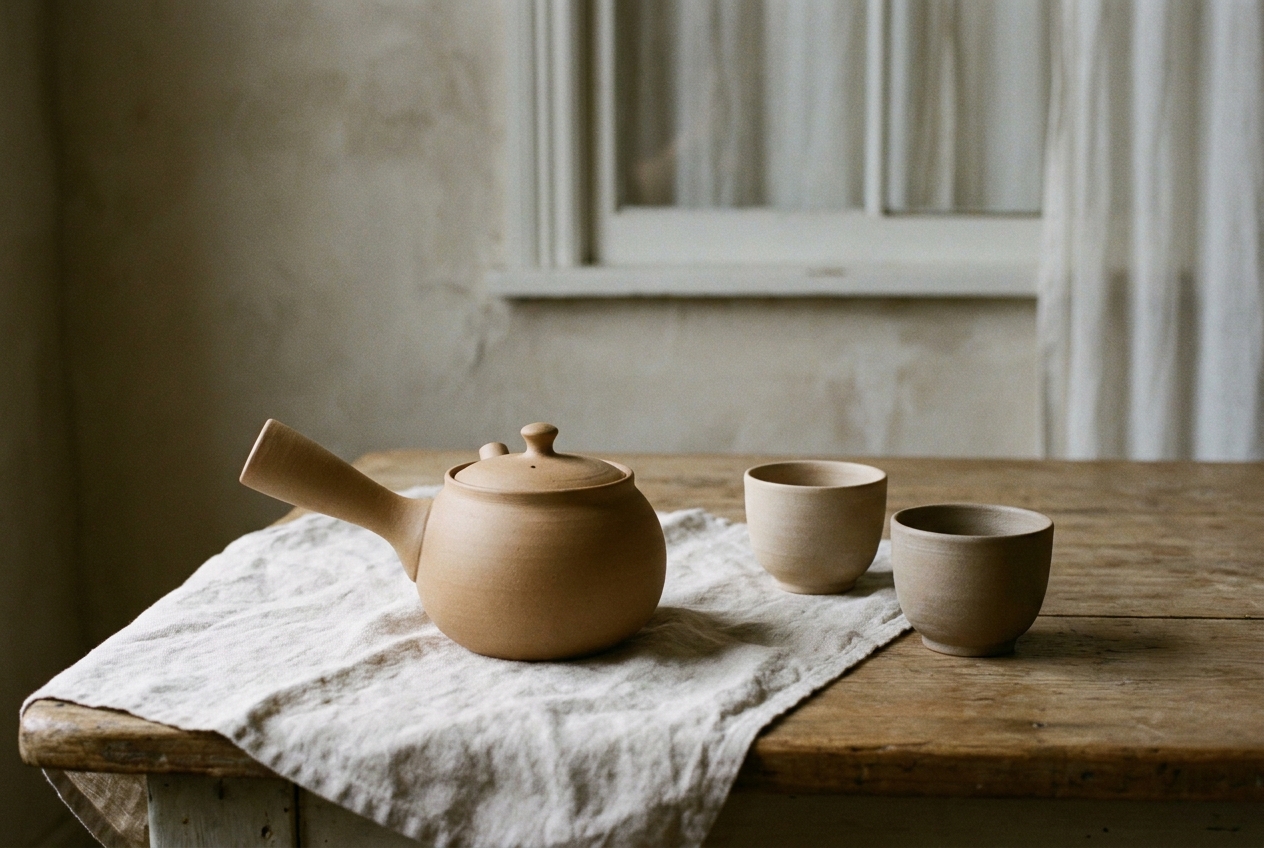
A Japanese teapot can put its handle in one of four places, and the dobin guide walks through all of them: the side handle (the everyday kyusu, yokode), the bail arched over the top (uwade, which is what makes a dobin a dobin), the handle behind the spout like a Western pot (ushirode), and no handle at all (the hōhin). The spout sits in the same place in all four. Only the handle moves.
Three of those four are indifferent to which hand you are. A bail handle is lifted from directly above the centre of the pot, so there is no side to be on. A rear handle is on the axis of the spout, which makes it symmetrical by construction — it is the reason every Western teapot in the world is sold without a handedness label. A hōhin is held in the fingertips of whichever hand you like.
The side handle is the only one set off the axis. It sits at a right angle to the spout, which means it has to choose a side, and the side it chose several centuries ago was the right. Yunomi traces the shape to the tatami room: “Originally, this shape made it easy to pour when sitting on a tatami mat in a traditional Japanese room, as the host would sit across from the guest rather than pour tea from the side or from behind.” A host facing a guest, pouring with the right hand, is the posture the pot was drawn around.
That is the whole mechanical story, and it explains the scarcity better than any theory about tradition. A kiln that wants to offer a left-handed kyusu is not flipping a switch. It is making a second pot, in a second mould or on a second throw, for a tenth of the customers. Hibiki-an is unusually plain about how this happens: after repeated customer requests, they say, they “specially arranged for this Left-handed Kyusu” with a kiln. It exists because people asked, one shop at a time.
What actually goes wrong: it is the lid, not the pour
Here is the part that the shops selling left-handed pots never quite explain. They write “for left-handers” and stop. So let me describe the failure properly, because once you see it you can decide for yourself whether it matters to you.
The yokode grip is specific. Writing in TeaMuse, Heather Edwards puts it as plainly as anyone: “use your palm and the four fingers of your hand to hold the handle and your thumb, to hold the lid down securely.” Four fingers do the carrying. The thumb does something else entirely — it presses the knob so the lid does not slide off when the pot goes past forty-five degrees. Then the wrist rolls, and the pour happens.
Now put a left hand on a right-handed pot. The fingers manage fine; a handle is a handle, and you can grip it from either side. But the thumb is on the wrong edge of that grip, pointing out into the air instead of in over the lid. The pot pours. The lid is simply not being held by anything.
And your second hand having a job is exactly what a side-handle pot was built to avoid. Look at what the other shapes ask of you. A dobin asks two hands by design: fingers lift the bail, the other hand steadies or tips. A rear-handle pot of any size wants a second hand near the lid the moment it is more than half full. The kyusu is the one that promised you a free hand — to hold a yunomi, to move the yuzamashi, to do anything at all — and a mismatched handle quietly takes the promise back.
Notice what is not on this list. The strainer is unaffected; whether you have a ceramic sasame or a wrapped band of mesh, it sits at the base of the spout and is symmetrical about it, so nothing in the strainer guide changes for a left-handed buyer. The lid’s air hole is meant to sit opposite the spout either way. The clay does not care. Handedness touches exactly one thing, and that thing is where your thumb lands.
Four ways out, and three of them are free
Because the problem is narrow, the solutions are too. There are four, and it is worth being honest that buying the mirrored pot is only one of them, and not automatically the best.
| What you do | Cost | What you keep | What you give up |
|---|---|---|---|
| Pour with your right hand | Nothing | One-handed pour, full range of pots at every price | Your dominant hand does not do the job |
| Buy a neutral shape — hōhin, dobin, rear-handle pot | Nothing extra | Full choice, in stock, no compromise on the pot itself | The yokode pour, which is the shape’s whole appeal |
| Buy a mirrored kyusu | Same price, long wait | Everything — this is the only option that keeps all of it | Roughly forty-nine models out of fifty |
| Hold the lid with your other index finger | Nothing | The pot you already own | The one-handed pour — you now own a two-handed pot |
The first one deserves more respect than it usually gets. A kyusu holds 180–360 ml and weighs very little; the pour is a wrist roll, not a feat of dexterity. Plenty of left-handed people pour tea right-handed for the same reason plenty of left-handed people use scissors right-handed — the motion is gross, not fine, and the hand learns it in a week. If you are unsure, Edwards’ advice is the right test: practise “with the pot filled with only plain cool water.” Ten minutes will tell you which camp you are in, and it costs nothing to find out before you spend.
The second is the one I would push hardest, and it is the answer a tea forum gave a left-hander years ago when the question came up: “Your other option would be a hōhin, since those have no handle and would be easier to find.” If you drink gyokuro or a good sencha at low temperatures — and the sencha and gyokuro brewing guide explains why those temperatures are the point — the hōhin is not a consolation prize. It is the better tool, it costs less, and your hands never enter the conversation.
Buy this, not that
Buy the mirrored kyusu only if you have tested the right-handed pour with cool water and genuinely disliked it — then expect to wait, because the model you want will be one of perhaps one or two the shop carries. Do not buy one as a default just because you are left-handed. A 90–150 ml hōhin or a rear-handle pot costs less, is in stock today, asks nothing of your hands, and for gyokuro is the better brewer anyway. And if a shop charges a premium for “left-handed,” treat that as scarcity pricing rather than extra craft: at the one shop selling the identical pot in both hands, both are ¥7,000.
Reading a listing when nobody says which hand
The difficulty with buying is not that shops lie about handedness. It is that right-handed is the unmarked default, so it is never stated. A listing says “left-handed” or it says nothing, and “nothing” means right-handed roughly always. This is the same habit of silence that our guide to reading a Japanese tableware listing is built around: the specification that matters most is the one the seller had no reason to type.
- Work it out from the photograph. Find the spout, then ask where the handle sits relative to it. Imagine standing behind the pot, looking the way the tea will pour: on a right-handed kyusu the handle is then on your right, and on a mirrored one it is on your left. That single test settles it on any photograph that shows both, and it does not depend on the shop having chosen a particular camera angle.
- Search the words that shops actually use. They are not consistent: “left-handed,” “lefty,” “left handle,” and “left grip” all appear on the shops I looked at today, sometimes in the product title and sometimes only in the body text. Searching just one of them will make the shelf look emptier than it is.
- Check stock before you fall in love. Two of the seven I found were already sold out on the day I looked — one taking preorders, the other not. A mirrored pot is a small production run; when it goes, it can be gone for a season.
- Ignore the strainer and capacity debate for a moment. Those decisions are the same for you as for anyone, and the strainer guide and the sizes and terms page cover them. Handedness narrows your shortlist first; make the usual choices inside whatever is left.
What is actually on sale
Here is every left-handed kyusu I could find listed in English on 14 September 2026, with what each shop was asking. Prices and stock move; the shape of the list is the point.
| Shop | Pot | Capacity | Price as listed | Stock that day |
|---|---|---|---|---|
| Hibiki-an | Lefty Kyusu, handcrafted Tokoname | 360 ml | US$53 | Listed |
| Ippodo | Left-handed Black Kyusu, Tokoname | 240 ml | ¥7,000 in Japan / US$100 on the US site | Listed |
| Ippodo | Left-handed Yakishime Kyusu, Banko ware | 8 oz | US$260 | Listed |
| Yunomi | Tousei Kiln, silver & pink striped Tokoname | 330 ml | ¥6,980 | Out of stock, preorder |
| Tezumi | Gyokko kiln, Matsugawa Tokoname | 250 ml | US$84 | Sold out |
| Sazen | Chōjū-giga Kyusu, left handle | — | US$132 | Listed |
| KOS-tea | Standard kyusu, left-handed side grip | 250 ml | €118 | Listed |
Two things jump out of that table. The first is that Tokoname dominates it. If you were going to end up with a Tokoname pot anyway, which most first-time kyusu buyers do, handedness costs you nothing in provenance. The second is the spread, which runs from US$53 to US$260. That looks alarming until you see what produces it: at the bottom is a workshop pot made in a batch, at the top a handmade yakishime piece from a Kyoto tea house. It is a gap in what happens to have been mirrored, not a levy on left-handers. There is no middle of this market because there is barely a market.
One more thing worth saying out loud, since it affects how you read a shop’s selection. Ippodo’s ratio looks marvellous — on its Japanese site, one left-handed pot out of five kyusu. But that is because Ippodo deliberately carries five. A curated shelf of five with one mirror is a different signal from a warehouse of eighty with one. Do not read the percentage; read the absolute number, which at every shop is one or two.
If you are buying it for someone else
A left-handed kyusu is a thoughtful gift and a risky one, in the same breath. Thoughtful, because noticing is most of the gift, and because a left-hander who drinks Japanese tea has almost certainly resigned themselves to the right-handed pour. Risky, because you cannot return a small-run pot easily, and because they may be one of the many left-handers who pours right-handed happily and has never thought about it.
If you do not know which they are, the safe version of this gift is a hōhin or a rear-handle pot with good leaf and a pair of yunomi, and the handedness question never arises. The gift guide has more on what travels well and what does not. If you do know — if they have complained about it — then buy the mirror, and buy it when you see it rather than when you need it.
Frequently asked questions
Is a left-handed kyusu more expensive?
Not inherently. Ippodo sells the same 240 ml black Tokoname pot right-handed and left-handed at ¥7,000 each. Where you do see higher prices on left-handed listings, it tends to be because the few that exist happen to be artisan pieces, not because the mirror costs a potter more.
Can I just use a normal kyusu with my left hand?
Yes, and many people do. The pour works; what you lose is the thumb on the lid, so you will either press the knob with your other index finger or accept a little lid movement at steep angles. Try it with cool water before deciding it is unacceptable.
Is the strainer different in a left-handed kyusu?
No. The strainer sits at the base of the spout and is symmetrical about it, so every option in the strainer guide is available to you on the same terms. The only mirrored element is the handle position.
Which teapot should a left-hander buy if they want no fuss at all?
A hōhin, if you drink gyokuro or high-grade sencha, or a rear-handle pot if you want volume. Both are handedness-neutral, both are fully stocked, and neither asks you to compromise on the pot to solve a grip problem. The hōhin guide covers the hōhin in detail and the dobin guide covers the larger shapes.
Are Japanese cast iron teapots left-handed or right-handed?
Neutral. A tetsubin and most tetsu kyusu use a bail handle over the top, which is symmetrical by construction — see the cast iron guide. The handedness question only belongs to the side handle.
Does any of this apply to other Japanese tableware?
Barely, and that is interesting in itself. Japanese table manners are explicitly mirrored for left-handers — the etiquette guide notes that the bowl goes in the non-dominant hand and nobody minds which that is — and tools like a suribachi and pestle or a renge are held by whichever hand suits. The kyusu is close to the only object on a Japanese table with a built-in side.
The short version
The mirror is free and the waiting is not. Before you join a waiting list, fill whatever pot you have with cool water and pour it right-handed ten times, because a good number of left-handed tea drinkers find the objection evaporates. If it does not evaporate, you have two honest routes: pay ¥7,000-ish for one of the handful of mirrored pots and take what is in stock, or step sideways to a hōhin or a rear-handle pot and buy from the whole shelf instead of one shelf-worth of exceptions.
What I would not do is spend more for the word “left-handed” on a pot you have not tested against a right-handed one. The side handle is a wonderful piece of design and it is worth having in the hand it was drawn for. It is not worth having in the wrong hand at a markup. Start with the tea set guide if you are still deciding what kind of pot you want at all, and let handedness be the last filter you apply rather than the first.
Disclosure: Nagori Ware is an independent editorial guide written from Japan. Some links elsewhere on the site are affiliate links. Parts of this site are drafted with AI assistance and checked against Japanese sources. General information, not legal or safety advice.