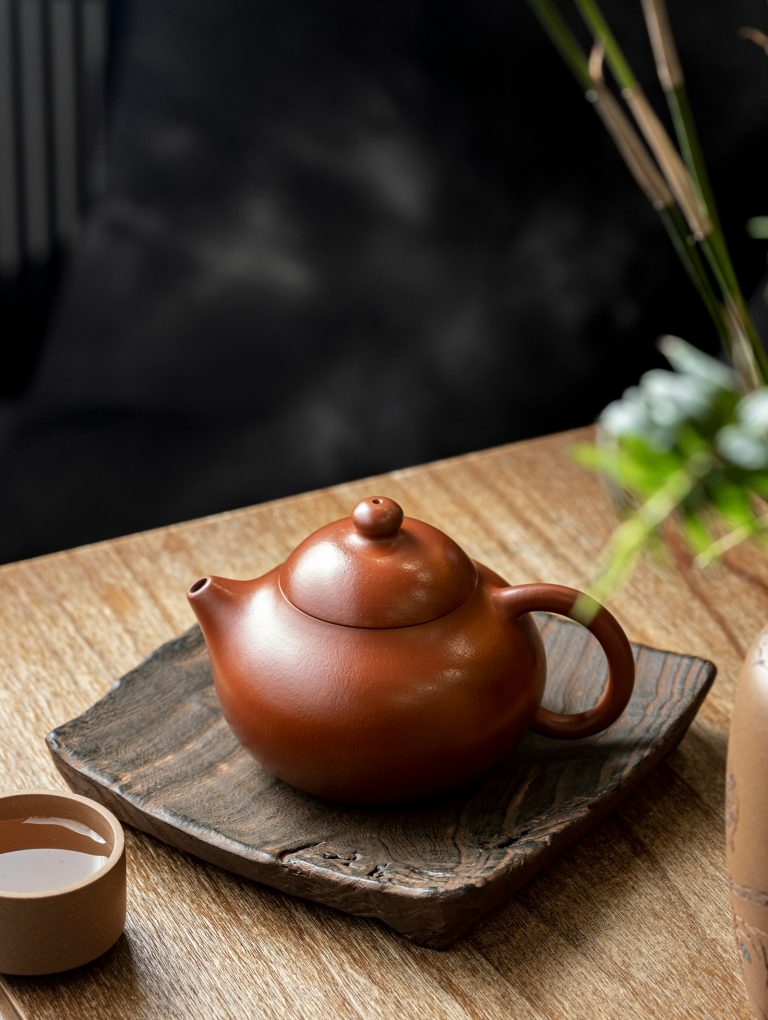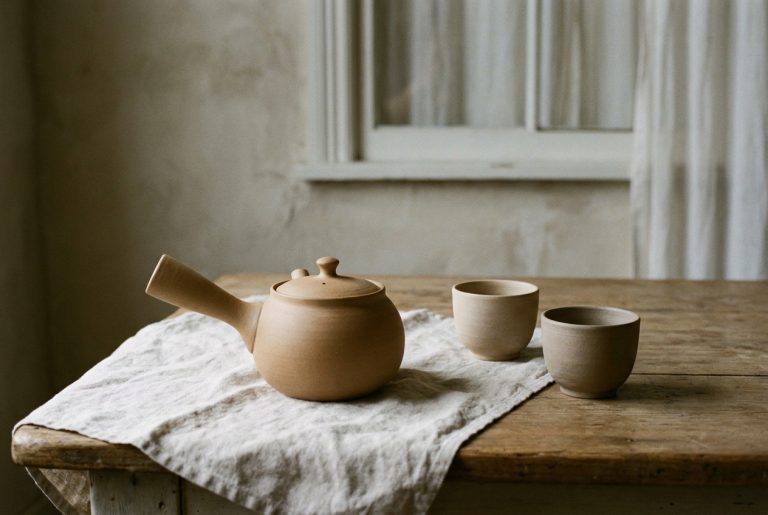
Kyusu Replacement Lid: Why a Broken Japanese Teapot Lid Can’t Be Replaced
On the oldest English-language tea forum there is a thread titled “Tokoname Replacement Lids?” Somebody had broken the lid of a Japanese teapot and wanted to know where to buy another. The thread is still there. It has no answer.
That is not neglect. It is the answer. For almost every Japanese kyusu worth owning, there is no replacement lid — not from the shop, not from the importer, and not from the potter who made the pot. A specialist Tokoname and Banko dealer puts it in one flat sentence on its own product education page: “Please remember that in case you break a lid, there is no replacement.”
It is worth knowing why, because the reason changes how you should buy a kyusu in the first place, and what you should do with the pot you have already broken.
Why there is no kyusu replacement lid
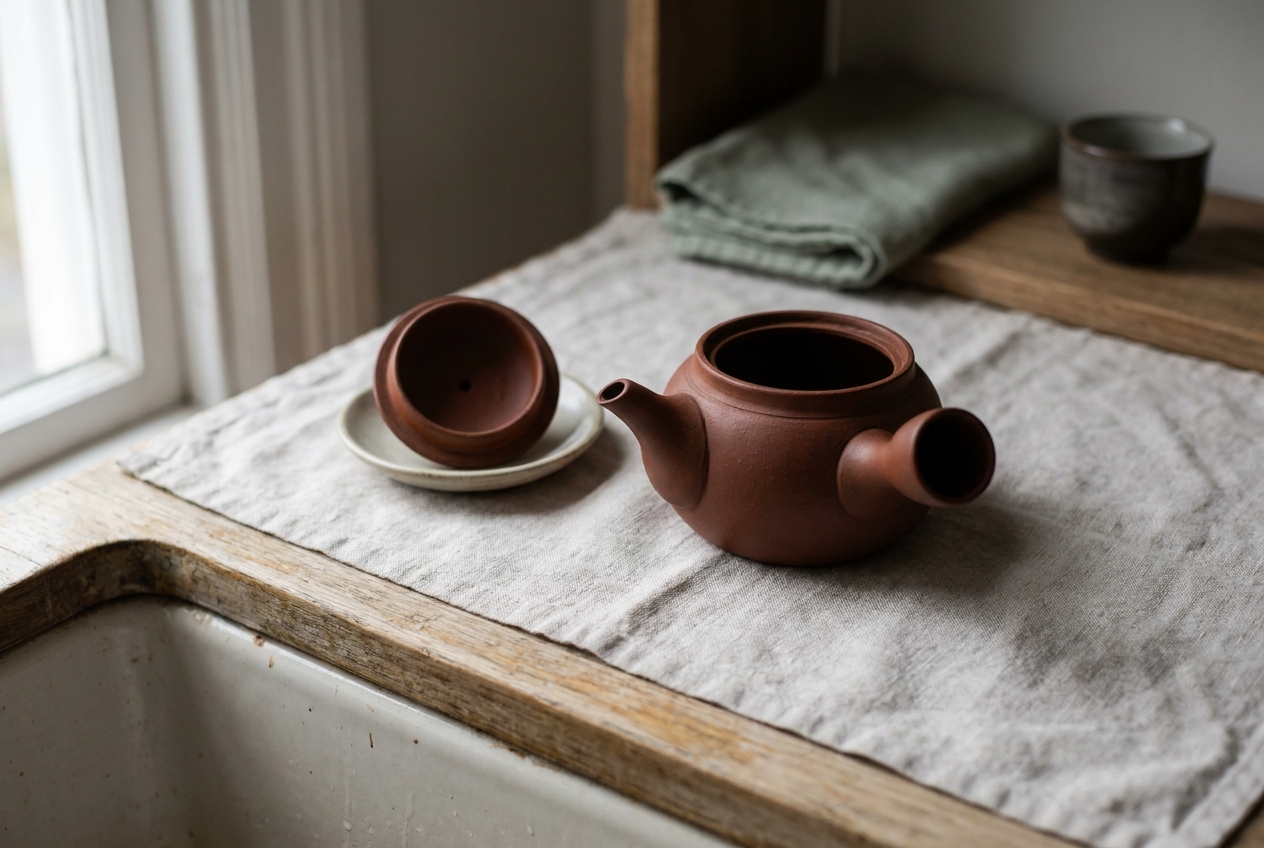
A kyusu lid is not a part. It is half of a pair, and the pair is made by hand, after the fire.
Here is the sequence. The potter throws the body and the lid together, and throws the lid deliberately too big. Then both go in the kiln. Tokoname is fired at around 1,100 °C, and Tokoname kiln guides describe firings of roughly 12 to 18 hours. Clay shrinks as it fires — ceramics references put typical shrinkage somewhere in the region of 8 to 14 per cent depending on the clay body — and that is the whole problem. The shrinkage is predictable enough to plan a pot around. It is not predictable enough to plan a seal around.
So three bodies out of the same kiln load come out with openings that differ from one another by a millimetre or two. The lids differ too, and not in a matching way. At that point the potter takes one lid and one body, puts an abrasive powder between them, and grinds them against each other by hand until the lid drops in and sits flush. Japanese potters call this suriawase (擦り合わせ); the English-speaking trade usually calls it pairing, or lid matching.
The lid that comes out of that process is not “a lid for this model of teapot.” It is the shape of one particular opening, worn into it by friction. The same dealer describes the result as a one-to-one relation between that lid and that body. Another lid off the shelf — same potter, same clay, same week — will rock, or bind, or sit proud, because it was ground to a different circle.
What a good fit is actually doing, and the three-second test
The fit is not decoration and it is not pride. It is the mechanism.
A kyusu is poured with a finger resting on the lid, over the small air hole. That hole is the only intended way for air to get into the pot as tea leaves it. When the seal at the rim is good, covering the hole starves the pot of air and the pour stops — instantly, mid-stream, like closing a tap. Japanese sellers use exactly this as the demonstration of a well-fitted lid, and you can run it yourself in about three seconds with water.
If the water keeps running while your finger is on the hole, air is coming in somewhere else: around the rim. That pot is not broken and it will still make tea. But it will also keep dribbling after you stop pouring, and with fine fukamushi sencha, where you are trying to cut the pour off cleanly at a few seconds, a lid that does not seal takes that control away from you.
This is also why a lid that has been dropped and glued is not a repaired lid. A chip you can barely see with your eye is enormous compared with the tolerance the potter ground in.
Flat lid or inner-wall lid — and why neither one is interchangeable
There are two ways a teapot lid can locate itself, and it is worth being able to name them, because English listings rarely do.
| Lid type | Where you see it | How it locates | Spare available? |
|---|---|---|---|
| Flat lid | Most Japanese kyusu — Tokoname, Banko | Sits down into the ground rim; the seal is the ring of contact itself | No |
| Inner-wall lid (inrōbuta) | Uncommon in Japanese kyusu; usual on Chinese Yixing pots | A short collar drops inside the mouth and centres the lid | No |
| Western infuser pot lid | Glass and porcelain pots sold as “Japanese-style” | Moulded to a tolerance, identical across the batch | Yes — often about $10–15 |
The third row is the one that confuses people searching. Type “Japanese teapot replacement lid” into a marketplace and you will get results, and they will be in stock, and they will be cheap. They are for mass-produced Western infuser teapots, which are moulded rather than thrown and fitted, so every lid in the batch is the same object. Those are genuinely replaceable. A Tokoname kyusu is not the same category of thing, and no measurement you send a seller will make one of those lids fit it.
One real exception exists and it is worth knowing about before you buy rather than after: a small number of kyusu are sold with two lids, and English-language shops sometimes tag them as exchangeable-lid pots, generally in the region of $30–50 for the pot. It is uncommon. If you see it on a pot you like, that second lid is the only spare that will ever exist for that body.
What it costs to try to fix it anyway
People ask this in the wrong order. They ask what a repair costs, decide it sounds survivable, and only then find out what they are repairing.
Professional ceramic restoration is skilled work priced like skilled work: repairers quoted in English-language tea forums describe minimums around $95 and typical jobs in the $140–380 band. Kintsugi done by an established practitioner is commonly quoted at over $100 for a single piece. Both of those numbers are comfortably more than most kyusu cost.
Which gives you a blunt rule. On a $30 machine-made pot, professional repair is not a decision, it is a mistake. On a pot with a name on the base that you chose and waited for, it may well be worth it — but you are paying to keep that object, not to restore function, because a $35 replacement pot restores the function.
The one thing I am not going to do here is tell you which household adhesive is safe to drink out of. That is a food-safety question and it is genuinely not mine to answer; it depends on the specific product and what its manufacturer certifies it for. If you are looking at glue, read the tube, and take the manufacturer at their word rather than a forum post.
How to buy a kyusu knowing the lid is the failure point
Once you accept that the lid ends the pot, buying gets simpler rather than more frightening.
Ask where the pot will live. A kyusu used properly comes apart four times a day: lid off to add leaf, lid off to look, lid off to tip the leaves out, lid off to dry. Every one of those is a chance to set a smooth, domed, fist-sized ceramic object down on a wet counter beside a sink full of crockery. If that is your kitchen, buy the pot you can afford to lose, and put the money into the leaf instead. A machine-made Tokoname kyusu in the $25–50 range pours the same tea.
If you do want the hand-made pot, the question to answer before you pay is not “is it beautiful” but “where does the lid go while I rinse this.” A small dish kept beside the sink, permanently, is the entire solution, and it costs nothing.
And check the seal in the shop with the finger test above. You are buying the grinding. It is the most labour-intensive step in making the pot and it is the one thing a photograph cannot show you.
Buy this, not that
Buy the kyusu you will actually wash at a crowded sink, and price it as a consumable: a machine‑made Tokoname pot at roughly $25–50 does the same job as the artisan one and costs a tenth as much to lose. Don’t make a $200–400 hand‑made kyusu your everyday pot unless you have somewhere to set the lid down while you rinse — that pot has one part that ends it, the part you take off four times a day. And if a shop offers the same model with a second lid for another $10–20, take it; it is the only spare you will ever be able to buy for that body.
Your lid is already broken. The pot is still a pot.
This is the part the forum thread never gets to, and it is the useful part.
A kyusu without a lid has lost the air-hole mechanism and the heat retention. It has not lost the spout, the built-in strainer, or the clay. What you have is a spouted vessel with a filter in it, which is a genuinely useful object on a tea tray:
- A yuzamashi, more or less. Boiled water poured into a wide open vessel drops temperature fast, which is exactly what sencha wants. A lidless kyusu does that and then pours neatly.
- A serving pitcher. Brew in a second pot, decant through the lidless one, and the strainer catches what the first pot let through.
- A cold-brew jug for the fridge overnight. No lid required; cover it with anything flat.
This is not consolation. Japanese kitchens demote objects like this constantly, and a demoted pot in daily use is worth more than an intact one in a cupboard. What you should not do is keep it on the shelf intending to find a lid, because the thread at the top of this page is what finding a lid looks like.
How not to break it, in three habits
Nothing here is clever. All three are about where the lid is when it is not on the pot.
Give the lid a place. One small dish, always the same one, always in the same spot. The lid never touches the counter, never goes in the washing-up bowl, never sits on the edge of the sink. Almost every broken kyusu lid was put down somewhere reasonable.
Empty the pot before you wash it. Leaves out first, then rinse. Trying to hold a full pot and its lid in two wet hands is how the lid goes.
Don’t carry the pot by the lid knob, and don’t let anyone else. It is the obvious handhold on a hot pot and it is holding nothing. On a side-handle kyusu especially, the grip that feels natural to a first-time user is often the wrong one.
Beyond that, the ordinary care for unglazed clay applies — and if you are reading listings to work out what clay you are looking at in the first place, what a Japanese tableware listing does and does not tell you covers the vocabulary.
Questions people actually ask
Can I send my teapot to the potter and have them make a matching lid?
Generally no, and this surprises people most. The pairing is a grinding process between two pieces that shrank together. A potter making a fresh lid would have to throw it, fire it, guess the shrinkage, and grind it — and if it came out undersized there is no recovering it. Dealers describe replacement as unavailable even from the original maker. If the potter is alive, working, and you are willing to ask, asking costs nothing; just do not plan around a yes.
Will a lid from the same model fit?
Not reliably. Same model, same clay and same batch still means a different opening, because the fit was ground in per pot rather than moulded. This is the difference between a hand-fitted pot and a manufactured one.
What about the lids sold on marketplaces for Japanese teapots?
Check what pot they are for. The ones that are actually in stock are almost always spares for Western infuser teapots sold under Japanese-sounding names — moulded lids for moulded pots, where every unit is identical. Those fit their own pots and nothing else.
Is a loose lid a defect I can return?
It depends on what you bought. On an inexpensive machine-made pot, a slightly loose lid is normal. On a hand-made pot sold on the strength of its fit, a lid that does not stop the pour when you cover the air hole is a fair thing to raise with the seller. Test it when it arrives, not in six months.
Do tetsubin and dobin have the same problem?
No, and for different reasons. A cast-iron tetsubin has a cast lid, and cast parts are made to a mould, so spares are at least conceivable for a current model. A dobin is ceramic and hand-fitted like a kyusu, so it inherits the same one-to-one problem.
Related guides
- The Best Japanese Teapots (Kyusu): A Buyer’s Guide — clay, spout, strainer and size, before you get to the lid.
- Kyusu strainers and fukamushi sencha — the other part of the pot that decides how your tea pours.
- Japanese Tea: A Complete Beginner’s Guide — what you are brewing in it.
- Japanese Tableware & Dinnerware: A Complete Guide — where the teapot sits in the rest of the table.
- Kintsugi: Is It Food Safe? — if you are considering repair rather than replacement.
Disclosure: Nagori Ware is an independent editorial guide written from Japan. Some links elsewhere on the site are affiliate links. Parts of this site are drafted with AI assistance and checked against Japanese sources. General information, not legal or safety advice.