Masu Sake Cup: What Size to Buy, and Why the Sake Overflows Into the Box
Buy the one-gō box, about 85 mm square, in plain kiso hinoki, and keep it for cold sake you already know you like. That is the answer for almost everybody, and the reason has nothing to do with taste: a gō is 180.39 ml, the box was cut to hold exactly that, and every other size on the shelf exists because somebody needed to measure something else.
A masu (朑) is not a cup that ended up square. It is a measuring vessel that ended up in a bar. Japan has used these boxes for well over a thousand years to portion rice, soy sauce, sake and salt, and the shape you are looking at on a product page — four straight walls, finger-jointed corners, no foot, no lip, no handle — is the shape of an instrument. Once you know that, the listings stop being confusing. The dimensions make sense, the strange overflow ritual makes sense, and so does the fact that nobody in Japan can agree on which edge you are supposed to drink from.
What size masu to buy: the gō decides it, not your hand
Every masu size is a volume with a box built around it. The units come from the old shakkanhō system, which the modern sake bottle still runs on: one gō is 180.39 ml, ten gō make one shō at 1.8 litres, and the standard 1.8-litre isshōbin you see in a liquor shop is literally a shō of sake. So when a listing says “1 gou” it is not describing a cup size. It is telling you the box was cut to a legal measure.
Here is one specialist maker’s published range, and it is representative. The mini is 50×50×37 mm and holds 33.5 ml. The half-gō is 68×68×45 mm and holds 91 ml. The standard one-gō is 85×85×60 mm and holds about 180 ml. Above that you are into 143×143×75 mm at roughly 900 ml and the one-shō box at 175×175×92 mm, which holds 1,800 ml and is not a drinking vessel by any reading — it is what gets filled at a kagami-biraki, when a sake barrel is broken open at a wedding or an opening, and then it goes on a shelf.
Two numbers in that list are worth pausing on. First, the outside and the inside are not the same: the walls run about 5 mm, so the one-gō box measures 85 mm across the outside and only about 75 mm across the inside. Sellers quote whichever is flattering, and reviews fill up with people who measured the wrong one. Second, a 180 ml pour is a lot of sake at 15–16% alcohol — roughly the same alcohol as a large glass of wine, arriving in a vessel with no stem, no handle and no way to put it down half-finished without looking at it. If you drink a masu the way you drink a wine glass, you will finish it faster than you meant to.
For most people, the half-gō at 91 ml is the more sensible cup and the one-gō is the more useful object. Buy the one-gō.
Mokkiri: why the sake overflows, and why the box is the saucer
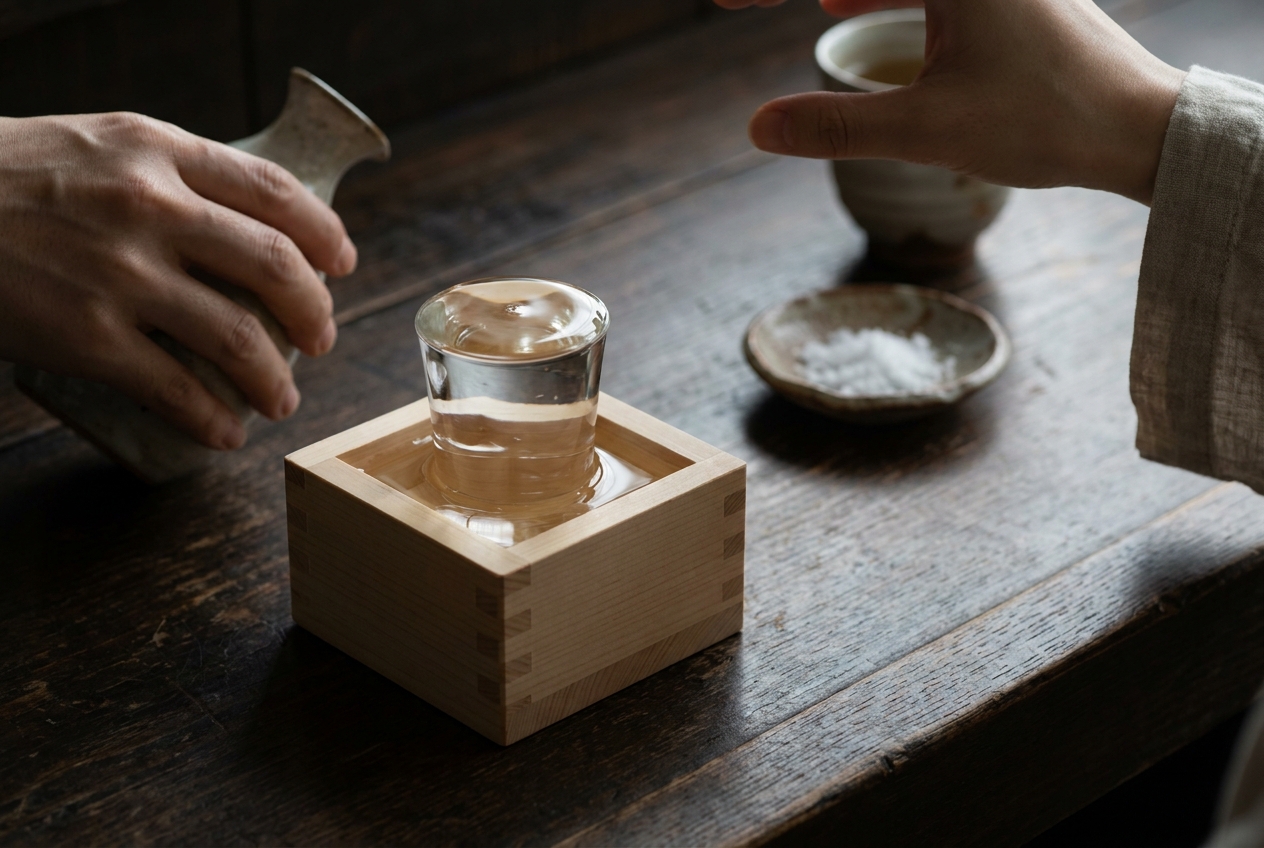
The thing most people are actually shopping for is the picture in their head from an izakaya: a glass sitting inside a wooden box, sake poured until it runs over the rim and pools underneath. That service is called mokkiri, or sosogi-koboshi, and every seller will tell you it is a gesture of hospitality — overflowing abundance, the host giving you more than you asked for.
That reading is not wrong, but it came second. The word descends from morikiri, which in the Edo period meant measuring sake out in a masu and pouring it into the customer’s tokkuri flask. When izakaya later moved to serving by the glass, the glasses they had did not hold a full gō. So they set the glass in a masu or on a saucer and kept pouring past the rim, and the surplus in the box brought the serving back up to the measure the customer had paid for. The overflow is how you make an honest gō out of a glass that holds about 120 ml.
This matters commercially, and almost no product page says it. In mokkiri service the masu is not the cup. It is the saucer. If that is the setup you want at home, one box is not enough: you need a straight-sided tumbler that will actually sit down inside about 75 mm of interior width. Anything wider than roughly 70 mm across the base will perch on the rim instead of dropping in, and the pour will go over the side of the box instead of into it.
When you get to the end, the remaining sake in the box is yours. You can tip it back into the glass or drink it straight from the box; both are normal. What is not normal is leaving it, which reads as wasting the part the house deliberately gave you.
How to drink from a masu — corner or flat edge?
You will find both answers stated as fact, and I am not going to pretend one of them is settled. American and European shops generally describe holding the box diagonally, two opposite corners in your hands, a third corner pointing at you, and sipping from the corner — it is easier, and the wood channels the sake into a narrow stream. Japanese etiquette pages, including ones published in Gifu where most masu are made, say the opposite: drink from the flat edge, and treat the corner as the beginner’s mistake. They also add a handling rule that is more widely agreed on — support the base with four fingers and rest the thumb on the rim, rather than grabbing the box from above, which looks graceless.
My read, for what it is worth: the corner is what people actually do, the flat edge is what the more formal sources prescribe, and nobody at the table is going to correct you. If you are drinking a masu at a wedding, use the flat edge. If you are at home, use whatever does not end up on your shirt.
One more practice you will see and may not understand: a small heap of salt in one corner of the box. It is real, and it is not decoration. Sake has sweetness, acidity, bitterness and umami but effectively no salt, so a lick of salt between sips widens what you taste. It is an enthusiast’s move rather than a rule, and it belongs with plain dry sake, not with anything fragrant.
Hinoki, and the honest problem with drinking good sake out of wood
Almost every masu worth buying is hinoki, Japanese cypress — the same timber used for shrine building, and the best of it from the Kiso valley. It is chosen for straight grain, for stability, and for the smell. That smell is the entire selling proposition: a fresh hinoki box gives off a clean resinous scent that reads as forest and citrus, and pouring cold sake into one puts that scent directly under your nose.
Which is also the problem. Wood aroma does not sit politely beside a sake’s own aroma; it sits on top of it. If you have bought a ginjō or daiginjō — the styles that are milled down and fermented cold specifically to produce delicate melon and pear notes — a hinoki masu will bury the thing you paid for. Sake professionals reach for a wine glass for those bottles, for exactly the same reason a wine drinker does not serve Riesling in a cedar cup.
So the masu is not a neutral vessel and should not be treated as one. It suits cold, plain, sturdy sake: futsūshu, honjōzō, a robust junmai, the kind of bottle that is improved rather than masked by a coniferous top note. It also suits an occasion, which is most of why it exists.
If you like the object but not the flavour it imposes, buy a lacquered masu instead. A coat of urushi seals the wood, so you get the geometry and the ceremony without the cypress getting into the drink, and it wipes clean instead of staining. You lose the smell, which for a good bottle is a gain.
Buy this, not that
Buy one plain kiso hinoki masu at one gō (85×85×60 mm) and use it for cold, inexpensive sake — futsūshu or honjōzō — or for a toast. Roughly $12–30 buys a properly finger-jointed one made in Japan.
Do not buy a masu as your everyday sake cup, and do not drink ginjō or daiginjō out of one: the hinoki scent covers the aroma those bottles are priced for. For drinking sake every night, a guinomi or ochoko is the right vessel and costs less. If you want the izakaya picture at home, remember you are buying a saucer and will need a tumbler under about 70 mm wide to sit inside it.
What to check on the listing before you buy
Masu is a small object with a surprising amount of craft in it, and the difference between a good one and a bad one is visible in photographs if you know where to look.
The corners
A proper masu is joined, not butted and glued. Look at a corner: you should see interlocking finger tenons cut into the end grain, the pieces meshing like clasped hands. This is the joint that keeps the box square and stops it leaking, and it is why a well-made one does not need any coating to be watertight. Boxes with plain square corners and a visible glue line are the ones that open up at the seam after a few washes.
Where it was made
Ōgaki in Gifu Prefecture produces roughly 80% of Japan’s wooden masu. The trade concentrated there in the late nineteenth century when masu craftsmen who had been working in Nagoya — the distribution hub for Kiso hinoki — went home, and the shift completed after Nagoya was bombed in the war. A listing that names Ōgaki, or names the Kiso valley for the timber, is telling you something checkable. One that only says “Japanese cypress” is not, and the same goes for the word “cedar”, which English listings use loosely for at least three different woods. This is the same silence-reading problem covered in how to read a Japanese tableware listing.
Plain, branded, or lacquered
Plain boxes are the default and the cheapest. Branded ones are stamped or burnt with characters such as fuku (fortune) or kotobuki (celebration) — these are the ones handed out at openings and weddings, and they photograph well. Lacquered ones cost more, taste of nothing, and are the only version I would put in a cupboard with confidence. For gifts, the branded hinoki box is the safe choice; see the gift guide for the numbers rule that applies when you buy them in sets.
| If you want… | Buy | Why |
|---|---|---|
| The izakaya mokkiri setup at home | One-gō plain hinoki masu plus a tumbler under ~70 mm wide | The box is the saucer; the glass is the cup |
| To actually drink sake from wood | Half-gō masu (68×68×45 mm, 91 ml) | 180 ml is a large pour with nowhere to set it down |
| A gift or a celebration | Branded one-gō hinoki, fuku or kotobuki | This is the object’s actual social role |
| The shape without the cypress flavour | Lacquered masu | Sealed wood: no scent transfer, wipes clean |
| A sake cup for every evening | Not a masu — a guinomi or ochoko | Cheaper, washable, does not flavour the drink |
| A barrel-opening prop or a planter | One-shō masu (175×175×92 mm) | 1.8 litres; nobody drinks from this |
Care: the rules are short, and one of them is the opposite of what you expect
Rinse it in running water straight after use and wipe it dry with a cloth. Do not soak it, do not put it in a dishwasher, and do not use hot water. Makers are also fairly consistent in telling you not to bother with detergent at all — the reason they give is that hinoki and the related softwoods carry their own antibacterial compounds, and the reason that matters to you is simpler: soap strips the oils that produce the scent you bought the box for. Dry it standing in moving air, out of direct sun, and put it away only when it is dry all the way through — trapped water is how these boxes go mouldy, and mould in end grain does not come out.
The care logic is the same as for lacquer and for a wooden ohitsu or hangiri: wood wants a quick wash and a long dry, and it is ruined by the opposite. If you already own any of those, you already know the routine.
Two things people are not told. The scent is finite — it is strongest in the first months and fades with every wash, and hot water accelerates the loss, which is the real reason for the cold-water rule. And plain hinoki stains: sake, soy sauce and anything with colour in it will leave a mark in unsealed wood. A used masu looks used. Whether that reads as ruined or as patina is a question this site answers the same way every time, in the wabi-sabi guide — but you should decide before you buy, not after.
Who should skip it
If you drink sake most evenings and want one vessel, do not start here. A masu is a poor everyday cup: it holds too much, it cannot be washed properly, it flavours what is in it, and it will not survive a dishwasher household. The Japanese table solved this a long time ago with the ochoko and the guinomi, and if you are drinking chilled premium sake, a tin cup or an ordinary wine glass will serve the bottle better than any box.
Buy the masu for what it is: a measure that became a ceremony. It is the right object for a New Year toast, for a housewarming, for the evening you open something you have been saving and want the moment to have edges. Mine comes out perhaps six times a year, and that is exactly the correct number.
Disclosure: Nagori Ware is an independent editorial guide written from Japan. Some links elsewhere on the site are affiliate links. Parts of this site are drafted with AI assistance and checked against Japanese sources. General information, not legal or safety advice.