Kaishi or a Plate? What to Put the Sweet On When You Drink Matcha at Home
The paper. Almost always the paper.
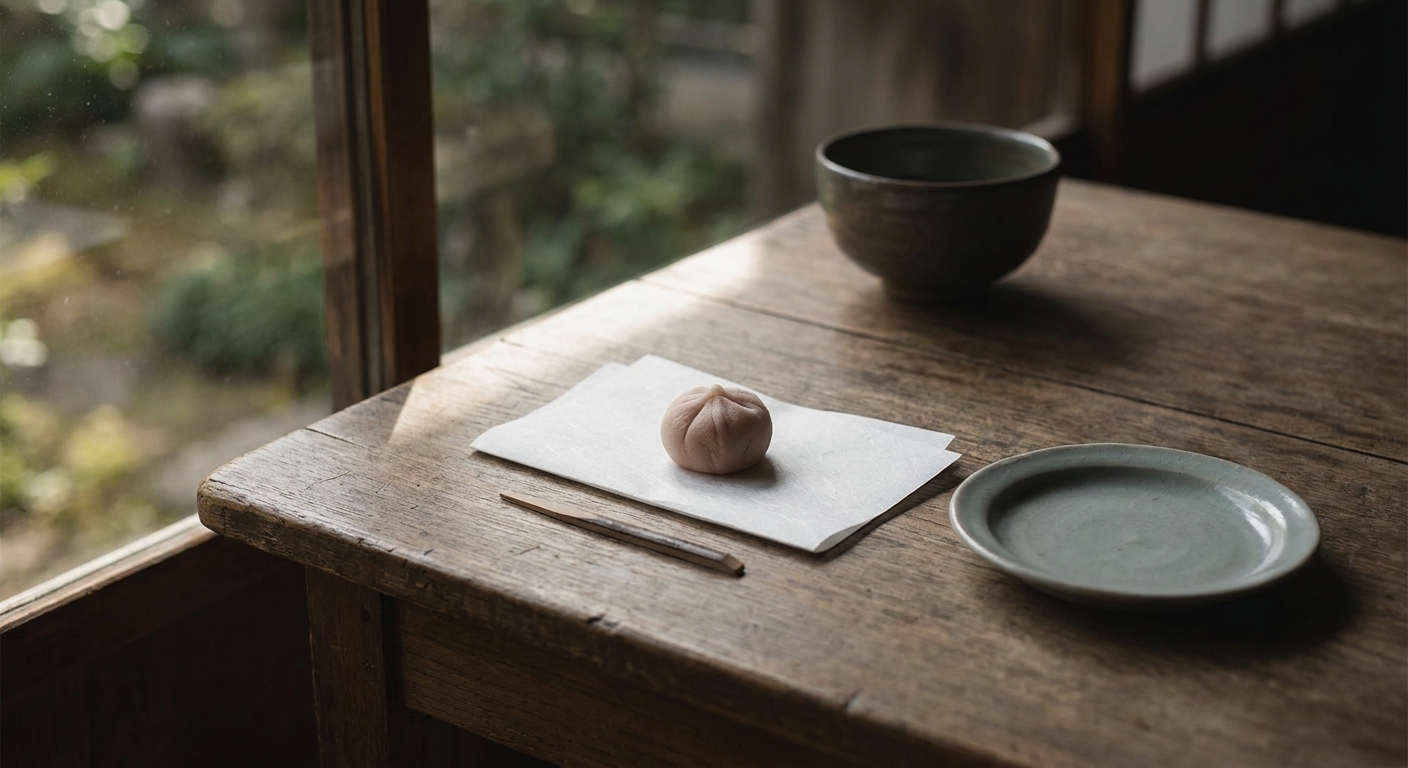
If you make matcha at home and you want to know what the sweet sits on, the answer is a folded sheet of kaishi (戈紙) — washi, 14.5 × 17.5 cm for the common size, about $7 a pack from Ippodo. Not a plate. English shops file it under “tissue” and “paper napkins,” which is how most people outside Japan end up treating it as a doily to put under something else. It is not under anything. It is the plate, and in a tea room it is the only individual surface anyone is given.
The ceramic plate is a separate purchase, and it turns on exactly one thing: how much water is in the sweet. Get that one variable right and the rest of this page is detail.
What kaishi actually is, in numbers
Kaishi is sold by the jō (帽), and a jō is normally thirty sheets, already folded in half. Two sizes are standard. The smaller, 145 × 175 mm, is sold as the women’s size and is also called honkaishi — the “true” kaishi. The larger, 175 × 206 mm, is sold as the men’s size. Japanese sellers explain the split as a matter of hand size and the depth of a kimono’s breast fold, which is where the paper was carried.
Two grades exist, and they are not interchangeable. The loose, low-density sheet is soft, absorbent and meant for tea. The denser sheet has more spring, a smoother face, and resists bleeding — that one is for writing on. If you buy the writing grade and then put a fresh sweet on it, you have bought the wrong paper for the job. Shops will also sell you the paper under the name kogiku (小菊), which refers to the same thin, small-format washi.
One side is smooth and one is slightly rough. The smooth face goes up. In use you keep the sheet folded, with the fold nearest you, so the surface you are actually working on is about 14.5 × 8.75 cm for the women’s size and 17.5 × 10.3 cm for the men’s. That is already plate-sized, which is the point.
The tea room never sets a small plate — and that is the whole answer
This is the part that reframes the question. Walk through how sweets are actually served in chanoyū and there is no individual dish anywhere in the sequence.
Moist sweets — omogashi, the fresh ones served with thick koicha — arrive in a fuchidaka (締高), a stack of square lacquered boxes with raised rims, one tier per guest. The tier is the portion; the guest takes the sweet out of it and onto their own kaishi. Dry sweets — higashi, served with thin usucha — come from a shared takatsuki or furidashi, and again land on the guest’s paper. The communal vessel belongs to the host. The individual surface belongs to the guest, and the guest brought it in their kimono.
So the honest version of the question in the title is not “paper or pottery, which is more correct.” Paper is more correct, in the narrow sense that it is what the ritual uses. The ceramic plate is a home object, and a dinner-table object, which means it is sized by the sweet and by your table rather than by any rule you can get wrong. That is freeing. It also means nobody can sell you the “proper” one.
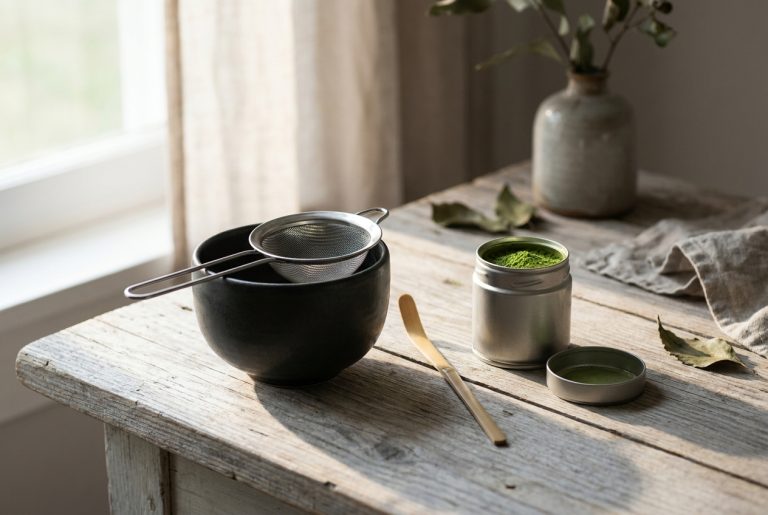
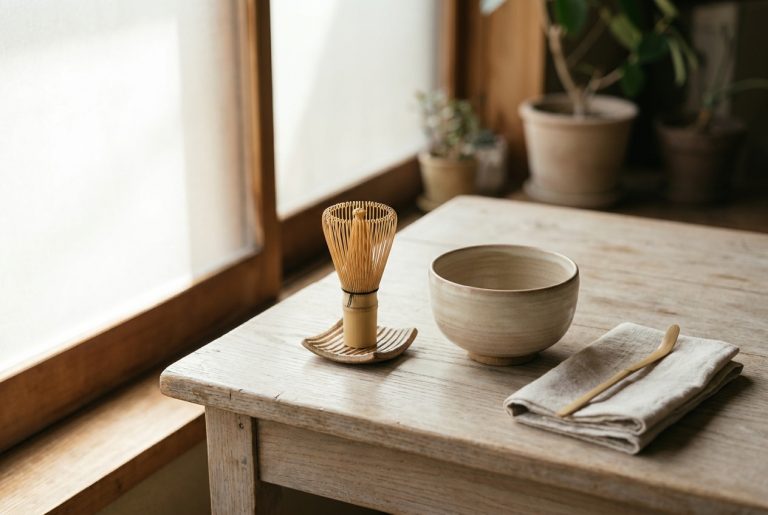
If you are building out the rest of the matcha side of the cupboard, the same logic applies to the whisk and scoop, the caddy and the sifter: there is a tea-room answer and a kitchen answer, and they are allowed to differ.
One variable decides the surface: how wet the sweet is
Washi absorbs. That single property explains every rule below it.
Dry sweets — pressed-sugar rakugan, senbei, the little stamped shapes that come with thin tea — need the paper and nothing else. There is nothing to soak through.
Moist sweets — nerikiri, manjū, anything with a worked bean paste surface — will stick to washi and will leave a damp ring in it. The Japanese answer is a second sheet: ryūsanshi (硫酸紙), laid flat on top of the kaishi. It is wood pulp that has been dipped in concentrated sulfuric acid and then washed, which leaves it translucent, slick, and resistant to both water and oil. One tea-school guide puts it exactly right: if kaishi is the plate, ryūsanshi is the parchment you line the plate with. It is sold cut to the women’s kaishi size, usually fifty sheets to a jō, for something like ¥184.
Here is the useful part for anyone outside Japan: ryūsanshi is parchment paper. The same Japanese guide notes that the West calls this material parchment. You almost certainly have a roll of it in a kitchen drawer. Cut a rectangle a little smaller than your folded kaishi and you have reproduced the formal answer for nothing.
Wet sweets — mizu-yōkan, kuzukiri, anmitsu — are where the paper genuinely fails. Free liquid goes through washi, and ryūsanshi on top only moves the problem, because these are soft enough that a wooden pick will not lift them cleanly. Mizu-yōkan is eaten with a spoon. A spoon needs something with a rim to work against. Put these on a plate, or on glass, which is what a Japanese household does in July anyway — and which is part of the broader habit of changing the material with the season.
Which way up, and which way the top layer points
Most of the etiquette around kaishi does not matter at home. One piece does, because getting it backwards communicates something you did not mean.
You place the sheet folded, with the fold toward you and the smooth face up. If you want it to look finished, pinch only the top layer and nudge it — to the upper right for a celebration, which is to say for tea, for a birthday, for a guest on a Sunday afternoon. For a memorial or an offering, the nudge goes left instead. Japanese guides to this are blunt about the consequence of reversing it; the reversal is deliberate, an instance of sakasagoto, the practice of doing things backwards in the context of death.
If you are not confident, leave the two layers square and nudge nothing. No offset says nothing at all. The wrong offset says something.
The pick matters less than people fear. A kuromoji — a single spindle of spicebush wood — is held in three fingers and used to cut a moist sweet into two unequal parts, roughly one to two, before lifting the smaller piece. Three or four bites is the target for the whole thing. A fork is not a substitute, and not because of etiquette: a fork tears nerikiri rather than cutting it.
If you do buy a plate: 9–13.5 cm, and it is filed under “sauce plate”
Japanese retailers are consistent about the size band. The individual sweet plate is a meimeizara (銘々皿), and it runs about 3 to 4.5 sun — 9 to 13.5 cm, with 15 cm quoted as the loose upper bound. Below that, under 3 sun, you are in mamezara territory: those are the tiny dishes built for pickles, condiments and soy sauce. Above it, 15 to 18 cm, you are holding a torizara, the plate people take a share onto from a communal dish. The sun is the old unit, about 3.03 cm, and it shows up constantly in Japanese listings for tableware.
Now the practical trap, and it is a real one. Shops selling Japanese ceramics to English-speaking buyers use category names that do not map onto the Japanese sizes. At Musubi Kiln, the dishes in the right band sit under Sauce Plate: the Shoebill Sauce Plate, for instance, is Tobe ware porcelain at 11 cm across and 1.5 cm tall, $22 — which is a textbook meimeizara. Meanwhile the collection actually called Side Plates starts at 13 cm and runs to 20.9 cm, from about $28 to $176. By Japanese sizing, most of that collection is torizara. Search “dessert plate” or “side plate” and you will be shown the wrong shelf. This is the same gap between what a listing says and what the object is that makes it worth reading the specification rather than the category.
One more line on that Shoebill plate, because it is typical rather than exceptional: the seller marks it neither microwave nor dishwasher safe. A lot of the prettiest small plates are the same, and a sweet plate is a thing you will wash three times a week. If a dishwasher is non-negotiable in your house, check that field before the picture persuades you, and read what those marks are actually telling you rather than guessing from the glaze.
“Men’s” and “women’s” kaishi are two paper sizes, nothing more
Buy the one that fits the sweet, not the one that matches you. The men’s sheet is 3 cm wider and 3 cm taller; folded, it gives you roughly 17.5 × 10.3 cm of working surface against 14.5 × 8.75 cm. If you lean toward larger sweets — a daifuku, a slab of yōkan, a shop-bought roll cake eaten alongside matcha — the larger sheet is simply a larger plate.
The one genuine difference is pattern. The women’s size is where almost all the seasonal designs live; the men’s size is overwhelmingly plain white, and fewer shops stock patterned versions of it at all. So if you want the sheet to carry a seasonal motif — a maple leaf in November, the sort of thing that does the same work as a motif on the ware itself — the smaller size is where the choice is. That is a stocking decision by Japanese paper merchants, not a rule.
What to buy first, and what to skip
Start with the paper, because it is the cheapest honest object in this entire category and it removes the plate question for most of the year. One pack covers a month of tea. Buy the soft, absorbent grade, not the writing grade.
Buy this, not that
Buy one pack of soft-grade kaishi (around $7 for a jō) and, if you want a plate, one round 9–13.5 cm dish — search “sauce plate,” not “dessert plate.” Don’t buy a mamezara under 9 cm as your sweet plate: a 3.5 cm nerikiri leaves you no room to cut, and cutting is the whole use. Don’t import ryūsanshi — it is parchment paper, and you own some. And don’t buy a matcha starter set because it includes a plate; the plate is the one item in that box you can replace with a sheet of paper.
The same caution applies to bundles generally. A matcha set earns its price on the whisk, the scoop and the bowl, where the quality difference is real and the sizing is fussy. A small plate is neither fussy nor expensive, and a bundled one is usually the thinnest item in the box. If you are buying for someone else, the same ranking holds — the paper is a charming addition to a gift, not the centre of one.
Skip, too, the instinct to buy a lacquered sweet plate as your first one. Lacquer is beautiful and it handles damp sweets without staining, but it wants hand washing, it dislikes long soaking, and it is the opposite of a casual object — all of which is covered in more detail in the guide to urushi. Buy porcelain first and lacquer later, if at all.
Care, and the one thing that will ruin a sheet
Kaishi is single-use. That is not fastidiousness; the soft grade is designed to take moisture, and once it has, it has done its job. Keep the pack flat and dry and out of the sun, which yellows washi, and carry a few sheets in a kaishi-ire if you are the sort of person who ends up needing one at a restaurant.
The thing that ruins a sheet is using it as a napkin for something greasy. Oil wicks straight through and you are left holding a translucent rag halfway through the course. Wiping your fingertips after a sweet is what the paper is for; wiping your hands after tempura is not. Ryūsanshi, which resists oil as well as water, is the sheet for anything fatty.
The plate side is easier, and the rules are the general ones: no thermal shock, no soaking unglazed feet, dry the foot ring before stacking. All of that is in the care guide.
Questions people actually ask
Can I just use a small dessert plate I already own?
Yes. Measure it first. If it falls between 9 and 13.5 cm you are inside the Japanese band and nothing about it will look wrong. A 20 cm plate with one nerikiri on it looks like a serving error, which is the only reason size is worth caring about here.
Do I need kaishi at all if I drink matcha alone?
No. Alone, a plate is less work and you are not carrying anything away. The paper earns its keep when there is a guest, or when the sweet is dry and crumbly and you would rather fold the crumbs up than sweep them. At roughly twenty-three cents a sheet, it is a cheap thing to try before deciding.
Is kaishi the same as a coaster for the cup?
No, and the confusion is worth clearing up. The saucer that goes under a cup of sencha is a chataku, usually wood or lacquer. Matcha in a chawān gets nothing under it at all — the bowl goes straight on the mat or the table. Kaishi only ever relates to the sweet.
What about dry sweets served to several people?
The host’s dish is shared and the guests’ sheets are individual — that is the pattern, and it scales down to a kitchen table perfectly well. One shared plate of higashi in the middle, one sheet of paper per person. You do not need four small plates, which is the quiet reason this question has an expensive wrong answer.
Does any of this change what tea I should be making?
Not directly, though the pairing does run the other way: dry sweets belong with thin tea and moist ones with thick, which is a distinction worth understanding before you buy either. The tea guide covers where matcha sits among the rest.
Buy the paper. Measure the plate. The rest is just knowing which drawer the parchment is in.
Disclosure: Nagori Ware is an independent editorial guide written from Japan. Some links elsewhere on the site are affiliate links. Parts of this site are drafted with AI assistance and checked against Japanese sources. General information, not legal or safety advice.