Wabi-Sabi Tableware: Buy the Piece That Will Change, Not the One That Looks Old
Search for wabi-sabi tableware in English and you will be shown, almost without exception, the same thing: matte beige stoneware with a deliberately uneven rim, sold in sets of six identical pieces, photographed on a linen runner. It is a look, and the look is finished before it reaches you. Nothing about it will be different in five years.
The Japanese ideas behind those two words point somewhere else entirely. They are not a description of how a thing looks on the day you buy it. They are a claim about what happens to it afterwards — about a surface that is left open enough to record being used. Which turns the buying question inside out. Not does this look imperfect, but can this change, and am I willing to do what that requires?
Almost every practical decision below follows from that one question: which materials keep a record, how to tell a real one from a distressed finish in a listing photograph, what the porous piece will cost you in care, and how many of them a table can actually carry. If you want the short version: buy one, use it every day, and buy the rest of the table plain.
Two words that were never really one word
Wabi arrives through tea. In the fifteenth and sixteenth centuries, a tea gathering was a display of expensive imported Chinese wares — karamono — and the move away from that towards plain local pots is credited to a line of three men: Murata Jukō (1423–1502), then Takeno Jōō, then Sen no Rikyū, who finished the job. What they built is called wabi-cha: tea with the ornament taken out, where a rough local bowl is not a compromise but the better object.
Sabi comes from a different direction, out of poetry, and names the particular beauty that age and wear give a thing — the quiet a surface acquires when time has been at it.
The hyphenated compound does most of its work in English. It was Leonard Koren’s small 1994 book, Wabi-Sabi for Artists, Designers, Poets & Philosophers, that installed the pair in design vocabulary outside Japan, and nearly everything written since sits downstream of it. That is not a complaint — it is a useful book — but it does explain why the term has drifted towards being a colour palette.
The word that potters and tea people actually reach for when talking about a specific pot is keshiki (景色), “scenery.” It covers everything the fire did to the surface — pooled glaze, scorch marks, ash melted into the clay, a crack that healed — and, crucially, it covers what use adds later. Keshiki is not finished when the kiln cools. Some of it is your doing, over years. That is a much more usable idea than an aesthetic, because it tells you what to look for.
The only sorting that matters: what keeps a record
Ignore, for a moment, region and price and the shape of the rim. Sort the shelf by one property: whether the surface lets anything in.
Soft-glazed porous ware. Hagi is the standard example — fired low, with a thin, soft glaze that crazes into a fine net of cracks called kannyu. Tea works into those cracks, and the net darkens, and the colour of the whole bowl shifts. Tea practitioners have a name for it: Hagi no nanabake, the seven changes of Hagi. Nobody agrees on what the seven are. What is not in dispute is that a new bowl and the same bowl twenty years later are hard to recognise as relatives. If you are choosing a bowl for whisked matcha, this is the family the tradition points at — the reasoning is in our guide to matcha bowls.
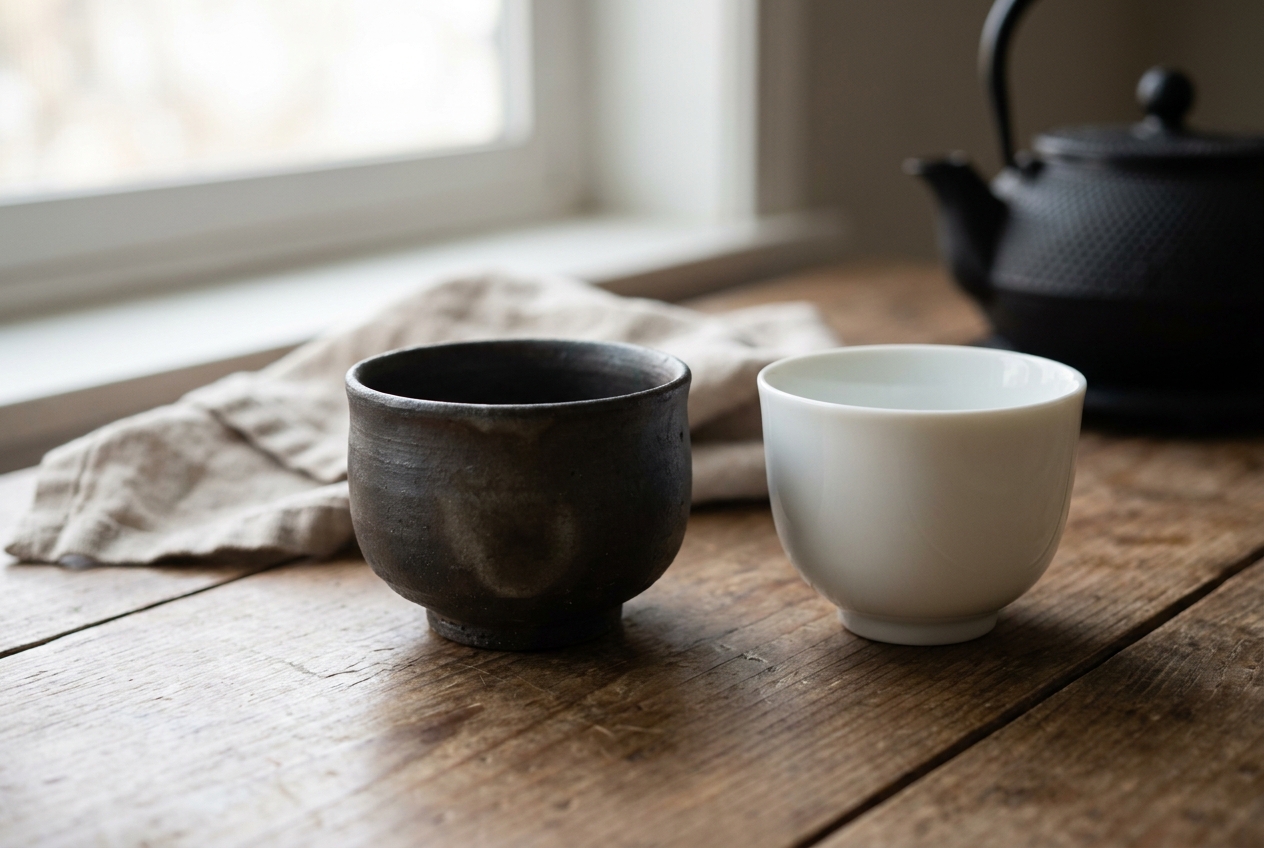
Unglazed high-fired stoneware. Bizen and Tokoname are yakishime: no glaze at all, fired to roughly 1,200–1,300°C until the clay itself vitrifies. Nothing soaks in, but the surface is bare, so handling works on it directly — it slowly smooths and takes a low sheen. The Japanese verb used for this is sodateru, to raise or bring up, the same word you would use for a child or a plant. It is not a marketing phrase; it is how people talk about a cup they have owned for a decade. If you cannot yet tell these wares apart in a photograph, start with how to recognise the main pottery styles.
Lacquer over wood. Urushi is built up in thin coats, so it wears in a pattern that maps your habits: thin at the rim where your lip lands, thin at the foot where it meets the table. Alone among these materials, it can be sent back and recoated rather than simply replaced.
Industrial porcelain and glass. Vitrified, water absorption near zero — against roughly 2–5% for stoneware and 10% or more for earthenware. Nothing gets in, so nothing accumulates. A plain white plate will look the same in 2036, and that is a feature, not a failure: it is the steady ground that lets one changing piece read as something rather than as a mess. Most of a working Japanese dinnerware set should be exactly this.
Distressed, or ageing? Four checks on a photograph
The commercial problem is that both categories look rough at thumbnail size. Manufactured irregularity photographs beautifully and is much cheaper to produce. These four tells separate them without the piece in your hands.
The strongest of the four is the set photograph. Genuine hand-thrown pieces disagree with each other: stack two bowls from the same set and expect 1–3 mm of difference in height, a rim that is not quite level, a colour that runs warmer on one side. Six pieces with the same charming wobble in the same place came out of the same mould, and the wobble is a decision someone made once, in a factory.
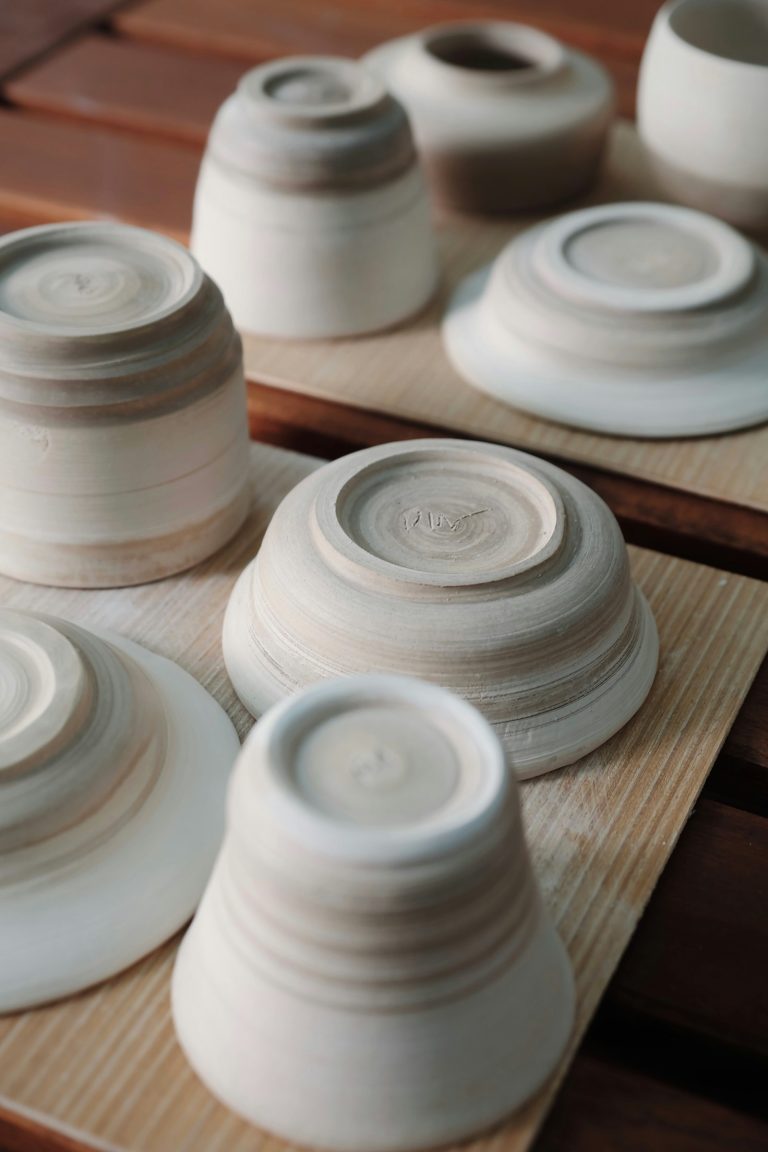
The second-strongest is the base. Turn the piece over — or find the photograph that does, and if there isn’t one, ask. Bare clay at the foot ring, tool marks, a little kiln grit, a ring that sits very slightly off centre: that is a piece that was made one at a time and left open. A perfectly ground, perfectly uniform foot has nothing to tell you. The foot is also where you settle the practical questions of porosity and what can go in the microwave or dishwasher, so it is worth learning to read either way.
What a piece that changes costs you
Here is the part the aesthetic writing tends to leave out. An open surface is open in both directions. Curry, turmeric, red wine and strong tea will all leave their opinions on a porous cup, and not always in the places you would have chosen. Some unglazed and porous pieces want medome — a starch seasoning before first use — and most want to be washed by hand, dried thoroughly, and never left to soak. Our care guide for Japanese ceramics covers the routine in detail; it is genuinely five extra minutes a week, not zero.
So the honest answer for some people is: don’t. If you are renting a place you will leave in a year, if the household loads everything into the dishwasher, if the sight of a stained rim would bother you rather than please you — a changing piece will be a low-grade irritation instead of a pleasure, and there is nothing wrong with a beautiful vitrified white bowl.
And if you do want one, buying six of them is the common mistake. A set of porous bowls means six things to hand-wash and six things that stain unevenly depending on which one you happen to reach for. One piece, used every day, ages coherently. Five identical ones age like a group of strangers.
Buy this, not that
Buy one porous or unglazed piece you will genuinely use every day — a yunomi or a small unglazed cup, usually $25–60 — and keep the rest of the table vitrified and plain. Don’t buy the six-piece matching “wabi-sabi” set of distressed stoneware: you are paying a premium for a factory finish that has already done all the changing it will ever do, and taking on six hand-wash items in exchange. If a listing shows six identical irregularities and no photograph of the base, that is the set to skip.
One changing piece per table
The styling advice follows from the material sorting, and it is unglamorous: keep the ratio low. One piece that is doing something — the dark unglazed cup, the crazed bowl, the plate with a shifted glaze — against plain, quiet, repeatable ground. Two such pieces on a small table start competing; three is a shop display.
This is the same discipline that governs setting a Japanese table through the year and the same reason a seasonal pattern is used sparingly rather than everywhere at once. Ground, then one event. The small dishes that carry pickles and condiments are the easiest place to break the rule and the easiest place to regret it: a table of six different characterful mamezara is noise.
The exception worth knowing is serveware. A long serving plate is on the table once, holds food that is arranged rather than piled, and is looked at directly — it can carry more character than an everyday piece without unbalancing anything, because there is only one of it.
Where to start, if you are starting
Buy a cup. Not a bowl, not a set — a cup, in the 150–220 ml range that a yunomi usually occupies, or a smaller unglazed sake cup if that is what you would actually pour into. A cup is the piece you touch most often and wash most often, which means it accumulates faster than anything else you own. It is also the cheapest way to find out whether you like the responsibility before you commit a whole cupboard to it.
Then leave it alone for a year. Use it every morning, wash it by hand, dry it properly, and don’t audit it. Somewhere around month eight you will notice that the inside is no longer the colour it was. Everything else about the table — the plates, the bowls, the structure of a Japanese place setting — can stay resolutely plain, and should.
If after that year the cup looks exactly the way it did the day it arrived, you didn’t buy an object that ages. You bought a finish. That is worth knowing, and it costs about twenty-five dollars to find out.
Disclosure: Nagori Ware is an independent editorial guide written from Japan. Some links elsewhere on the site are affiliate links. Parts of this site are drafted with AI assistance and checked against Japanese sources. The photograph is AI-generated and illustrative. General information, not legal or safety advice. Terms like wabi, sabi and keshiki are used differently by different writers and schools; the descriptions here follow the way they are used around ceramics and tea in Japan.